mrkeyoor.com_
Tue 01 Sept 17:41 UTC
LLM Toolsevaluationupdated 30 Aug 2026

openinterpreter review

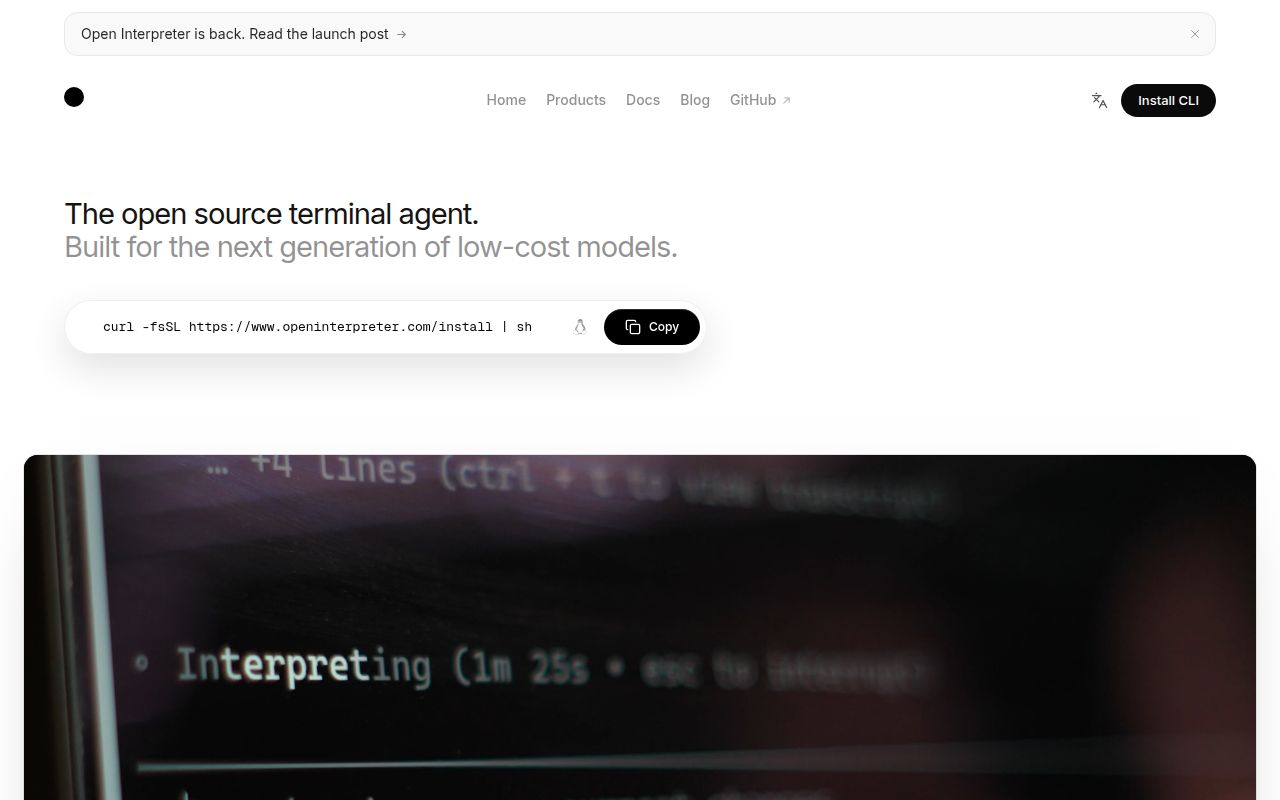
Open Interpreter is now a Rust coding agent built from OpenAI's Codex codebase, with selectable harnesses for lower-cost and local models. It runs commands on your computer, connects to editors through ACP, reads shared agent instructions and skills, and can speak the Codex exec protocol.

+11 / 1dstars / 7d
Verdict

Our Open Interpreter checkout installed 1 pnpm package in 40 seconds, but exposed no root build or test target, so that clean install says almost nothing about whether the Rust agent works. Try it if comparing low-cost model harnesses, ACP, MCP, and Codex-compatible execution is the actual job. Choose the upstream agent or a narrower client if you need one supported model path and a testable source build with fewer protocol variables.

We ran it

Lab card: what happened when we ran openinterpreterScreenshot of openinterpreter (openinterpreter.com)
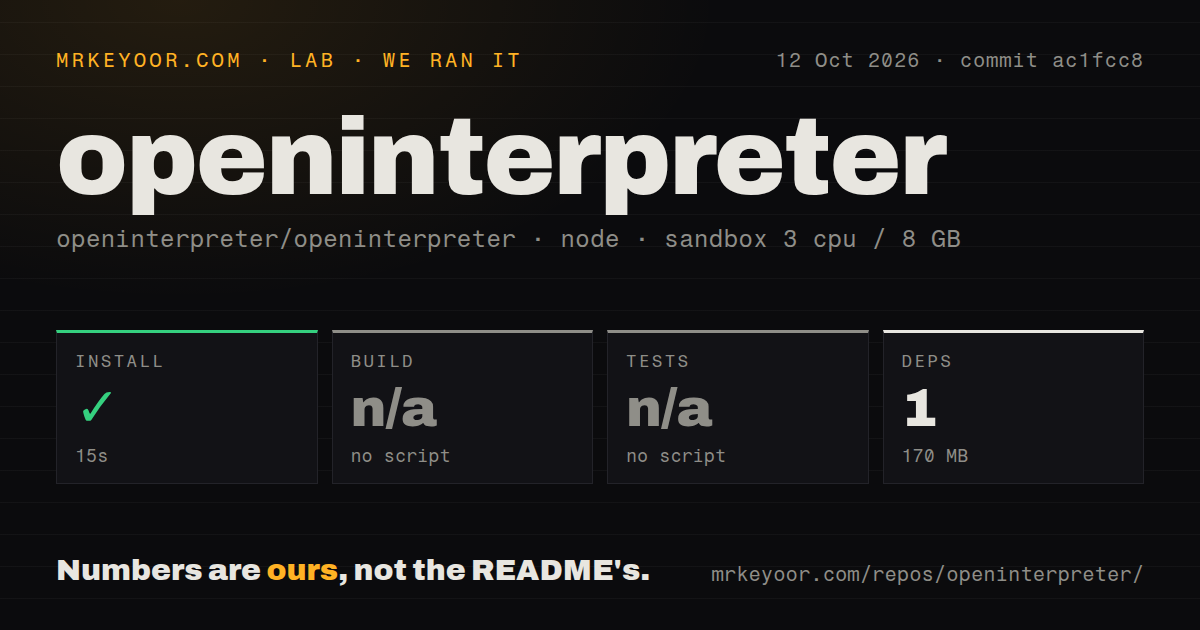
Install✓ · 40s1 packages · 170 MB
Buildn/ano build script
Testsn/ano test script
Repo6475 files~1,505,323 lines of source · 69.6 MB · 25 CI workflows

Answers from our run

Does openinterpreter build from source?

Dependencies installed in 40 seconds (1 packages), and the project has no separate build step. We cloned commit 5b07159 into a clean Debian container with 3 CPUs and no project-specific setup.

Does openinterpreter have tests you can run?

Not through a standard command: the project exposes no test script or target that our harness could run.

Who should not use openinterpreter?

Anyone looking for the original Python Open Interpreter experience: the README says that project moved to the community-maintained endolith/open-interpreter fork.

What are the alternatives to openinterpreter?

Codex, Claude Code, Aider. Our Open Interpreter checkout installed 1 pnpm package in 40 seconds, but exposed no root build or test target, so that clean install says almost nothing about whether the Rust agent works.

Setup3/540-second root install, but no build or test target
Docs4/5Harnesses, protocols, providers, and portability are mapped
Community5/568,206 stars and an August 20 push with active reports
Maturity3/5New Rust line is at 0.0.40 with provider-specific bugs

Discussed on

  1. hnShow HN: Open Interpreter – CodeLlama in your terminal, executing code82 points
  2. hnOpen-interpreter: A natural language interface for computers72 points

Who it’s for

Developers comparing several hosted or local coding models behind one terminal interface.
Teams already using AGENTS.md, MCP tools, ACP editors, or Codex SDK integrations.
Advanced users who want to inspect and switch the prompt and tool harness around a model.
Fork maintainers who need an Apache-2.0 Codex-derived base with documented branding rules.

Who it’s NOT for

Anyone looking for the original Python Open Interpreter experience: the README says that project moved to the community-maintained endolith/open-interpreter fork.
Users who want a coding agent with no provider configuration: hosted models need their provider credentials, while local models still need a compatible server and harness.
Teams assuming every OpenAI-compatible API will execute tools correctly: issue 1883 reports Kimi K3 tool calls failing over one documented chat transport.
Developers expecting the root pnpm workspace to prove the Rust product works: our install added 1 package, but the repository exposed no build or test target to the lab.
Unattended operators who are unwilling to review command permissions and sandbox policy before an agent can alter a real checkout.

Setup reality

Our pnpm sandbox install succeeded in 40 seconds, adding 1 package and using 170 MB on disk. The root workspace had no build script or target, so build was skipped. It also had no test script or target, so tests were skipped.

A normal user installs a released binary, then supplies credentials for a chosen hosted provider or connects a local model server. Configuration, credentials, session history, logs, caches, and daemon state live under ~/.openinterpreter or the operating system credential store. MCP servers add their own commands and credentials.

The 6,475-file monorepo is mainly Rust even though our root harness detected pnpm. Native sandboxing differs across macOS, Linux, and Windows. Harness and wire-protocol choices matter: current reports describe failed Kimi tool calls and excessive context compaction with one DeepSeek setup.

This is a Codex fork for switching model harnesses

Open Interpreter has changed shape. The current repository is a Rust coding agent based on OpenAI's Codex, aimed at getting useful tool behavior from lower-cost and local models. The original Python project now lives in a community-maintained fork. Old tutorials and configuration examples may describe a different codebase.

The main control is /harness, which lists 9 documented choices including native, Claude Code, Kimi Code, Qwen Code, DeepSeek TUI, SWE-agent, and minimal modes. A harness shapes the instructions and tools around a model. Switching one can help compare how a provider behaves, but it also adds another variable when a command loop, context limit, or tool call goes wrong.

ACP and Codex compatibility reduce client lock-in

Open Interpreter can run as an Agent Client Protocol agent inside compatible editors. It also speaks the Codex exec protocol, and the README shows a Codex SDK client using codexPathOverride to launch interpreter. Shared AGENTS.md files, .agents/skills directories, and MCP integrations can be read without conversion into a private format.

Product-specific state still exists. Configuration, credentials, sessions, logs, caches, and daemon data remain under ~/.openinterpreter or an operating system credential store. The portability guide treats shared files and protocols as the reusable surface, while runtime history remains tied to the application. That is a reasonable boundary, but a team migrating agents should inventory both sides rather than assuming one directory contains everything.

What happened when we ran it

Our sandbox checked commit 5b07159 with 3 CPUs and 8 GB of RAM. The pnpm install succeeded in 40 seconds, added 1 package, and occupied 170 MB. The repository had 6,475 files, about 1,505,323 lines of source, and a 69.6 MB checkout. Its root package is a private maintenance workspace with Prettier as its development dependency.

There was no root build script or target, so our harness skipped build. There was also no test script or target, so tests were skipped. This is not a passing build or passing suite. It means the automated Node entry point could install its single package but had no command by which to judge the Rust application. Our scan found 25 CI workflow files, no Dockerfile, no tests directory, and monorepo workspaces.

Those facts make the published binary the faster evaluation route, while source buyers need to inspect the Rust workspace and CI commands themselves. The 40-second pnpm result verifies repo-wide maintenance tooling only. It does not exercise a provider login, a model response, command approval, MCP connection, ACP session, browser action, or Codex SDK request.

Provider and harness pairing can decide whether tools run

Open Interpreter can switch providers and models from its terminal interface, but compatibility has layers: provider, model, wire API, harness, and tool schema all have to agree. Hosted routes require the relevant API credentials. Local routes avoid a hosted key but still depend on a running model server and a model capable of following the selected harness.

Issue 1883 gives a concrete failure on version 0.0.40. The reporter could connect to Moonshot K3, yet prompts requiring shell or browser tools stopped with a compatibility-transport error before any tool ran. Issue 1889 describes an Ollama Qwen 2.5 Coder 7B setup repeatedly selecting an explorer target instead of filesystem or terminal tools. Each report concerns one configuration, but both make a staged provider test essential.

Start that test with read-only repository questions, then a harmless command, a controlled file edit, and a task that needs more context. Record the selected model, harness, and wire API with each result. A label such as OpenAI-compatible is too broad to prove that tool calls, streaming responses, context accounting, and error recovery agree with this client.

Context settings can regress on a specific provider path

Issue 1877 reports that a DeepSeek configuration on version 0.0.39 reset a user-specified context window after the first prompt and began compacting frequently. The report names Windows 11, the native harness, and the Responses configuration. It does not establish behavior for every provider or for release 0.0.40, but it identifies a useful acceptance check for long coding sessions.

Run a conversation past the point where compaction starts, inspect the displayed limit after the first response, and confirm that instructions survive. This matters more than a one-message demo because an agent can answer an opening prompt correctly while losing earlier constraints later. Our lab ran no model session, so it provides no evidence about output quality or context retention.

Command execution requires a local permission policy

The README says commands run inside native sandboxing on macOS, Linux, and Windows, and links to sandbox and approval documentation. That is better than treating shell access as an invisible side effect. Still, the useful safety boundary is the policy you configure on the platform you deploy, including network access, writable paths, MCP tools, and when a human must approve an action.

Computer use widens that boundary. The bundled QA skill can drive a browser through agent-browser or native applications through trycua. A team should keep initial trials inside disposable accounts and checkouts, especially when testing an unfamiliar 7B local model or a newly selected harness. Model price is not a substitute for reliable tool selection.

August 2026 activity accompanies a very new release line

GitHub recorded 68,206 stars, 9 combined open issues and pull requests, and a last push on August 20, 2026. Release 0.0.40 was published that day. Open reports from August 18 through 29 cover DeepSeek context handling, Kimi transport behavior, custom-provider documentation, and Ollama tool choice, so issue activity is current alongside the code.

Open Interpreter earns a trial when model and harness comparison is itself useful. Its shared files, MCP, ACP, and Codex protocol can reduce migration work between clients. The trade is a larger compatibility matrix than a single-provider agent has. Test the exact provider, harness, context length, permission policy, and tool set you intend to use before allowing it to work unattended.

Alternatives

ProjectWhat it isPick it when
Codex gh↗The upstream terminal coding agent that Open Interpreter says it forks.pick this instead when first-party Codex behavior matters more than switching among emulated low-cost-model harnesses.
Claude Code gh↗Anthropic's terminal coding agent for Claude models and development workflows.pick this instead when your team is standardized on Claude and does not need provider or harness switching.
Aider gh↗A terminal pair programmer with broad model support and a Git-centered workflow.pick this instead when explicit edit-and-commit control matters more than Codex protocol compatibility.
Crush gh↗A terminal coding agent with provider choice and a polished text interface.pick this instead when you want a simpler multi-provider terminal experience without harness emulation as the main idea.

What people are saying

  1. [github-trending] openinterpreter/openinterpreter

Sources

  1. Open Interpreter README
  2. Open Interpreter portability guide
  3. Open Interpreter 0.0.40 release
  4. Moonshot K3 tool-call report
  5. DeepSeek context compaction report
  6. Ollama Qwen tool-selection report

More llm tools reviews

rig · open-knowledge · graphiti · cve-mcp-server · minimind · SillyTavern · the whole board →