LobeHub has grown from model chat into agent operations
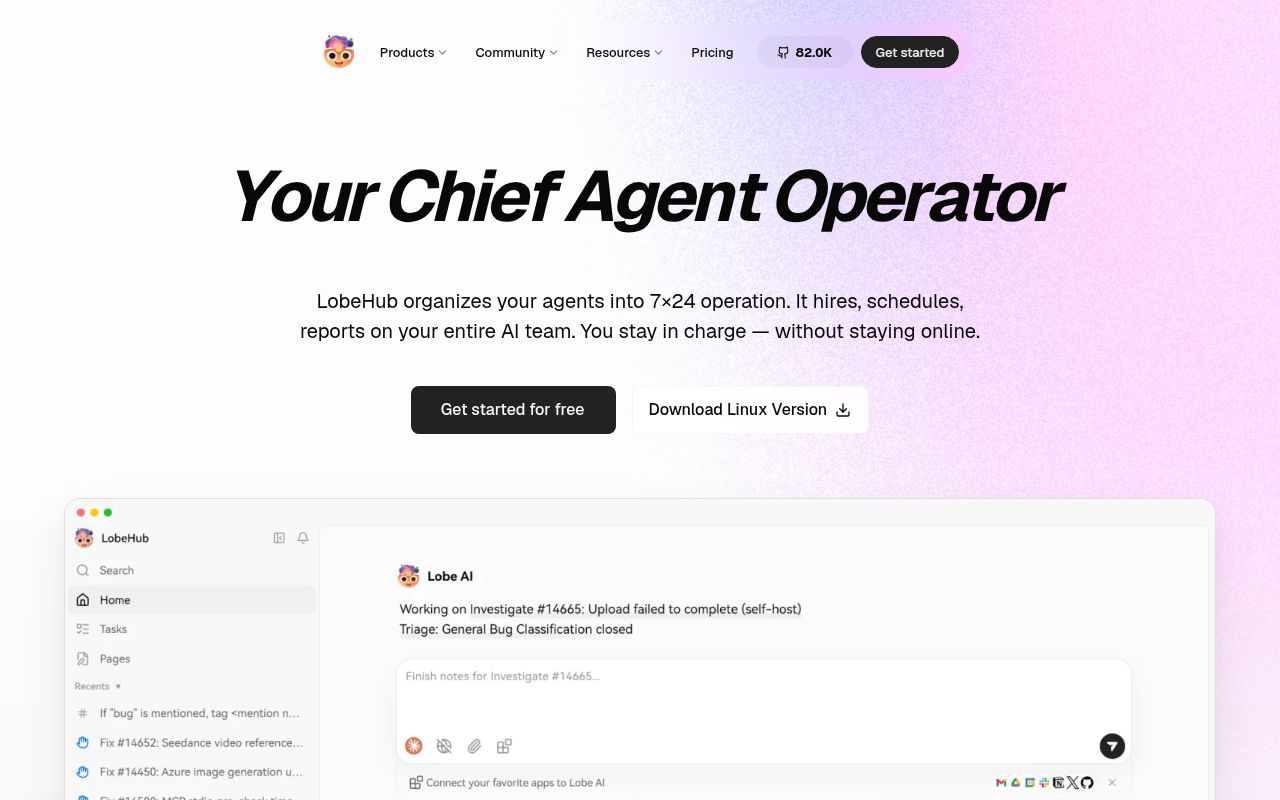
The product now treats an agent as the main unit of work. Users create agents, assign models and tools, group them, organize work into projects, schedule tasks, and receive reports. Personal memory and shared workspaces keep context beyond one chat. Messaging gateways bring agents into existing channels. This makes LobeHub closer to an agent operating console than a themed front end for one model API.
Release v2.2.14, published August 16, 2026, adds projects and goals in alpha, 7 more CLI coding-agent runtimes, a local sandbox, a generated OpenAPI specification, scoped API keys, and workspace skills. It also introduces home customization and desktop split views. The volume matters: each feature adds permissions, persisted state, or another external runtime that a self-hoster must understand.
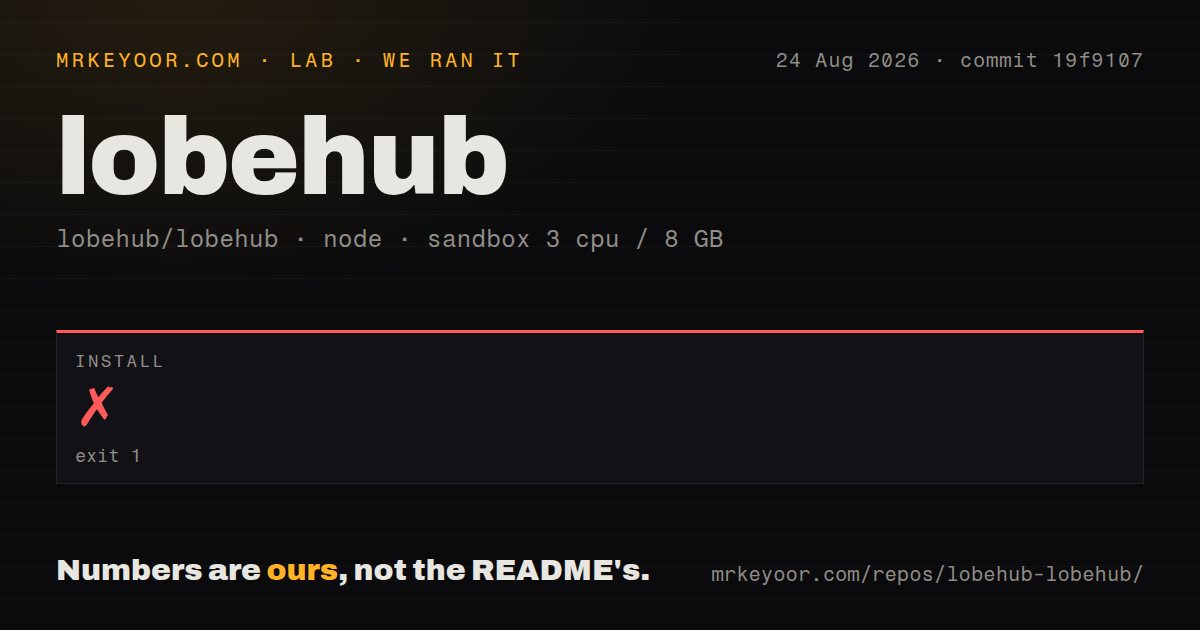
The 198.4 MB repository expects pnpm, while our npm install failed
Our checkout at commit 19f9107 contained 15,260 files, about 2,097,297 lines of source, and 198.4 MB. The lab identified a Node npm path and attempted installation in an unprivileged container with 3 CPUs and 8 GB of RAM. That choice did not match the README's local development commands, which explicitly say pnpm install.
After 296 seconds, npm exited with code 1. The log repeatedly reported EUNSUPPORTEDPROTOCOL and Unsupported URL Type "workspace:": workspace:*. A forced retry produced the same protocol error. The log does not show a missing compiler, network failure, or package conflict, so we should not name one. It shows that npm could not process this workspace dependency form in the measured run.
What happened when we ran it
Our 296-second install failed before dependencies were ready. No build ran, and no tests ran. That boundary is important: there is no lab evidence here about compiled output, application startup, or test health. The checkout had 36 CI workflow files, a Dockerfile, a tests directory, and monorepo workspaces, but those repository signals do not turn an aborted install into a passing check.
The practical next attempt is the documented pnpm path, not another npm flag. Contributors run pnpm dev for the full-stack application or bun run dev:spa for the SPA on port 9876. The README's debug proxy sends that local SPA through a production backend URL. Teams should decide whether sending local development requests toward a production-hosted service is acceptable before using that shortcut with private data.
Self-hosting starts with a remote script and expands into several services
The Docker quick start creates a storage folder, pipes https://lobe.li/setup.sh into Bash, then runs Docker Compose. Piping a changing network response into a shell gives the remote endpoint immediate code-execution authority. Download the script, inspect it, pin a known revision or digest where possible, and keep the resulting Compose and environment files under internal review.
Model use requires at least one provider key or compatible endpoint. A production workspace also needs persistent database and file storage, authentication, backups, TLS, outbound policy, and secrets for messaging or plugins. Version 2.2.14 adds API-key scopes and hardening around provider base URLs, restricted knowledge bases, connector deletion, and auth cookies. Those security changes are welcome evidence that the team works on boundaries, while also showing how many boundaries exist.
Local sandbox execution changes the threat model
The release notes describe a local sandbox with a real working directory and integrations for several coding-agent CLIs. Published agents can run tasks while the user is away, and goal launch still requires confirmation even in automatic mode. That confirmation is a sensible safeguard. It does not replace operating-system isolation, workspace restrictions, command policy, network controls, or audit logs around an agent that can execute code.
Treat every plugin, MCP server, model provider, CLI agent, and messaging connector as a separate trust decision. The README advertises more than 10,000 skills and MCP-compatible plugins. Catalog size is not a security review. Start with a small allowlist, use narrowly scoped credentials, keep execution away from production secrets, and test whether scheduled or remote-triggered agents can reach files and services outside their intended project.
The community license permits use but restricts derivative distribution
GitHub could not assign a standard SPDX license identifier. The repository license says it is based on Apache 2.0, permits commercial use of LobeChat as an unmodified frontend and backend service, and requires a commercial license to develop and distribute a derivative work. Contributors also agree that the producer can change the agreement and use contributed code commercially. Legal review belongs before a company builds a product around a fork.
LibreChat's MIT license may be simpler when multi-provider chat, agents, and MCP cover the requirement. Open WebUI is a more direct match for local-model conversation. LobeHub earns a trial when agent scheduling, groups, projects, memory, and messaging all reduce separate tooling. Its 296-second npm failure is recoverable through the documented pnpm path, but the larger commitment is permission design across a fast-moving agent platform.
August activity is intense enough to demand staged upgrades
GitHub showed 82,024 stars, 818 combined issues and pull requests, and a last push on August 27, 2026. The default branch is canary, and v2.2.14 says 363 pull requests from 21 contributors landed since the previous release. This is active maintenance, and it is also a lot of change to absorb between self-hosted upgrades.
Pin releases instead of deploying a moving branch. Back up the database and files, compare environment changes, test model calls and messaging, and verify sandbox restrictions on a staging instance. The product's breadth is its reason to exist, but it also means a regression can land in chat, schedules, memory, plugins, storage, or execution. Teams that cannot rehearse those paths should use the hosted service or choose a narrower client.