LibreChat v0.8.8-rc1 combines chat, agents, and MCP
LibreChat v0.8.8-rc1 is much more than a self-hosted ChatGPT lookalike. It can connect to OpenAI, Anthropic, Google, AWS Bedrock, Azure, local servers, and custom OpenAI-compatible endpoints. The same interface also handles shared conversations, files, web search, image generation, speech, presets, and conversation branching. Teams can give users separate accounts and manage roles or groups from the included admin panel. That range is the reason to consider LibreChat over a small model frontend.
The cost of that range is visible in the repository. We measured 4,509 files and about 1,132,340 lines of source at commit 9cee6f9, arranged as a monorepo with workspaces. The checkout itself was 49.2 MB, yet installation expanded the project far beyond that size. This is a web platform with an API, shared packages, deployment assets, and integrations that move independently. Owners should budget for application operations and regression testing, rather than treating it like a static interface placed in front of Ollama.
What happened when we ran it
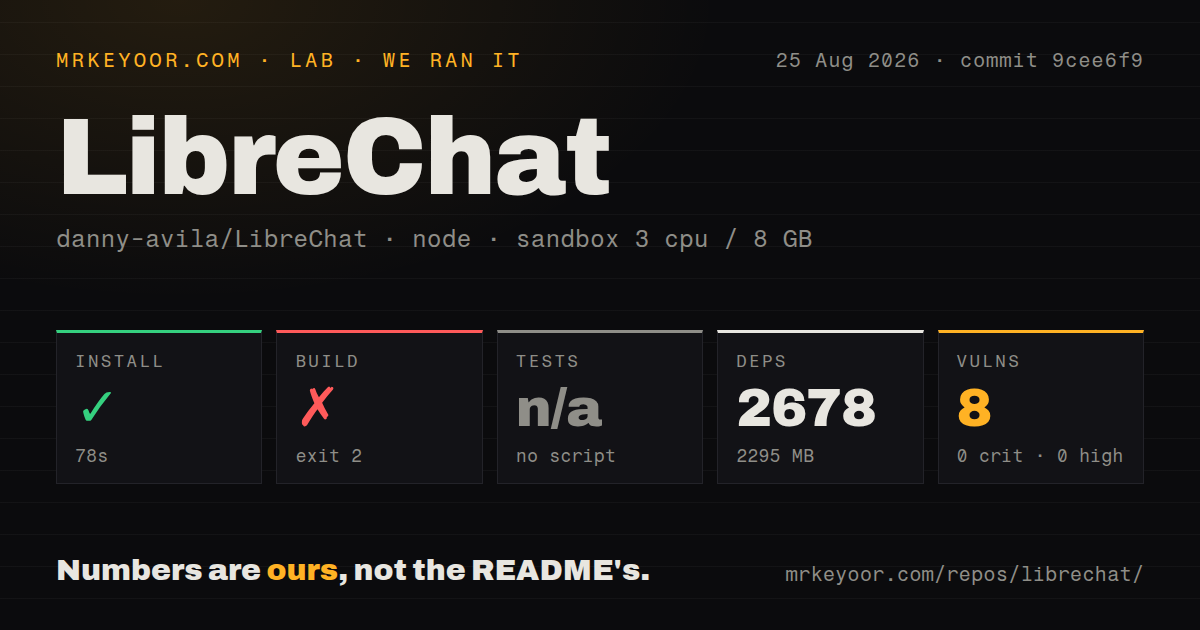
Our run installed 2,678 packages in 78 seconds inside a fresh Debian container with 3 CPUs, 8 GB of RAM, Node 22, and no secrets. Those packages occupied 2,295 MB. The build started but failed with exit code 2 after 20 seconds, leaving zero successful tasks in the reported build summary. The dependency audit found 8 known vulnerabilities, split into 2 moderate and 6 low, with none rated high or critical.
The final log lines identify the failing workspace as librechat-data-provider version 0.8.521. Its build command ran a clean step, tsdown, and TypeScript against tsconfig.build.json, then returned npm error code 2. The excerpt does not contain the earlier compiler diagnostic, so it does not establish a cause. We will not guess whether the failure came from the container, the toolchain, or that revision. Our test method also found no tests script or target, so tests were skipped rather than reported as passing.
Docker Compose starts it, while production needs persistent secrets
The official v0.8.x local guide has a short first run: clone the repository, copy .env.example, install Docker, and use docker compose up -d. That is the friendliest evaluation route and may use prepared images instead of the source-build path that failed for us. A running page is only the beginning. LibreChat still needs an AI provider key or a reachable local endpoint before it can answer, and useful optional features introduce search, speech, storage, RAG, or code-execution configuration.
MongoDB stores the application data, and the server defaults to port 3080. Public deployments must set their client and server domains, choose an authentication policy, terminate TLS, persist uploaded files, and back up conversations. The credential guide requires fixed encryption and JWT values for production replicas. Temporary generated values can persist in the bundled Compose volume, but the docs describe them as a bootstrap aid. With 2,295 MB installed in our sandbox, upgrades also deserve disk monitoring and a rollback plan.
Agent breadth in v0.8.8-rc1 comes with experimental paths
Version v0.8.8-rc1 brings agent steering, queued follow-ups, human approval, memory isolation, Skills, MCP refresh, subagents, and background code tools into one builder. That is a persuasive package for an internal AI workspace. An administrator can offer several provider models while agents share approved tools and users keep their work in one account. The release also adds SSRF checks around speech, OCR, and web tools, plus encrypted registered secrets, which are relevant controls for a service that can reach outside systems.
Some of the newest paths still need qualification. The release calls Agent Plugins and reusable stateful Code Interpreter sessions experimental. On 2026-08-25, an open v0.8.7 report said an orchestrator selected the intended subagent but failed to return the correct response, while calling that subagent directly worked. Another same-day report showed programmatic Bash execution crashing when a script enabled set -u. The repository has 27 CI workflow files, but those concrete reports are reasons to test the exact tools, models, and approval flow your users will run.
The 42,446-star project is active and carries a large queue
LibreChat had 42,446 GitHub stars when we checked it, and its last push was 2026-08-25. Issues and pull requests were also updated that day. GitHub's combined open count was 726, which we split through search into 370 open issues and 356 open pull requests. That is a busy project rather than a dormant one, but the queue is large enough that adopters should search for their provider and feature before upgrading. The latest published GitHub release was the v0.8.8-rc1 prerelease from 2026-08-14.
LibreChat earns its operational weight when several users need multiple providers, managed agents, and MCP tools behind organization-controlled access. Our 78-second install proves the dependency graph can resolve in a clean container, while the 20-second build failure blocks a clean recommendation for source deployment at commit 9cee6f9. Start with Docker Compose, pin the chosen release, set permanent secrets, and rehearse restore and rollback. If those jobs sound excessive for your use case, Open WebUI or Hugging Face Chat UI offers a narrower place to begin.