The 24,465-line app is still a Hydra DB client
Open Glean is a substantial interface, not a complete search backend. The measured checkout contained 241 files and about 24,465 lines of source. It can scope queries across collections, stream cited answers, show a knowledge graph, manage connector syncs, and run a research plan as a directed graph of sub-questions. The user experience sits in this Apache-2.0 repository.
Retrieval goes through the official @hydradb/sdk, which points to Hydra DB by default. A self-hosted Open Glean container still needs a Hydra key and reaches that service unless you configure another compatible Hydra base URL. Package version 0.1.0 is therefore best understood as an open client and orchestration layer around a separate data platform, rather than a drop-in replacement for hosted enterprise search.
What happened when we ran it
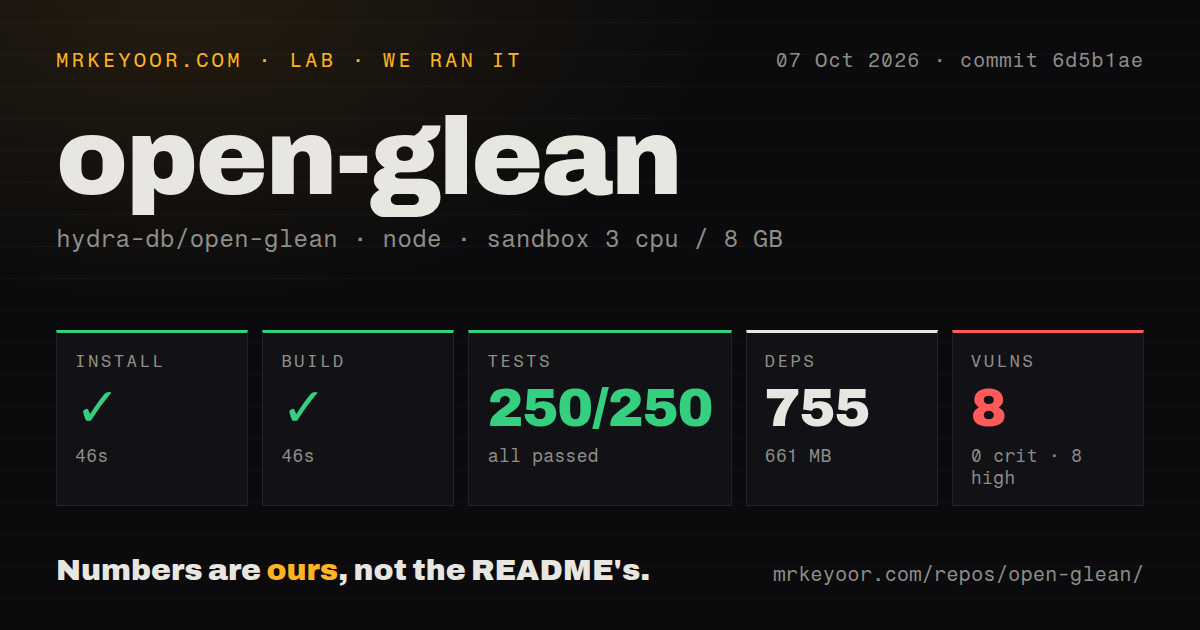
Our unprivileged Node 22 sandbox installed commit 6d5b1ae in 46 seconds. Npm added 755 packages and used 661 MB on disk. The Next.js build completed in another 46 seconds. The checkout also included 1 CI workflow and a Dockerfile, which is a better starting point for repeatable deployment than a README-only container recipe.
Vitest finished in 13 seconds with 250 passed and 0 failed. Npm audit reported 8 known vulnerabilities: 0 critical, 8 high, 0 moderate, and 0 low. The supplied measurement does not name the affected packages or exploit paths, so this review will not guess. A production owner should reproduce the audit against the lockfile, trace each advisory to reachable code, and decide whether mitigation or an upgrade is available.
A 16-character secret protects API keys, not user identity
Hydra and model keys entered through settings are encrypted into an httpOnly cookie with AES-256-GCM. The required OPEN_GLEAN_SESSION_SECRET must be at least 16 characters. Stored keys are pinned to the endpoint they arrived with, which prevents a caller from pairing a saved secret with an attacker-controlled host. Private and loopback LLM URLs are denied unless an operator turns them on.
The security policy draws a separate boundary around identity. An anonymous subject distinguishes 1 browser profile from another, but it is not authentication. Anyone using the same profile gets the same chats. If HYDRA_API_KEY is configured at deployment level, every visitor uses that key. The project explicitly tells operators to place such a deployment behind their own access control.
Three concurrent research requests can fan out quickly
Deep Research plans sub-questions, executes each level in parallel, writes branch findings, deduplicates sources, and produces one cited answer. The default allows 3 concurrent research requests per instance. The README warns that each uses many model and retrieval calls. This mode is useful when one search cannot answer the question, but it needs spending limits, provider quotas, cancellation, and concurrency chosen for your workload.
Transient provider failures are still being worked through. Open pull request 8 says one 429 or 503 can fail an answer or a research step, then proposes bounded retries before any streamed text has been read. Because that change remained open when checked, it should not be described as current behavior. Test rate limits and partial-stream failure against the providers you intend to pay.
MongoDB is optional, while persistence behavior changes without it
Open Glean stores conversations in MongoDB when the database is reachable. Without it, the app falls back to localStorage and shows a banner. That is convenient for one browser, but it changes backup, sharing, retention, and device access. DocumentDB users need a standard MongoDB connection string or the Lambda proxy because the documented IAM database-authentication path cannot authenticate to DocumentDB.
Answer generation is another optional layer with a hard boundary. Search can work without an LLM, while written answers need an OpenRouter or OpenAI-compatible model and have no built-in default. Web search citations come from the model provider's plugin. A 3-system deployment can therefore involve Hydra DB for retrieval, a model provider for synthesis, and MongoDB for shared chat persistence.
The October 6 security update has no versioned release
GitHub showed 1,580 stars, 6 open issues and pull requests, and a last push on October 6, 2026. All 6 open items returned by the API were pull requests. The latest merged change upgraded Next.js for a September security release. The repository was created on September 17 and has 0 GitHub releases, while its security policy says fixes land on main without backports.
Those dates describe an active young project, not a settled distribution. The 250 passing tests cover URL safety, outbound fetching, rendered-answer attacks, and application behavior well enough to justify a trial. The 8 high audit findings and shared-key access model block a casual public rollout. Open Glean makes the most sense when Hydra DB is already an accepted dependency and an operator can own the remaining security boundary.