The open source app still routes most generation through Muapi
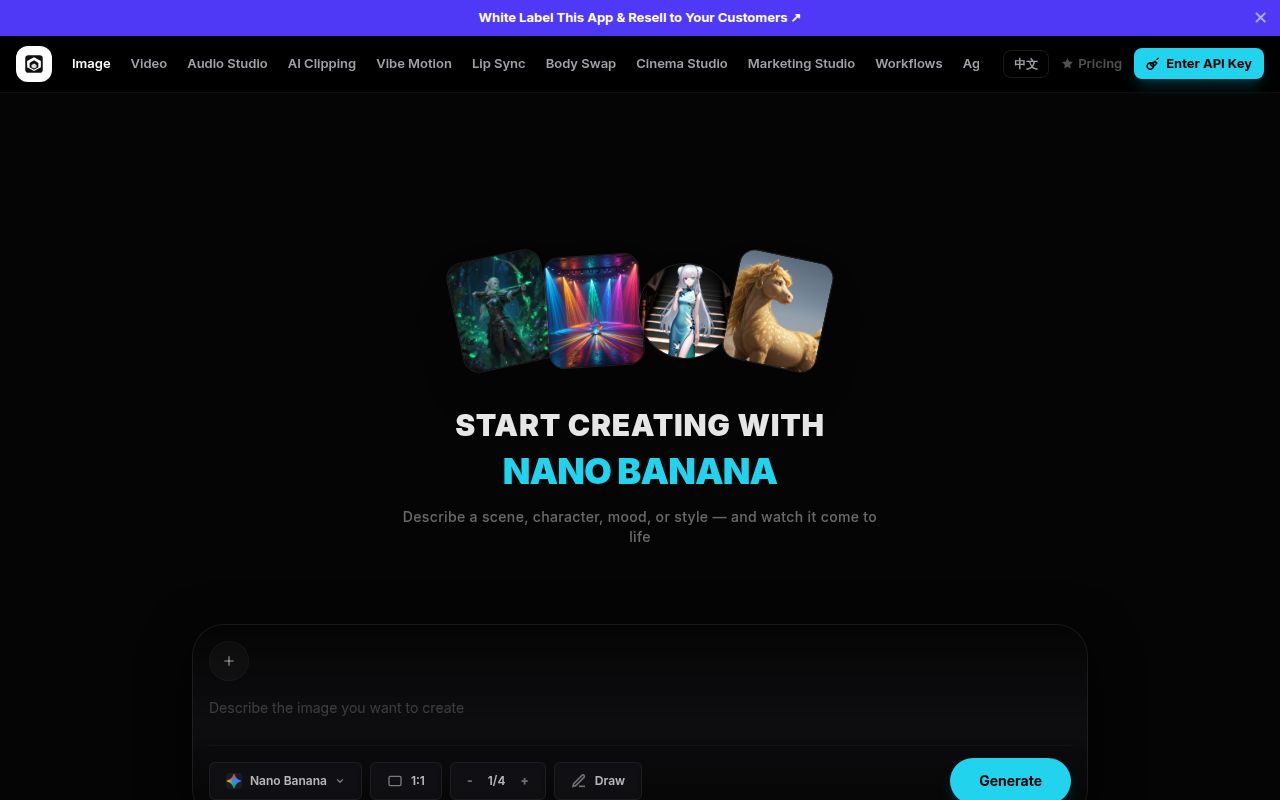
Open Generative AI puts a large media catalog behind one Next.js and Electron interface. The README counts more than 420 models across image, video, lip sync, audio, and related categories. You can move among task-specific studios instead of wiring each provider yourself. That is the useful part: model selection, uploads, controls, polling, history, and downloads share a UI.
The word self-hosted needs a qualifier. The documented cloud path sends a request to Muapi, polls its prediction endpoint, and uploads input files to Muapi before conditioned generation. The browser stores the access credential in localStorage. Running the front end on your server does not move those models onto your hardware. The separate local paths cover selected models and exist only in the desktop app.
What happened when we ran it
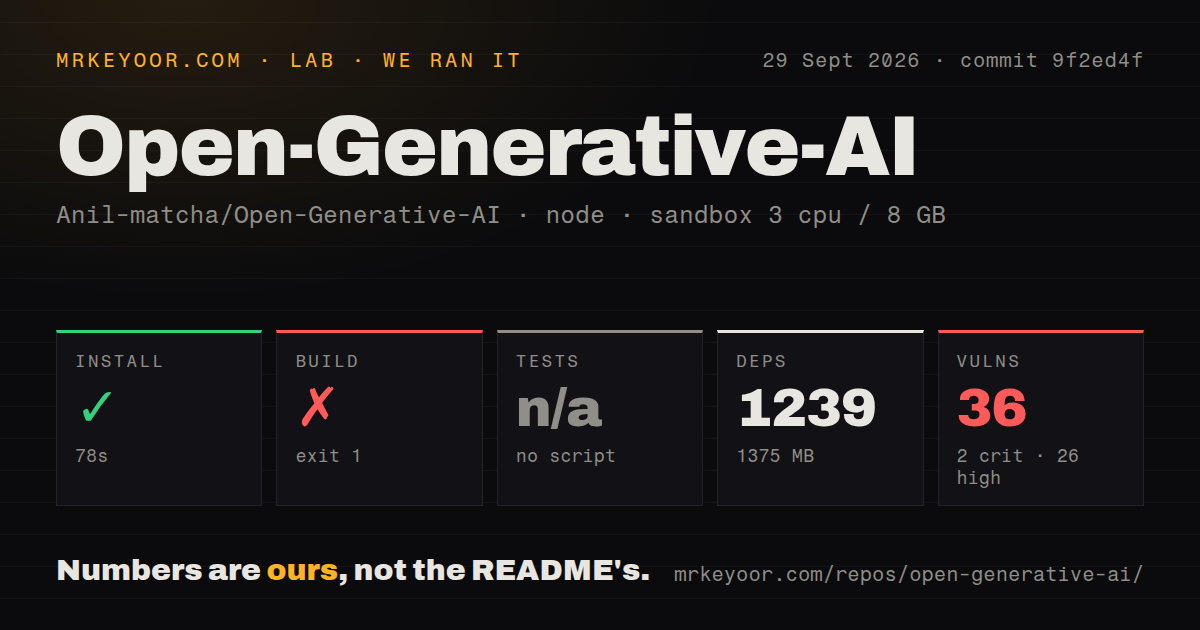
Our sandbox installed commit 9f2ed4f in 78 seconds. Npm added 1,239 packages, and the installed tree occupied 1,375 MB. The checkout itself contained 398 files, about 98,320 lines of source, and used 32.9 MB. Installation succeeded, so the failure came at the next gate.
The production build stopped after 28 seconds. Webpack could not resolve ai-agent/dist/tailwind.css from AgentChatClient.js, AgentCreateClient.js, and AgentEditClient.js. The log does not establish whether the missing file came from a workspace build, package export, or import mistake, so assigning a cause would be guesswork. It does establish that the measured commit did not produce a deployable Next.js build in the fresh container.
There was no test script or target, so our run skipped tests. Npm audit reported 36 known vulnerabilities: 2 critical, 26 high, 5 moderate, and 3 low. The repository did include a Dockerfile, a compose file, a tests directory, and npm workspaces, but no CI workflow files. Those files are useful scaffolding. They do not replace a passing command that a maintainer or adopter can run.
Local mode is desktop-only and split between two engines
The bundled sd.cpp engine runs selected image models on the same computer as the Electron app. The documented choices range from 2.1 GB Stable Diffusion 1.5 files to SDXL Base at 6.9 GB. Z-Image needs its model plus a 2.4 GB text encoder and a 335 MB VAE. That route can use Metal on Apple Silicon, with CUDA, Vulkan, or ROCm options on other supported systems.
Wan2GP is a different arrangement. You operate a Python and PyTorch server on an NVIDIA or AMD GPU machine, then point the desktop client at its Gradio URL. It covers larger image and video families, though the README says full Video Studio wiring remains on the roadmap. A Mac can stay as the client, but the compute box, model downloads, network exposure, and access policy are yours to manage.
Windows deserves a trial before you commit to the local route. Issue 356 reports that v2.0.0 local generation exits with code 3221225781 because the bundled executable looks for debug CRT DLLs that ordinary Windows systems lack. The reporter reproduced it with two Z-Image models. That is one user report, not our sandbox result, but it concerns the exact packaged path offered to non-developers.
The source baseline fails both build and audit gates
A 1,239-package install is not automatically bad, yet it raises the cost of every unresolved advisory and workspace mismatch. Our audit found 36 vulnerabilities, and our build failed before we could check production behavior. An open pull request, number 352, proposes dependency changes that its author says reduce the audit to zero. It was still open and marked dirty by GitHub on October 6, so those changes are not evidence about the default branch we measured.
The repository also has no test script in its root package file. Open issue 337 asks for browser-level coverage of the standalone video model picker because helper tests would miss failures in search, selection, and image fallback behavior. That is a narrow issue, but it points at a broader adoption problem: the interface spans many studios while the standard root command gives a buyer no runnable regression suite.
October activity is current, while the release docs lag
GitHub recorded 29,690 stars and a last push on October 3, 2026. The open queue contained 17 issues and 10 pull requests when checked, rather than 27 bugs. Release v2.0.0 shipped on May 23 with Windows, macOS, AppImage, and Debian assets. This is active work, not a repository left untouched after its installer release.
The README is detailed enough to get a contributor oriented, but its packaging story drifts. The download table still links v1.0.9 installers while GitHub lists v2.0.0 as latest. Model totals also move from 400-plus near the top to 420-plus later, while the repository description says 600-plus. None of that caused our build failure, though it makes the exact product boundary harder to pin down.
Choose the interface only if Muapi is part of the plan
At commit 9f2ed4f, the source app installed but did not build, and npm audit counted 36 known vulnerabilities. The packaged desktop app can still make sense for someone who already wants Muapi and values one interface across many media jobs. If local control is the reason you are shopping, start with ComfyUI or InvokeAI and accept a narrower catalog rather than calling a hosted gateway self-hosted.