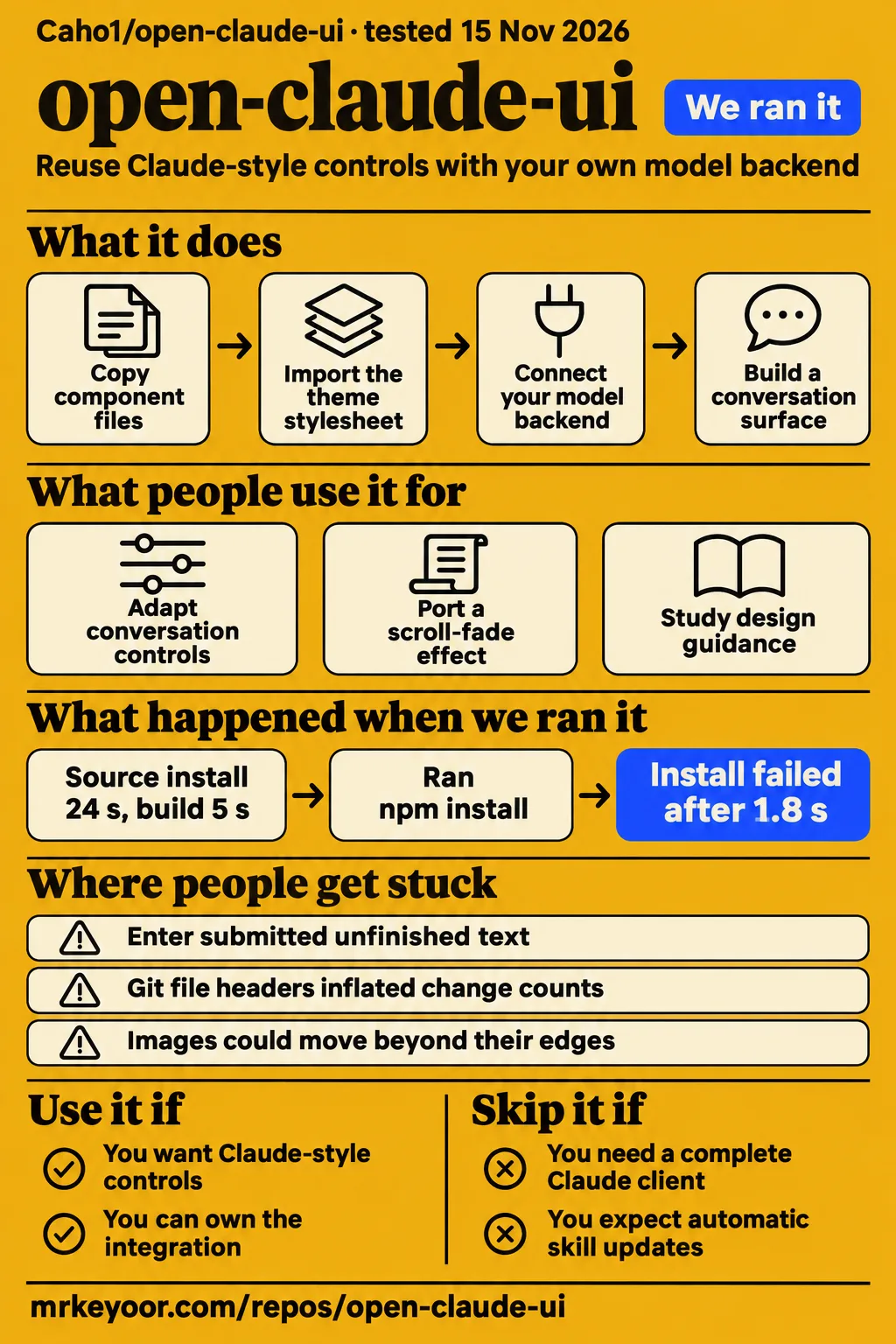
Our source checkout of open-claude-ui installed in 24 seconds and built in 5 seconds. Use it if you want to study or adapt Claude-style interface details and can own the integration. Skip it if you need a ready-to-use Claude client or expect agent instruction files to install as an updateable skill. The useful decision is which pieces to bring into your application, and which responsibilities stay with you.
What people use open-claude-ui for
Caho1/open-claude-ui supplies interface components and design guidance; you connect your own model backend. The REA case study explicitly separates its UI and motion modules from a Claude API backend. A model picker on screen therefore isn't evidence that the application can call that model. Budget for the connection between the controls and your service.
The project site describes a practical route: copy the component files you need, import the theme stylesheet, and account for React, Tailwind and, for some motion, Framer Motion. That suits a developer building a conversation surface who wants to inspect the implementation. It also makes selective adoption sensible. You can take a scroll treatment without committing your whole application to the project's chat composer or desktop window helpers.
The author of issue #17 reports porting a scroll-fade effect into a harness plugin. The host already owned the conversation interface. Other supplied records describe using community agent guidance, reconstructing interface details and reviewing the project for catalog inclusion. These are different activities with different outcomes, so the table keeps the actor and the reported result together.
| Who used it | What they did | Recorded outcome |
|---|---|---|
| Author of issue #17 | Ported the ScrollFadeContainer design into a harness plugin | Reports a working sample and says Chromium 115+ can express the visual result without JavaScript |
| Requester in issue #24 | Installed Waylish/open-claude-ui-skill | Reports using a community skill, then asks upstream for an installable option with updates |
| Project author, in the site's process account | Analyzed the desktop frontend bundles and rebuilt components | Published a handbook and React implementations with source references |
| kaixinbaba, in the REA catalog submission | Reviewed the README and source for catalog inclusion | Reports inclusion through a merged contribution and explicitly limits the assessment to source review |
The harness report is especially helpful if your application already has a sidebar and input box. Its author explains that the host cannot consume another plugin's components. CSS variables and effects fit that constraint, whereas importing a replacement ChatComposer does not. That is a concrete reason to extract the design layer instead of forcing a React component into an incompatible host.
What happened when we ran it
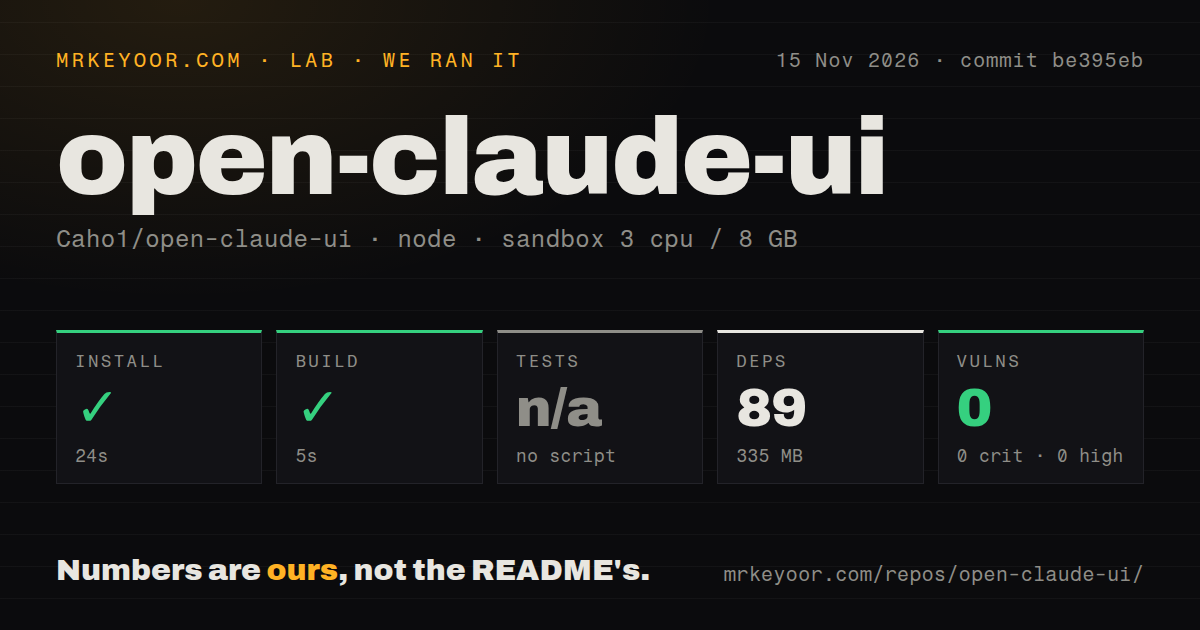
Our sandbox source-checkout run installed open-claude-ui in 24 seconds and built it in 5 seconds at commit be395eb on November 15, 2026. Our measurement setup used 3 CPUs, 8 GB RAM and image label lab-node:22. These are source setup results, useful for judging whether the checkout can clear its recorded build steps.
| Source-checkout measurement | Recorded result |
|---|---|
| Dependency installation | Succeeded in 24 seconds |
| Dependencies recorded | 89 |
| Installed footprint | 335 MB |
| Build | Succeeded in 5 seconds |
| Tests | Skipped because there was no test script or target |
| npm audit | 0 known vulnerabilities, including 0 critical, high, moderate and low |
| Repository scan | 97 files, about 7,440 source lines, 2.1 MB checked out |
| Automation and packaging signals | 1 CI workflow file, no Dockerfile, no tests directory |
The separate hands-on install step failed in 1.8 seconds after running npm install open-claude-ui@latest and exited with code 1. npm reported E404 and 404 Not Found for GET https://registry.npmjs.org/open-claude-ui. Its response said 'open-claude-ui@latest' is not in this registry. This is the failed package lookup recorded by the quickstart-lib recipe, separate from the successful source-checkout installation above.
That recipe's run record identifies commit be395eb4b783 and a fresh unprivileged lab-node:22 container with 2 CPUs, 4 GB RAM, no published ports and no secrets. The clone step took 3 seconds. Although the run summary says it installed from npm, the step log records failure. The install-failed finding points to /work/home/.npm/_logs/2026-11-15T17_50_40_012Z-debug-0.log, and teardown completed.
Those results answer different setup questions. The source checkout cleared the recorded install and build steps. The npm recipe could not retrieve the named package. If you arrive through examples containing package imports, start with the documented source-copy route rather than assuming the import name proves registry availability. The registry response concerns package retrieval; the issue reports below concern component behavior.
Where people get stuck: use the repair record, not the closed badge
Issues #1 through #4 include maintainer accounts of repairs in commit 501c05a; the interaction reports below have closed status and reporter explanations. The table identifies the original failure and what the supplied thread says happened next. For component selection, that distinction is more useful than treating every closed issue as the same kind of repair evidence.
| Report | What went wrong | Resolution shown in the record |
|---|---|---|
| #2, dependency and typing | Reporter hit an unavailable lucide-react version and TypeScript errors involving Electron, CSS properties and a typed array | Maintainer reports dependency and typing repairs in 501c05a |
| #3, theme integration | Component variables fell back to hardcoded colors, and Tailwind omitted code-examples from scanning | Maintainer reports semantic-token mappings, dark overrides and the content-path repair in 501c05a |
| #1, artifact frame | Reporter found parent-page access through the iframe configuration and inadequate message checks | Maintainer reports sandbox and messaging changes in 501c05a |
| #4, numerical documentation | Reporter found disagreements between comments, formulas and implementation, including token-estimation and retry descriptions | Maintainer reports corrections in 501c05a |
| #11, ChatComposer | Enter confirmed an IME candidate and submitted unfinished text | Closed; supplied thread contains a suggested composition guard |
| #9, StreamingDiffViewer | Full Git file headers were treated as changed code | Closed; supplied thread describes the parser defect |
| #10, session dragging | A downward drop landed below the displayed indicator | Closed; reporter supplies an index adjustment |
| #12, image panning | Images could move beyond their edges, including images smaller than the viewport | Closed; reporter supplies corrected boundary arithmetic |
The theming report explains a particularly deceptive failure. The controls still rendered because their CSS variables had fallback colors. A developer could change the foundation palette, see no change and blame their own theme setup. The reported repair connected semantic names to the foundation tokens and brought the example files into Tailwind's scan. For an adapted component, inspect both the variable mapping and the generated utility classes before rewriting the palette.
Real input exposes more than a component preview
Issue #11 reports that ChatComposer submitted half-composed CJK text when Enter confirmed a candidate, even though RichComposerWithMentions already had a composition guard. That distinction matters more than a general claim that the project supports IME input. Test the actual composer you plan to ship with a Chinese, Japanese or Korean keyboard. The relevant action is candidate confirmation, followed by a deliberate send. Reporter's reproduction.
The other reports supply similarly specific acceptance inputs. Feed StreamingDiffViewer a full Git diff containing file headers. Drag a session downward across a neighbor and compare its final position with the drop indicator. Zoom an image and drag toward its boundary, including an image that fits inside the viewport. These suggested checks come from diff issue #9, drag issue #10 and image issue #12.
For a busy conversation interface, put those cases ahead of tuning spring motion. Incorrect diff counts or an accidental send changes what the user does next. The issue reports give you a concrete starting set of inputs for your own application, where message handling and state ownership will differ from the examples. Their value is the reproducible action each reporter describes.
Security: the artifact iframe needs its own review
The maintainer reports removing allow-same-origin from EpitaxyIframeBridge after issue #1 described parent DOM access through a srcDoc frame. The reporter's concern was specific: combining script execution with the parent's origin defeated the intended isolation. The response also describes explicit origin validation and replacing trust in user-activation information supplied inside a message body. Issue #1 and maintainer response.
For anyone rendering generated artifacts, inspect the frame and messaging code before adoption. Decide which origins your application accepts and what actions an artifact can request. A UI that displays an approval card still needs application code that enforces the approval. The issue's repair account identifies the implementation areas to read: sandbox flags, event origins and the source of the user-gesture signal.
English documentation exists, but check the version volume
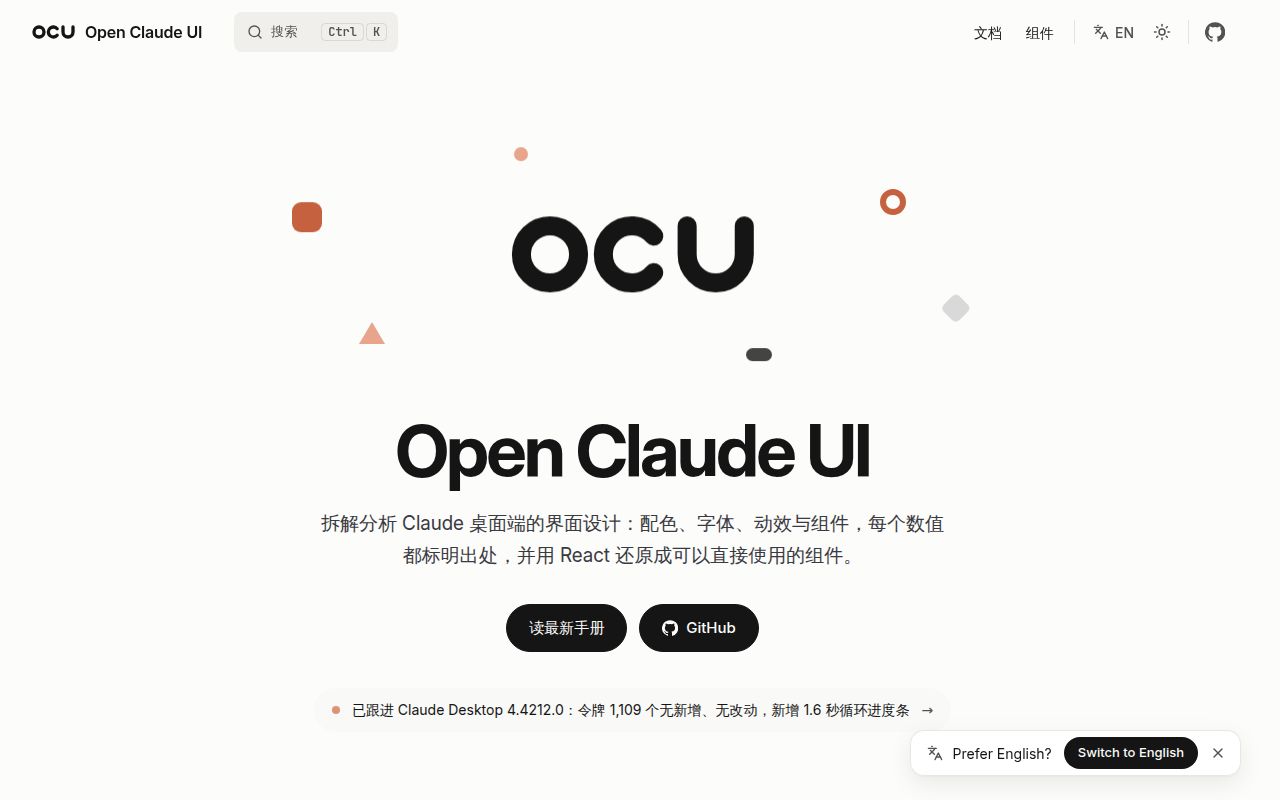
The default README is Chinese, and an English README and translated handbook are available. The English 1.x overview says all eight chapters are translated from Chinese and warns that comments inside reproduced code can remain Chinese. An English reader can start with component explanations, then follow the implementation references when a detail matters.
Version labels need equal attention. The English site snapshot points readers to a 4.4212.0 handbook, described there as Chinese-only. The repository README identifies v4.16336.0 as its current volume and earlier directories as historical. Choose the volume before copying a value. Mixing a historical surface color with a later interaction description can create a design that matches neither documented baseline.
open-claude-ui vs shadcn/ui and Radix
Open-claude-ui provides a Claude-style reference, while shadcn/ui invites developers to build their own component library and Radix offers a primitive base. Those stated purposes help choose a starting point. The comparison below uses the projects' descriptions and the harness integration report, with recommendations based on whether you want to follow the Claude reference or define your own interface.
| Choice | What the evidence supports | When to choose it |
|---|---|---|
| open-claude-ui | Component code, tokens and documentation aimed at Claude-style interactions | Studying or adapting that particular conversation interface |
| shadcn/ui | Its README describes customizable components for building your own component library | Owning a broader application design instead of following the Claude reference |
| Radix Primitives | Its README describes a low-level library focused on accessibility and customization | Building your own styled controls on a primitive layer |
| An existing UI library plus selected CDS effects | The harness author reports porting a scroll-fade design without importing the React component | Keeping the host's existing state and controls while borrowing an effect |
shadcn/ui's README explicitly invites developers to build their own component library. Radix's README describes incremental adoption or use as a design-system base. Those are different starting points from reconstructing one product's visual language. For an established application, start with the smallest CDS piece that solves a visible problem, then keep the application's own control contracts.
The HotRepo comparison calls open-claude-ui narrow and opinionated compared with general-purpose libraries. The traditional-kit comparison also favors traditional kits for breadth. The harness report supplies a more concrete selection criterion: whether the host can import another React component at all. For that host, retaining its controls and borrowing an effect matched its integration rules.
What the other reviews get wrong
The project's detailed guidance labels SPRING_GENTLE as a local addition with no observed client call site. That corrects the broader suggestion that all named presets came from the official client. The same guidance identifies the static fade stops as a compatibility fallback for engines without scroll-driven animation. Keep those provenance labels attached to the values when reusing them. Provenance notes.
The README's older quintic wording also needs care. In issue #4, the reporter compares the alpha samples with the proposed curves, and the maintainer reports correcting the description to approximately x^1.5. Gradient positions and alpha values are different quantities. Copying a formula's label without that distinction makes the explanation less useful than the CSS itself.
Bytesprint's tutorial treats the IME guard as solved across the codebase. Issue #11 identifies a composer-specific gap. Explainx's October 23 account says it found no unaffiliated statement or trademark notice, while the supplied handbook includes both. The handbook therefore supplies an explicit answer for readers evaluating affiliation and trademark wording.
The skill request deserves the same precision. In issue #24, the maintainer calls agent instruction files a solution, but the requester's subsequent installer output says it found no valid skills. Repository instructions and discoverable skill packages solve different distribution problems. The requester also specifically asks for automatic update detection, explaining why a manually maintained folder does not answer the request.
Questions people ask
To use open-claude-ui in an existing React project, the project site says to copy the needed component files and import cds-theme.css. Its guidance names Tailwind and some Framer Motion dependencies. Choose files by function, then apply the issue checklist to the components you adopt. The questions below connect those integration instructions with the specific failures readers reported. Integration guidance.
How do I use open-claude-ui components in an existing React or Tailwind project?
Copy the needed .tsx files from code-examples, import the theme stylesheet and make sure Tailwind scans their location. The site's component-copy instructions and the maintainer's content-scan repair explain both parts of that process. Include the relevant theme mappings when moving files into your own directory structure. Project instructions, theme issue #3.
Can I use its tokens and CSS effects without React or Tailwind?
Yes, the project documents a pure-CSS layer, and the author of issue #17 reports a working harness port of the scroll-fade design. The report explains why that host needed styles and tokens: it already owned its conversation stream, input and sidebar. That makes the integration constraint explicit. Project instructions, harness report.
Is open-claude-ui an official Anthropic project, and can I use it commercially?
No, the project describes itself as unaffiliated with Anthropic. Its licensing FAQ says MIT permits commercial use with the copyright notice retained and excludes Anthropic trademarks from that license. Keep those statements together when evaluating reuse: the code and documentation license and the Claude name have different treatment in the project's explanation. Project licensing FAQ.
Does open-claude-ui include a working Claude backend or just interface components?
It supplies UI and motion modules, and you wire your own model host. The REA case study explicitly says it is not a drop-in Claude API backend. Treat the composer, model picker and tool cards as interface pieces whose events and state must connect to the application you are building. Scope explanation.
Why does npm install fail, and how are the TypeScript errors fixed?
Issue #2 records a historical dependency-version problem and typing repairs reported by the maintainer in 501c05a. The separate package recipe received a registry E404 for open-claude-ui@latest. These identify different failing lookups: one concerns a dependency version, and the other concerns retrieval of the named package itself. Historical repair.
Why do theme changes have no effect, and why are Tailwind utilities missing?
Issue #3 traced that behavior to disconnected CSS variable names and a missing code-examples scan path. The maintainer reports alias mappings, dark-mode overrides and a Tailwind content change in 501c05a. In copied code, follow those connections between foundation values, semantic names and scanned files before changing the palette. Theme repair.
Does ChatComposer prevent Enter from submitting unfinished Chinese, Japanese, or Korean input?
The issue #11 reporter found that ChatComposer lacked the composition guard already present in RichComposerWithMentions. The thread suggests applying that guard to the simple composer. Its reproduction uses Enter to confirm a candidate while composition is active, which distinguishes the accidental submission from a deliberate send after composition ends. IME report.
Is the artifact iframe actually isolated from the host page?
The maintainer reports changing the unsafe sandbox flags and message checks after issue #1. The original report explains why a srcDoc frame with script execution and same-origin access could reach the parent page. The response names removal of allow-same-origin, explicit origin checks and a change to user-gesture handling. Artifact-frame report and response.
Does StreamingDiffViewer correctly parse full Git diffs, including file headers?
Issue #9 reports that parseGitDiff classified file-header lines as changed content. The reporter's distinction is between complete Git output and the built-in sample, which starts at a hunk header. Use complete output, including its header section, when checking the adopted viewer's displayed change counts. Diff-parser report.
Why does dragging a session downward place it below the drop indicator?
Issue #10 explains that the insertion index came from the original array while the splice used the array after removal. Removing an earlier item shifts later positions. The reporter supplies an adjustment for that shifted position and demonstrates a drop that visibly swaps rows despite the indicator showing a no-op. Drag-index report.
Why can a zoomed image be dragged past its edges?
Issue #12 attributes that behavior to inflated overflow bounds. The reporter recommends clamping each bound to max(0, (size - viewportSize) / 2). The report also covers images smaller than the viewport, which should have no overflow to pan through, and distinguishes the initial zoom position from the bounds used by subsequent dragging. Image-boundary report.
Do the documented spring and fade-mask numbers match the code?
Issue #4 found mismatches, and the maintainer reports corrections in 501c05a. The detailed agent guidance also distinguishes observed client presets from a local addition. Read the value, its provenance and its version scope together, especially when a historical README description and newer guidance appear to describe the same effect. Numerical corrections, provenance guidance.
What we have not tested yet
Our evidence covers source setup and a failed package lookup, not a deployed conversation workflow. We have no measured browser performance, accessibility assessment, mobile interaction run, model-backend integration or long-running application result. The image label does not establish the actual runtime or operating-system version. The clean npm audit reports known dependency advisories, not a security certification. The alternative-library comparison concerns stated scope rather than measured performance or integration effort.
The supplied extracts contain no independent retest of the iframe repair and no applied-fix confirmation for the closed IME, diff, drag and image-boundary reports. The acceptance actions above are recommendations drawn from those reports, not additional sandbox results. The community skill report establishes installation by its requester, not generated-interface quality or automatic update behavior. The author's bundle-analysis account is also not an independent fidelity comparison against the official client.
The supplied video transcript, UI Libraries for Claude Code, stops during a general discussion of component-library categories. It contains no completed open-claude-ui demonstration. The synthesis also identifies an X result about a different design skill. Neither supplies a deployment result for Caho1/open-claude-ui, and similarly named chat applications are separate projects. The harness author's demonstrated port concerns ScrollFadeContainer; it does not extend to every effect.
GitHub's supplied repository metadata records a last push of November 6, 2026. The supplied metadata does not establish a latest release. The sampled issues show maintainer responses alongside closed reports with no accompanying repair account. Long-term maintenance and production adoption remain open questions. These boundaries support adopting selected parts under application-specific checks, including an isolation check for the artifact bridge and candidate-confirmation input for the composer.