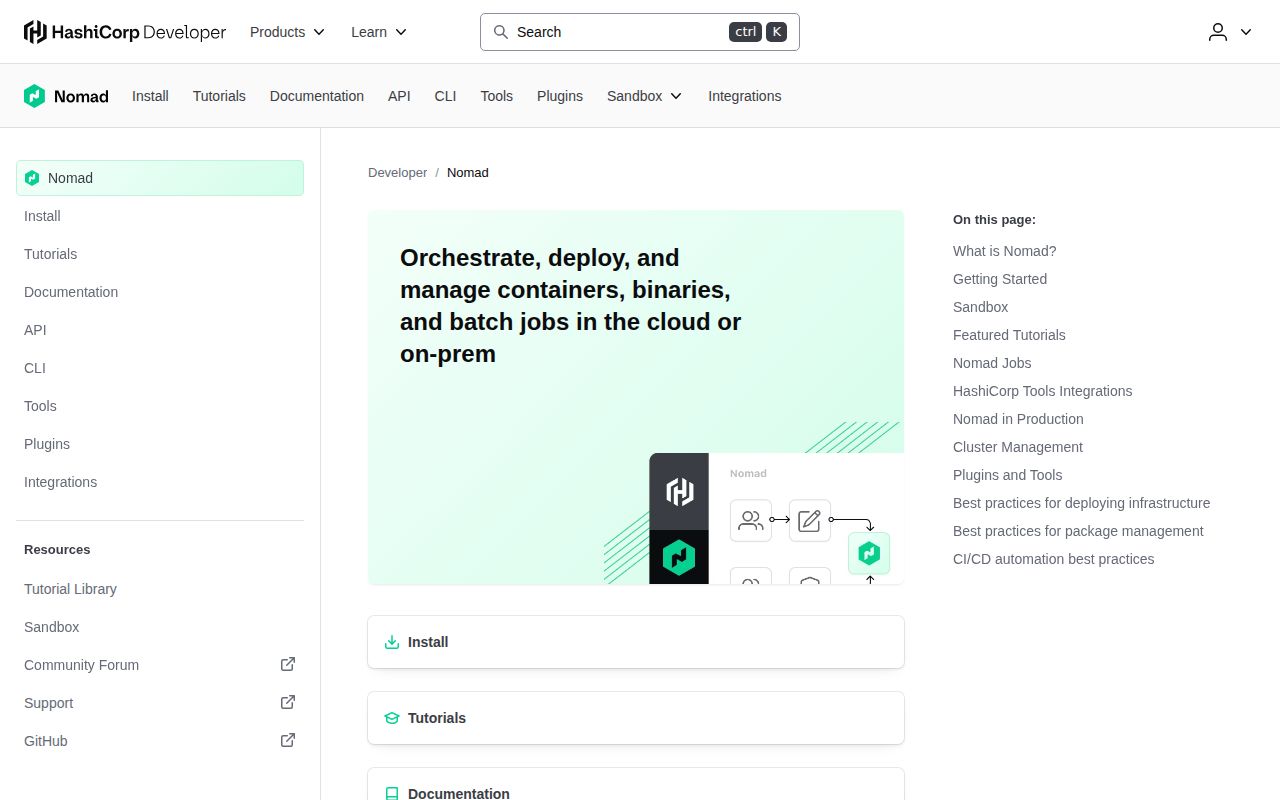
Nomad schedules containers, binaries, batch work, and VMs
Nomad's main advantage is workload variety. One cluster can run Docker or Podman containers, ordinary executables, Java programs, batch jobs, and QEMU virtual machines. Device plugins can expose GPUs and specialized hardware. That mix suits companies whose systems cannot all fit a container-only model. Jobs are described in HCL or JSON, planned before submission, placed according to resources and constraints, and rescheduled according to declared policy.
The core is compact by orchestrator standards. Nomad ships server and client behavior in one binary and stores coordination state through Raft rather than an external database. Servers decide placement; clients run allocations and report health. This reduces mandatory control-plane products, but networking, service discovery, ingress, secrets, storage, and observability still need choices. Consul and Vault are common companions, not invisible features bundled into the scheduler.
A development agent is smaller than the production system
The README directs evaluators to a local development cluster. That is a useful way to submit a jobspec, inspect an allocation, and try task drivers. HashiCorp's production reference architecture calls for 3 or 5 servers, no more than 7, with quorum spread across failure domains. It expects high-bandwidth links and latency below 10 milliseconds between server members. Those requirements turn a friendly single binary into a real distributed control plane.
Production security includes TLS, ACL policies and tokens, gossip encryption, restricted task drivers, protected artifact sources, network rules, host-volume policy, backups, and tested recovery. Nomad clients deserve scrutiny because they launch the workloads. Running a raw executable is useful for legacy systems and dangerous when untrusted users can submit jobs. Platform owners must decide which drivers, devices, mounts, networks, and identities each namespace can access.
What happened when we ran it
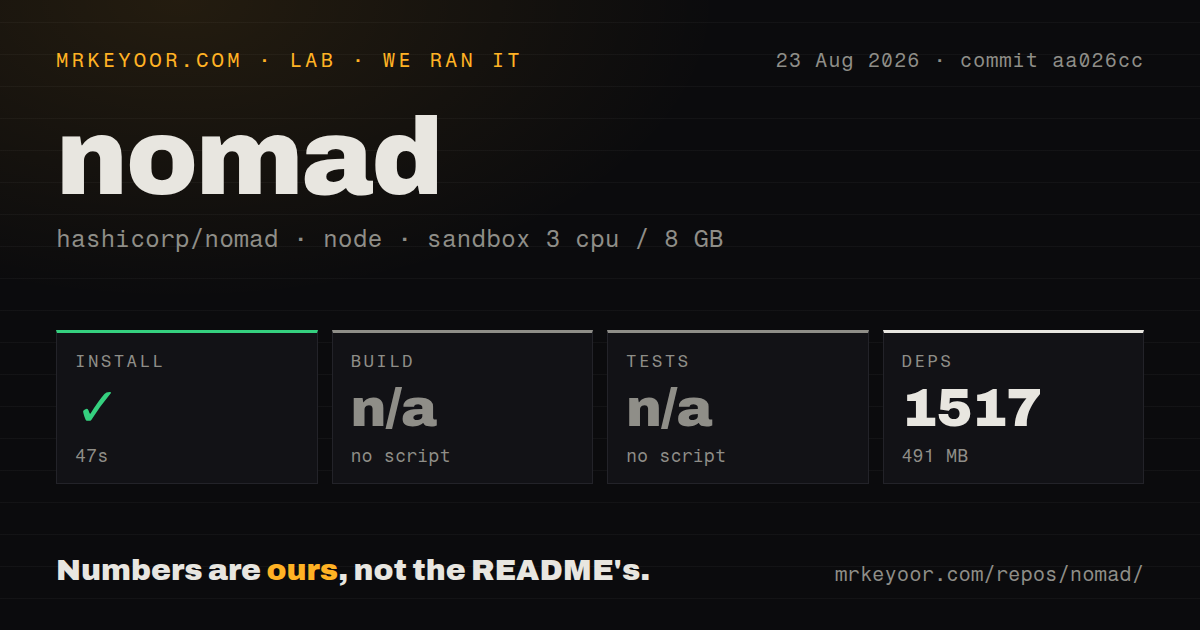
Our sandbox detected the repository's Node and pnpm workspace and installed 1,517 packages in 47 seconds, using 491 MB on disk. The checkout at commit aa026cc contained 6,011 files, roughly 800,108 lines of source, and 68.4 MB before dependencies. The measured workspace had monorepo configuration, 18 CI workflow files, a Dockerfile, and no tests directory. Installation succeeded in the stated unprivileged Debian container.
No build script or target was available to the harness, so build was skipped. No tests script or target was available either, so tests were skipped. This is not a passing build or test result for Nomad's Go scheduler. It only shows that the surfaced pnpm dependency step completed in 47 seconds. Buyers should run a Go build, integration suites, driver tests, and a staged cluster upgrade before deploying this commit.
Federation connects regions without copying most state
Nomad can federate independent regions over WAN gossip and let operators address them through one administrative view. The production architecture is explicit that regional clusters do not share jobs, clients, or most state. Some global policy material can replicate, but a failed region does not automatically re-create its workload elsewhere. Disaster recovery needs source-controlled jobs, replicated application data, server snapshots, DNS or traffic changes, and a tested resubmission process.
Release v2.0.5 added structured job-plan output and a planner setting for more outstanding Raft writes. It also fixed deleted allocations remaining active, a client panic after garbage collection, secret and private tmpfs remounting, blocked CSI evaluations, CPU-set enforcement, scheduler panics, and service-secret interpolation. The release is active maintenance evidence. It also shows how many paths exist between submitted intent and a correctly running allocation.
Current reports target restarts, planning, and Windows artifacts
Issue 28439 reports that each in-place task restart leaked 1 operating-system thread and 1 file descriptor in logmon with a stated Podman setup. After 146 restarts, the reporter measured 159 threads and 163 descriptors. A fix pull request opened the next day. Operators running long-lived workers with frequent restarts should graph process threads and descriptors rather than assuming a healthy allocation status covers helper-process resources.
Issue 28444 concerns the new plan-apply pipeline under concurrent placement. A retained optimistic snapshot can miss an evaluation that exists in canonical state, return an error, and add about 1 second through the initial negative-acknowledgement delay. Issue 28150 reports a Windows periodic-job regression where later runs intermittently skip S3 or MinIO artifact downloads. These reports affect specific configurations, which makes configuration-matched staging more useful than generic smoke tests.
Business Source License 1.1 changes who can adopt it
Current Nomad code uses Business Source License 1.1 rather than an OSI-approved open-source license. The grant allows many internal production uses, while restricting certain paid hosted or embedded offerings that compete with IBM's paid Nomad products. Each version is scheduled to convert to MPL 2.0 after its stated change period. Internal platform teams may accept that model; vendors and open-source-only organizations need procurement or legal review.
The edition boundary matters separately. Nomad Enterprise sells organizational, governance, and support capabilities beyond the community build. Match required controls to the edition before designing a platform around them. A feature in HashiCorp documentation may carry an Enterprise marker, and commercial support can change the economics compared with operating the community binary alone. Licensing and edition fit should be decided before teams invest in jobspecs, drivers, and training.
August activity supports maturity, while fit decides the choice
GitHub recorded 16,837 stars, 1,638 combined open issues and pull requests, and a last push on August 25, 2026. Version 2.0.5 shipped on August 13. Recent activity covers bug reports, release backports, scheduler work, UI fixes, and a Go toolchain update. The large queue is not 1,638 confirmed bugs; it reflects a mature scheduler with many operating systems, drivers, APIs, and long-lived deployments.
Nomad is persuasive for mixed workloads, direct server ownership, and teams already comfortable with HCL, Consul, or Vault. Kubernetes is safer when managed control planes, hiring familiarity, and operator compatibility dominate. Our pnpm-only run leaves build integrity unconfirmed for the Go product, so adoption should start with a pinned binary or reproducible Go build, a 3-server staging cluster, and failure drills for quorum, artifacts, drivers, secrets, and regional recovery.