Kubernetes with the packaging decisions made
K3s takes upstream Kubernetes and packages the control plane and supporting services behind one launcher. A default server includes containerd, runc, Flannel networking, CoreDNS, Traefik ingress, a service load balancer, network-policy control, a Helm controller, and local storage provisioning. SQLite is the default datastore for a single server. Embedded etcd and external MySQL, PostgreSQL, or etcd are available when the cluster design requires them.
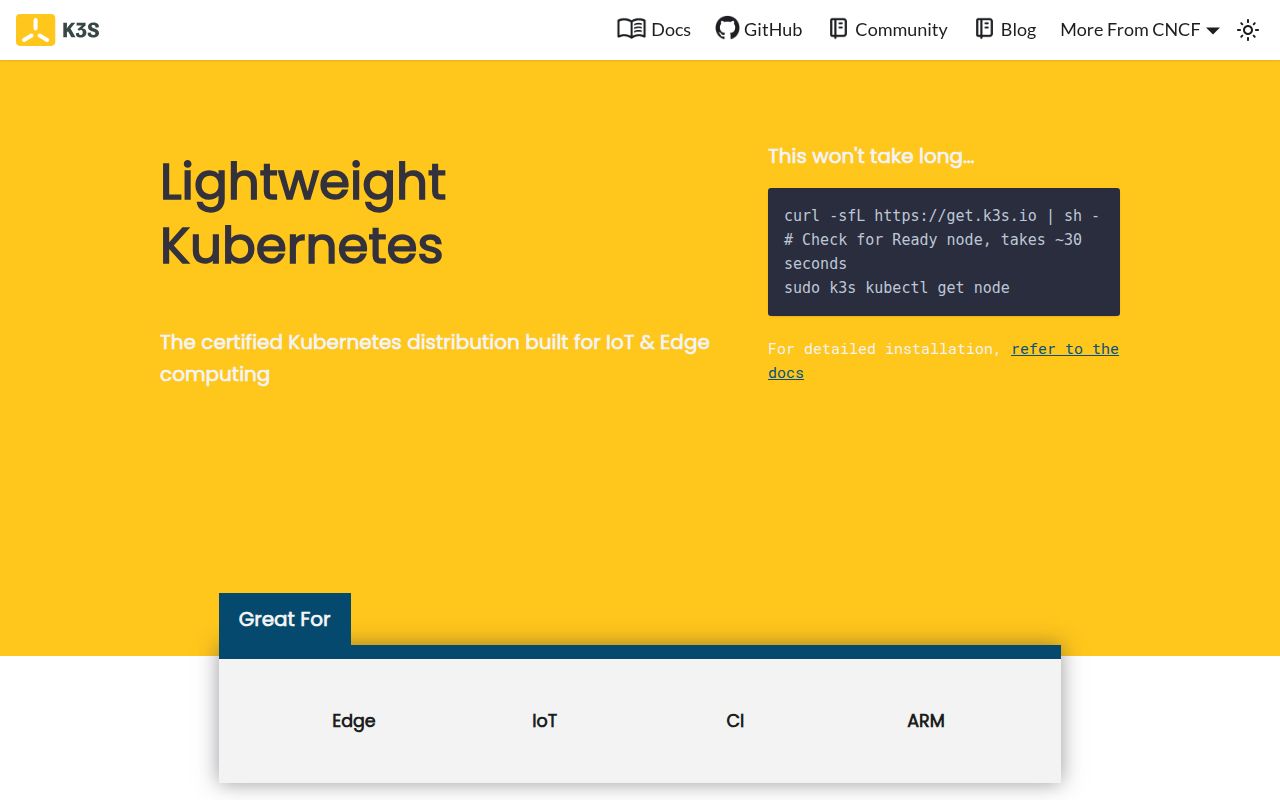
That bundle is why K3s feels easier than assembling Kubernetes from separate components. One install script can configure a systemd or OpenRC service, place kubeconfig under /etc/rancher/k3s, and install command-line helpers. A single server is already a functioning cluster that can run workloads. Agents join by receiving the server URL and token. For a lab, branch office, or small Linux host, the first useful result arrives with very little ceremony.
The word "lightweight" needs the right interpretation. K3s reduces packaging and process overhead; it does not create a smaller orchestration model. Deployments, Services, RBAC, admission policy, persistent volumes, DNS, ingress, pod security, and upgrades still behave like Kubernetes concerns. A team that finds Kubernetes unnecessary for its workload will not improve matters by choosing a tidier distribution.
Defaults help until you need different defaults
K3s's component choices are sensible for its target environments. SQLite avoids operating etcd for one node. Flannel supplies a straightforward cluster network. Traefik and the local-path provisioner make an empty machine useful without a separate add-on session. The README says these technologies can be disabled or swapped, which gives experienced operators an exit when a standard CNI, ingress controller, or storage platform is required.
Replacing them is real design work. K3s removes Kubernetes's in-tree storage drivers and cloud provider, expecting CSI and cloud-controller-manager integrations instead. Firewall rules depend on the chosen network backend. The official requirements call out API server access on TCP 6443, Flannel VXLAN traffic on UDP 8472, and more ports for metrics, WireGuard, or embedded etcd. It explicitly warns against exposing the VXLAN port to the internet.
Hardware can be small, though workload capacity is separate from cluster overhead. The current requirements list 2 CPU cores and 2 GB of RAM for a server, and 1 core with 512 MB for an agent. They recommend SSD storage because database performance matters, with a stronger warning for etcd on SD cards and eMMC. Those are baseline requirements for K3s and its packaged components, not a sizing promise for applications.
What happened when we ran it
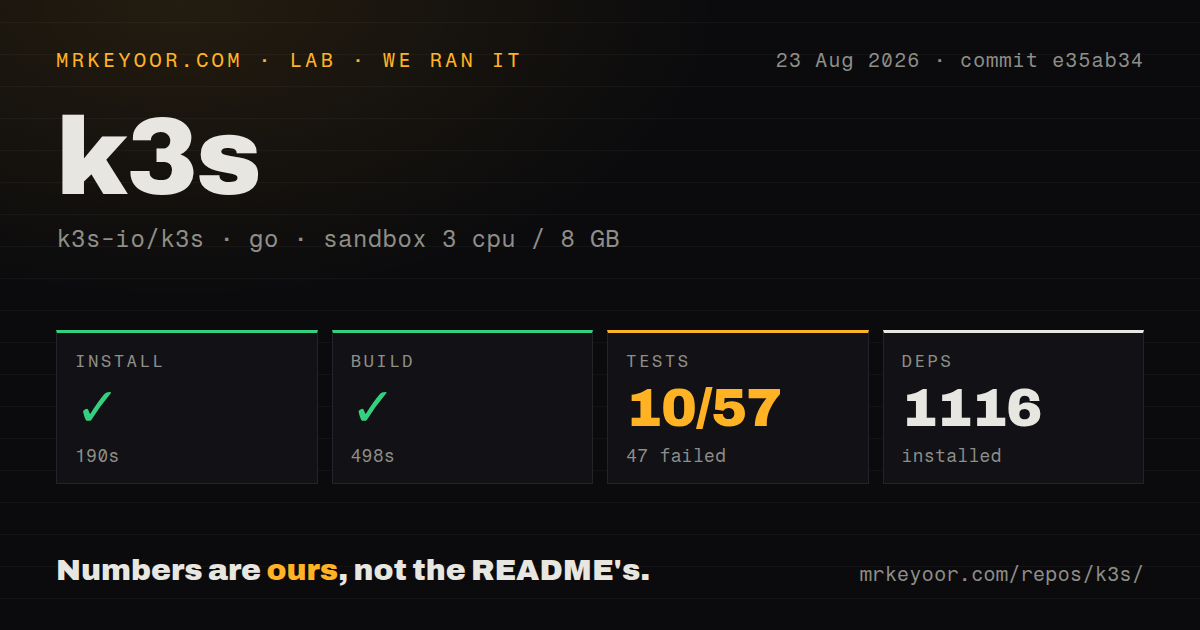
We cloned commit e35ab34 into an unprivileged Debian container with 3 CPUs and 8 GB of RAM. The repository contained 665 files and about 64,020 lines of source, using 3.1 MB in the checkout. Installation succeeded in 190 seconds and installed 1,116 packages. The build then completed successfully in 498 seconds.
Tests ran for 543 seconds and returned exit code 1. Across the parsed Go test result, 10 passed and 47 failed out of 57. The final log excerpt comes from tests/integration/startup. It says the case for creating a default server with no arguments failed at startup_int_test.go:37. That suite ran 1 of 60 specs, recorded 1 failure, and skipped 59.
The excerpt does not include the failed assertion or an error message explaining why the server case failed. Our container was unprivileged and had no secrets, but that alone does not prove the cause. The useful finding is narrower: dependency installation and compilation worked in the clean Go image, while the repository's test command did not pass in that environment and the supplied tail was insufficient to diagnose its broad failure count.
Production starts after the quick install
A single SQLite server is convenient, but it is also one control plane and one local datastore. The documented embedded-etcd design uses three or more server nodes so etcd can maintain quorum. An external-database design uses multiple K3s servers plus MySQL, PostgreSQL, or etcd. Agents should register through a fixed address when servers can change, which normally means adding a load balancer or stable endpoint.
Backups deserve special attention. K3s uses the server token to encrypt confidential data stored in the datastore. The backup guide says to save that token alongside the database; a restored snapshot is unusable without the same value. SQLite backup means copying its database directory. External database recovery belongs to that database's operator, while embedded etcd has K3s snapshot commands. This is manageable, but none of it is supplied by the one-line installer.
The uninstall script is deliberately destructive. Official docs say it stops pods and deletes the local datastore, node configuration, installed tools, and local persistent-volume data. An operator must also delete a node object before reusing its name in some reinstall scenarios, because node-password secrets protect identity. These details are ordinary cluster lifecycle work, and they are exactly where casual home-lab instructions can cause damage.
Maintenance and the buying decision
The repository was pushed on August 22, 2026. Release v1.36.3+k3s1 arrived on August 4 and tracked Kubernetes 1.36.3. Its notes included a breaking Traefik provider-name change, alongside component updates and fixes. Open issues and pull requests were updated through August 23, including work toward Kubernetes 1.37 and fixes for etcd restore and startup behavior. GitHub's open count was 70 issues and PRs combined.
K3s keeps pace with upstream Kubernetes and documents how its version suffix maps to an upstream release. That cadence is healthy, yet every upgrade can carry changes from Kubernetes and bundled components. Pin versions, read both sets of release notes, and rehearse rollback with a usable backup.
Choose K3s when you need Kubernetes APIs on Linux with less assembly, especially at the edge or on modest hardware. Choose kind for disposable CI clusters, MicroK8s for a snap-centered Ubuntu estate, or k0s if its component model is the closer match. K3s earns the recommendation, provided the team treats the quick install as the beginning of operations rather than the end.