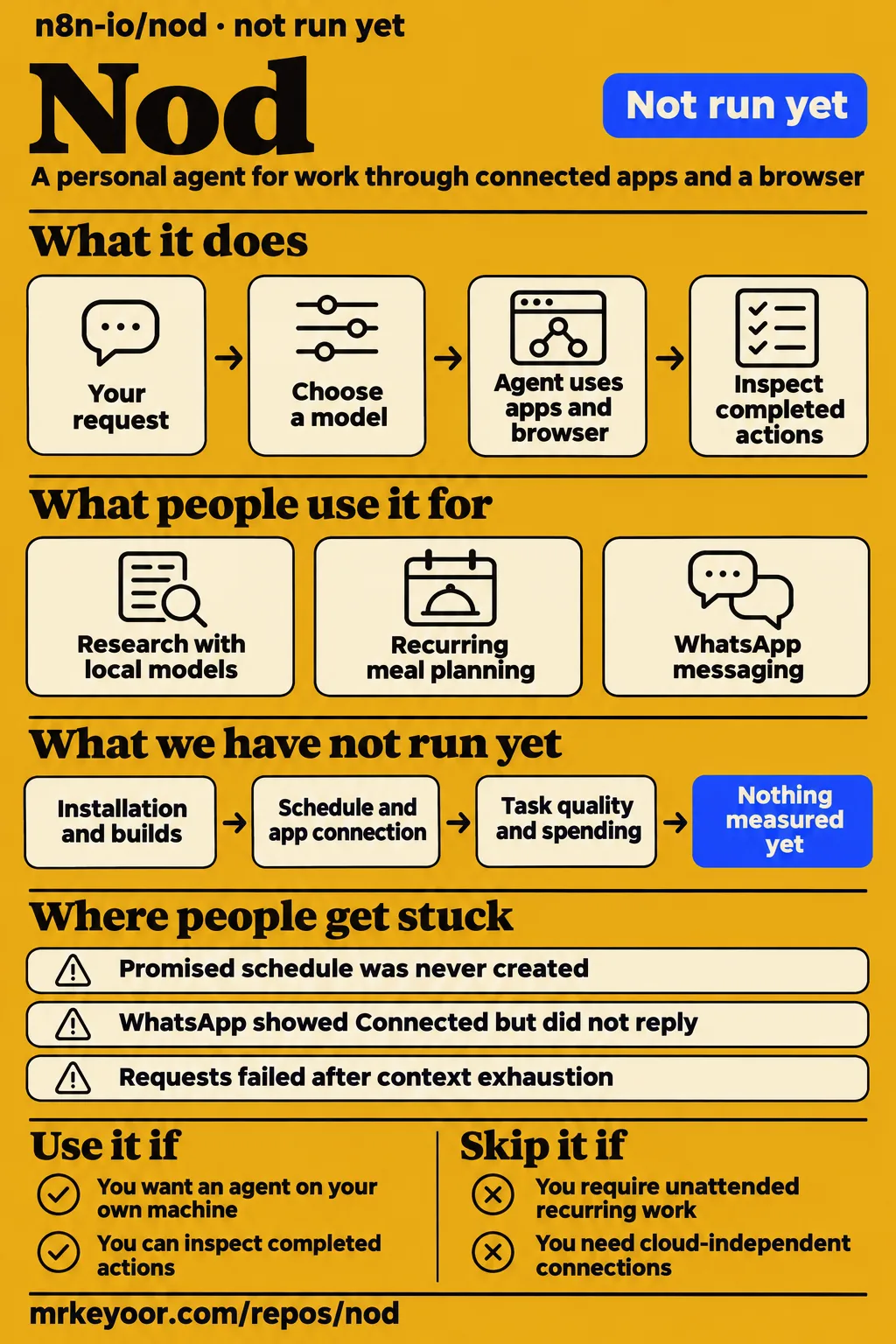
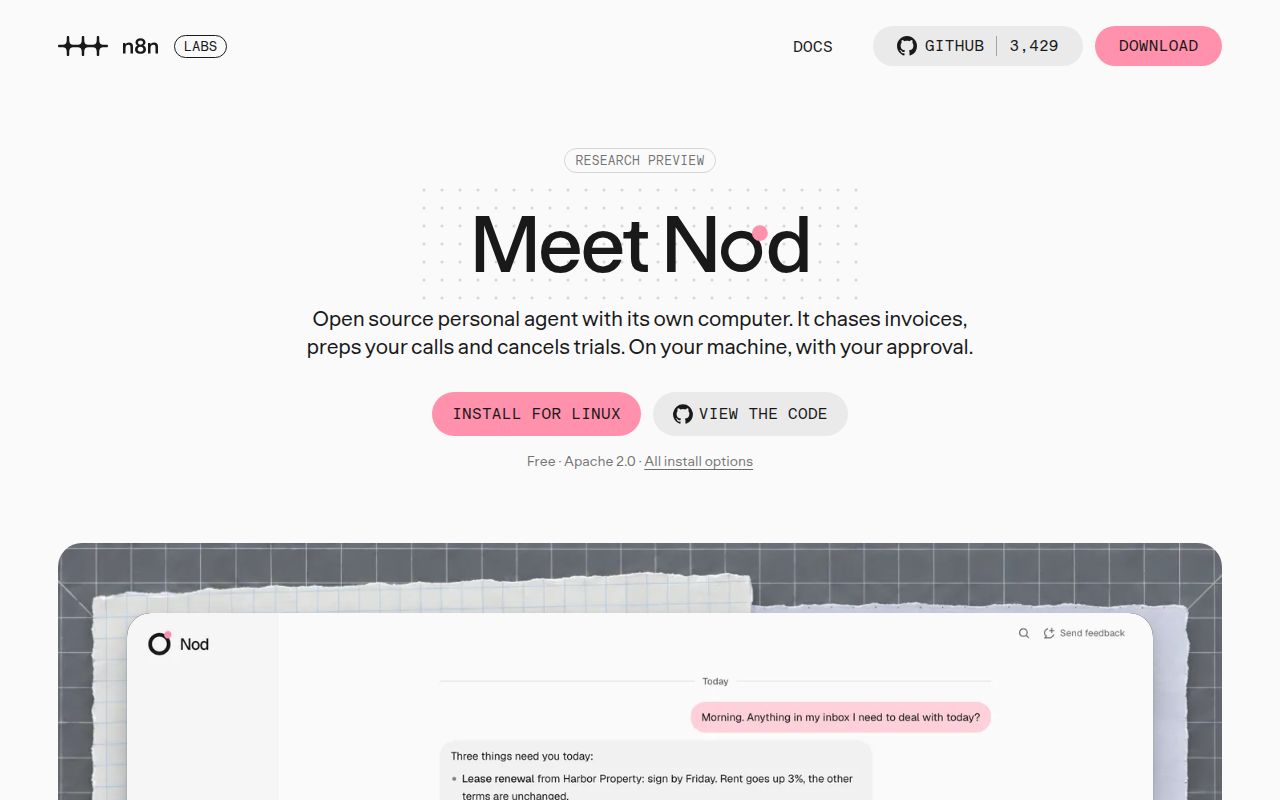
Our Nod run ended before installation: Git reported No space left on device, followed by invalid index-pack output. Nod is worth evaluating if you want a personal agent on your own machine and can inspect its completed actions. People depending on unattended recurring work should read the scheduling report first: the assistant promised a Friday meal plan without creating its schedule. Those are separate findings from our failed clone and jakobslt's scheduling report.
What people use nod for
Users tried research, recurring meal planning, WhatsApp messaging and access to a Mac's Downloads folder in #850, #814, #716 and #741. Nod is the standalone personal agent from n8n Labs described in Maru's overview. The reports below connect those intended jobs to observable outcomes: a saved schedule, an answered message, an accessible folder or a conversation that accepts the next request.
| Person and task | What happened | What to inspect in an evaluation |
|---|---|---|
| The reporter of #850 researched with self-hosted Nod and local models. | Research exhausted context on v0.7.4; subsequent requests failed, with later reproductions on v0.7.5 and v0.7.6. Context reports | Whether the conversation accepts another request after a long task. |
| jakobslt requested a recurring Friday meal plan with household preferences and German output. | Samples appeared, but the promised schedule did not. Reinstalling solved the reporter's case. Meal-plan report | The saved schedule and its runs. |
| R0DRIG0O connected a separate WhatsApp bot number. | Internal chat worked; WhatsApp messages received no reply despite Connected status. WhatsApp report | A reply through the intended number. |
| The reporter of #741 requested a Mac's Downloads listing. | v0.6.2 lacked local-file support; a later user still reported a missing Downloads directory after support was announced. Local-files report | Access to the required host folder. |
| The reporter of #905 used Linux Mint with an encrypted home directory. | Disk construction failed; manually building the disk got Nod running. A maintainer identified the v0.8.4 fix. Linux startup report | The filesystem and startup log. |
The meal-plan request specified one warm meal for each day from Monday through Saturday, delivered every Friday. The assistant first returned two connection errors, then produced a sample list and implied that scheduling existed. When challenged, it acknowledged that the task had never been created. Clicking New schedule returned the user to chat, according to #814. The useful acceptance check is the saved recurring task and its subsequent delivery, rather than the quality of the sample menu.
What happened when we ran it
Our November 25, 2026 run failed during cloning with fatal: write error: No space left on device and fatal: fetch-pack: invalid index-pack output, as recorded in the clone log. The sandbox configuration was 3 CPUs and 8 GB of RAM. The finding concerns a failed source checkout; the application had not reached installation or startup when Git stopped.
| Stage | Recorded outcome | Meaning |
|---|---|---|
| Clone | Failed with No space left on device and invalid index-pack output. |
Source checkout did not complete. |
| Installation, build and tests | Not run. | Application execution was not reached. |
| Task execution | Not reached. | The lab performed no meal-plan, browser or connector task. |
| Cleanup | Teardown recorded ok. | Cleanup completed after the failed attempt. |
A separate run-summary entry describes Docker Compose deployment with every port bound to 127.0.0.1. The clone log and harness instead record a failed checkout and no installation, build or test execution. We retain that contradiction explicitly: the summary describes deployment, while the detailed attempt stopped at Git. The failed clone is the outcome used throughout this review.
Where people get stuck: promises and completed actions diverge
Issue #814 records a missing schedule, while #1017 disputes the diagnostic used to declare connected tools unavailable. These are different failure points: the scheduling report concerns whether an action occurred, and the connector discussion concerns how tools are discovered. A Connected badge, generated answer and saved task each describe a different part of the process.
| Symptom and source | What the discussion supports | Recorded status |
|---|---|---|
| Context exhaustion, #850 | v0.7.5 was suggested, followed by reports on v0.7.5 and v0.7.6 and after changing models. | Closed; later prevention work and a favorable main-branch report appear. |
| New schedule returns to chat, #814 | A non-maintainer explains that creation requires a model scheduling-tool call. | Reporter-confirmed reinstall workaround. |
| Background-service timeout, #876 | A maintainer attributes the Windows delay to virus scanning during file loading. | #1440 identified for the next release; Try again was interim advice. |
| WhatsApp connected but silent, #716 | Replies discuss sender numbers and connection modes. | Reporter said the number suggestion had already failed; thread open. |
| Connected apps appear to lack actions, #1017 | A non-maintainer disputes inspecting a callable function as nested namespaces. | Open; the empty-object observation is challenged. |
| Approval before every browser click, #699 | A maintainer calls the repeated questions a bug and requests diagnostics. | Open; clearer requests were described as an interim measure. |
The startup report gives a numerical explanation with a practical consequence. In #876, a maintainer says the background service loads about 6,500 files before it can answer and attributes the Windows delay to virus scanning. The reporter encountered “Nod’s background service did not respond” on first startup after installation or updating, then reported that restarting resolved it. That is a maintainer's diagnosis and a user's workaround, separate from our lab's clone failure.
The connector discussion makes a narrower technical point. A non-maintainer explains in #1017 that apps is callable, so Object.keys(tools.apps) can be empty even with a healthy connection. Their suggested diagnostic searches through apps using SEARCH_TOOLS. The original reporter says the technical report was generated by AI. The comment therefore challenges the alleged root cause rather than confirming that OAuth succeeded but every app action was broken.
The broker report concerns an explicit service response instead. In #819, a self-hosted installation received 429 {"error":"public_budget_exceeded"} while connecting apps, and another commenter reported effects on the catalog and inbox polling for an already-connected app. The sign-in popup closed without displaying the underlying reason. This separates account authorization from the availability of the connection service handling the request.
Model choice affects spending and background work
The README says Nod is free and open source, while the model provider bills the user directly. It also describes per-task costs and a monthly limit for API models in its cost explanation. Onboarding adds that background checks of connected apps count as model usage. An inbox connection can therefore produce model activity outside the requests someone types into chat.
The task documentation describes a spending check-in at $5 by default, according to the task-guide extract. That check-in and the README's monthly API-model limit are separate controls with different scopes. Maru also reports that some early testers found task costs higher than expected in the overview. The decision aid is to record the completed result alongside its cost, including background activity associated with connected accounts.
Privacy includes the model and connection service
The README says files, memory and saved logins stay on Nod's host, while the model provider receives what each task needs. It also says app connections use an n8n-hosted service by default in its data explanation. Onboarding specifically identifies Composio as the service used to connect apps. Local hosting and external task services are both parts of the documented design.
The README describes Vault entering passwords, codes and cards privately on websites, and warns that the safety check uses a model's judgment. Separately, onboarding says basic usage data is on by default and conversation traces stay off unless shared. These are distinct choices about account access, model input and reporting. The documented settings put usage data and trace sharing under Settings → Privacy & data.
In #699, non-maintainer abhisheksharma001 reports a browser authorization evaluation using Jev 1.14 direct: 159 correct decisions and zero unsafe decisions across three repeats of 53 cases, with p50 0.7 seconds and about $0.04 total. The original repeated-approval report names DeepSeek through OpenRouter. Keeping the model names attached to the results prevents one commenter's numerical result from becoming a claim about the reporter's configuration.
Release fixes answer specific symptoms
A maintainer identifies v0.8.4 as containing the eCryptfs startup fix in #905. The explanation names normal reads and writes, a SHA-256 digest check and installation only after copying completes. Failed first setup is replaced on retry. This is a symptom-specific release statement about disk creation on Linux, rather than a judgment about every installation path in that version.
The Windows upgrade discussion records a different outcome. In #1130, the reporter confirms that moving an old n8n skill folder out of the installation resolved invalid skill metadata. The discussion associates the problem with upgrading to v0.8.4 and describes installer fix #1122 as merged afterward. Separately, #741 distinguishes local-file support announced for v0.7.0 from v0.6.2's missing feature and a later Downloads-location complaint.
The release record is nod-v0.9.7, dated November 25, 2026. Its notes announce saved-rule approval changes, Windows startup recovery, downloads following system proxy settings and longer waits for local-model checks. They also describe browser access from main chat and restoration of the task tool. These are upstream release announcements; the exact version remains nod-v0.9.7 throughout this review.
Nod vs n8n, Claude Duet and chat assistants
The n8n README describes building workflows with a visual canvas and custom code, while Nod's README describes its own personal-agent application. Those n8n workflow capabilities and Nod's separate application provide a concrete starting distinction. Joe Alonzo's comparison adds cloud execution and access restrictions for Duet; Maru distinguishes chat-based thinking and writing from ongoing delegated work.
| Option | Reason to consider it | Documented distinction |
|---|---|---|
| Nod | A personal agent on your machine with your chosen model. | The README says schedules run while its host is on. |
| n8n | Building workflows with a visual canvas and code. | The n8n README describes visual building and custom code. |
| Claude Duet | Cloud-hosted background work. | Alonzo describes Anthropic models and a US-only, waitlisted preview for Pro and Max subscribers. |
| A chat assistant | Thinking and writing in chat. | Maru uses this positioning distinction. |
For a worldwide reader, Alonzo's US-only qualification belongs beside the Duet recommendation. Nod has a different operational dependency: its README says schedules need the host computer on. A laptop that closes at the end of the day changes the suitability of that deployment for recurring work. The README names a Mac mini or a server as ways to keep the application running.
What the other reviews get wrong
Maru's overview overstates cloud independence by saying Nod performs tasks locally instead of relying on cloud services. The correction follows directly from that overview's wording, onboarding's Composio connection step and the README's default n8n-hosted connection service. A locally running browser can still depend on a remote model or account-connection service during the same task.
Maru explicitly says the author has not installed or used Nod and presents the article as an overview. That disclosure distinguishes its descriptions from the experiences recorded in GitHub issues. Joe Alonzo's comparison describes local versus cloud execution and Duet's restricted preview access. Read those articles for their stated product distinctions, and read #814's missing schedule as a separate account of what happened during an attempted recurring task.
Nod and Node.js are different products
Node.js is a JavaScript runtime; n8n-io/nod is the personal agent reviewed here. The official Node.js description establishes the runtime's identity. Two other similarly named products are erawn/nod's JupyterLab extension and hellonod.app's meeting product. Repository ownership and the product's stated purpose distinguish these entities without importing their features into n8n's agent.
Questions people ask
Nod is its own application, and its README says n8n is not required. That answers the application relationship directly: Nod's README calls it an app made by the team behind n8n, while Maru's overview says an n8n account is unnecessary. The questions below address that distinction, operating costs and the reported failures people encountered while trying delegated work.
Is n8n's Nod the same thing as Node.js or another product called Nod?
Nod here is n8n-io/nod, the personal agent; Node.js is a JavaScript runtime. The Node.js site, erawn/nod repository and hellonod.app comparison describe different software. A search result containing the word Nod therefore needs an owner and product category before its features can inform this decision.
How is Nod different from n8n, and do I need an n8n account?
An n8n account is unnecessary, according to Maru's overview, and the README says Nod is its own app. The main n8n platform describes workflow building through a visual canvas and custom code. Nod's stated role is personal delegated work through its own application, browser and app connections, rather than a new version of the workflow platform.
Should I choose Nod or Claude Duet?
Nod's README describes local execution and model choice; Alonzo's comparison describes Duet as cloud-hosted with Anthropic models and US-only, waitlisted preview access. Those distinctions support choosing which product to investigate first. For recurring tasks on Nod, the host's operating hours also enter the decision because the README requires it to stay on.
Is Nod really free, and what model costs or spending controls should I expect?
Nod is free and open source, while its model provider bills the user directly, according to the README. API models have displayed task costs and a monthly limit. Onboarding says connected-app background checks also consume model usage, and the task guide describes a separate $5 default spending check-in.
Can I use a ChatGPT subscription, a local model or my own model server with Nod?
The README supports ChatGPT Plus or Pro and lists model providers alongside an own-server option. Onboarding says the own-server address must be reachable from Nod's server. The reporter in #850 used local models for research and encountered context exhaustion, making that thread relevant to evaluating long conversations with a chosen model.
How do I clear or recover a conversation that has exceeded the model's context window?
The task guide documents /clear for fresh main-chat context in its Telegram and WhatsApp command section. It says independent tasks keep running and previous messages remain searchable in the command description. The historical discussion in #850 concerns context-limit failures across subsequent requests, including reports after changing models and updating releases.
Why does New schedule open chat without creating a recurring task?
A non-maintainer in #814 explains that actual schedule creation requires the model to call the scheduling tool. The reporter's assistant produced examples and acknowledged that it had never created the task. Uninstalling and reinstalling solved that user's case. The acceptance check is a saved schedule followed by its recorded run and requested delivery.
Why does Nod's background service fail on first startup or after an update?
A maintainer in #876 attributes the reported Windows delay to virus scanning while roughly 6,500 files load. The reporter said restarting resolved the failure, and the maintainer identified #1440 for the next release. The message in that case was “Nod’s background service did not respond. Try again to restart it.”
Why does WhatsApp show Connected while Nod ignores my messages?
The reporter in #716 describes Connected status with no replies, while internal chat worked. Replies distinguish a separate bot number from the Message yourself flow and discuss sender-number matching. The reporter said the number suggestion had already been tried and confirmed use of a separate bot number. The discussion records that symptom without a successful repair.
Why do connected Gmail, Discord or GitHub accounts appear to have no usable tools?
A non-maintainer in #1017 challenges the report's nested-tool inspection: apps is callable, and an empty Object.keys result is expected. The comment proposes searching with SEARCH_TOOLS and then using the returned tool slug. This distinction prevents an empty function inspection from becoming evidence that account authorization or every app action has failed.
How do I reduce repeated browser approvals, and does Nod have a full-permission mode?
A maintainer calls approval before every click a bug in #699. A commenter later clarifies that more explicit requests and scoped rules are temporary measures rather than the fix. The nod-v0.9.7 release notes announce that actions covered by saved rules no longer trigger another request for approval.
Is it safe to give Nod saved passwords or payment details?
The README describes Vault entering passwords, codes and cards privately on websites, and explicitly says the model-based safety check can make mistakes. Those design statements and warnings belong together when deciding which accounts to connect. The same README describes an action record in Usage and approval for actions outside the user's request and saved rules.
What we have not tested yet
Our failed clone leaves installation, builds, tests and application behavior unassessed. No checkout commit, image or actual runtime version was confirmed. The contradictory deployment summary supplies no successful startup log. Our run completed no browser errand, schedule or app connection, and measured no task quality, latency, memory consumption or spending. The recorded 3 CPUs and 8 GB describe sandbox configuration rather than application resource use.
The issue reports describe individual experiences rather than failure rates. Their closed labels do not demonstrate recovery of existing oversized conversations or restored broker capacity; broker budget scope and reset timing are unanswered. The documented /clear command is not evidence of recovery for #850's historical state. The schedule reinstall's cause, the disputed connector report's root cause and the later Downloads complaint also remain unresolved in these accounts.
We have not tested nod-v0.9.7's announced fixes, compared Nod and Duet on identical tasks, audited Vault or inspected network traffic. The Jev decision evaluation is a commenter's result for a different model path, rather than general safety evidence. Duet's access description is attributed to Alonzo's article, whose publication date is absent from the retrieved text. The video entries contain no transcript, and no independent production-adoption or completed-task cost measurement supports a numerical recommendation.
A useful next lab task is the Friday meal plan: save the schedule, inspect its next run, confirm German delivery and record the cost. That follows the failure described in #814 and makes the completion criterion explicit. It would produce a task outcome to assess alongside the chat response, schedule entry and run record, rather than another sample menu.