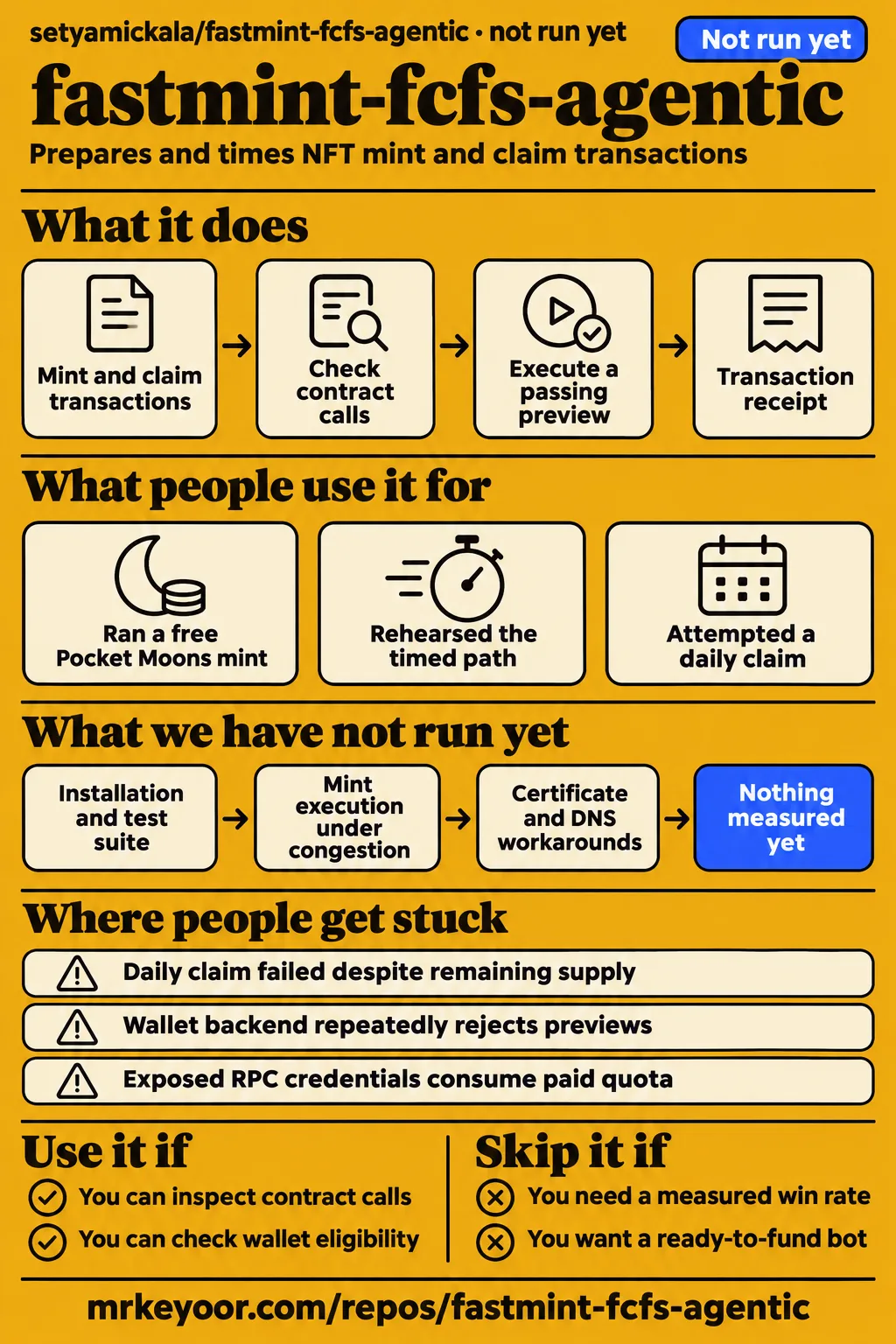
The author reports one free Pocket Moons mint reaching a receipt in 2.0 seconds, but that sale was already open when the trigger fired. That is a useful example of the execution path, not proof of winning a sale at its opening. Use fastmint-fcfs-agentic as a project to study if you already understand Binance Agentic Wallet and can inspect contract calls. Skip it as a ready-to-fund mint bot while the two open credential reports lack a documented upstream resolution. Our lab stopped before execution.
What people use fastmint-fcfs-agentic for
The project author used it for a free NFT mint and timed rehearsals; a separate claim attempt exposed an eligibility requirement that speed couldn't solve. These examples are more useful than treating every item in the author's collection as a result from this repository.
| Who used it | What they did | What happened |
|---|---|---|
| Project author | Ran a free Pocket Moons mint(2) | Reported broadcast at about 1.2 seconds and receipt at 2.0 seconds from the trigger, for an already-open sale in the documented live example. |
| Project author | Rehearsed the timed path | Reported three dry runs with successful previews at T+0.62 to T+0.76 seconds; the later broadcast and inclusion figures were projections in the skill documentation. |
| Author's agent | Attempted a daily claim | Stopped on QuotaExceeded despite remaining supply; the author traced it to missing paid holdings in the claim account. |
| Issue #1 reporter | Read the repository to learn its technique | Reported publicly committed premium RPC credentials in issue #1. |
| Issue #2 reporter | Cleaned a personal fork | Reported removing .env from hotlinebro/fastmint-fcfs-agentic while the original still contained it in issue #2. |
The daily claim is the most instructive example. According to the author, the agent stopped when only 128 of 888 slots were filled. The contract required five paid shares, and the wallet held none. Buying eligibility would have cost 50 USDT, which the user had not approved. The author says subsequent runs checked eligibility getters, the contract functions that reveal requirements and wallet status, before arming the tool. That is an account of the author's workflow, rather than evidence that every possible sale restriction is covered by this repository.
What happened when we ran it
Our November 21, 2026 sandbox assessment at commit 55e744d was NOT RUN: the harness had no supported ecosystem for this JavaScript project, and no Dockerfile was present. The recorded sandbox configuration was 3 CPUs and 8 GB RAM, with no image specified. Those are configuration details, not measured resource use or confirmed runtime versions.
| Check | Recorded outcome | What you can conclude |
|---|---|---|
| Build and test harness | NOT RUN: unsupported ecosystem, JavaScript; no Dockerfile | No installation, build or test result is available. |
| Separate hands-on safety step | FAILED: no compose.yaml, compose.yml, docker-compose.yaml or docker-compose.yml | The lab's rule required a Compose file, so execution stopped at the safety check. |
| Teardown | ok | The teardown entry reports success. |
The detailed safety log says, "unsafe repo: none of compose.yaml, compose.yml, docker-compose.yaml, docker-compose.yml exists (rule: a compose file is required)". Here, "unsafe" is the harness's classification for its missing prerequisite. It is not a finding that the minting code is malicious or that a native Node workflow fails.
A run-summary entry says it was deployed with its own Docker Compose, but the failed prerequisite contradicts that summary. The detailed stopped step and the NOT RUN assessment take precedence. There is no successful deployment or mint from our lab to describe, and no timing to compare with the author's receipt report.
Where people get stuck: eligibility and backend state
QuotaExceeded can mean your wallet lacks required holdings even while claim slots remain, as the author's daily-claim account shows. A website's supply counter cannot answer whether your particular wallet is entitled to claim.
| Symptom | Documented interpretation | Documented action or outcome |
|---|---|---|
| QuotaExceeded with supply left | The author's wallet lacked the required paid shares | Author reports adding eligibility checks; the purchase was not approved. |
| NotStarted keeps returning | Start time may differ from the contract's opening time | Compare the contract getter with the site and review the timeout. |
| Repeated simulation error 351805 | Binance's backend may still see a closed sale, or arguments may be wrong | Before opening this is expected; persistent failures call for inspecting saved preview JSON. |
| SoldOut or FreeGone | The free allocation is gone | Stop rather than silently switching to a paid mint. |
| AgentIdRequired or NotEligible | Wallet identity or eligibility needs attention | The documentation points to the agent-ID argument for the relevant contracts. |
| PaymentLow or WrongValue | Sent value differs from the required price and quantity | Read the price getter and obtain approval for the amount. |
| Execute error or missing receipt | Outcome requires investigation | Read transaction history and transaction locks without automatically executing again. |
Except for the attributed QuotaExceeded story, these are the repository's troubleshooting instructions, not errors reproduced in our lab. They separate a condition worth waiting for from one that should end the attempt. Changing a retry setting won't buy the paid holdings a contract requires.
The author also describes a website whose FAQ and mint counter disagreed with the contract. The recon command reads contract getters and proposes call data, the encoded function and arguments sent to a contract. Its output includes guessed arguments. You still need to decide whether the proposed call describes the mint you authorized, especially when a referral, wallet identity or moving counter changes its meaning.
The timing design starts previews before every signal agrees
Clock, block-head and successful eth_call triggers can each start a wallet preview, according to the skill's execution description. A block head is the latest observed block; eth_call is a simulated contract call that reads its result without sending a transaction.
This addresses a specific delay in the earlier sequential flow: waiting for a public RPC simulation before even asking the wallet backend for a preview. In the parallel design, the first passing preview is executed once and other preview results are ignored. Preview requests have spacing and concurrency limits. After the initial burst, the eth_call trigger continues watching for a late opening rather than keeping every trigger active.
That is a sensible design for this particular wallet interface, which requires a preview request before execution. It also makes the boundary between stages important. A successful public-node simulation, a passing wallet preview, a broadcast transaction and a receipt are different outcomes. ByteSprint's guide explains that transaction inclusion and gas affect the race. An earlier broadcast alone doesn't tell you whose mint succeeds.
Security: the reported leak concerns RPC access
Issue #1 reports exposed RPC credentials, not a leaked wallet private key. The reporter says those credentials can consume the owner's paid quota and impair the endpoint, but cannot move wallet funds by themselves in the security report.
An RPC endpoint is a service used to read chain state and submit requests. Losing control of its paid access is different from exposing the secret that signs wallet transactions. Both deserve attention, but describing this as a stolen-wallet-key incident would misstate the report. The launcher automatically loads a local .env file, so the report also matters to someone copying the project and unknowingly using another person's endpoint.
The wallet protections are separately documented: explicit authorization for a mint, a cap for paid value, refusal to bypass risk blocks, and a lock written before execution. The skill forbids automatic retries after execution, even after an error. If confirmation is pending, the user approves in the Binance app. The agent should not resend.
I would preserve that recovery rule before tuning any speed setting. A missing receipt is a reason to inspect history, not permission for another transaction. The documented dry run stops before execution, and checking its decoded call gives you a chance to catch the wrong function or arguments before approving a live attempt.
English docs exist; macOS certificates and local time need attention
The project provides an English README and a Bahasa Indonesia version, and its skill documentation names both. The repository description and the credential reports use Indonesian, but an English reader can follow the main workflow without translating the whole project.
The README specifies Node.js and Binance Agentic Wallet CLI access, with Developer Mode enabled in the Binance app and an authenticated wallet session. Bare HH:MM start times use WIB, Western Indonesian Time. If you operate elsewhere, the documented Unix timestamp or ISO-8601 forms avoid assuming that a typed clock time follows your computer's local zone.
Certificate handling deserves attention before a timed sale. For UNABLE_TO_GET_ISSUER_CERT_LOCALLY, the docs describe bench --ca on macOS, which builds a certificate bundle from the user's keychains. They also describe certificate-name errors involving an Indonesian ISP's DNS interception and recommend user-configured encrypted DNS or a VPN. That is a location-specific troubleshooting example, not a claim that Binance requests fail on every network. The agent instructions explicitly forbid changing system DNS on the user's behalf.
fastmint-fcfs-agentic vs manual minting, public RPCs and custom tools
The useful comparison is between a prepared Binance wallet workflow and doing more of the transaction work yourself; the author's timing evidence comes from one environment.
| Choice | Reason to choose it | Decision boundary |
|---|---|---|
| fastmint's parallel triggers vs its earlier sequential flow | Start wallet previews without waiting for every preceding signal | The author reports a slower earlier flow; the new live example was an already-open mint. |
| Automation vs manual website minting | Prepare the call and trigger it without clicking through a website at opening | The author describes short windows as the motivation, not a controlled comparison. |
| Public RPCs vs a premium QuikNode endpoint | Choose endpoint access and operating cost deliberately | The author reports latency differences from Indonesia; they are not worldwide provider rankings. |
These tradeoffs come from the author's account and the ByteSprint guide. A premium endpoint does not remove wallet eligibility rules or guarantee favorable block order. Its credentials also need a deliberate sharing policy rather than accidental reuse from a clone.
For a custom implementation, ethers.js provides contract objects from an ABI, the description of a contract's callable interface, and connections to Ethereum-compatible nodes. Choose ethers.js if you want to write and own that application logic. It is a library building block, rather than a ready-made replacement for the timed wallet workflow described here.
Foundry includes Cast for interacting with EVM contracts, sending transactions and reading chain data. Choose Foundry's Cast if your immediate task is direct contract investigation from a terminal. Neither recommendation is a claim that these tools reproduce fastmint's Binance preview rules or its lock behavior.
Outdated claims, corrected
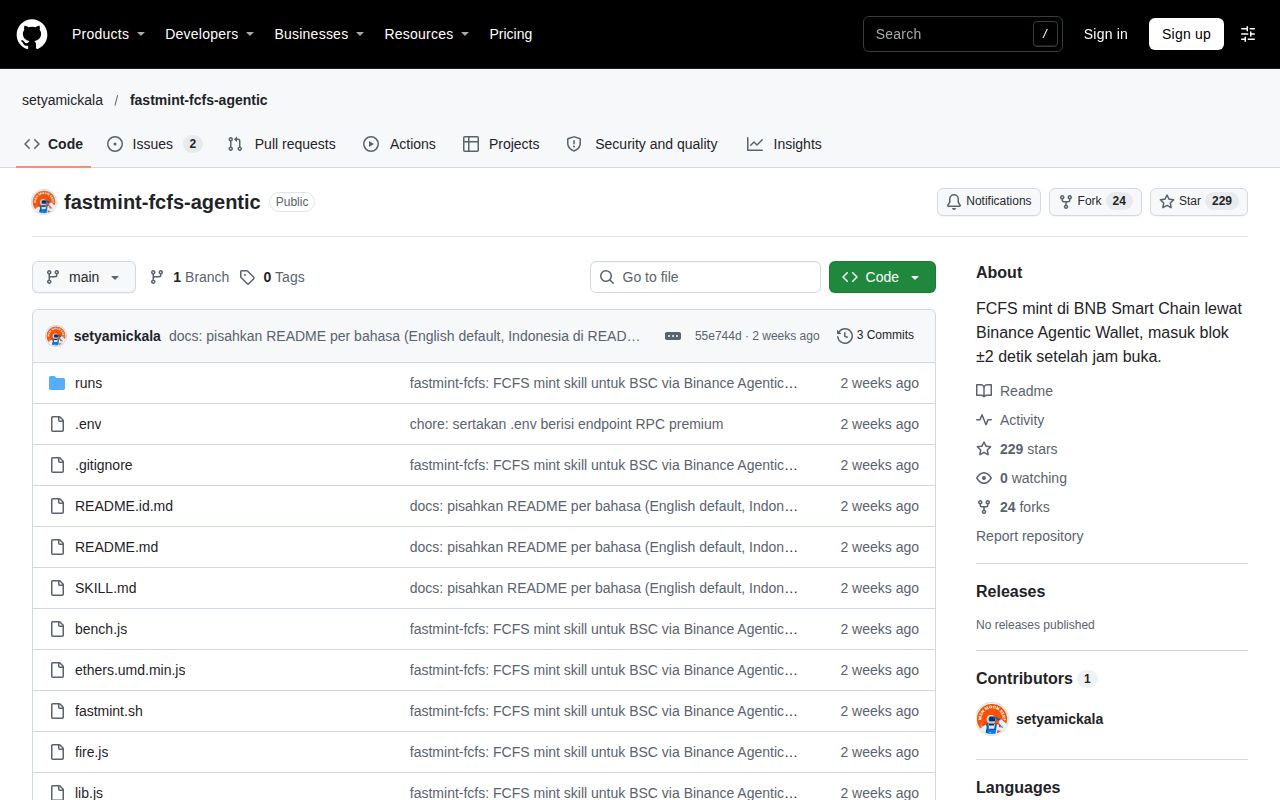
The launcher's statement that .env is git-ignored conflicts with the public-file reports in issues #1 and #2. The launcher comment also says the file is excluded from the zip, but a report about Git history cannot settle what a separate archive contains.
The author's DEV article, "My AI Agent Wins Free NFT Mints on BNB Chain", calls the premium endpoint private and mentions file permissions. The issue #1 reporter describes publicly committed access credentials. Local permissions don't retract a public copy. Issue #2's author says the personal fork was cleaned, not that upstream rotated the key.
The same DEV article says the race is decided by first broadcast. ByteSprint's guide is more careful: transaction order in blocks and gas affect the result. Use receipt evidence when describing a completed mint, and don't turn a broadcast offset into a guaranteed win at sale opening.
The article also describes a mandatory contract-audit layer before arming. The repository skill permits skipping deep risk research unless requested. Recon's extraction and simulation functions are not enough to substantiate every audit step in the author's broader workflow.
Finally, the article says a simulation revert stops the agent. The skill explicitly retries timing-related reverts and simulation failures before execution. Terminal conditions and wallet risk blocks stop it, while retrying a preview is distinct from repeating an executed transaction.
Questions people ask
Deleting .env alone does not revoke an exposed QuikNode credential; issue #2 asks for key rotation as well as Git-history cleanup.
How do I remove the exposed QuikNode credentials, and is deleting .env enough?
The credential owner needs to rotate the QuikNode key, remove the file from Git history and keep local secrets ignored. Those are the remedies requested in issues #1 and #2. If you only maintain a fork, removing your copy doesn't revoke credentials belonging to someone else. Use endpoint access you control rather than assuming a copied token is intended for you.
What is an FCFS mint on BNB Chain?
An FCFS mint allocates limited supply by transaction order: your transaction needs inclusion before the allocation runs out. FCFS means first come, first served. The ByteSprint guide distinguishes clicking or broadcasting from inclusion, which is why a quick local trigger alone can't settle the result.
How can I mint an NFT at sale opening without storing a private key locally?
This tool uses Binance Agentic Wallet's backend for signing, with the agent preparing call data and sending preview and execute requests. The guide describes Developer Mode, app pairing and a wallet session. You are relying on that wallet service and its session controls rather than giving this script a local private key.
Why does my mint transaction revert?
A closed sale, missing eligibility, incorrect value or wrong call data can cause a revert, according to the guide's error explanation. Decode the error against the contract interface before choosing whether to wait or stop. Retrying SoldOut has a different consequence from waiting through NotStarted.
Is it safe to let an agent send mint transactions for me?
The documented safeguards include explicit permission, paid-value caps, passing previews, risk checks and one execution lock. They give you specific behavior to inspect in the skill's safety rules, rather than a blanket safety guarantee. The credential reports and the mismatch between the audit promise and skill instructions are reasons to inspect the workflow before connecting funds.
Why does the mint keep returning NotStarted or simulation error 351805?
NotStarted points to the contract's opening condition; 351805 means the wallet preview simulation failed. The troubleshooting instructions say to compare opening times and inspect preview JSON when public RPC simulation succeeds but Binance's backend keeps refusing. Before the sale opens, a failing preview can be expected behavior.
Why can a mint transaction revert when the contract appears to be open?
An open sale can still reject your wallet or your arguments. The author's QuotaExceeded example had remaining supply but required paid holdings the wallet lacked. Public RPC state can also differ from the wallet backend's state, as the skill's troubleshooting notes explain. A website's "open" label isn't a wallet-specific eligibility result.
What we have not tested yet
No mint, installation or test suite was executed in our sandbox assessment, so this review supplies no independent speed, resource-use or transaction-safety measurement. Actual runtime and operating-system versions require the raw toolchain logs, not an inferred image label.
The author's one live mint and three rehearsals came from one location. Independent replication under congestion, from other locations and on sales opening at a scheduled time is missing. The broader collection described in the DEV article cannot be converted into this repository's success rate. Our review also leaves the proposed certificate and DNS workarounds untested.
The issue threads contain no confirmed upstream credential rotation or Git-history cleanup, and our research did not inspect a distributed zip. We have not established that the repository implements the author's entire claimed audit layer. Those are the facts a follow-up needs to settle before this becomes a recommendation to run with funds rather than an instructive execution design to inspect.