NGINX is best when traffic rules should be explicit
NGINX puts a web server, reverse proxy, load balancer, API gateway, and content cache behind the same directive-based configuration system. That makes it a natural front door for applications: it can serve static files, terminate TLS, forward requests to several backends, limit request rates, and cache selected responses. The master process reads configuration and manages one or more workers, so operators can apply changes through controlled reloads instead of replacing the whole service.
The appeal is control, not discovery magic. A configuration names listeners, upstreams, locations, headers, cache zones, and failure behavior. That model suits stable infrastructure and teams that want every routing rule reviewed in source control. It is less pleasant when hundreds of short-lived services should announce themselves automatically. In that setting, an orchestrator-aware proxy or a configuration generator may remove routine work.
Modules decide which directives exist
NGINX features arrive through modules, and the installed binary determines which directives are available. Static modules are selected when the binary is compiled. Dynamic modules can be loaded afterward, provided they match the installation. Running nginx -V shows the compile-time choices, which is often the first useful diagnostic when a copied configuration contains an unknown directive.
That boundary matters more than the friendly package install suggests. The README names GCC, make, PCRE, and zlib development libraries for a minimal Debian or Ubuntu source build. TLS adds the OpenSSL development library, and optional modules may add their own dependencies. A team compiling custom binaries must track those choices across upgrades. Package users trade some module freedom for a repeatable build supplied through a distribution or the official NGINX repository.
Shared memory is another operational detail that surfaces quickly. Rate limiting and several cross-worker features need named zones because worker processes do not keep one ordinary shared heap. A configuration can parse correctly yet behave poorly if a zone is undersized or its key is wrong. The directive reference is where the precise semantics live; the repository README is an introduction, not a substitute for it.
What happened when we ran it
We did not run nginx at commit 8fa349c in our 3-CPU, 8 GB sandbox. The lab does not have a supported harness for C projects, and this repository has no Dockerfile that could provide a project-defined route. That means we have no first-party install time, build result, test result, package count, or vulnerability audit for this checkout.
This gap should change how you read the setup score. It does not show that nginx failed to compile, and it does not show that the documented commands work in a fresh Debian container. The README's source route starts with system packages, then auto/configure, make, and an optional privileged install into /usr/local/nginx/. Our lab did not execute any of those steps, so we will not turn documentation into a measured claim.
For most users, the sensible evaluation starts with an official package on a disposable host. Record nginx -V, keep the complete configuration, run nginx -t before each reload, and send a real request through every important path. Source compilation is justified when a required module or build option is unavailable from packages, not merely because the repository is easy to clone.
The Windows build is not a production choice
The README explicitly calls NGINX for Windows a proof of concept for development and testing. That is a clear stop sign for a Windows-only production plan. Run the Linux build in a supported virtual machine or container host, or choose a server whose Windows port is treated as a production target.
Dynamic infrastructure creates a different mismatch. NGINX Open Source can proxy to changing backends, but its core workflow is still configuration plus validation and reload. Traefik reads routing intent from supported infrastructure providers, while Caddy makes automatic HTTPS part of the default experience. NGINX can achieve precise outcomes, though the operator owns more of the glue.
There are also feature boundaries hidden behind familiar names. Open issue #761 asks for OpenSSL 3 provider support because the Engine API is deprecated. That is specific enough to matter for organizations standardizing on provider-based cryptographic integrations. Issue #765 requests millisecond timestamps in error logs, another reminder that long-established software can retain small operational gaps that newer systems treat as defaults.
Current releases and issue work show active maintenance
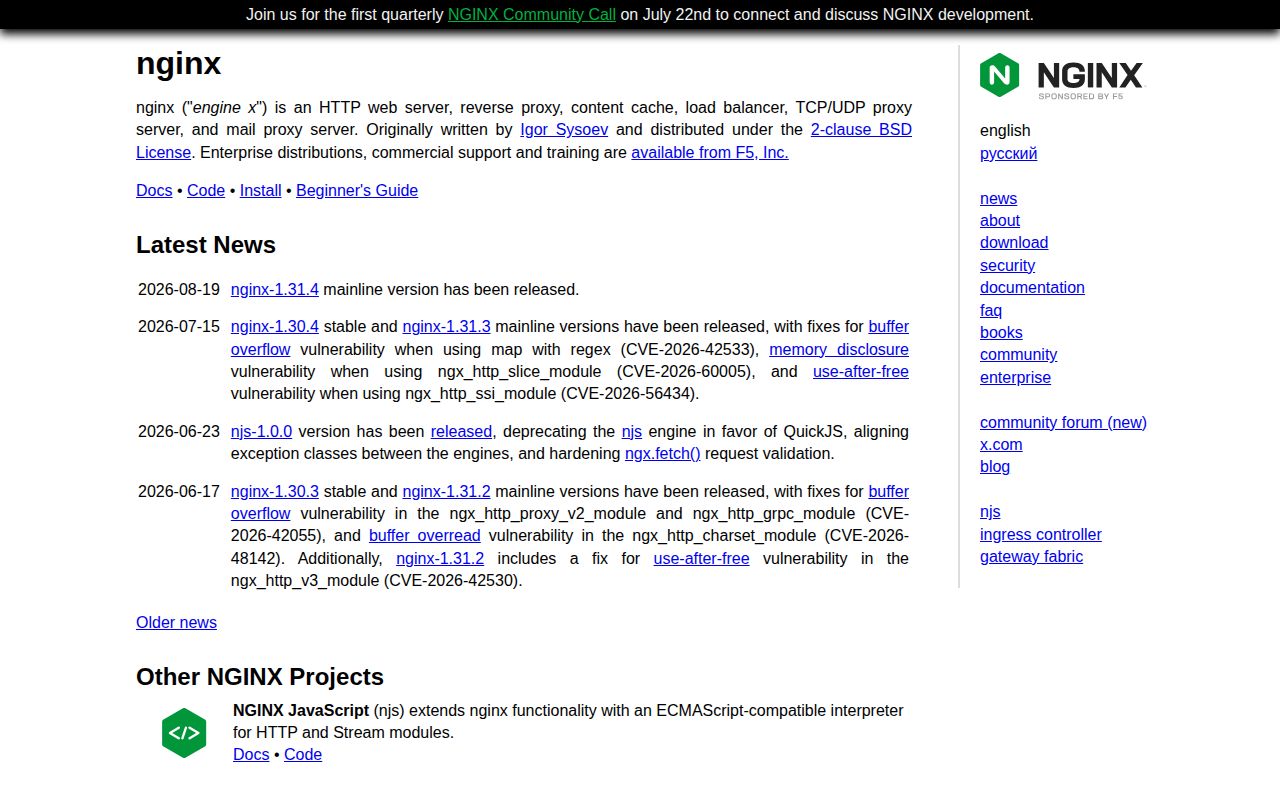
The repository was pushed on 2026-08-26, and release 1.31.4 arrived on 2026-08-19. Its release notes include fixes across HTTP and gRPC upstream handling, QUIC flow control, chunked parsing, event descriptors, and several modules. The listed 466 open items combine issues and pull requests, so that number is a work queue rather than a defect count. Recent updates include both bug analysis and active code proposals.
Documentation is split sensibly. The README explains the process model, package and source installation, common roles, and the build sequence. The nginx.org manual carries the directive reference, build switches, debugging guide, and beginner material. This division works once you know it exists, but a novice who stops at a copied server block will miss the constraints attached to individual directives.
NGINX is still the conservative pick for an explicit Linux edge layer. Its configuration demands care, module choices affect portability, and our sandbox provides no build evidence for commit 8fa349c. If your team already tests configuration changes and wants exact traffic behavior, those costs are manageable. If nobody wants to own certificates, reloads, and generated routes, pick a proxy designed around that operating model.