In the MongoDB Agent file at Zie619/n8n-workflows commit 94007c1, OpenAI Chat Model has the stored type n8n-nodes-base.noOp. A familiar node label is therefore insufficient evidence that this downloaded graph contains a working model step.
What the catalog provides
The README describes a Python application using FastAPI and SQLite FTS5 to search and download workflow JSON files. It documents full-text search and filters for category, complexity, and trigger type, plus a hosted browsing route.
This collection suits developers who want examples to inspect and adapt. Beginners expecting a working AI automation immediately after download should choose an example whose nodes and configuration they can verify. The catalog and the n8n runtime have separate jobs: finding a file does not establish that its graph will execute correctly.
What happened when we ran it
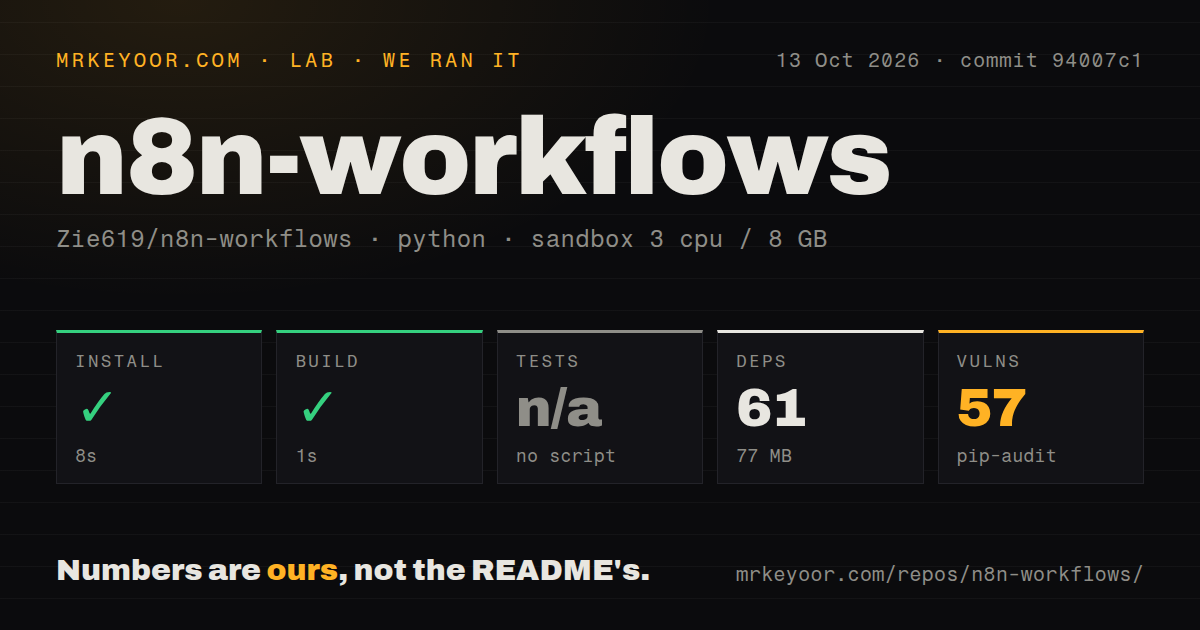
Our October 13, 2026 sandbox run checked commit 94007c1. Installation succeeded in 8 seconds, with 61 dependencies recorded and 77 MB on disk. The build succeeded in 1 second.
The sandbox had 3 CPUs and 8 GB RAM. Its recorded image was ghcr.io/astral-sh/uv:python3.12-bookworm; that label alone does not verify the interpreter or operating-system versions.
There was no test script or target, so tests were skipped. The checkout contained 2,178 files, about 10,761 lines of source, and occupied 41.9 MB. It had 5 CI workflow files, a Dockerfile, and a compose file, but no tests directory. These packaging files do not substitute for a test result.
Pip-audit reported 57 known vulnerabilities across 6 packages in the installed environment. The supplied summary does not identify affected packages, severities, or reachable attack paths. It supports reviewing the dependency advisories before deployment; it does not establish that a particular endpoint is exploitable. The run contains no workflow import or execution result.
The checked AI example needs inspection
Issue 200 reports AI-labeled nodes stored as noOp types and connection targets that do not resolve. The reporter says the analysis was pinned to 94007c1. Its suggested explanation for the conversion remains unconfirmed.
The supplied MongoDB Agent file at 94007c1 confirms that OpenAI Chat Model, Window Buffer Memory, and AI Agent - Movie Recommendation all have the type n8n-nodes-base.noOp. This is a direct mismatch between their names and stored types. Changing a label alone would leave that mismatch unresolved.
The issue remains open, and a September 12 comment reports an independent reproduction. Those are attributed reports about the wider collection. Our supplied file inspection supports the narrower finding about this named example; it does not reproduce the collection-wide analysis. No import of this file into n8n was recorded.
Before using a selected workflow, inspect its actual node types, trace connections, and review credential references. Evaluate it in a disposable n8n instance with test accounts and synthetic inputs, then check the resulting actions. These are recommended next steps, not tests completed for this review.
The README security assurance is dated
Under its November 2025 updates, the README says: "Full security audit completed, all CVEs resolved". Our October 2026 environment produced 57 known vulnerability findings. The dates and environments differ, so the older assurance cannot establish the current dependency state.
Obtain the advisory details and review dependency changes before exposing a self-hosted catalog. Keep production integration credentials in the automation environment rather than supplying them to a search service. The README also links hosted browsing for readers who want discovery without maintaining the Python catalog; that route was not tested in the supplied run.
September issue activity leaves repair status uncertain
Supplied repository metadata records the last push on June 24, 2026. Issue 200 was opened on September 4 and received a reproduction comment on September 12. This documents issue activity after the last recorded push. It does not establish a repair or justify declaring the project abandoned.
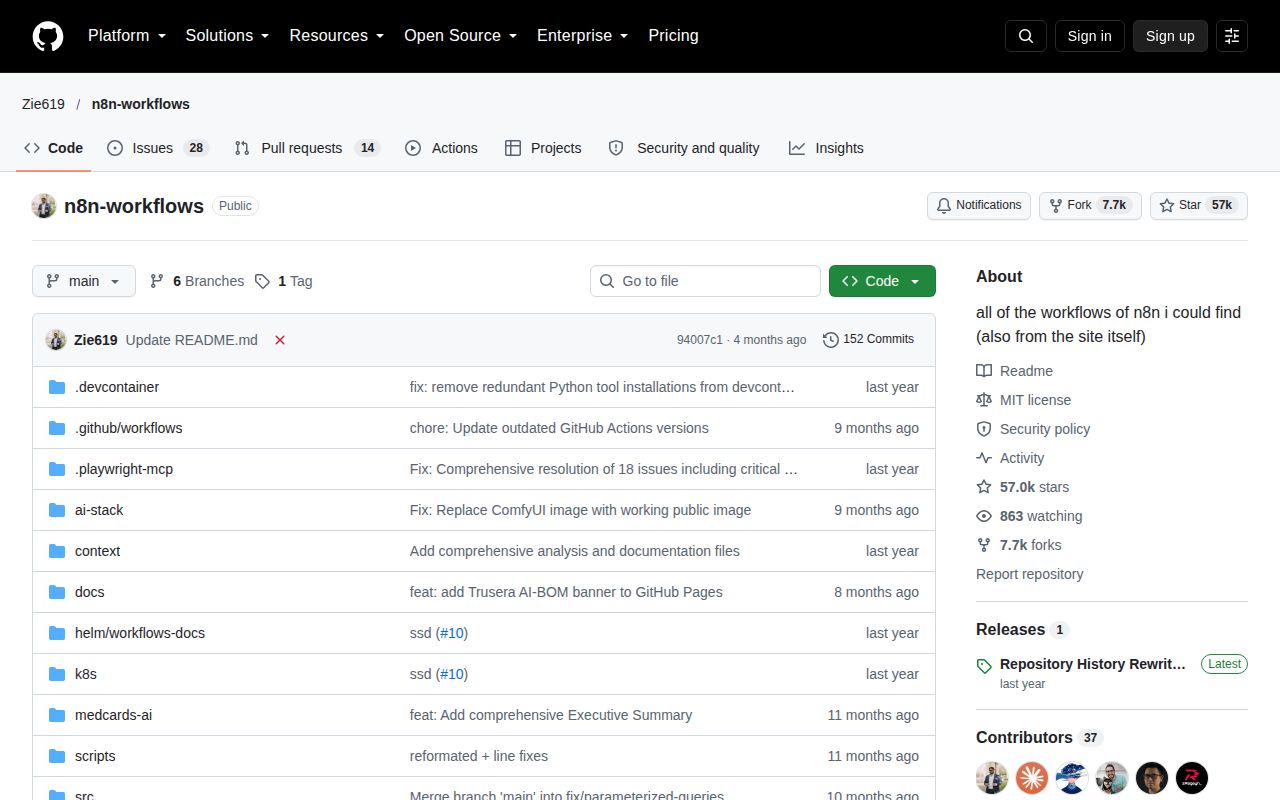
The latest supplied release, dated August 14, 2025, is a DMCA history-rewrite notice. It says existing forks and clones are out of sync and instructs local users to re-clone or force-reset. That notice explains the release tag; it provides no validation of the remaining workflows.
Choose a runtime when you need execution
n8n combines a visual canvas with custom code to build and deploy workflows. Choose it when you need the editor and runtime for an n8n graph.
Activepieces is another automation builder. Its integration pieces are npm packages written in TypeScript. Consider it when choosing an automation platform without a requirement to reuse n8n JSON. Neither alternative received a lab performance comparison here.
How to read the ratings
The ratings assess this collection for discovering and adapting examples. On the five-point editorial scale, 1 means unsuitable for that job, 2 means substantial documented limitations, 3 means usable with material caveats, 4 means favorable evidence within a narrow assessed scope, and 5 requires strong evidence across the stated scope. These are judgments, not benchmark results.
Setup receives 4 for the successful catalog installation and build, with import and execution outside the assessed scope. Documentation receives 2 because it explains startup and search but includes a security assurance that cannot describe the measured dependency state. Maturity receives 2 because tests were skipped and the pinned example contains the confirmed node-type mismatch. Community remains unassessed: issue activity alone cannot establish support quality or response times.
Use the collection when you can explain and verify the graph you select. If you cannot review its nodes and connections, start with a smaller example you can understand before adding credentials.