The 51-file repository runs one prompted analysis cycle
AutoHedge is small enough to understand in an afternoon: our checkout contained 51 files and about 2,383 lines of source. A director agent hands a prompt to sentiment, quantitative, risk, and execution agents. The result is conversation output that includes a thesis, scores, risk language, and a proposed order. That can be useful for studying agent handoffs or drafting an analyst brief. It does not by itself establish that the analysis is correct, that prices are current, or that an order reached an exchange.
The main AutoHedge.run() method executes one task and returns the conversation. Its command-line entry point is a REPL with a while True input loop, so a person submits each job. There is no documented scheduler, service unit, or continuous portfolio loop in the 51-file tree. The README calls the product an autonomous hedge fund with full Solana trading, but the default path we inspected behaves as an interactive AI market-research program. That gap changes the product from deployable trader to source material.
Five agent roles do not produce an on-chain order
The source defines 5 agent roles when the director is counted alongside sentiment, quant, risk, and execution. The execution agent receives a prompt asking for order type, quantity, prices, stop loss, profit target, and time in force. It has no tool list. In current code, only the sentiment agent receives a callable tool, Exa search. The execution result is therefore model-written text in the default flow, even though separate Jupiter functions can request, sign, and submit a Solana swap.
Open issue 42 documents the same disconnect against package 0.1.6. The reporter found the Jupiter functions in the registry but could not trigger them through the normal CLI, and found no unattended mode. The issue was opened July 6, 2026, with a detailed reproduction and had 0 maintainer replies when fetched. We also checked the current workers and CLI instead of treating that report as proof on its own. The files still support its central observations.
What happened when we ran it
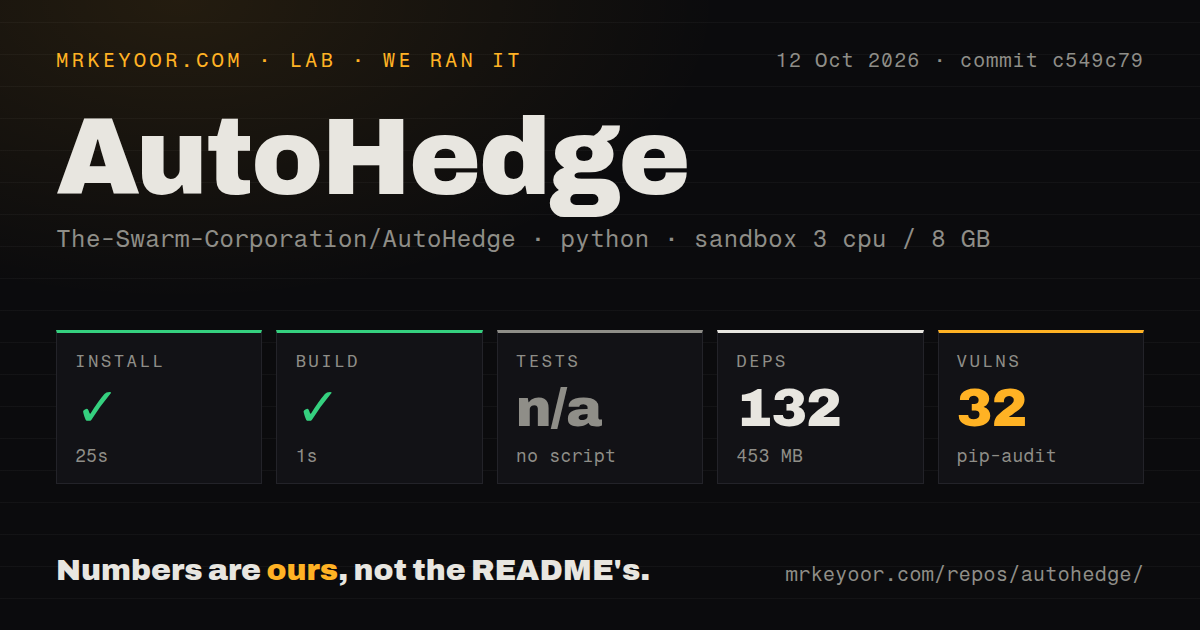
Our sandbox installed commit c549c79 in 90 seconds. The environment gained 130 packages and occupied 447 MB, a large dependency footprint beside roughly 2,383 lines of project source. The build completed successfully in 10 seconds. Those results show that the package can be resolved and built in a fresh Python 3.12 Debian container without privileged access or supplied secrets. They do not show that an agent produced sound advice or submitted a trade.
No tests script or target was available, so our harness skipped tests. The repository also had no tests directory. Pip-audit reported 12 known vulnerabilities in the installed dependency set. We are not assigning severity or exploitability because the supplied measurement gives only the count. For software that can load a wallet signing key and send transactions, the missing behavioral suite matters more than the successful 10-second build. A compiler check cannot prove position limits, approval rules, or correct transaction assembly.
Two wallet variable names can stop signing before it starts
AutoHedge's setup spans at least 4 external services or secrets in the current path. The agents use OpenAI model names, sentiment search reads EXA_API_KEY, Jupiter requests may use JUPITER_API_KEY, and signing reads SOLANA_PRIVATE_KEY. Yet both the README and .env.example show WALLET_PRIVATE_KEY, while Exa is absent from that example. Anthropic appears in the sample despite the checked-in workers naming OpenAI models. A copied configuration can therefore look complete and still fail during research or signing.
This is financial code, so correcting the variable name is only the first step. A safe integration needs a disposable wallet, restricted funds, allowed token pairs, maximum order size, slippage rules, a kill switch, and an approval step before signing. None of those controls is documented in the quick start. The Jupiter helper directly reconstructs a transaction, signs it with the loaded key, and posts it to the execution endpoint. Connecting that function to an LLM agent without a deterministic policy layer would be reckless.
Eighteen workflows do not replace a product test suite
Our scan found 18 CI workflow files but no Dockerfile and no tests directory. Several workflow names mention tests, quality, linting, Ruff, and PyLint, yet the checkout exposed no test command to our harness. The pyproject also uses wildcard runtime dependencies for packages including Swarms, Pydantic, and HTTPX, with no lock file in the 51-file tree. That leaves a future installation open to dependency changes even if the project source stays on the same commit.
The README is only about 4 KB and gives one installation command, one executable name, a small environment example, and a four-box architecture diagram. It does not explain a dry run, devnet, transaction confirmation, failure recovery, portfolio state, or continuous service operation. Issue 42 asks for exactly those missing instructions. Until code and documentation meet there, AutoHedge should be evaluated as a short agent example whose repository happens to contain live swap helpers.
The May 11 push and 12 advisories argue for waiting
GitHub recorded the last code push on May 11, 2026, while issue activity continued into July and September. The repository had 4,551 stars and 17 combined issues and pull requests when fetched, but no GitHub release was available through the latest-release endpoint. Stars show attention, not operational readiness. The detailed July report about autonomous execution remained open with 0 replies, and later pull requests had not changed the default branch we reviewed.
Our 90-second install and 10-second build make AutoHedge easy to inspect, but the 12 known vulnerabilities, absent test target, configuration mismatch, and disconnected execution tools make the decision easy too. Use it to learn how its agents are arranged, or fork it for a tightly controlled prototype. Do not fund its wallet on the strength of the README. A serious trial starts only after deterministic safeguards and a reproducible end-to-end test exist.