You still review the CV and submit the application
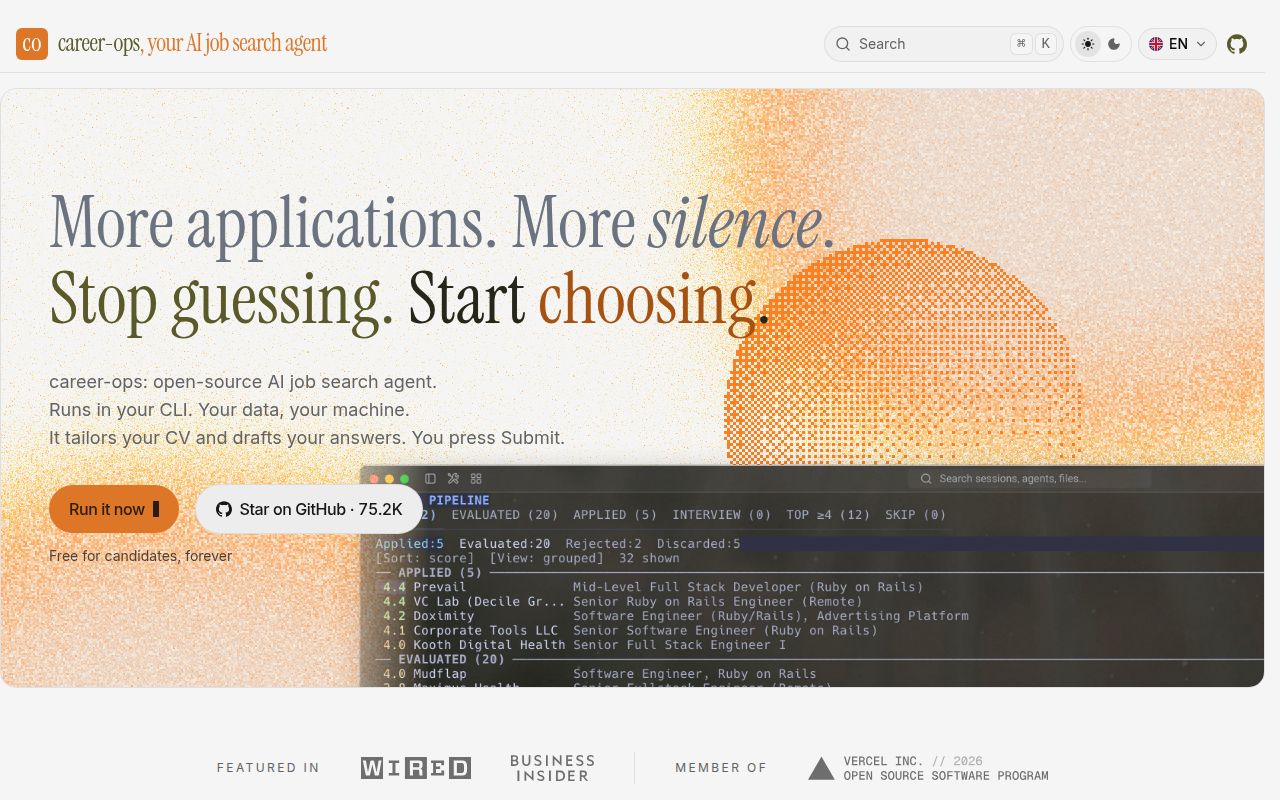
Career Ops stops short of the action that matters most: sending an application under your name. It evaluates a posting against your CV, prepares tailored documents, and records the opportunity in a local tracker. You review the result and press Submit. That boundary makes it interesting for someone whose job search has become repetitive administration, provided they still want to read every claim an AI writes about their experience.
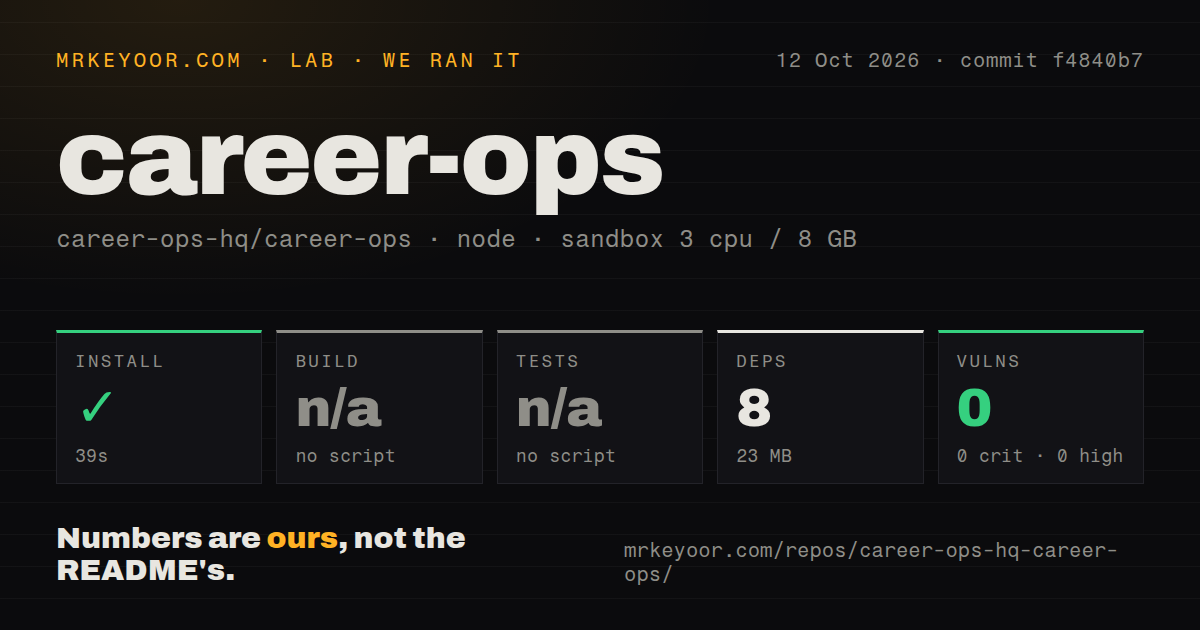
Our measured npm installation added 8 packages and used 23 MB. The modest footprint makes a local trial approachable, but the product also depends on the AI CLI you bring to it. Its skills and prompt files coordinate the work through that separate tool. Don't confuse a small Node environment with an entire job-search assistant running independently. Model access, personal source material, and browser support for PDFs remain part of the setup.
What happened when we ran it
Our sandbox installed Career Ops commit f4840b7 in 39 seconds on October 12, 2026. The fresh Debian container had 3 CPUs and 8 GB of RAM, ran image lab-node:22, and had neither secrets nor elevated privileges. Installation succeeded with 8 packages and 23 MB on disk. The checkout contained 2,104 files, roughly 354,191 source lines, and occupied 59.7 MB before installation.
The harness found no build script or target and no tests script or target, so it skipped both steps. It did find a tests directory and 27 CI workflow files, plus a Dockerfile and compose file. Those signals describe repository contents, not checks that passed in our container. The run establishes that the npm installation completed. It supplies no successful build or test result to cite, and no measured evidence about the quality of a tailored CV.
Npm audit reported 0 known vulnerabilities across all severity levels. That is useful within the installed dependency tree, but it doesn't assess whether a model invents a qualification or whether a job posting is still accepting applications. Neither the audit nor the 39-second installation measures employment outcomes. A recommendation about using Career Ops therefore has to rest on its workflow boundaries as well as these limited mechanical checks.
The AI CLI and Chromium sit outside the small npm result
The budget guide describes hosted providers and local model routes, including Ollama. Your chosen CLI needs working model access through its supported configuration. A hosted provider receives the material you send it, including CV content. Local storage alone doesn't mean offline processing. If keeping that material off an external service is a requirement, choose and configure the local model path deliberately.
The 23 MB measured environment also isn't a browser readiness check. The setup guide separately calls for Playwright Chromium when generating PDFs and points Linux users toward platform libraries when browser launch fails. You supply cv.md, a profile, and a portal list, either through the guided conversation or the manual files. That's reasonable for a developer already comfortable with an AI terminal tool. It is more involved than opening a hosted resume editor.
A fact check cannot approve every sentence of your CV
The README says PDF generation can reject numbers or facts absent from the candidate's source material. It also acknowledges that the check cannot judge every rewording, and documents a bypass flag. I would keep the original CV beside each tailored version and compare responsibilities as carefully as numerical claims. A sentence can overstate your experience without introducing a new number. The final review needs someone who knows what actually happened at the job.
The 0-known-vulnerability audit result cannot settle that content problem. Issue 1411, still open, proposes a broader CV faithfulness check that rejects unsupported changes. Its older description predates the partial checking now described in the README. Separately, the README still calls issue 2677 open, although GitHub marks that CV-title issue closed on October 1. Closure alone doesn't prove every wording concern is solved. The mismatch also lowers my confidence in the FAQ's status tracking.
The terminal workflow is the safer starting point
The web interface guide labels it experimental, alpha, and opt-in. Its main dashboard is a terminal interface, while application records and reports live in local files. Choose this because you want that working style. If you need an established browser application for nontechnical users, the alpha label is a direct reason to walk away. The repository's 27 CI workflow files don't change the documented status of the web interface.
Reactive Resume and OpenResume are more focused choices when the actual job is editing a resume or parsing an existing one. They don't need to replace Career Ops's entire search workflow to be better for that narrower task. If you're already choosing roles thoughtfully and only dislike formatting documents, adopting an agent, profile files, and a portal scanner adds work you may never recover.
October maintenance is active, while our runtime evidence stays limited
The last push was October 16, 2026. GitHub recorded 75,251 stars and 347 open issues and PRs, and recent proposals addressed profile-path handling in the core and web interface. Release career-ops-v1.37.0 shipped that day with tracker liveness checks and reporting changes. Those dates and specific repairs show active maintenance. The release is newer than our measured checkout, so its notes cannot turn our skipped steps into passing checks.
Career Ops is worth a bounded trial if you already use an AI CLI and will inspect every document before sending it. Our 39-second install makes that trial easy to begin. Start with a posting you understand and compare its evaluation against your own reasons for applying. If checking the tailored CV takes longer than writing the relevant changes yourself, keep the tracker and leave the drafting to your own hands.