The 1.27-million-line checkout spans Mojo 1.1 and MAX 26.6
At 1,277,082 lines in our measured commit, Modular puts a language, compiler, standard library, accelerator code, model graphs, and an inference server in one repository. The current README points to the Mojo compiler under Mojo, MAX kernels under max/kernels, Python pipelines under max/python/max/pipelines, and MAX Serve with an OpenAI-compatible endpoint. That range is useful when a team wants to follow a model operation from Python into lower-level code. It also means that "trying Modular" is too vague to be a useful engineering task.
The size makes that distinction concrete. commit f23fc09 occupied 226.1 MB before installation and contained 11,111 files, about 1,277,082 lines of source. Pick one path first: learn Mojo, port a model, write a kernel, or evaluate the server. Each path has a different setup and a different definition of success. A quick repository build says little about whether your model produces correct output on the accelerator you plan to use.
What happened when we ran it
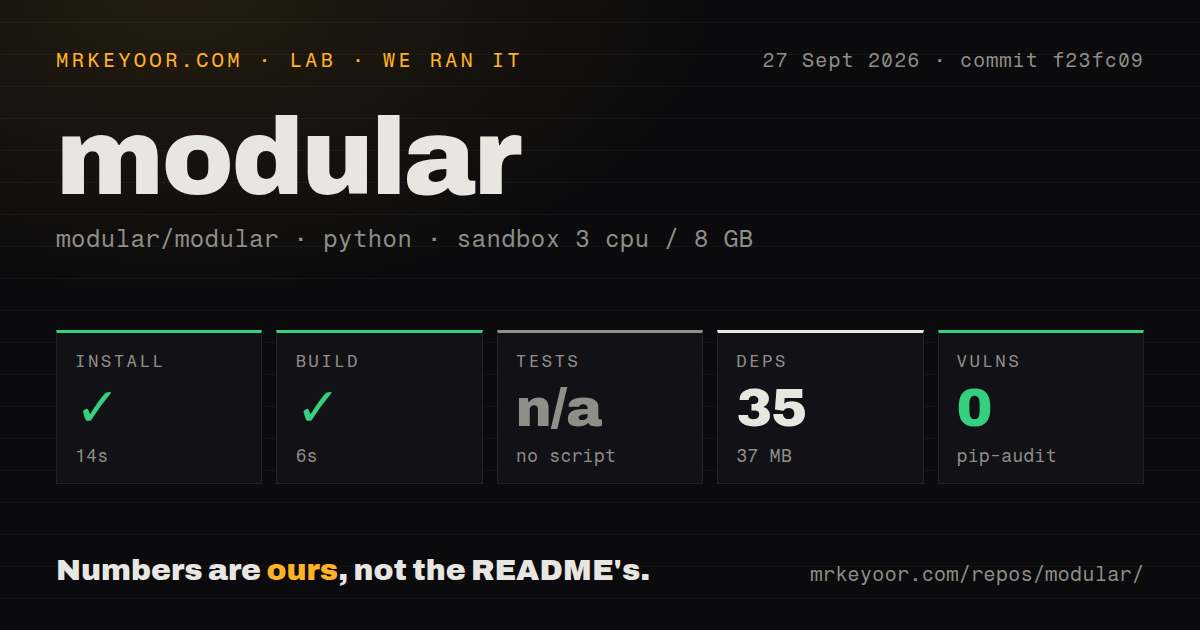
We cloned and ran commit f23fc09 in a fresh Debian sandbox with Python 3.12, 3 CPUs, 8 GB of RAM, no secrets, and no elevated privileges. Installation finished in 14 seconds. Installation added 35 packages and consumed 37 MB on disk. The available build then completed successfully in 6 seconds. Pip-audit found 0 known vulnerabilities in that installed Python environment.
No test script or target was available to the lab, so tests were skipped. The repository scan found 6 CI workflow files, no Dockerfile, and no tests directory. Those signals do not prove that Modular lacks tests. Component contribution guides refer to focused Bazel checks. They do mean that a fresh general-purpose checkout did not expose one repository-wide test command our runner could execute. We measured package and build readiness, not model quality, inference speed, or numerical accuracy.
A 6-second build did not run a model or exercise a GPU
Our 6-second build did not start MAX Serve or exercise a GPU. The current quickstart recommends an NVIDIA B200, H200, or H100 for representative performance and offers Pixi and uv installation paths. Serving a model adds weights, a supported hardware target, and any model-specific license or access step. Mojo's quickstart has its own installation route and system requirements. A developer can get started without understanding all 1.27 million lines, but production evaluation still belongs on the hardware and model family that will carry the workload.
The same run did not download model weights or compile every Mojo library. It also did not measure throughput or compare outputs with a reference implementation. Treat the 14-second install and 6-second build as an entry check. For a model port, compare full graph outputs across representative shapes and data types. For serving, measure cold starts, memory use, and request behavior under your own traffic.
Mojo 1.1 still asks users to follow language changes
The September 17 release paired MAX 26.6 with Mojo 1.1.0. It marked types including String, SIMD, and List as stable, while removing deprecated items such as the fn and alias keywords plus older compile-time loop and conditional syntax. The release also says the move from legacy closures to unified closures is still underway. A 1.x version gives some APIs firmer ground, though it does not freeze every language and library surface.
That matters for code intended to live longer than one experiment. Pin the toolchain, read the Mojo release notes before an upgrade, and budget time for compiler-driven migrations. Open issue #7238 gives a more specific warning for Apple GPU work: its reporter reproduced a Metal linker crash on Mojo 1.1.0 and MAX 26.6.0 where changing one struct field altered whether a kernel linked. One report does not prove that all Metal kernels fail. It still justifies a representative compile suite.
The repository and MAX runtime have different license terms
The README says repository code and contributions use Apache License 2.0 with LLVM Exceptions. It separately places MAX usage and distribution under the Modular Community License and tells users to check licenses for downloaded third-party software and models. GitHub reports NOASSERTION in its license field, which is understandable when one repository points readers to more than one set of terms.
Map the exact pieces you plan to ship before treating "open source" as a deployment answer. A team editing the Mojo standard library does not necessarily have the same obligations as one packaging the MAX runtime and third-party weights. This is legal and procurement work, not a reason to reject the project outright. It is a reason to avoid copying an Apache label from the repository header onto the entire deployed system.
An October 4 push shows activity, along with a crowded queue
GitHub showed 29,927 stars when checked, with 891 open issues and 284 open pull requests. The last push was October 4, 2026, and the latest release arrived September 17. Those dates show active work. They also describe a young language and AI platform carrying compiler, standard-library, GPU, model, and documentation reports in one tracker. Search by component and version before assuming an old report applies to your path.
Contribution guidance deserves the same care. The MAX 26.6 release says Modular began accepting Mojo compiler contributions, while the README fetched on October 5 still says compiler contributions are not accepted yet. The contributor guide asks developers to open an issue before any substantial change and uses roughly 100 lines as one boundary for early discussion. Ask first. On a repository this large, that small conversation can save a week spent on the wrong side of an ownership line.