
PyTorch 2.14.1 keeps tensor work inside ordinary Python
PyTorch 2.14.1 combines NumPy-like tensors, reverse-mode automatic differentiation, neural-network modules, data utilities, multiprocessing, and native acceleration. A line of eager Python runs when you write it, so you can inspect a value or follow a familiar stack trace while changing a model. That directness is the main reason to choose PyTorch when experimentation still involves frequent changes to control flow, tensor shapes, or custom layers.
The same package reaches far beyond a research notebook. PyTorch tensors can run on CPUs or GPUs, and its extension API lets developers add C or C++ operations. The README documents NVIDIA CUDA, AMD ROCm, Intel GPU, and CPU builds, while the surrounding documentation covers tutorials and the API. This breadth is useful, but it also means the repository is a native systems project wearing a familiar Python interface.
A source checkout starts at 2,431.3 MB
Our commit c7a1a0c checkout occupied 2,431.3 MB before installation. It held 142,243 files and about 25,138,101 lines of source, plus 156 CI workflow files, a Dockerfile, and a tests directory. Those figures change the meaning of "install from source." You are taking on compiled backends, vendored components, hardware integrations, build scripts, and a test estate that cannot be treated like a small Python package.
The README asks source builders for Python 3.10 or later, a compiler with full C++20 support, GCC 11.3 or newer on Linux, and at least 10 GB of free disk. It estimates 30 to 60 minutes for an initial build. A virtual environment is allowed, but the page warns that CUDA, MKL, and other dependencies may need system-level installation. GPU work then adds a driver, toolkit, and compatible compiler.
What happened when we ran it
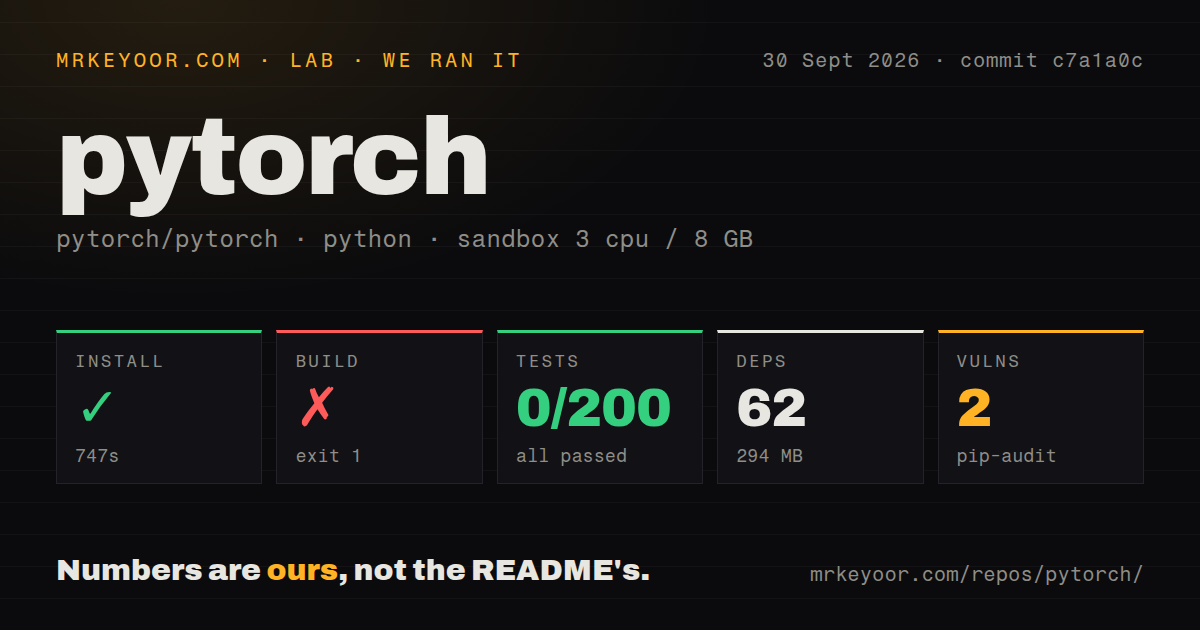
Our sandbox installed the repository in 747 seconds. The environment gained 62 packages and occupied another 294 MB on disk. This was a fresh Debian container with 3 CPUs, 8 GB of RAM, Python 3.12, no secrets, and no elevated privileges. Installation completed, which shows that the Python dependency step worked for this commit. It does not show that the native framework compiled.
The build exited 1 after 93 seconds. Its last lines were SyntaxWarning messages about invalid escape sequences in vendored TensorPipe copies of GoogleTest, libuv, and pybind11 files. The log tail does not contain the decisive error, so those warnings are evidence from the failure, not an explanation for it. The defensible finding is that commit c7a1a0c did not finish its build in our container.
Pytest then exited 1 after 15 seconds, before running a test. It reported 200 collection/setup errors, 0 passed, and 0 failed, then stopped at the 200-error limit. The visible tail names distributed-checkpoint modules covering save and load, fine-tuning, FSDP, and asynchronous execution. It does not show the underlying exception. Pip-audit separately found 2 known vulnerabilities, without package names or severities in the supplied measurement.
Official binaries avoid a 142,243-file source build
The failed source run does not show that PyTorch's released wheels are broken. The README sends ordinary users to a binary selector, and that is the right starting point. A pinned wheel avoids compiling the 142,243-file tree, though you still need to match the package flavor to the target CPU or accelerator. Teams should test their actual operators, precision choices, and device fallbacks on the hardware they will ship.
Containers reduce packaging work without flattening the hardware differences. PyTorch's prebuilt image expects Docker 23.0 or newer. The README also warns that multiprocessing and multithreaded data loaders can outgrow Docker's default shared-memory segment, recommending host IPC or a larger allocation. For source work, CMake variables pass through environment settings, and cached values can persist after those settings change. A stale cache can therefore preserve an old build choice until you edit it or remove the cache file.
Version 2.14.1 shipped while 14,039 issues remained open
GitHub showed 14,039 open issues and 3,563 open pull requests on October 6, 2026. The repository was pushed the same day, and release v2.14.1 had arrived on September 30. Its notes focus on regressions and silent correctness problems, including fixes for complex linear algebra on Apple hardware and a CUDA binary update. That combination points to active maintenance on a very large compatibility surface, not a quiet or abandoned project.
A queue this large needs careful interpretation. GitHub's repository summary combines issues and pull requests, so it should not be read as a defect count. Same-day work covered distributed tensors, CUDA, test infrastructure, compiler paths, and profiling. For adopters, the practical lesson is to pin releases and read the notes for the devices and operations they use. For contributors, targeted tests and the project's CI dashboard matter more than attempting the whole tree in a generic container.
A 747-second install makes the alternative depend on your stack
Our 747-second install is a reason to compare operating models, not a reason to assume another framework is a drop-in replacement. JAX is the sharper option for NumPy-shaped programs built around transformations and compilation. TensorFlow fits organizations already committed to its training or deployment formats. Tinygrad is easier to read when the goal is learning how tensor and gradient machinery works. Model compatibility, accelerator support, and existing team knowledge will usually decide among them.
PyTorch earns a recommendation for application teams that already need its ecosystem, but through official binaries and a hardware-specific test suite. The source repository is a different commitment. Our build failed after 93 seconds, test collection stopped at 200 errors, and the checkout already consumed 2,431.3 MB. Start from source only when you need to modify PyTorch itself, and reproduce the project's documented native environment before judging a change.