One engine reaches native GPUs, WebGPU, iOS, and Android
MLC LLM is for a harder job than running a model on one Linux server. Its engine targets CUDA, ROCm, Vulkan, Metal, WebGPU, WebAssembly, and mobile OpenCL. The same project exposes chat through Python, a REST server, JavaScript, Swift, and Android bindings. That breadth is the reason to consider it, and it is also the source of most of the setup work.
The quick start shows an int4 Llama 3 8B model and recommends at least 6 GB of free VRAM. A local REST command exposes an OpenAI-compatible chat endpoint on port 8000. Browser deployment goes through the related WebLLM project, while iOS and Android package compiled model libraries with their native apps. You are choosing a deployment system, not a drop-in Python wrapper.
The 469.8 MB checkout signals compiler-scale ownership
Our commit af58bcb checkout contained 23,907 files and roughly 3,310,338 lines of source before installation. It occupied 469.8 MB. Much of that scope comes from the included TVM tree and platform code. A team adopting the repository should decide whether it will consume prebuilt wheels, compile the runtime, compile model libraries, or maintain mobile packages. Those are different operating paths.
The docs recommend isolated Conda environments and Python 3.13. Source compilation calls for CMake 3.24 or newer, Git, Rust and Cargo, plus CUDA, Metal, or Vulkan. Linux instructions also call out Git LFS and possible C++ runtime packages. The prebuilt route uses nightly wheel indexes split across CPU, CUDA 12.8, CUDA 13.0, and two ROCm 6 releases.
What happened when we ran it
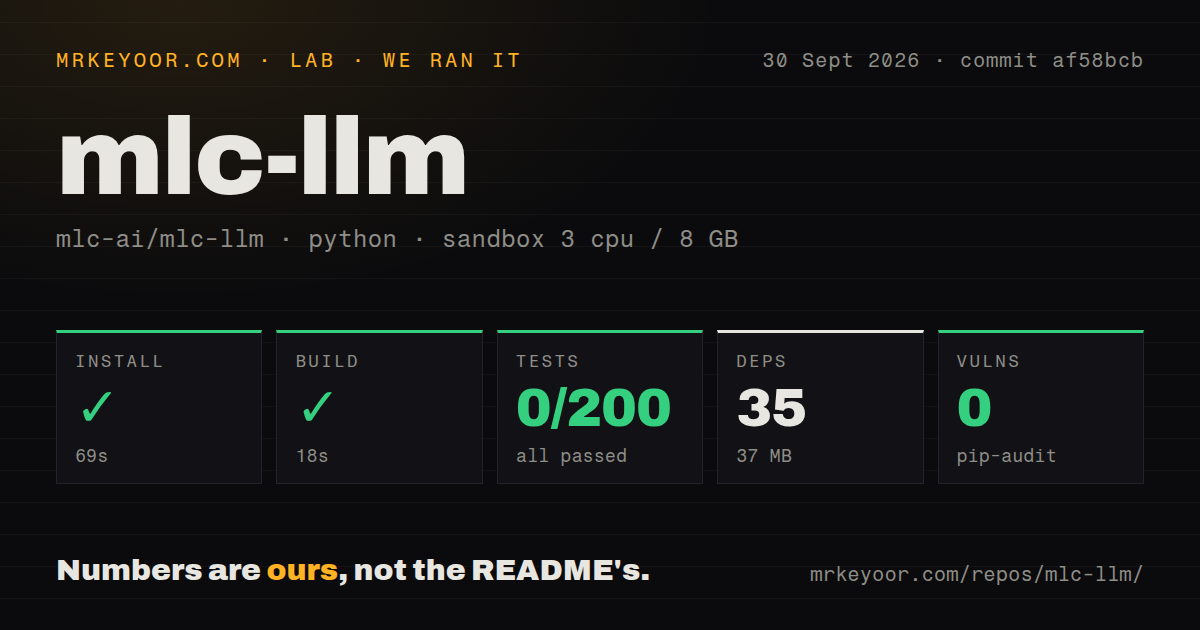
Our sandbox installed commit af58bcb in 69 seconds. It added 35 packages and consumed 37 MB on disk beyond the checkout. The build succeeded in 18 seconds. Pip-audit reported 0 known vulnerabilities. These measurements came from an unprivileged Debian container with 3 CPUs, 8 GB of RAM, Python 3.12, and no secrets.
Pytest failed after 18 seconds. Its summary reported 0 passed tests, 0 failed test cases, 1 skipped test, and 200 collection/setup errors out of 200 before stopping. The final lines name TVM meta-schedule tests for thread binding, tile size, unrolling, post-order application, and several post-processing passes. They do not include the underlying exceptions.
That distinction matters. We can say the supplied test invocation did not collect cleanly in our container; we cannot say which missing package, configuration, or code defect caused it. The repository had a tests directory and 4 CI workflow files, while no Dockerfile was present. A green build did not translate into a runnable full suite under the same fresh environment.
Each target adds a separate toolchain contract
Running a pre-quantized model through Python is the shortest route. Compiling your own model needs TVM in addition to the runtime. Android packaging adds the NDK, CMake, Rust, a JDK, several environment variables, and a physical phone for accelerated testing. The iOS flow needs Xcode and an Apple developer team identity when you build the app. Web delivery moves compatibility checks into the browser and its WebGPU support.
Current issue activity shows why those target contracts need independent proof. Issue #3552 reports that a fresh Android build from main broke because the pinned TVM code and MLC LLM expected different interfaces. Issue #3551 says the Vulkan install page gives loader instructions without an actual Vulkan package command. Both were open on September 23, 2026. They are specific warnings against treating one successful desktop command as evidence for every target.
The local API is useful, but operations still need work
The REST path speaks the OpenAI chat-completions shape, which makes existing clients easier to redirect. Models can load from MLC's Hugging Face repositories, and the Python engine supports streamed responses. This keeps prompt traffic on hardware you control. It does not provide fleet scheduling, authentication, model governance, or deployment packaging by itself.
Open issue #3556, filed September 29, reports that the metrics endpoint emits label values Prometheus cannot parse after decoding work begins. GitHub listed 350 open issues and pull requests in total, so that number should not be read as 350 bugs. It does show a large active surface. Teams putting the REST server behind a router should verify monitoring output and access controls rather than assuming OpenAI-compatible means production-complete.
September 30 activity is current, without a stable release marker
The repository had 23,198 stars and was pushed on September 30, 2026. Pull requests that day covered image processors and model token handling, while other September work touched WebGPU limits and serving. GitHub's latest-release endpoint returned no published release, and the installation guide points users to nightly wheels. The project is active, but a release tag cannot serve as your compatibility boundary.
MLC LLM makes sense when cross-platform compilation is the requirement you cannot remove. Our successful 18-second build shows the source can assemble in a plain container, while the 200 collection/setup errors show why each chosen route needs its own acceptance run. Pin the repository, wheels, TVM state, model artifacts, and target SDK together. If you only need one NVIDIA service or one Apple laptop, vLLM or MLX LM asks you to own less.