Every turn stays in an append-only event log
Maka records model messages, tool calls, permission decisions, results, and termination events as runtime data. The desktop, terminal, and CLI read projections of that record. Old tool output can leave the next model prompt without disappearing from history. That gives a failed or interrupted agent job something closer to a receipt than a transient chat transcript.
One Runtime Host owns execution for each state root, while desktop, TUI, CLI, bots, and evaluation clients connect to it. The repository spreads that design across 4,352 files and roughly 1,390,415 source lines. This is a full agent workstation, with storage, permissions, recovery, model adapters, MCP integration, graph scheduling, and experiment machinery in one monorepo.
The easy quick start hides several operating choices
The source path looks familiar: install with npm, start the desktop development environment, then add a model connection. Maka bundles no shared model account. You supply an API key, a local model, or a compatible gateway, test the connection, and choose a default. Node.js 22.19 or newer, npm, Git, and ripgrep are required before the first task.
Peer features make the setup wider. Direct Peer and Peer Mesh development require Rust 1.98 or newer plus Xcode Command Line Tools on macOS or MSVC Build Tools on Windows. The 78.7 MB checkout has no Dockerfile, so there is no repository-level container path that hides those host differences. Its 26 CI workflow files show extensive automation, but they do not turn source setup into a one-command appliance.
What happened when we ran it
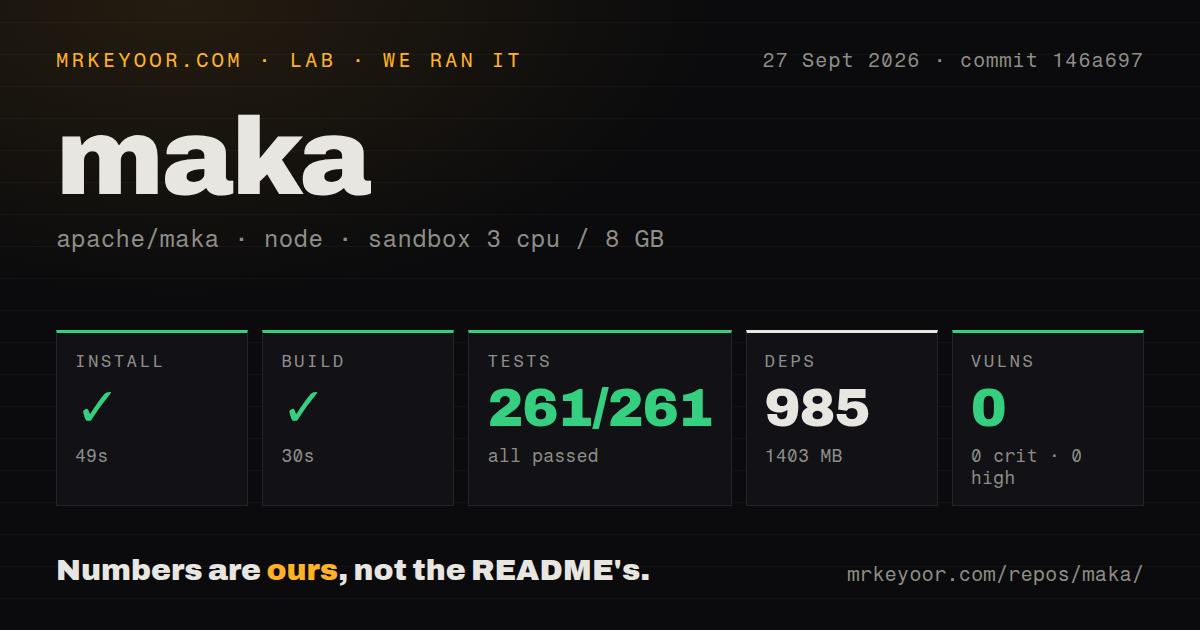
Our sandbox installed commit 146a697 in 49 seconds, adding 985 packages and occupying 1,403 MB on disk. The build finished successfully in 30 seconds. Npm audit found 0 known vulnerabilities. We ran this in an unprivileged Debian container with 3 CPUs, 8 GB of RAM, Node 22, and no secrets.
The test command continued for 724 seconds and exited with code 1. The supplied node:test summary says 261 passed and 0 failed out of 261. Those facts do not reconcile into a successful run, and the log tail does not provide the missing explanation. A green assertion count does not override the command's nonzero exit status.
The last visible entries, numbered 1567 through 1578, are all marked ok. They cover WorkHub persistence, cancellation, attached checkout operations, malformed-profile rejection, WSL argument handling, and bridge diagnostics. Nothing in that tail identifies a failing assertion or a cause for exit 1. We can say the build worked and the test step failed; blaming Debian, a timeout, or a particular workspace would be guesswork.
Local recovery comes with a plaintext credential boundary
Workspace state lives in SQLite beside settings, artifacts, connection metadata, and a credential file. Provider API keys and subscription tokens are stored as plaintext JSON with owner-only filesystem permissions on POSIX systems. The renderer does not receive cleartext secrets. Still, the operating-system account and disk controls are the boundary, not an OS keychain.
Maka's security policy is unusually direct about agent containment. It treats the operating system as the enforcement boundary and describes in-process permission checks as safety aids. Restricted non-PTY commands use Seatbelt on macOS and bubblewrap on Linux. Windows AppContainer coverage is narrower, and managed PTY Bash is refused when the selected profile requires sandboxing.
Recovery also has migration costs. Older JSONL transcripts and Electron safeStorage credentials are not imported, so an upgraded profile can show empty threads and require authentication again. Explicit resume may call the model and spend more tokens. A backup of the 1,403 MB development environment does not replace a backup of Maka's state root and credential file.
The complete CLI is nightly software, not an Apache release
GitHub's latest-release endpoint returned no release, matching the README's statement that Maka has not made an Apache release. The CLI guide says the full maka-agent package lives under the moving nightly tag. The latest tag points to an early alpha stub limited to doctor, help, and version commands. A bare global npm update can therefore move a working nightly install onto the stub line.
The Apache incubation disclaimer records an open initial-code authorization review, which gives product teams a concrete licensing task before incorporation. Graph mode adds another practical limit: it creates isolated Git worktrees and requires the source repository to be clean before starting. Developers who keep uncommitted experiments around will feel that rule immediately.
October activity is high, while the release contract remains unsettled
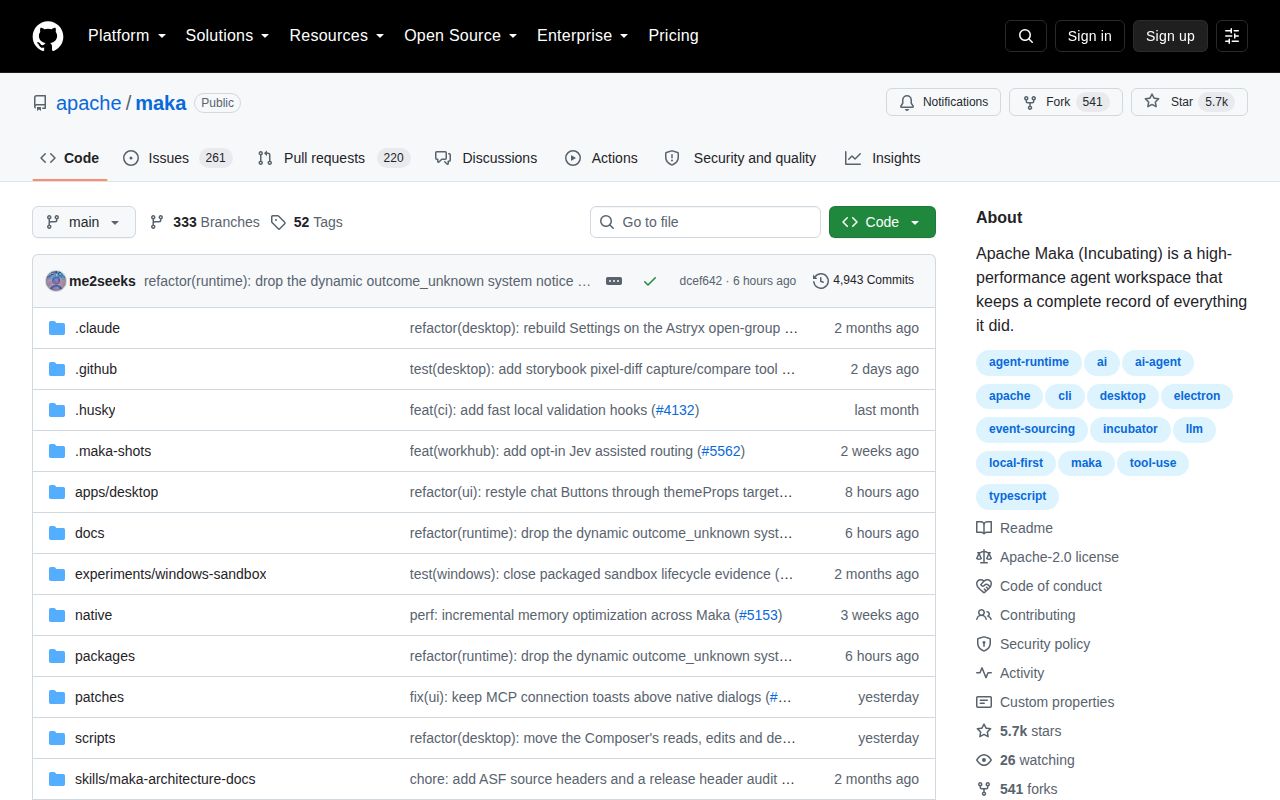
The repository was pushed on October 4, 2026 and showed 5,688 stars. GitHub counted 481 open issues and pull requests; separate searches returned 261 issues and 220 pull requests. Issue 5843 was updated the same day and describes Runtime Host startup trouble once stored transcripts exceed a 45-second readiness window. Current maintenance and current operational risk are visible in the same queue.
Maka is worth a sandbox trial when durable agent history, shared execution authority, and repeatable evaluation matter more than a small install. Our 30-second build says contributors can compile it; the 724-second test command says they should verify their exact checkout before trusting it. The sensible adoption line is an internal pilot with protected credentials and disposable repositories, pending an Apache release and a clean suite on your target platform.