GPUI Kit puts more than 60 desktop controls over GPUI
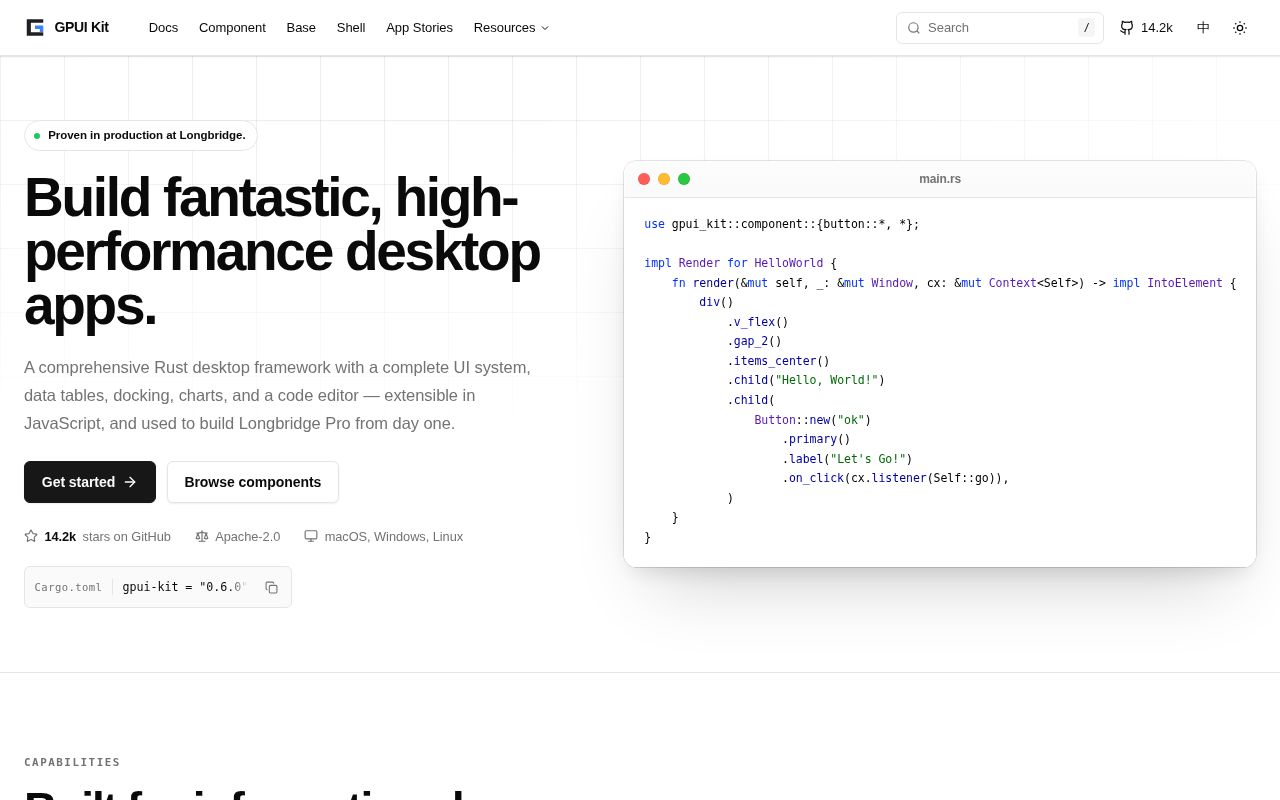
The requested longbridge/gpui-component URL now redirects to GPUI Kit, which packages the old styled component layer into a wider framework. Its README lists more than 60 controls plus virtual tables, lists, a code editor, dock layouts, Markdown, HTML, and charts. Rust applications can depend on gpui-kit as the main crate instead of matching several related packages themselves. The result aims at information-dense native software rather than a thin wrapper around web content.
Three layers divide the work. gpui-component supplies styled controls, gpui-base owns reusable behavior and state, and gpui-shell lets a shipped Rust host run JavaScript extensions with explicit capabilities. That split gives a design team room to replace presentation while retaining focus, selection, positioning, and scrolling code. It also makes adoption architectural: GPUI Kit becomes the common UI vocabulary across the application, not one isolated widget dependency.
Tables and text editing are the reason to accept the larger stack
The table supports virtual scrolling, fixed and resizable columns, sorting, and cell selection. The editor covers Tree-sitter syntax work, diagnostics, completion, hover, search, folding, and multiple cursors. Release v0.6.1, published on 2026-09-09, added automatic bracket pairing, smarter indentation, and a headless UI test API. Those are costly systems to recreate, and they share the same theme and event conventions here.
The stock interfaces still leave holes for demanding products. Open issue 2795 documents row events that omit mouse-button modifiers, blocking Command-click and Shift-click selection without custom table code. Its reporter maintains a fork for a file manager and has to port upstream fixes by hand. Issue 3017 says editor search allocates every matching range in a large document even though only visible matches can be drawn. Both reports identify specific extension costs behind the broad feature list.
What happened when we ran it
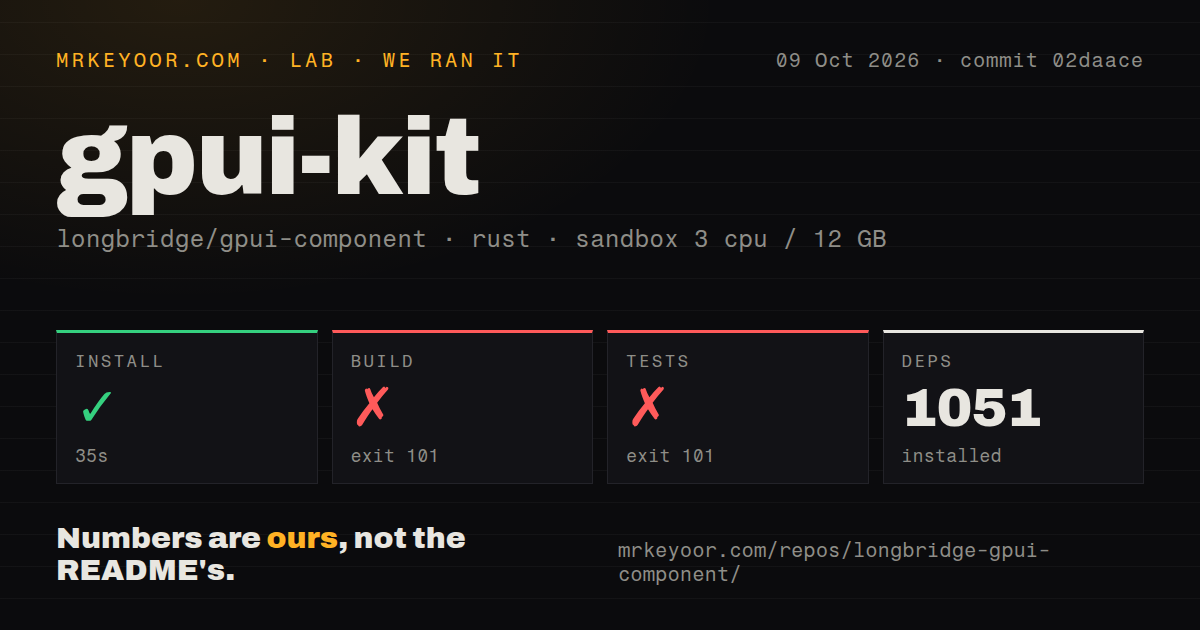
Our run at commit 7885c41 installed 863 packages in 112 seconds. The checkout contained 1,062 files, about 182,601 lines of source, and occupied 12.3 MB before installed dependencies. Cargo completed the install stage, but the build failed with exit code 101 after 431 seconds. The final linker message said rust-lld could not find -lxkbcommon-x11, so it could not compile the gpui-component-story binary.
Tests failed with exit code 101 after 14 seconds. The supplied tail shows the same missing xkbcommon-x11 library while Cargo was compiling the story package's brush example. It does not contain a failed assertion or a Rust compiler diagnostic about project logic. Our fresh Debian container therefore reached native linking and stopped there; the evidence does not tell us which tests would pass after the library is present.
The contributor guide treats native packages as a required step and points Linux users to ./script/bootstrap. Windows gets a separate PowerShell installer. That requirement is easy to miss if someone copies only the README's short dependency snippet. The repository has 4 CI workflow files, no Dockerfile, and no tests directory, while the current release notes describe a feature-gated headless testing API and broader integration coverage.
Native accessibility still needs product-level checking
Open issue 2968 reports that SidebarMenu and SidebarMenuItem have no AccessKit role. The reporter reproduced the problem with GPUI Component 0.6.0 on macOS and says sidebar destinations never appear in the platform accessibility tree. Issue 2838 separately asks for complete keyboard behavior in tabs, including roving focus, arrow navigation, Home and End, activation, and disabled-item handling. Teams shipping to regulated or keyboard-heavy environments should test their exact control set.
The latest v0.6.1 release did improve accessible activation for selects, name calendar items, and adjust dialog close buttons. It also introduced headless interaction and layout checks through gpui_kit::test. That is useful movement, though the two open reports show why a new testing surface should not be mistaken for finished coverage. Native behavior varies across Windows, macOS, and Linux, so the release gate needs all target platforms.
Weekly GPUI snapshots trade convenience for upstream movement
GPUI Kit pins a matching GPUI release and republishes version-aligned gpui-pre snapshots. The contribution guide says an automated job checks Zed's GPUI crates weekly. Publishing pauses if an upstream API change breaks compatibility, then GPUI Kit adapts rather than carrying behavioral patches. This avoids a permanent fork, but application teams still need locked revisions and an upgrade window for changes arriving from two projects.
Icons and initialization remain application duties. The default asset feature supplies Lucide icons, while teams can disable it and provide SVG files under names defined by IconName. Every application must call gpui_kit::init before using components and put a Root at the first level of a window. None of these steps is unreasonable, yet together they make the framework more opinionated than a bag of Rust controls.
A same-day release and 103 open items show an active, moving project
GitHub recorded 14,188 stars, 103 combined issues and pull requests, a push on 2026-09-09, and the v0.6.1 release on that same date. The open count is not a bug count. Recent reports and release work span editor allocation, sidebar accessibility, keyboard behavior, Windows library loading, Markdown rendering, and testing, which shows users and maintainers working on current code.
GPUI Kit makes the most sense when its table, editor, dock, and shared desktop behavior match the product closely. Iced is a cleaner comparison for a standalone Rust application model, egui favors immediate-mode tools, and Slint adds declarative files plus embedded targets. Our 431-second failed build is a warning to budget native setup before evaluation, while the current issue detail is a reason to prototype the hardest interaction before committing the rest of an application.