WolfCut is now Concat, a local 0.2.2 video editor
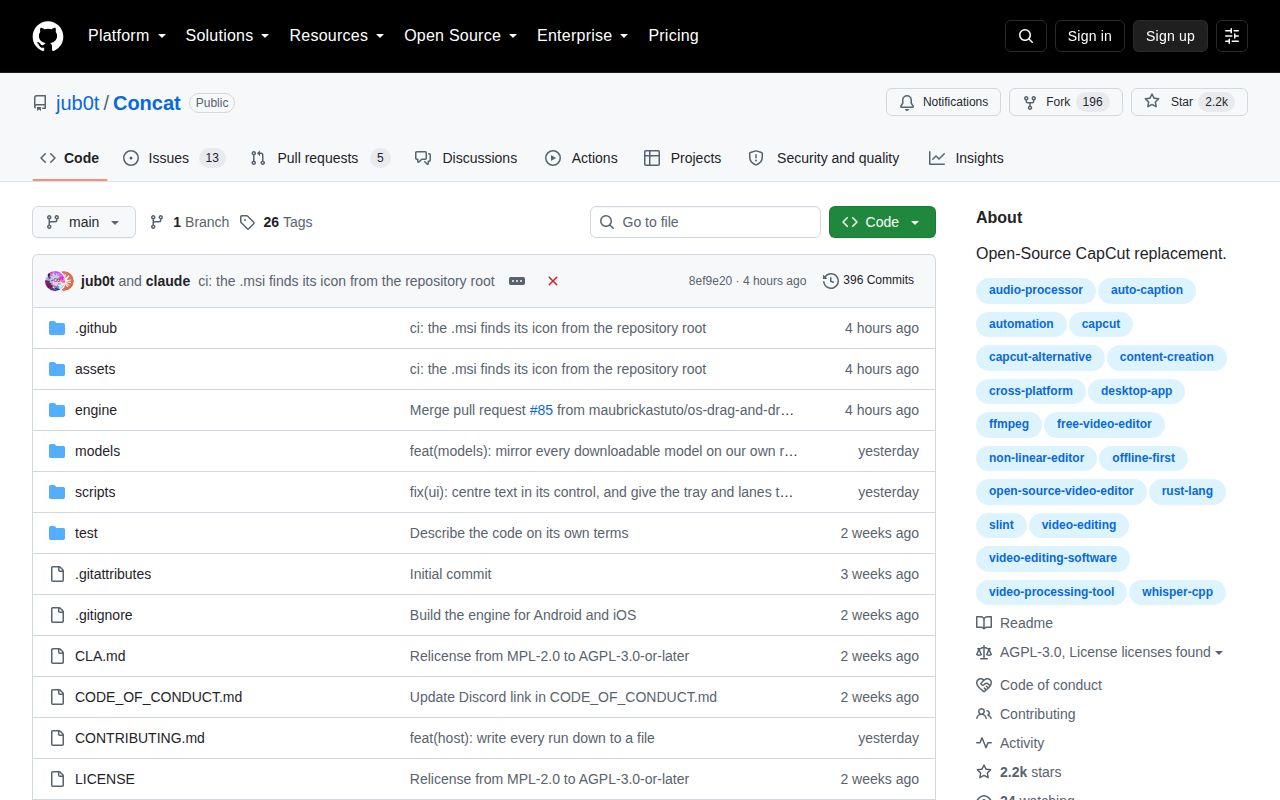
GitHub redirects jub0t/WolfCut to jub0t/Concat, and the current app calls itself Concat. The pitch is direct: a native editor for cutting video without an account, a subscription, or cloud processing. It has multi-track timelines, transitions, speed controls, titles, templates, local captions, text-to-speech, voice filters, and background cutout tools. The main README is in English, while the interface ships in 12 languages.
This is already a substantial codebase for a young editor. We measured 539 files, about 45,943 lines of source, and a 13.5 MB checkout at commit 709e29d. The Rust workspace lived under engine/, with 6 CI workflow files and a tests directory. There was no Dockerfile, which fits a native desktop application better than a service. Those figures describe the measured WolfCut commit before the public rename to Concat.
The packaged release avoids a demanding source toolchain
Release v0.2.2 supplies self-contained bundles for macOS, Windows, Linux, Android, and iOS or iPadOS. Windows gets an installer and archives; Linux gets tarballs; macOS gets disk images. The mobile files exist, although the README marks those platforms as needing testing. For a user evaluating the editor, downloading the release is the shortest path and the one the contributor guide recommends for practical bug reports.
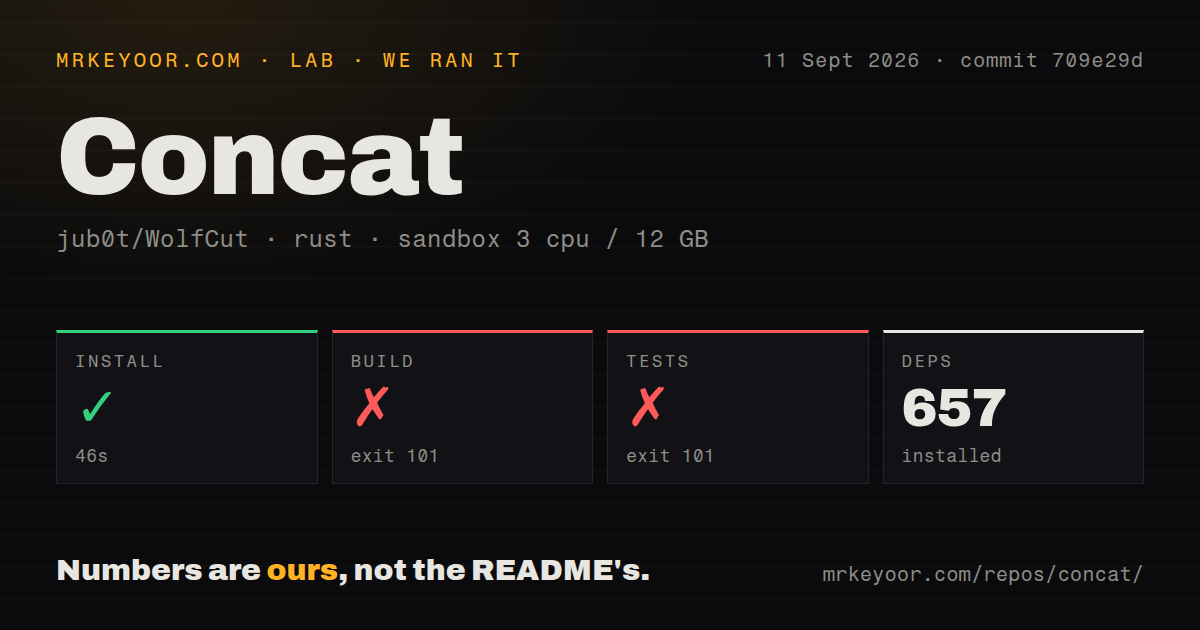
Compiling is a different job. The guide requires Rust, FFmpeg 7 development libraries, CMake, and a C++ compiler before cargo run -p concat. Our dependency installation succeeded in 46 seconds and added 657 packages. That did not provide every native library the Rust crates expected. The distinction matters because Cargo can fetch crates while pkg-config still cannot see a system library.
What happened when we ran it
Our sandbox build reached 678 seconds, then exited with code 101. ffmpeg-sys-the-third asked pkg-config for libavutil, and pkg-config could not find libavutil.pc. PKG_CONFIG_PATH was unset. The log explicitly says the required system library was not found. We used a fresh unprivileged Debian container with 3 CPUs and 12 GB of RAM, so the result describes that clean source environment rather than the downloadable desktop bundle.
Tests failed with the same exit code 101 after 43 seconds. Their log also stopped at the missing libavutil check, before a test result summary appeared. We therefore have no passed or failed test count to report. The only supported finding is that both compilation paths required a native FFmpeg development component our box did not contain. The logs do not show whether any test would fail after that dependency is supplied.
Local AI tools require model storage, not service accounts
Concat runs captions, speech, and cutout inference on the user's machine. The README lists caption models from 78 MB to 488 MB, two speech downloads at 132 MB and 349 MB, and three cutout-related models from 15 MB to 179 MB. They download when first selected and then work offline. That is appealing for footage that should stay on a workstation, though editors need to budget the storage and wait for the first download.
The documented minimum is 4 GB of RAM and 500 MB of storage; the recommendation rises to 16 GB for 4K timelines and larger caption models, plus 2 GB for every optional model. Those are project requirements, not results from our run. Our measured checkout was only 13.5 MB, but the 657-package source install and native media dependencies tell a more useful story for contributors: the repository is small, while the workstation environment is not.
H.264-only export and mobile bugs narrow the audience
The project comparison says Concat currently exports H.264 MP4 only. It also describes the effects collection as a few dozen and says keyframes lack a curve editor. Those limits are easy to accept for social clips that end as MP4. They are harder to accept for delivery work involving several codecs, detailed animation curves, established interchange formats, or a large stock effects library. The roadmap lists many of those ideas without promising dates.
Mobile support needs even more caution. Issue #42 reports an Android 15 installation that would not open, and issue #92 says a tablet layout covered menu controls while media import buttons did nothing. Both were open on September 16. A 43-second test command that stops during native dependency discovery cannot tell us anything about those devices. Treat the APK and IPA as test builds, exactly as the README labels them.
Daily changes make v0.2.2 a beta, not a stable workstation
The repository was pushed on September 16, 2026, one day after v0.2.2. GitHub showed 2,195 stars, 18 open issues and pull requests combined, and 13 open issues through issue search. Reports and fixes were moving quickly, including a closed request for Linux binaries and recent work around hardware decoding. That pace is healthy for development, while the project's own beta label remains the right expectation for users.
Our run installed 657 packages successfully, yet the build spent 678 seconds before the missing libavutil file ended it. That is a poor first source experience unless you begin with the contributor prerequisites. It says little about the packaged app because v0.2.2 carries its own libraries. Download users and source contributors are taking two different setup paths, and this review should not blur them.
Private short-form editing is the best reason to try it
Try v0.2.2 on copies of real footage and export the format you intend to deliver. Check captions against speech, reopen saved projects, and confirm the process exits cleanly on your operating system. Source contributors should install FFmpeg 7 development files before judging the Rust workspace. Our 678-second failure is a clear setup warning, while the self-contained release remains the fair way to judge whether the editor itself fits.