Graph retrieval earns its place only when relationships matter
LightRAG's 1,329-file checkout contains a document ingestion system, a graph store, vector search, and a web interface. It extracts named things and their relationships from documents, then retrieves that evidence to help a language model answer questions. Choose it when an answer depends on connections across sources, such as which services depend on a component. A search that only needs the closest matching paragraph gives you less reason to maintain a graph.
The default mix mode combines entity, relationship, and text retrieval. You can inspect the graph in the admin interface, query it through REST, or embed the Python core. Those are useful ways to investigate an answer rather than treating the search result as opaque. They aren't proof of better answers on your documents. The lab run measured repository mechanics, so retrieval quality still needs a comparison against your existing search.
What happened when we ran it
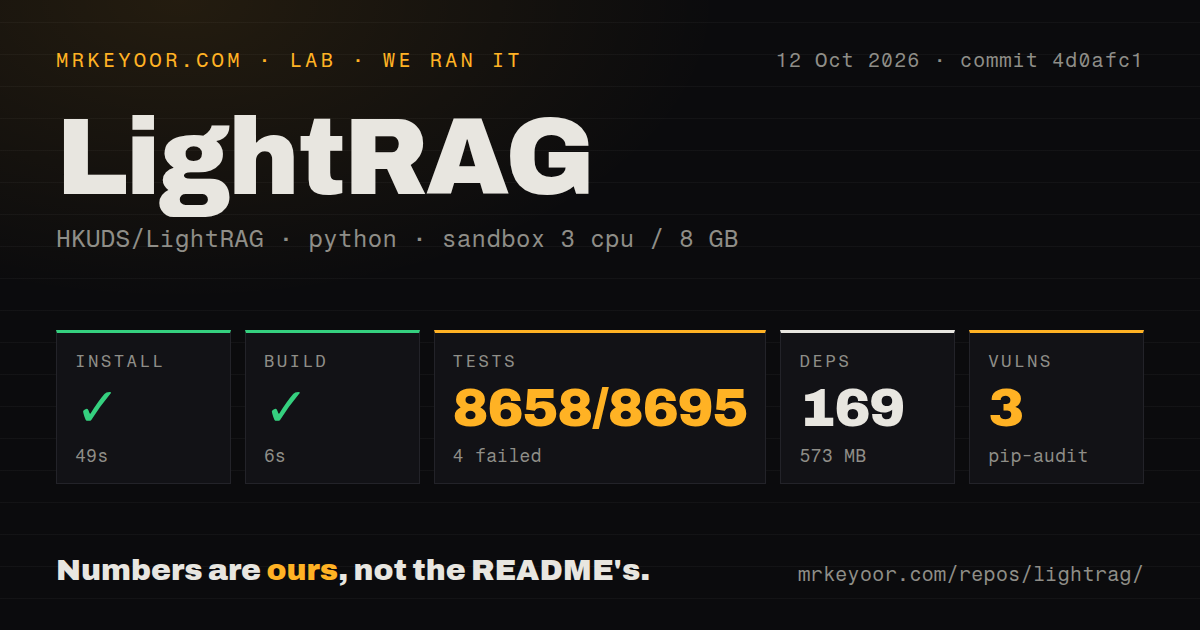
Our run installed LightRAG commit 4d0afc1 in 49 seconds, adding 169 packages and using 573 MB on disk. The build succeeded in 6 seconds. We ran it on October 12, 2026, in an unprivileged Debian container with 3 CPUs, 8 GB of RAM, Python 3.12, and no secrets. The checkout occupied 27.5 MB and contained about 452,101 lines of source.
The test step failed with exit 1 after 792 seconds. Its pytest summary reported 8,658 passed, 4 failed, 260 skipped, and 33 collection/setup errors. Two path-prefix cases expected HTTP 200 and received 307 redirects. A UI route audit did not find /ui/customization where expected. The markdown cache case expected one warning and received two. These are specific failures, even alongside thousands of passing cases.
The visible error tail repeatedly reports that lightrag.kg has no faiss_impl attribute in file-backed vector-space cases, including cases labelled nano. The log excerpt does not establish why that attribute was unavailable, or explain every collection/setup error. Pytest's own elapsed time was 748.08 seconds, separate from the 792-second test step. Neither number measures document indexing or answer latency.
Pip-audit reported 3 known vulnerabilities. The supplied result does not identify packages, severity, or reachable code paths, so it supports a dependency-review requirement rather than an exploit claim. Our sandbox found 11 CI workflow files, a Dockerfile, a compose file, and a tests directory. Those controls exist, but the complete suite still did not pass in this environment.
The default stores keep the whole dataset in memory
A 573 MB installed environment says little about the memory needed for your corpus. The storage guidance says the default stores hold the dataset inside the server process, with local files providing persistence. That makes them reasonable for trying a small collection. The README explicitly excludes production use and recommends PostgreSQL, which can handle every storage category without a separate graph database.
You must also configure language models and an embedding service, with provider credentials when using hosted endpoints. Extraction runs on document chunks before anyone asks a question, so ingestion creates model work as well as storage work. The setup wizard helps write the configuration. It cannot choose whether your documents may leave your network or whether the extraction model preserves the relationships your readers care about.
A successful build does not configure authentication
The 6-second build passed, while the README's quick start binds the server to every network interface. Without authentication, its endpoints are public. Configure an API key or accounts with a token secret before exposing it. The Ollama-compatible routes remain open by default for client compatibility unless you change the whitelist. This is a concrete deployment decision, not something a green build settles.
The query-only /workspace interface is useful for readers who should not see document-management controls. It hides those controls from the screen, but the README warns that this split is not an authorization boundary. Both UI entries remain mounted. A branded chat page therefore needs the same server-side access checks as the admin console. Test permissions through API requests instead of assuming a hidden menu protects an operation.
Parsing and model changes add work after the 49-second install
The 169 packages installed in our sandbox do not settle optional native requirements. Embedded SVG handling needs the system's Cairo library, and the opt-in Word heading feature needs separate spaCy language models. External MinerU or Docling parsing adds services to configure. These are documented requirements for particular paths, not explanations for the failures in our test log.
Embedding changes also deserve care. One README passage says there is no re-embedding tool, while its later maintenance section documents lightrag-rebuild-vdb for changing models or dimensions. That contradiction makes the linked maintenance instructions worth checking before a migration. The later guidance tells real deployments to preserve the working directory, which contains graph and text data, and stop writers before rebuilding vectors.
October activity shows maintenance alongside unresolved defects
GitHub records the last push as October 12, 2026, with 40,098 stars and 343 open issues and PRs. Issue activity continued on October 13. Issue 4222 reports interrupted uploads leaving partial files that block retries and can enter a later scan. A corresponding pull request is open. This supports calling the project active, while giving operators a specific ingestion failure to investigate.
The latest release, v1.5.7, shipped on September 2 with the query-only UI and deployment customization. I'd trial LightRAG for relationship-heavy document search with someone responsible for storage and permissions. Haystack suits teams wanting to assemble retrieval components themselves. Microsoft GraphRAG offers another graph approach, though its README now declares maintenance mode. Before handing LightRAG to readers, require complete uploads and inspect the evidence behind its answers.