A framework for data-heavy model applications
LlamaIndex began around retrieval over private data, and that remains its clearest use. It can read documents and services, split and represent the content, build an index, retrieve relevant pieces, and pass those pieces to a model. The current project extends that chain with agent workflows, tools, memory, reranking, and structured responses. A team can assemble a document assistant without designing every interface between those parts.
The framework is most useful when integrations are the bottleneck. Its catalog has more than 300 packages covering model providers, embedding services, vector stores, readers, and other components. Code importing llama_index.core uses the common framework, while imports under paths such as llama_index.llms.openai come from separate integration packages.
There are two installation philosophies. The llama-index starter package brings core plus a selection of common integrations. The llama-index-core package lets you add only what the application needs. We prefer the second approach for production because provider clients bring their own dependency pins, credentials, release schedules, and failure modes.
The abstraction pays off during experiments
The README's short example loads files, creates a vector-store index, and exposes a query engine in a few lines. Settings can replace the default model and embedding provider with local choices such as Ollama and a Hugging Face embedding model. Storage starts in memory and can be persisted to disk.
LlamaIndex also gives advanced users access to the pieces below the query engine. Retrievers, node parsers, rerankers, indexes, response synthesis, and workflows can be replaced or extended. This escape hatch matters. Retrieval systems often fail in details such as chunk boundaries, metadata filters, empty results, or citations, and a fixed five-line helper cannot solve every corpus.
The cost is framework knowledge. An error may originate in LlamaIndex core, a provider integration, the provider's SDK, a vector database, or the model itself. Frequent fixes describe a surface where version pinning and end-to-end tests are mandatory.
What happened when we ran it
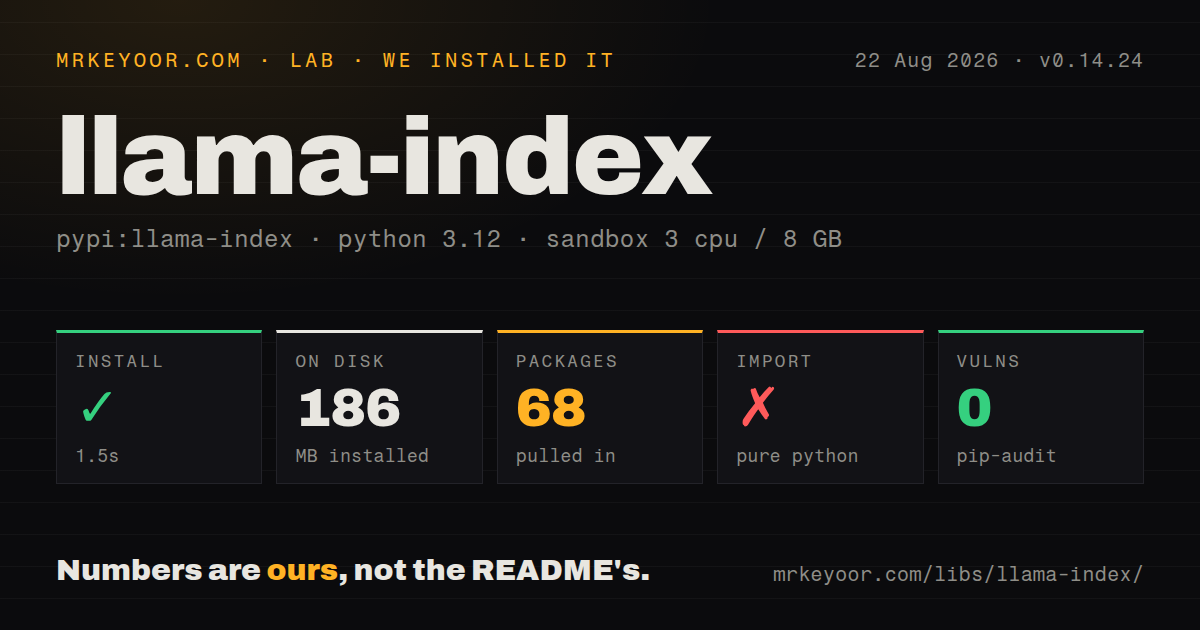
We cloned commit d802122 into a fresh Debian container with 3 CPUs and 8 GB of RAM. The repository was unusually large for a Python framework: 10,029 files, about 477,714 lines of source, and a 711.6 MB checkout. Installation succeeded in 67 seconds. It added 94 packages occupying 220 MB. Pip-audit reported 0 known vulnerabilities.
The build failed with exit code 1 after 12 seconds. Our supplied measurement did not include the last lines of that build log, so there is no responsible way to name a missing tool, package, or configuration as the cause. The generic build path chosen by our harness did not complete in a clean container, even though dependency installation did.
Our harness found no generic test script or target, so it skipped tests. It also saw no top-level tests directory and no Dockerfile, while detecting 14 CI workflow files. This is a monorepo with many separately packaged integrations, so those signals should not be read as proof that upstream runs no tests. They say the root checkout did not expose the conventional target our sandbox expected.
Open source and cloud are separate choices
The README now gives substantial space to LlamaParse, the company's document platform. Parse handles OCR and document conversion, while related cloud products cover extraction, managed indexes, splitting, and deployed document agents. These services can work with LlamaIndex, but they are not capabilities you receive merely by installing the MIT-licensed framework. They require signup and an API key.
That distinction matters for architecture and purchasing. The open-source framework can use local readers, local models, and storage you operate. Choosing LlamaParse moves document processing to a hosted service. It may save engineering work on difficult files, but teams with residency or procurement constraints should decide that boundary deliberately.
Credentials multiply with the chosen stack. A typical hosted setup may need keys for a language model, embeddings, parsing, and a vector database. A local setup replaces some keys with model downloads and services such as Ollama. LlamaIndex coordinates these systems; it does not remove their cost, security rules, quotas, or outages.
Where production teams should be cautious
Provider parity is never automatic in a framework this broad. An open request from August 2026 asks for native structured output in the Bedrock Converse integration instead of its function-calling workaround. Another active request describes missing reusable preprocessing and postprocessing hooks around agent tool calls, motivated by authenticated MCP tools and oversized tool results. These specific gaps show why an architecture review must follow the exact path an application will use.
Empty retrieval deserves similar attention. An open report says one asynchronous chat engine returns Empty Response when metadata filtering yields no nodes, rather than letting the model answer without retrieved context. Whether that behavior is wrong depends on the application, but silence is dangerous when a caller expects a streamed answer. Test empty indexes, permission filters, provider errors, and malformed documents before launch.
GitHub recorded a push on August 24, 2026, and v0.14.24 shipped on August 19. The open count was 682 issues and pull requests combined. Current commits and a release packed with fixes show an active project. They also argue against casual upgrades. Pin core and every integration, record a known-good set, and test retrieval quality as well as import compatibility.
LlamaIndex earns its place when a team is still comparing models, stores, and document paths, or when one application genuinely needs several of them. The abstraction becomes less attractive after a small stack has stabilized and direct SDK calls are easy to own. Start narrow, keep the integration list visible, and treat the cloud products as separate purchasing decisions.