Seven Chinese genres are supported, while statutory forms are excluded
Lieflat Gongwen covers seven Chinese document genres: six government-document styles plus one Party-affairs style. The repository is written in Chinese and has no English guide. Its job is unusually narrow. An agent first identifies the document family and genre, reads the matching parameter card and example, proposes an outline for approval, writes the draft, and runs a Python checker. That sequence is more useful than a bag of ceremonial phrases because it forces the agent to choose a document type before copying its surface habits.
The exclusions matter just as much. The project README says it does not handle notices, requests, approvals, or replies whose structures are already fixed. A request for meeting-minute support appeared in issue 1 and was closed without that genre being added. If your queue is mostly statutory forms or minutes, the seven supplied profiles do not cover the work. No amount of parameter checking changes that boundary.
The 1.02-million-character study produces constraints, not truth
The author says the profiles came from 1.02 million Chinese characters of source material. The output includes typical length, heading depth, sentence length, enumeration density, common structures, and genre-specific signals. Twenty-two synthetic examples show those rules in use. The checker reserves hard errors for genre conflicts, such as giving a work plan the structure of a research report; other deviations are warnings because the source samples varied too much for an average to become a pass line.
That restraint is one of the better choices here. A placeholder such as 【待补:xx】 tells the drafter to insert a local fact instead of manufacturing one. The README also says the parameters cannot decide whether an argument is sound, political phrasing is appropriate, or confidential material is safe to publish. A human reviewer still has to verify every claim and approve external wording. This skill can identify a mismatched shape. It cannot certify the document's substance.
What happened when we ran it
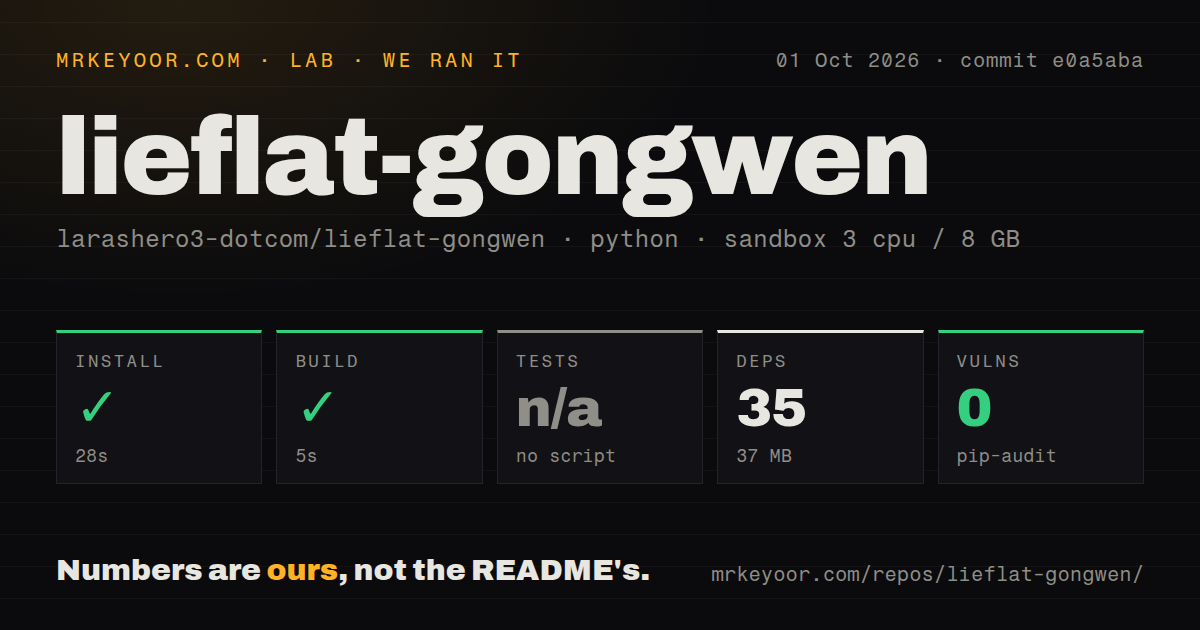
Our sandbox installed commit e0a5aba in 28 seconds. It pulled 35 packages and occupied 37 MB on disk. The build succeeded in another 5 seconds, and pip-audit reported 0 known vulnerabilities. We used a fresh Debian container with 3 CPUs, 8 GB of RAM, Python 3.12, no secrets, and no elevated privileges. Those results show that the repository's small Python surface is easy to prepare. They do not measure the quality of Chinese drafts.
There was no test script or test target, so we skipped that step. The repository also has no tests directory, Dockerfile, or CI workflow. Its Python checker is a central part of the promised workflow, yet the project does not supply an automated suite that lets a new user confirm its rules against known inputs. A successful 5-second build therefore tells us the package can be prepared. It does not establish that every genre rule and failure message behaves as intended.
PolyForm Noncommercial rules out ordinary paid use
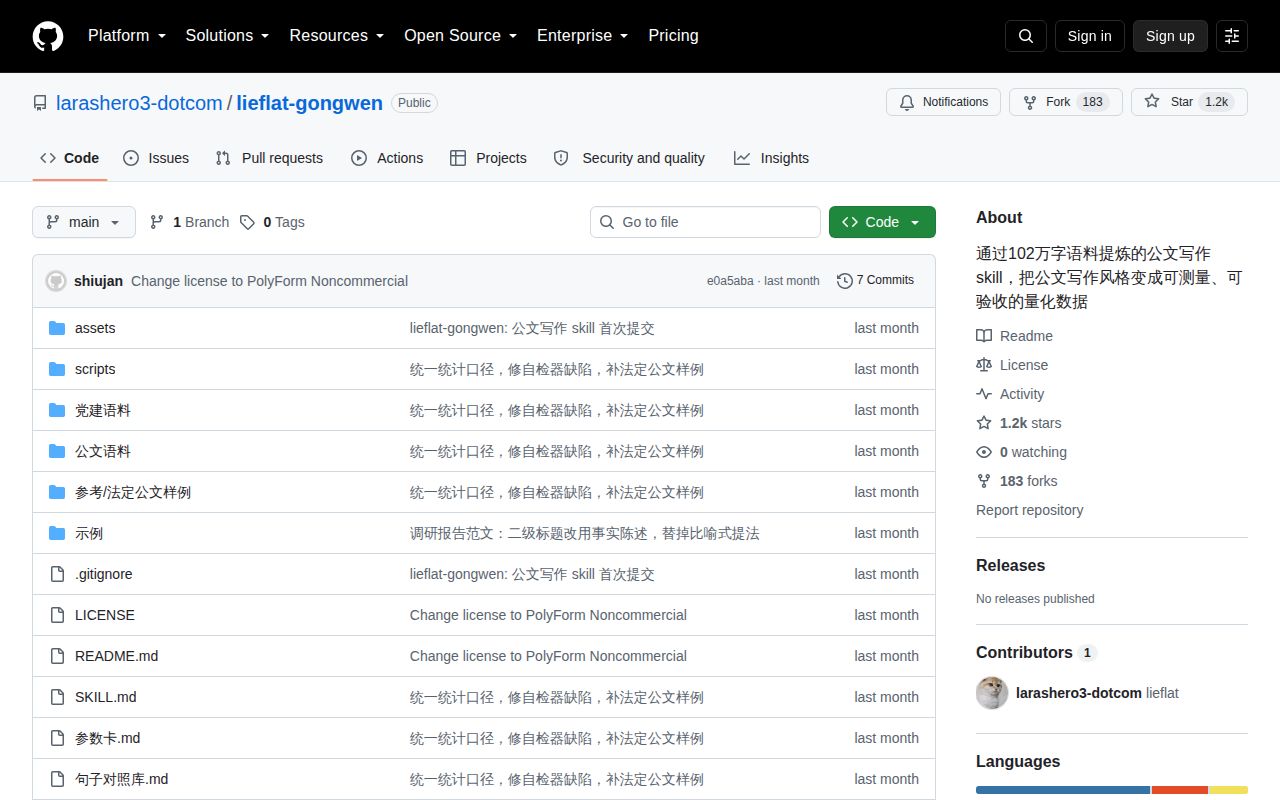
commit e0a5aba changed the repository to the PolyForm Noncommercial 1.0.0 license. Government institutions, schools, public research bodies, personal study, and other noncommercial users receive broad permission under those terms. A paid writing service, commercial agent product, or internal business deployment should not treat the visible source as permission to ship. The README asks commercial users to obtain a separate written license.
This is also why calling Lieflat Gongwen open source would mislead a buyer. The code is available to inspect and modify for permitted purposes, but the commercial restriction conflicts with the usual open-source definition. That may be perfectly acceptable for a government research team. It is a stop sign for a startup that planned to bundle the skill into a subscription product, unless the author grants another license. Check that before you build a workflow around its 58-file repository.
The missing corpus prevents independent replication
The 1.02-million-character corpus is absent from the repository because of copyright. What remains includes aggregate data, genre notes, metadata, synthetic examples, and an account of statistical mistakes the author later corrected. That disclosure is candid, and the README names thin samples for work plans and experience summaries. Still, an outside reviewer cannot rerun the full extraction or verify that the published distributions match the original texts.
That limitation changes how much authority to give the numbers. Treat them as the author's editorial model, then compare outputs against documents your organization is legally allowed to use. For a public body, the best version of this setup would pair Lieflat Gongwen's seven genre routes with an internal terminology list and named approvers. The supplied 22 examples can teach rhythm and structure, but they cannot replace your office's facts, legal forms, or review chain.
September activity shows a young repository, not a settled tool
The last code push was September 5, 2026, three days after the repository was created. GitHub showed 1,246 stars and 0 open issues or pull requests on October 2, while the latest-release endpoint returned no release. Two issue threads had been closed later in September, so activity did not stop with the last commit. Even so, six commits, no versioned release, and no automated test target describe an early project.
Lieflat Gongwen earns a trial when the license fits, every operator reads Chinese, and one of the seven genres matches the assignment. Its strongest idea is the approval pause between outline and full draft. Keep that pause. The project itself warns that statistical resemblance cannot decide whether a document is correct, safe, or suitable for publication, which is exactly where a named human reviewer must take over.