The catalog lists 115 Spanish resources across 32 sections
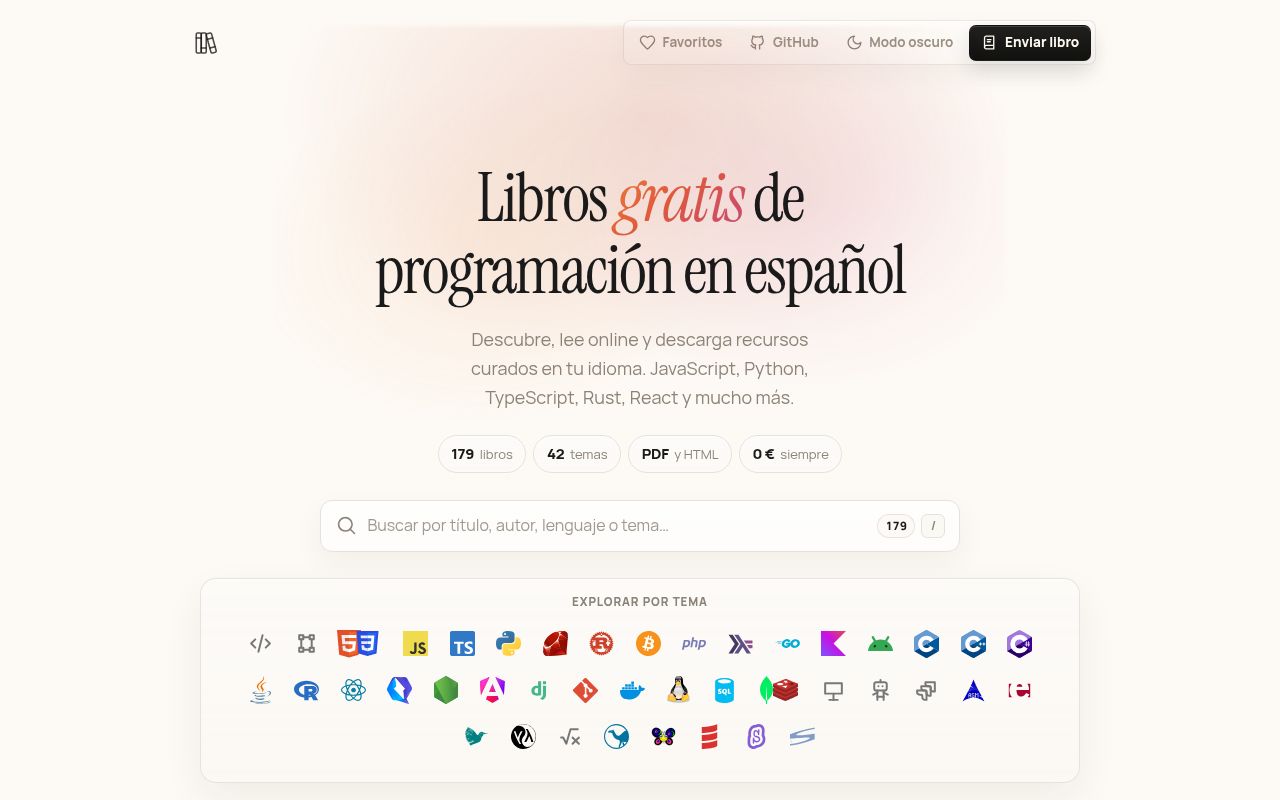
Libros Programación Gratis is a Spanish-language library rather than a book publisher or online course. Its README lists 115 resources across 32 sections, including programming foundations, algorithms, web development, languages, frameworks, Git, Docker, databases, operating systems, artificial intelligence, and development methods. Entries point to hosted PDFs or external HTML material and usually name the author, translator, and format. The project accepts only free Spanish resources and explicitly says that free does not mean pirated.
That focus is genuinely useful. Searching the open web for a Spanish introduction to Python or a legal PDF on data structures often produces stale mirrors, partial translations, and download traps. This catalog puts official documentation beside books, workshops, university notes, and community translations. Its weakness follows from the same model: quality, age, depth, and teaching style vary by source. A list can shorten discovery, but it cannot guarantee that 115 different resources form one coherent education.
A 304.6 MB checkout is mostly a content project
Our measured checkout contained 204 files and about 5,050 source lines, yet occupied 304.6 MB. The large ratio comes from keeping book assets with a relatively small Astro application. The catalog's source of truth lives in web/src/data/library.ts, and the README mirrors that list for GitHub browsing and review. This design makes additions easy to inspect in a pull request, while every hosted PDF also increases clone and deployment weight.
The web package requires Node 22.12 or newer. It uses Astro 7.1.6, the Cloudflare adapter, Tailwind CSS, PDF.js, and Wrangler. The root workspace delegates development, building, link checks, and deployment into web. Cloudflare Workers is therefore part of the deployment model, and the README notes a 25 MiB asset limit when explaining why one oversized PDF stays external. A fork needs to decide whether carrying PDFs in Git and deploying them through that platform still makes sense.
What happened when we ran it
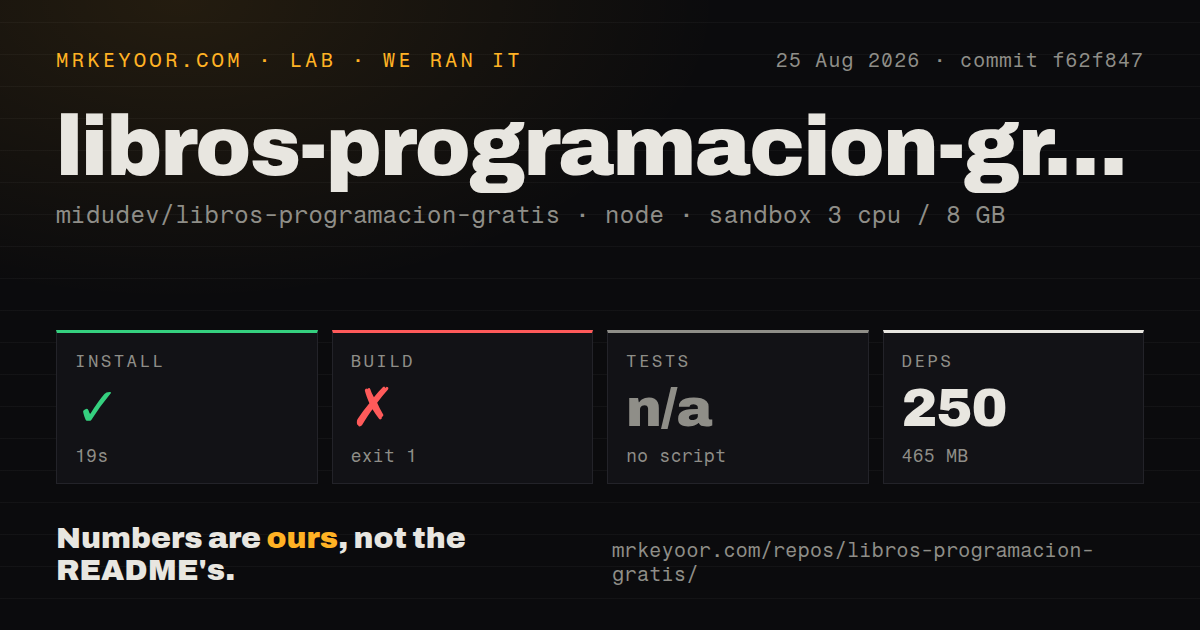
Our sandbox installed 250 pnpm packages in 19 seconds and used 465 MB after installation. The source tree itself used 304.6 MB, so a fresh working copy plus dependencies is substantial for a catalog site. We found one CI workflow, pnpm workspaces, no Dockerfile, and no tests directory. The package had no test script or target, so the harness skipped tests instead of implying coverage that was not present.
The Astro build failed after 12 seconds with exit code 1. Its stack trace passed through the Cloudflare adapter and Astro static build code during getStaticPaths, then ended with connect ECONNREFUSED 127.0.0.1:46169. The log does not identify which local service owned that temporary port or why it was unavailable. It supports one narrow conclusion: commit f62f847 did not produce a clean build in our fresh unprivileged Node 22 sandbox.
That failure also affects maintenance because the check:links command runs a site build before its link checker. A maintainer cannot rely on the catalog's automated outbound check until the build completes in the chosen environment. The right repair starts by reproducing the exact static-path request and documenting any required local process. Guessing that Cloudflare, Astro, or the sandbox alone caused it would go beyond the supplied log.
Five broken-link checks show the shelf needs upkeep
Issue 89 lists 5 failed link checks. Two refer to the same university page from different generated pages, one external host did not resolve, and a GitBook URL returned 401. Those results can include temporary network or access failures, but they show why a resource catalog needs regular verification. A title remaining in the TypeScript list does not mean its reader can still reach the book. Teachers should open assigned links shortly before sharing them with a class.
The contribution process asks for a title, author or project, official link, available format, and confirmation that the item is free and Spanish. Blog articles are excluded. Large external assets and community translations still require human judgment about legality, stability, and provenance. The repository's current GitHub metadata has no detected license, which concerns the application code rather than the separately authored books. Contributors can submit changes, but organizations planning a fork should ask the maintainer to clarify reuse terms first.
July source activity and August issues show a maintained catalog
GitHub reported 5,807 stars, 5 open issues and pull requests, and a last push on July 30, 2026. There is no latest GitHub release. Issue activity continued through August 26 with broken-link tracking, and issue 90 reports low contrast in the dark-mode submission form. A missing release tag is not evidence that the catalog is abandoned; the recent push and issue dates show current maintenance through the repository and live site.
Free Programming Books is the stronger index when a reader wants many languages and a far larger pool. freeCodeCamp or OSSU fits someone asking what to study next, because each supplies an ordered path. Libros Programación Gratis has a simpler job: provide a browseable Spanish shelf. It does that well enough to recommend as a discovery tool, provided readers verify links and do not mistake category membership for a review of teaching quality.