Start with a subject you need to learn
Free Programming Books is easiest to use once you can name what you need: an English book on a programming language, a course in Hindi, or a set of practice problems. Its README separates English books by programming language and by subject, then links to lists in other languages. That organization makes it a useful place to assemble candidates. A beginner still has to decide which candidate deserves the next evening of study.
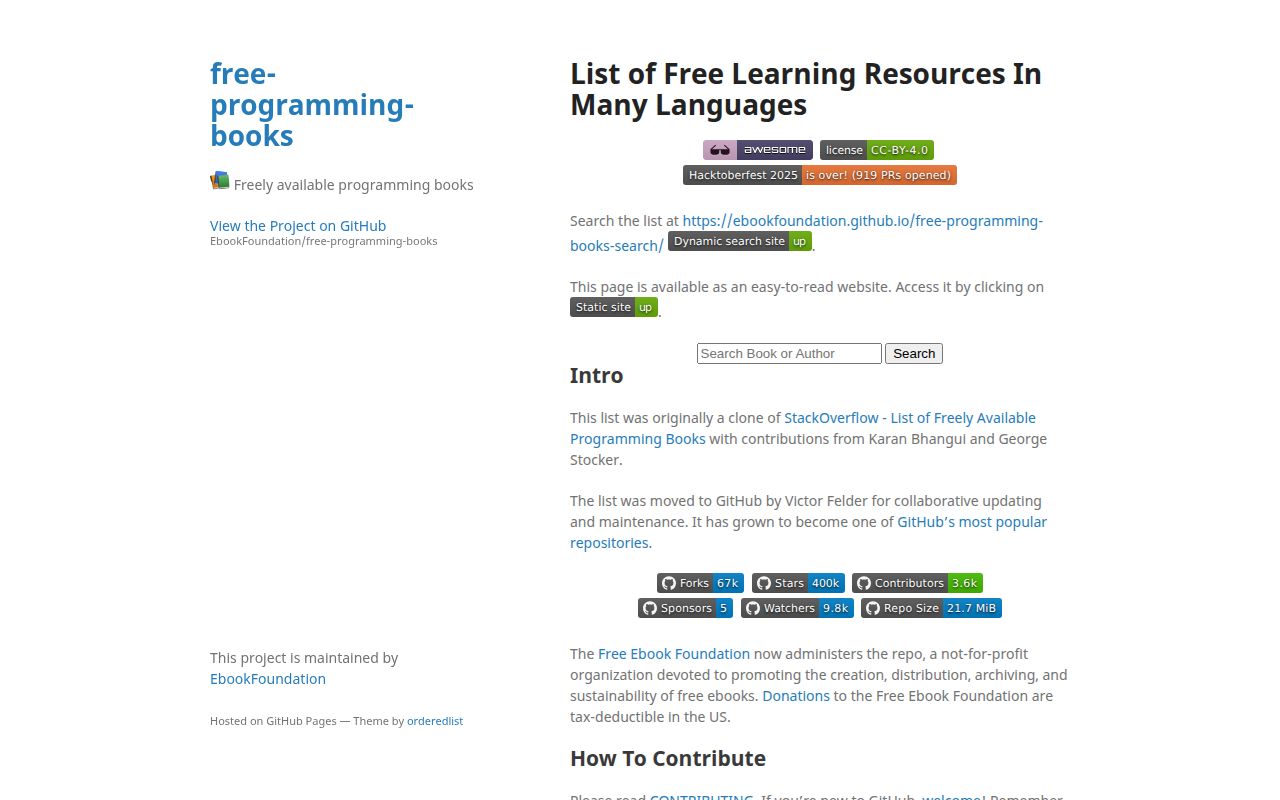
The name understates the formats available. Alongside books, the README links to courses, cheat sheets and interactive tutorials. There are programming playgrounds and problem sets, too. You can switch the kind of material without leaving the catalog's navigation. The reader-facing entry points are GitHub, a static website and a separate search site. Installing repository tooling is unnecessary for that browsing job.
What happened when we ran it
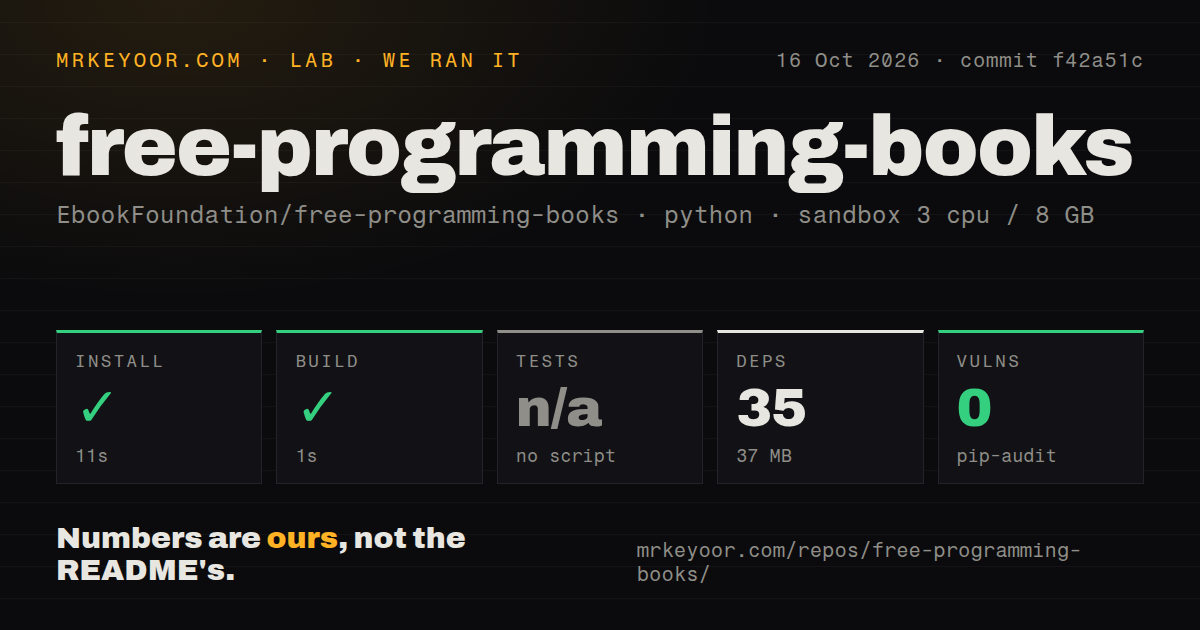
Our sandbox installed commit f42a51c in 11 seconds, recorded 35 dependencies and 37 MB on disk, and completed the build in 1 second. The October 16, 2026 run classified the repository as Python. The checkout contained 233 files, about 606 source lines and 2.4 MB of material. Those measurements describe the repository and the lab's setup path, not the size or quality of the linked books.
No test script or target was available, so tests were skipped. Pip-audit reported 0 known vulnerabilities. The scan found 7 CI workflow files, no Dockerfile and no tests directory. The missing test target does not erase the workflows, and the workflows do not turn our skipped test step into a pass. Nothing in this run establishes that every destination is reachable or that its lessons are accurate.
The recorded sandbox configuration had 3 CPUs and 8g RAM and used image ghcr.io/astral-sh/uv:python3.12-bookworm. Actual runtime and operating-system versions require the raw toolchain logs. For someone choosing a textbook, even a fast successful build answers a different question from whether the book suits their background. Use the setup result when considering repository work. Judge the learning resource on its own contents.
Alphabetical lists leave the study order to you
The contribution guide asks contributors to insert links alphabetically. Its metadata rules focus on titles, creators and access notes. That produces predictable lists, but alphabetical order cannot tell you which explanation assumes less mathematics or which course supplies enough practice. If you need an assigned route from introductory programming into systems, this catalog leaves that route for you to construct.
For a mentor, that freedom is useful. Choose a subject, open a promising resource and check its prerequisites against the learner's current skills. Read an actual lesson before assigning it. Then choose an exercise that reveals whether the learner understood it. This is a suggested selection process, not an exercise sequence supplied or tested by the repository. Keep the final reading list short enough that the learner can begin.
Free reading does not settle reuse rights
The guide permits resources that are All Rights Reserved but free to read. It also excludes limited-time offers and generally prefers an author's site over a publisher or another host. These rules help define what belongs in the index. They do not make all destinations interchangeable for an instructor who needs to distribute copies or adapt a chapter for class.
The README applies CC BY licensing to files inside the repository. For a linked book, check that book's own terms before planning redistribution. A saved checkout preserves the lists rather than an offline collection of all their destinations. If connectivity is unreliable, confirm that the chosen resource offers an appropriate download and that you can use it as intended before making it part of a lesson.
October repairs show why links need a final check
The last repository push was October 22, 2026, and GitHub reports 92 open issues and PRs. A recent pull request proposes repairing dead links in the English programming-language list, including an Agda tutorial and Computing Fundamentals. These are contributor reports and proposed changes. We have not independently reproduced each destination failure, so they should not be presented as failures from our sandbox.
The push date and current repair work together show continuing maintenance. They also expose a practical limit: the index depends on sites its maintainers do not operate. A correct link can stop working later. Before a workshop, open the exact page you plan to assign, follow through to the reading material and keep a permitted fallback. A green repository build cannot do that preparation for you.
OSSU supplies a sequence, while roadmap.sh maps topics
OSSU Computer Science groups study into Intro CS, Core CS and Advanced CS, followed by a final project. Its guidance recommends working through Core CS from top to bottom and lists prerequisites. Choose it when deciding the order is your main difficulty. OSSU also warns that some courses charge for graded work, so check access terms before committing to a route. We did not measure OSSU in this run.
Developer Roadmap, the repository behind roadmap.sh, offers interactive roadmaps whose topic nodes open further explanations. Pick it when you need to identify the subjects associated with a developer role or technology. Free Programming Books is more useful after you have chosen one of those subjects and want reading options. For your next session, pick one resource, verify its access and read its first substantive lesson. Bookmark the catalog after you have started.