2 files are the entire repository
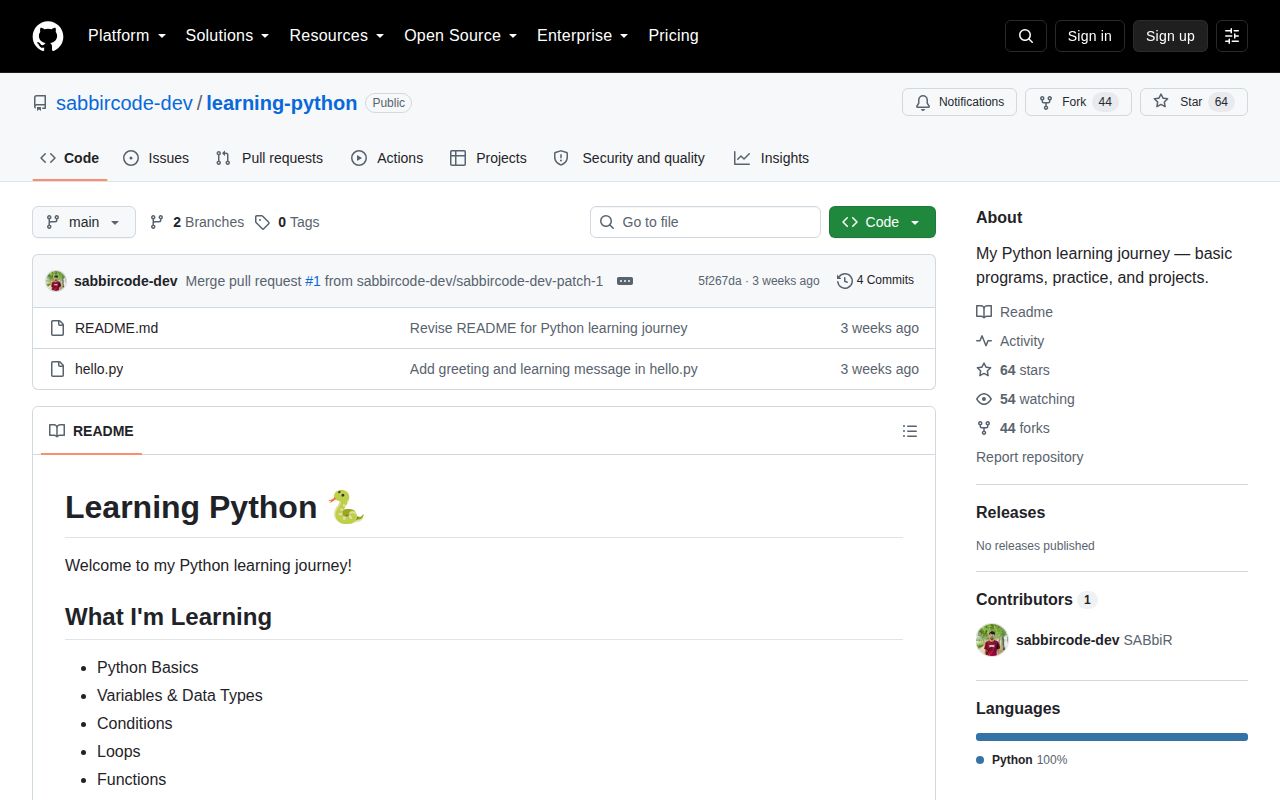
learning-python contains README.md and hello.py. The script has 2 print calls: one says hello to GitHub and the other says the author is learning Python. There are no variables beyond string literals, no conditions, loops, functions, imports, inputs, exercises, or projects. The README is 260 characters long and lists those concepts under a heading about what the author is learning. That makes the repository easy to understand, but it also settles the review quickly. This is evidence that a learner started, not material that teaches another learner.
GitHub showed 64 stars, 0 open issues and pull requests, and a latest push on 2026-09-17. Those figures may reflect encouragement or interest in the journey, but they do not add missing lessons. A beginner deciding where to spend study time needs explanations, worked examples, tasks, and some way to check answers. None appears in the 2-file tree. The README's goal is to build real-world projects, phrased as an ambition. It does not say that projects are already included or give a dated plan for adding them.
3 source lines cannot support the promised topic list
Our repository scan counted about 3 lines of source and 0 MB checked out after rounding. The README names Python basics, variables and data types, conditions, loops, functions, and simple projects. The program demonstrates only basic output. This gap is not a documentation flaw hiding a useful codebase; it is the current state of the codebase. A reader cannot practice branching, iteration, decomposition, error handling, or testing here because there is no example or prompt that uses those skills.
The repository also has no detected license. That matters less for reading 2 print statements than it would for a course, but it matters if a teacher wants to copy future exercises or examples into class material. There is no contribution guide, issue template, discussion prompt, or curriculum sequence either. A mentor could still use the repository as a place to suggest the next commit, yet that relationship would happen outside the published material. The page does not tell an unfamiliar contributor what kind of help the author wants.
What happened when we ran it
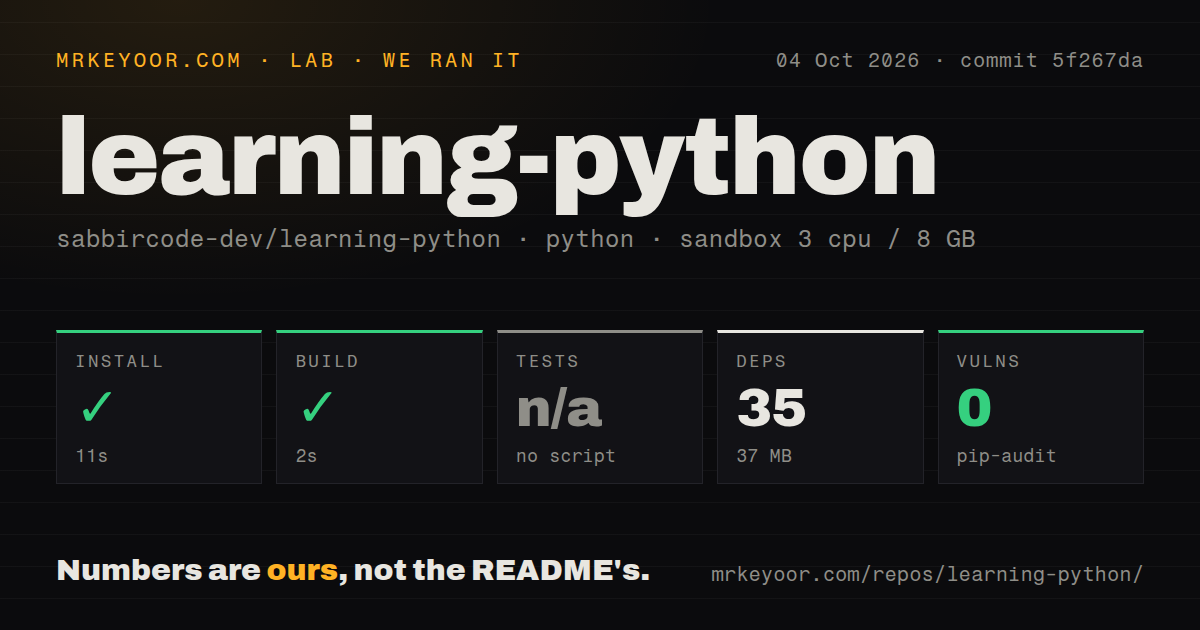
Our sandbox processed commit 5f267da in 11 seconds. The Python harness installed 35 packages occupying 37 MB, and its build step succeeded in 2 seconds on 3 CPUs with 8 GB of RAM. The repository declares no dependency file, so those packages describe the harness environment rather than a documented requirement of hello.py. The checkout itself had only 2 files and about 3 source lines. pip-audit reported 0 known vulnerabilities in the environment it examined.
There was no test script or target, so the lab skipped tests. The repository had 0 CI workflow files, no Dockerfile, and no tests directory. That is proportionate for 2 print calls, although it means there is no automated signal to grow with future exercises. We did not invent a test command for a project that supplies none. If later commits add functions or small projects, even simple example assertions would turn the repository from a statement of intent into material a learner can safely change.
A 260-character README is a status note, not a course
The README succeeds at one modest job: it tells visitors that the author has begun learning Python and names a few intended subjects. Its 260 characters are readable, and the tone fits a first repository. It does not explain how to run the script, which Python version to use, what order to follow, or how the listed subjects connect. There are no links to outside lessons. Calling this documentation poor is accurate for a reusable project, but perhaps misses the owner's purpose. The stronger point is that strangers should not mistake a public journal stub for instruction.
A useful next stage would require actual artifacts, such as one small program per concept, expected output, exercises, and tests. That is editorial judgment, not a claim that the author promised those items. The current repository should be judged as it exists on 2026-09-17. With 0 releases and no license, it offers no stable course edition or reuse terms. Stars do not change that decision.
3 alternatives already teach the missing material
trekhleb/learn-python is the closest replacement for someone who wants explanations, examples, and test-backed practice in one repository. Asabeneh/30-Days-Of-Python supplies a daily sequence and exercises, which gives a complete beginner a pace and visible checkpoints. TheAlgorithms/Python is better later, after syntax basics, because its many implementations are material to read, run, and compare. Each alternative serves a reader. learning-python currently serves its author, and there is nothing wrong with that as long as nobody mistakes the title for a finished curriculum.