mrkeyoor.com_
Wed 02 Sept 16:57 UTC
Dev Toolsevaluationupdated 02 Sept 2026

30-Days-Of-Python review

30 Days of Python is a free, English-language course that takes a beginner from installing Python through data work, web APIs, Flask, and MongoDB. Each numbered day combines an explanation, examples, and exercises, with translation folders for several languages. It solves the blank-page problem for self-directed learners by supplying an ordered route through a large subject.

trackingstars / 7d
Verdict

Our python_for_web/ install pulled 41 packages and pip-audit found 19 known vulnerabilities, so use this course as reading material rather than deployable starter code. The 30-day sequence is friendly and unusually broad for a free beginner resource, but old version guidance and unverified examples require an alert learner or instructor. Choose it for momentum, then check behavior against current Python documentation and build projects in a clean environment.

We ran it

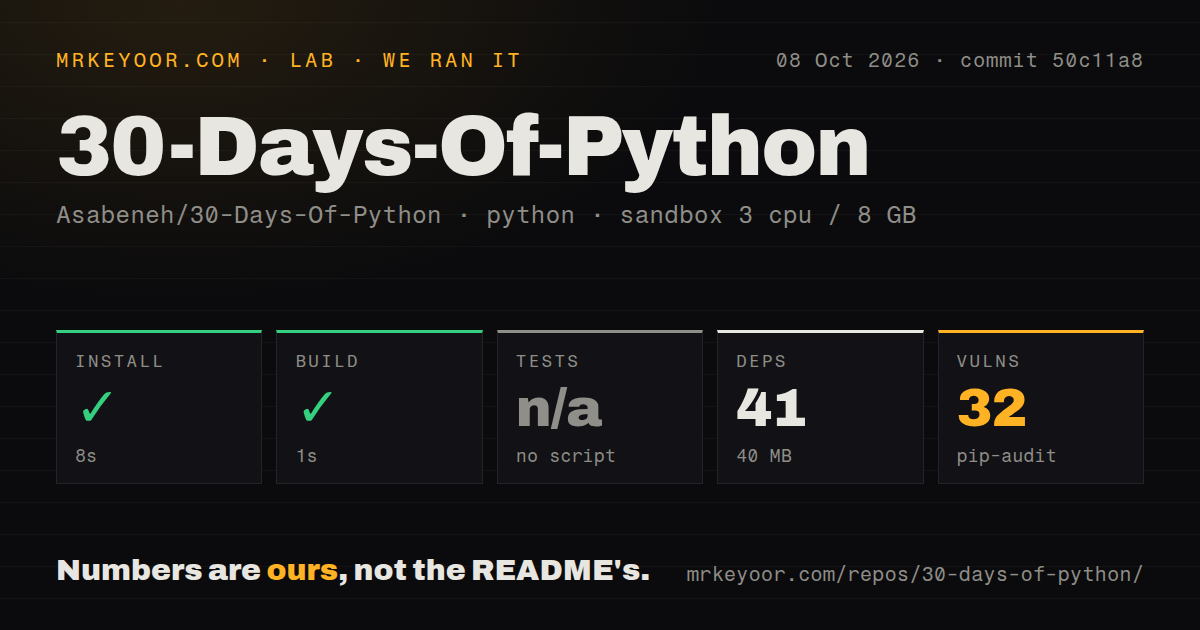
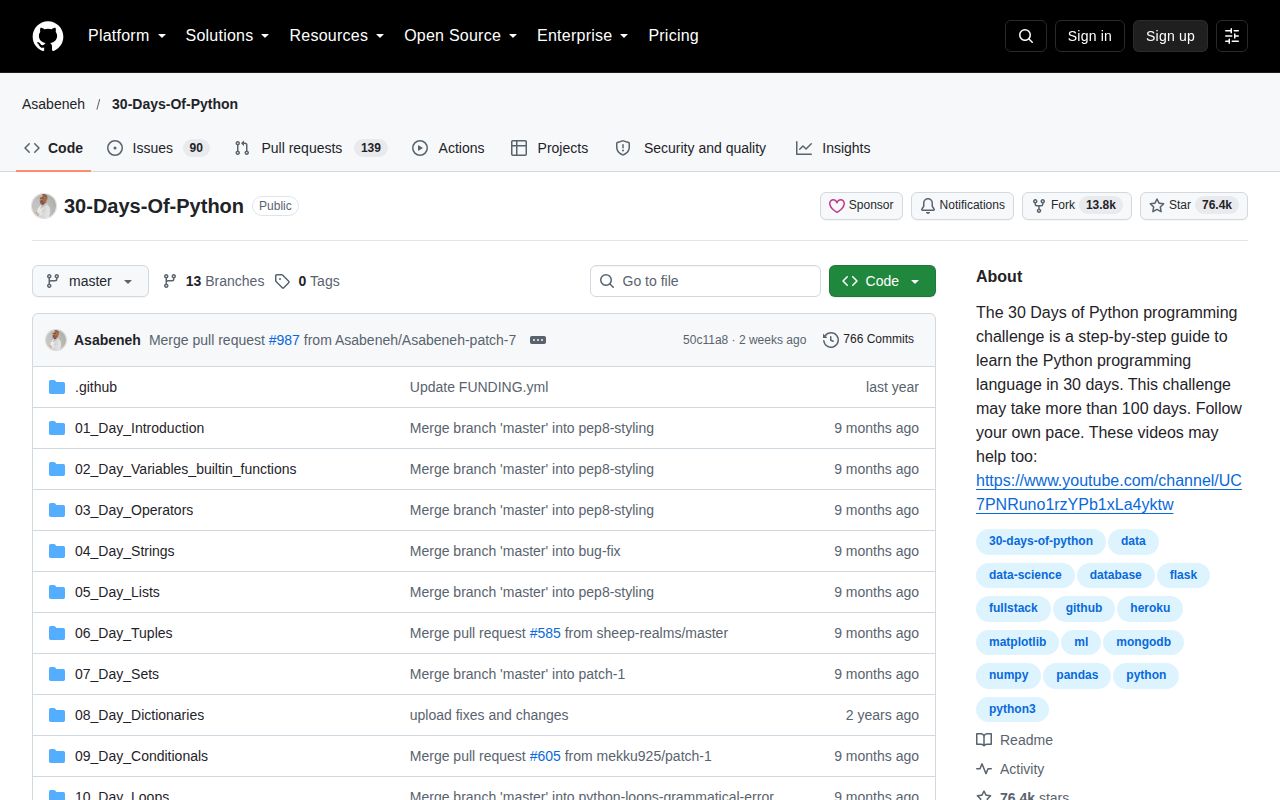
Lab card: what happened when we ran 30-Days-Of-PythonScreenshot of 30-Days-Of-Python (github.com/Asabeneh/30-Days-Of-Python)
Install✓ · 16s41 packages · 40 MB
Build✓ · 3s
Testsn/ano test script
Known vulns19(pip-audit)
Repo404 files~4,495 lines of source · 71.2 MB · 0 CI workflows

Answers from our run

Does 30-Days-Of-Python build from source?

Dependencies installed in 16 seconds (41 packages), and the build succeeded in 3 seconds. We cloned commit e1841c0 into a clean Debian container with 3 CPUs and no project-specific setup.

Does 30-Days-Of-Python have tests you can run?

Not through a standard command: the project exposes no test script or target that our harness could run.

Does 30-Days-Of-Python have known vulnerabilities in its dependencies?

pip-audit flagged 19 known advisories in the dependency tree at the time of our run.

Who should not use 30-Days-Of-Python?

Learners who need current version-specific setup guidance: Day 1 shows Python 3.7.5, says 3.6 or newer is sufficient, and identifies the material as a July 2021 second edition.

What are the alternatives to 30-Days-Of-Python?

Exercism Python Track, Learn Python, Python Data Science Handbook. Our python_for_web/ install pulled 41 packages and pip-audit found 19 known vulnerabilities, so use this course as reading material rather than deployable starter code.

Setup4/5Lessons need little setup; the web example installed in 16 seconds
Docs3/5Clear 30-day scope, with old examples and open corrections
Community4/572,639 stars and August 2026 activity, with a large backlog
Maturity2/5No release or tests, plus 19 audited vulnerabilities

Who it’s for

First-time programmers who want one topic sequence and daily practice prompts.
Self-taught Python users who learn well from short explanations followed by exercises.
Instructors willing to select lessons, check examples, and supply their own feedback.
Readers who want introductions to pandas, scraping, Flask, APIs, and MongoDB after the language basics.

Who it’s NOT for

Learners who need current version-specific setup guidance: Day 1 shows Python 3.7.5, says 3.6 or newer is sufficient, and identifies the material as a July 2021 second edition.
Developers seeking a web starter they can deploy: the measured Flask example pins old packages, pip-audit found 19 known vulnerabilities, and its app starts with debug mode enabled on all interfaces.
Students who depend on automated grading or verified examples: our scan found no test target or tests directory, while open issue 943 documents an index() lesson that calls find().
Organizations planning to redistribute course material without separate permission: GitHub reports no detected license for the repository.
Anyone expecting a maintained release channel: GitHub returned no latest release, and updates arrive as repository changes instead.

Setup reality

Our sandbox installed the python_for_web/ subproject in 16 seconds, adding 41 packages and using 40 MB. Its build succeeded in 3 seconds. The 71.2 MB repository held 404 files and about 4,495 source lines. There was no test target, so tests were skipped; pip-audit found 19 known vulnerabilities.

Most early lessons need only Python and an editor. Later days introduce external packages, scraping targets, pandas, MongoDB, Flask, and APIs. The measured web example pins six direct dependencies, including Flask 1.1.1, Jinja2 2.10.3, and Werkzeug 0.16.0.

The lab result belongs to python_for_web/, not to every lesson or exercise. That sample starts Flask in debug mode on 0.0.0.0, and the repository provides no automated suite for checking course answers. Use a fresh environment for exercises and do not deploy the included web app unchanged.

Thirty lessons move from syntax to a small web API

The table of contents assigns one subject to each of 30 days. It begins with installation, values, collections, control flow, and functions. Later lessons cover regular expressions, files, package management, classes, scraping, virtual environments, statistics, pandas, Flask, MongoDB, APIs, and an API-building exercise. Most days pair conversational explanations with code snippets and several levels of exercises, giving a lone beginner a route that is easier to follow than a folder of unrelated examples.

The author says completion may take 30 to 100 days, which is a healthier expectation than the title alone sets. The repository has 404 files and occupies 71.2 MB because lessons sit alongside screenshots, data, examples, and translation folders. That breadth is useful for browsing, although translation coverage is uneven by folder. Treat the day labels as ordering rather than deadlines, especially once the course reaches packages and web services.

Day 1 still teaches from a Python 3.7.5 setup

The first lesson identifies itself as the July 2021 second edition, shows Python 3.7.5, and tells readers that 3.6 or newer should work. The basic syntax remains recognizable, but beginner setup advice ages quickly. Screenshots walk through downloading Python and Visual Studio Code, then opening a shell and running a file. A new learner may follow those pictures literally without realizing that supported Python versions and editor screens have moved on.

Only about 4,495 lines in the 404-file checkout were counted as source by our harness, since much of the course is prose and imagery. That ratio explains why a code-oriented scan cannot grade the teaching material. It also argues for checking examples rather than assuming a large educational repository has software-project controls. GitHub detected no repository license, so readers can study the public material while organizations should obtain permission before redistribution or course repackaging.

What happened when we ran it

Our sandbox targeted the project in python_for_web/. Installation succeeded in 16 seconds, bringing in 41 packages and using 40 MB on disk. The build completed in 3 seconds in an unprivileged Python 3.12 Debian container with 3 CPUs and 8 GB of RAM. The whole checkout measured 71.2 MB. These results show that the selected Flask example can be prepared by the harness without extra system packages.

There was no tests script or target, so our run skipped tests. The repository scan found no tests directory and 0 CI workflow files. Pip-audit reported 19 known vulnerabilities in the installed environment. The log block supplied for this review does not list advisory IDs or assign them to particular packages, so the defensible conclusion is limited: this dependency set should not be carried into a public service without an update and a fresh audit.

The 41-package Flask example belongs on a learning machine

The measured requirements file has six direct pins: Click 7.0, Flask 1.1.1, itsdangerous 1.1.0, Jinja2 2.10.3, MarkupSafe 1.1.1, and Werkzeug 0.16.0. Its small app renders pages, accepts form text, and redirects to a result view. When launched directly, it enables Flask debug mode and binds to 0.0.0.0. Those choices make classroom inspection easy and are poor production defaults.

Our 16-second install resolved those pins to 41 packages and produced 19 known vulnerability findings. An open pull request, number 936, proposes CSRF protection for the form endpoint, but it remains a proposal rather than code in the measured commit. Beginners should run this example on a local machine or isolated container, understand each route, and then start a separate application with current dependencies and production settings.

Exercises are plentiful, while correctness checks are manual

Daily exercises ask learners to write their own strings, collections, functions, file handlers, data analysis, and API code. That progression creates useful repetition. It does not provide a built-in grader. Open issue 943 points to a concrete Day 4 error: a section labeled index() demonstrates find() instead. The two methods differ when a substring is absent, precisely the kind of detail a beginner needs an executable check to catch.

The absence of a test target across 404 files means learners must compare outputs themselves or ask another person. Several August 2026 pull requests correct terminology, spacing, string-method examples, and stale exercise URLs. That activity is welcome evidence that readers still inspect the lessons. It also shows why an instructor should run selected snippets on the Python version used in class before assigning them, particularly later examples that call outside APIs.

August 2026 contributions have not cleared the backlog

GitHub recorded the last push on August 27, 2026 and 72,639 stars when fetched. The repository API showed 202 combined issues and pull requests, while recent entries included corrections to class naming, string examples, and exercises. This is an active audience around a course first published in 2019. GitHub returned no latest release, so there is no tagged edition that freezes a known set of lessons and dependency choices.

The 3-second build and 16-second install make the Flask folder easy to open, but the 19 audit findings make it a bad starting point for deployment. The course works best as a paced reading and practice guide, with current Python documentation beside it and a mentor available for disputed examples. Its value is the ordered 30-day route. Its limit is that neither popularity nor recent pull requests verifies each lesson for you.

Alternatives

ProjectWhat it isPick it when
Exercism Python TrackA Python exercise track with automated checks and optional mentoring.pick this instead when feedback on working code matters more than a continuous 30-day narrative.
Learn PythonA topic-based Python tutorial built around executable examples and tests.pick this instead when you want examples organized for local execution and verification.
Python Data Science HandbookA notebook-based book focused on NumPy, pandas, visualization, and machine learning.pick this instead when you already know Python syntax and want a deeper data-science path.

What people are saying

  1. [github-trending] Asabeneh/30-Days-Of-Python

Sources

  1. 30 Days of Python repository
  2. 30 Days of Python README at measured commit
  3. Measured web example requirements
  4. Measured Flask example
  5. Issue 943 on the index example
  6. Pull request 936 proposing CSRF protection

More dev tools reviews

Magisk · FFmpeg · trippy · portless · fmt · herdr · the whole board →