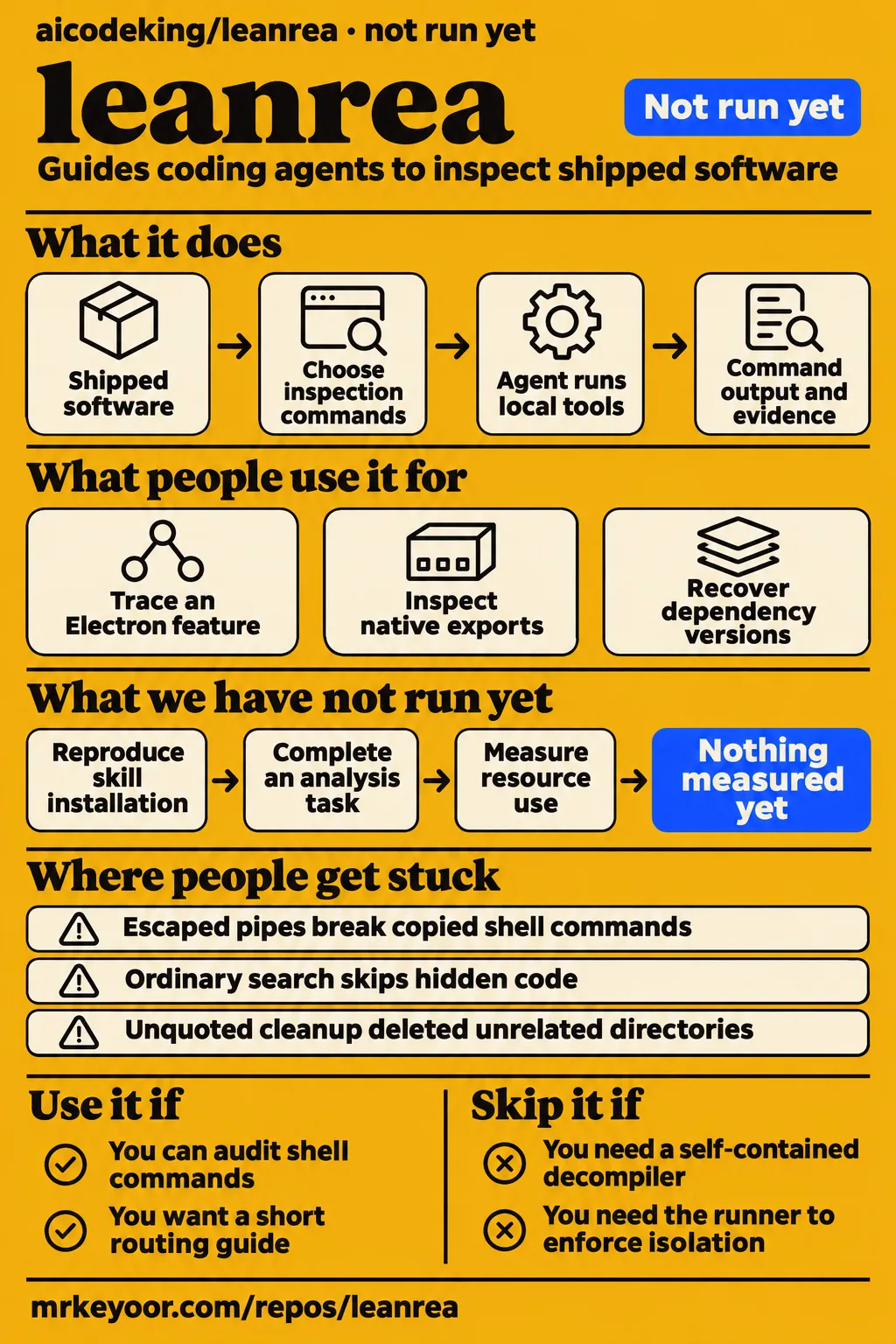
Use leanrea if you already work comfortably with command-line analysis tools and want an agent to choose sensible first commands. Skip it if you expect a self-contained decompiler or commands you can trust without reading. The author's benchmark scored leanrea 74/75 against REA's 75/75; our sandbox attempt stopped before execution. Those are different kinds of evidence, and the distinction determines how much weight to put on this review. Author's benchmark
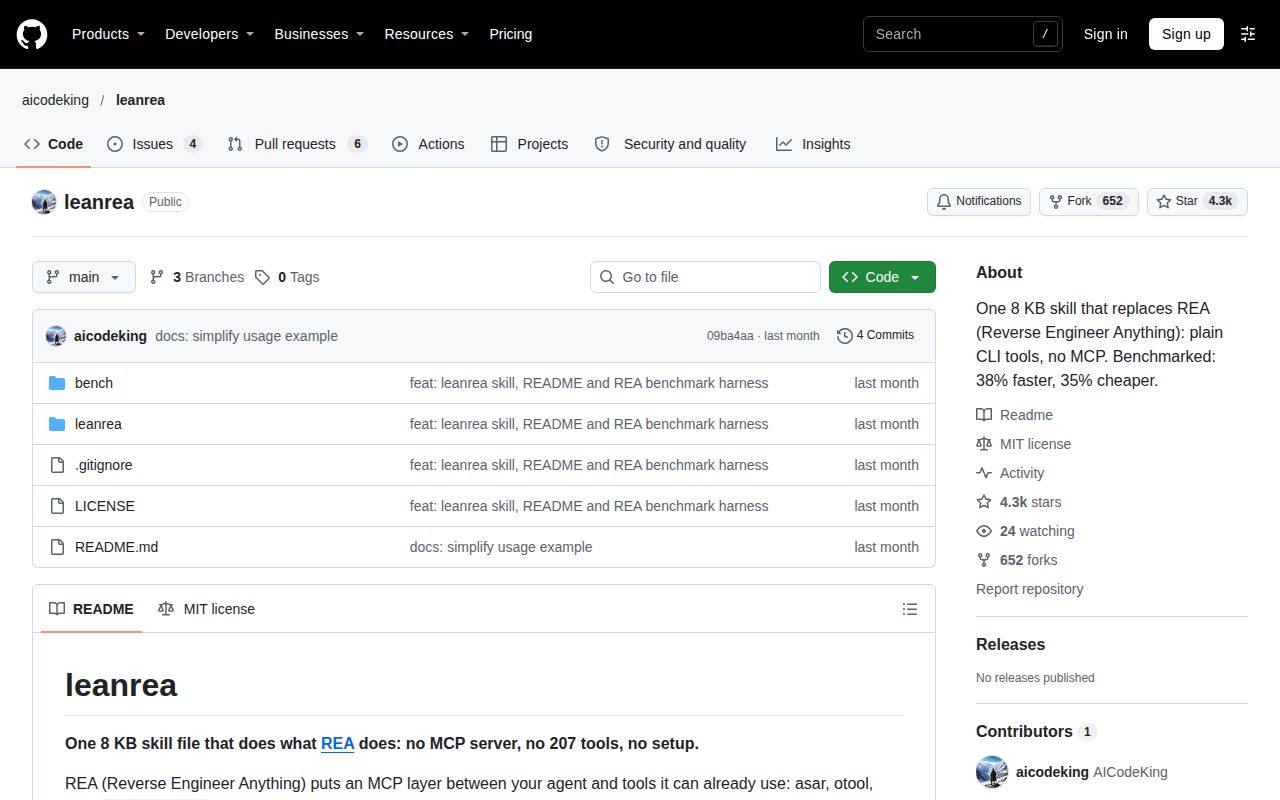
leanrea is an MIT-licensed instruction file for coding agents that inspect shipped software through local tools, without adding an MCP server. Its GitHub repository is aicodeking/leanrea. The useful idea is to start with the file format, choose a cheap inspection command, and ask for evidence before escalating to decompilation. The open command bugs make this a skill worth reading and adapting, rather than installing and forgetting. Project README
What people use leanrea for
The author's benchmark used leanrea to trace an Electron feature, inspect a native addon, read Go build information and reconstruct a native lock protocol. These are specific analysis tasks, with answer keys, rather than reports of a company deploying it across its engineering team. Each benchmark use case below belongs to aicodeking's comparison; the installation account belongs to Argusic's testing agent. Benchmark collection
| Who used it | Task | Recorded outcome |
|---|---|---|
| aicodeking, project benchmark | Trace Notion's microphone and meeting-detection feature through its Electron archive | The aggregate result lost a point for identifying an existing older IPC channel instead of v2. Electron case record |
| aicodeking, project benchmark | Inspect a native addon's exports, TCC permission check and single-instance lock | This was part of the four-task comparison whose leanrea aggregate was 74/75. Native case record |
| aicodeking, project benchmark | Recover toolchain and dependency versions from a stripped GitHub CLI binary | The Go task appears in the comparison; the README separately compares raw build-info inspection with REA's CLI. Go case record |
| aicodeking, project benchmark | Recover the lock's socket path, wire protocol and peer authentication from disassembly | The comparison used Xcode tools for native analysis. Disassembly case record |
| Argusic's testing agent | Add the skill from its remote repository and a local checkout | Its evidence describes copying and registering the instruction file. Installation record |
In aicodeking's Electron use case, leanrea follows a feature from a native function to a main-process class and IPC channels. That gives the agent a specific trail to investigate instead of asking it to summarize an entire application. The reported miss also shows why the requested channel version matters: both channels existed, but the answer selected the older one. Electron task and reported miss
In aicodeking's native-addon use case, the task asks for exports, a TCC permission check and a single-instance lock. These are concrete outputs a reader can compare with an answer key, rather than a broad request to explain a binary. The same benchmark gives the deeper lock reconstruction its own task, asking for a socket path, wire protocol and peer authentication. Native and deep task records
In aicodeking's Go use case, leanrea recovers toolchain and dependency information from a stripped GitHub CLI binary. This is a useful starting question because the desired output consists of named versions and dependencies. The README also lists a separate tool-level comparison for Go build information, keeping that command measurement distinct from the agent's full analysis task. Go task and command comparison
What happened when we ran it
Our run stopped before execution: the November 15, 2026 sandbox record at commit 09ba4aa says the harness had no supported ecosystem for its Python classification and found no Dockerfile. The recorded configuration was 3 CPUs and 8 GB of RAM, with image listed as n/a. The harness result concerns its supported execution routes; leanrea's installed product is an instruction file consumed by an agent.
| Recorded check | Result | What it means |
|---|---|---|
| November 15 sandbox execution | NOT RUN: unsupported ecosystem, classified as Python; no Dockerfile | The harness stopped before installation, build, tests or an analysis workload |
| November 16 hands-on safety step | FAILED: none of the accepted Compose filenames existed | The hands-on runner required a Compose file and stopped at its safety check |
| November 16 teardown | ok | Cleanup was recorded separately from the failed safety step |
The later safety record says: unsafe repo: none of compose.yaml, compose.yml, docker-compose.yaml, docker-compose.yml exists. Here, "unsafe repo" is the runner's label for failing its Compose requirement. The error names the missing files and the rule that stopped the attempt. It does not describe a malicious-code finding.
A separate November 16 run-summary record says it was "deployed with its own docker compose," which conflicts with that failed step. The teardown record says teardown: ok. We treat the failed safety step as the concrete launch outcome and retain the summary conflict so readers can see why the deployment wording is unreliable.
Where people get stuck: raw Markdown changes shell commands
Issue #1 reports that escaped pipes in the skill's Markdown table break commands when an agent copies the raw text. That defect affects the route through which an agent consumes the skill, so a correctly rendered GitHub table is not enough. The reporter identifies nine commands in six rows and distinguishes shell-pipeline failures from changed regex meanings and a rejected jq filter. Issue #1
| Report | Symptom | Practical response | Recorded status |
|---|---|---|---|
| Issue #1, shell pipelines | A backslash makes the pipe an argument instead of a shell operator | Review the executable command outside the Markdown table | Open; a referenced correction awaits merging in the supplied source |
| Issue #1, regex and jq | Escaped alternations search for a literal pipe; jq rejects its filter | Distinguish presentation escaping from executable syntax | Open; the report demonstrates the distinction |
| Issue #1, Electron regex | Unescaped pipes split the rendered table cell | Use a presentation that preserves the command and its display | Open |
| Argusic installation account | The skills CLI hit a Node compatibility obstacle | Check the CLI's supported runtime before installation | Its account reports a workaround, with inconsistent version claims |
The reporter's regex example returns 0 with escaped alternation and 79 with ordinary alternation. The working form shown in the issue is rg -c 'bl|call|literal|cmp' dis.txt. These results belong to the reporter's Bash-on-Linux reproduction, using ripgrep 14.1.1, jq 1.8.1 and GNU binutils. Inspect the command before interpreting an empty search as evidence that a function or instruction is absent. Issue #1 reproduction
The README tells agents to search extracted bundles with rg -uu, because code may live under hidden directories such as .webpack/. An extraction can succeed while an ordinary search skips relevant files. This differs from the escaped-pipe bug: one changes the files searched, while the other changes the command's meaning. A MindStudio account also describes a bare shell marker breaking under zsh parsing and being corrected by quoting it. Search rule, shell-marker account
Security: the benchmark runner grants broad shell approval
Issue #3 reports broad Bash preapproval without isolation enforced by the runner itself, plus an unquoted cleanup path that the reporter reproduced locally. The issue identifies the reviewed commit as 09ba4aa0217f82cd880f855a60b877f59f39b22b, matching the prefix of our sandbox checkout. Its two findings concern different operations: permissions for agent commands and shell expansion during extraction-directory cleanup. Issue #3
The issue says the runner launches Claude with --allowedTools Bash,Read,Grep,Glob,Write,Skill,mcp__rea. It does not itself enforce an OS sandbox or supply a filtered subprocess environment. According to the report, external deny rules, managed policies and existing sandbox configuration can still apply. The reporter recommends a disposable VM or restricted container, narrower approvals and a minimal environment. Runner analysis
The cleanup reproduction in the supplied issue uses Python to create disposable directories, including a TMPDIR path containing a space, then invokes the published Bash cleanup command. The reporter's assertions and observed result say the intended extraction directory remained while two unrelated test directories were deleted. The issue attributes this to word splitting and pathname expansion of the unquoted variable. Cleanup reproduction and observed result
The reporter recommends allocating a unique private extraction directory with mktemp -d, quoting path expansions, handling an unset or empty TMPDIR, and validating the cleanup destination before deletion. The supplied issue remains open and references a proposed correction. These recommendations address the actual failure mechanism more precisely than simply telling readers to be careful with shell access. Cleanup remediation
The benchmark favors leanrea, with a one-point accuracy gap
The author reports 388 seconds and $2.17 for leanrea, versus 627 seconds and $3.36 for REA, across 12 runs per arm. The published scores are 74/75 and 75/75 respectively. The benchmark document identifies Claude Code 2.1.301 headless, Sonnet 5.5, macOS arm64 and REA 6.5.0, with answers graded by regex against author-written keys. Primary benchmark methodology and totals
| Author's benchmark arm | Total analysis wall time | Reported cost | Score |
|---|---|---|---|
| leanrea | 388 seconds | $2.17 | 74/75 |
| Agent without a skill | 479 seconds | $2.21 | 67/75, with one refusal |
| REA MCP plus its skill | 627 seconds | $3.36 | 75/75 |
The plain-agent baseline changes the decision for someone who already has a coding agent with shell access. Its reported cost was almost the same as leanrea's, while its aggregate score was lower. The skill's case is better routing on these tasks. The primary benchmark also discloses a corrected grading false negative: an answer wrote "Go 1.27.1" where the regex expected "go1.27.1". Baseline and grading correction
The 400.7k-token figure belongs to a separate probe with every REA tool loaded upfront. In the primary benchmark's context table, REA MCP with deferred tool search uses 34.9k tokens, while invoking the REA skill plus MCP uses 42.7k. Invoking leanrea uses 34.5k. Reading those configuration labels gives a more useful comparison than treating eager loading as the cost of every REA session. Primary context-overhead table
An agent still needs tools, a model and readable evidence
The README's "no setup" pitch means no extra MCP server; the agent still runs local analysis utilities. The listed routes include archive extraction, native inspection, Go build information and Android decompilation. Choose the target first, then check which commands that route needs. Installing the instruction file supplies guidance, while the agent's shell invokes the analysis tools. README architecture and routing
For repeated analysis, the skill recommends bounded output and explicit evidence. Its rules include slicing large or minified files, batching independent probes, and distinguishing seen facts from inference and unknowns. Those rules give readers a way to audit an answer. They also explain why the instruction file's small size says little about the work a difficult target requires: reasoning and tool execution happen through the agent and its utilities. Workflow rules
Community attention largely repeats the benchmark. On X, @saadkamal frames leanrea as a way to remove MCP overhead, citing the author's figures. On r/PostAI, gupguru links the "Cheapest REA Setup YET!" video; the collected thread has 0 comments. These records identify the claims attracting discussion and point readers toward the creator's workflow material. X discussion, Reddit link post
leanrea vs REA, a plain agent and rea-python
leanrea routes an agent directly to CLI tools, while the compared REA 6.5.0 arm adds an MCP server and its own skill. The author tested both against a plain-agent baseline. Issue #9 adds another proposed option: rea-python's maintainer describes CLI routing with evidence IDs, limitations and a small optional MCP surface. Primary comparison, rea-python proposal
| Option | Reason to choose it | Evidence supporting the choice |
|---|---|---|
| leanrea | You want a short routing guide for tools your agent can call directly | The author's measured tasks favor it on aggregate time and cost |
| REA | You want engine-driven analysis, structured evidence or a shared interface | Developers Digest recommends these uses in its comparison |
| Plain coding agent | You want to see whether existing shell access already answers the question | The author's baseline scored 67/75 and cost almost the same as leanrea |
| rea-python | You want to explore CLI routing with evidence IDs and an optional MCP surface | Its maintainer describes this middle ground in issue #9 |
Its maintainer says rea-python combines CLI routing with evidence IDs, limitations and a small optional MCP surface. The maintainer's issue #9 asks for a same-model comparison and toolchain preflight, with raw results published separately. That proposal gives readers a concrete alternative to the skill-or-large-server framing. The rea-python repository and REA repository identify the two projects.
Developers Digest recommends REA for Ghidra, IDA or Hopper-driven pseudocode, structured evidence and shared team governance. That is the comparison author's recommendation, rather than our measured result. For a developer choosing a first experiment, the useful distinction is whether the task needs direct command output, a trace through bundled JavaScript, or an engine-driven reconstruction of native logic. Attributed REA recommendation
What the other reviews get wrong
"Same accuracy" overstates the published result: leanrea scored 74/75 and REA scored 75/75. The README itself uses the phrase, and Instagram coverage repeats equal-accuracy wording. Near-equal describes that result more accurately than identical. The disclosed older-channel answer is a concrete reason to keep the one-point difference visible when discussing how faithfully the agent reconstructed the requested behavior. README results, Instagram wording
| Coverage claim | Evidence-supported correction |
|---|---|
| MindStudio's explainer refers to a Sonnet 4.5-class setup | The primary README identifies Sonnet 5.5 |
MindStudio's DeepSeek guide installs ai-cookbook/lean-rea |
The official command names aicodeking/leanrea |
| All REA tool definitions always occupy context | Deferred tool search was enabled in the main comparison |
| No setup is needed | An agent and the tools for the target are still required |
| Argusic proves analysis worked, or proves the product cannot run | Its concrete evidence demonstrates skill installation and registration, while its running-state language contradicts itself |
| The Python repository label describes the installed product | The installed product is an instruction file, not a Python service |
These corrections follow the primary README and the supplied research synthesis of the MindStudio explainer, DeepSeek guide and Argusic record. Argusic reports a Node workaround whose version is below the minimum claimed in the same account. Its successful file copying and skill registration describe installation, while its opposing running-state verdicts describe the same product inconsistently.
Questions people ask
leanrea is an MIT-licensed coding-agent skill hosted at aicodeking/leanrea on GitHub. It directs an agent to local tools through existing shell access. The questions below cover the repository, installation, the published REA comparison and the DeepSeek workflow discussed in the supplied research. Their answers distinguish the project's documented commands from the benchmark's recorded outcomes and the creator's setup recommendations. Official README
What is leanrea, and where is its GitHub repository?
leanrea is a plain-text reverse-engineering guide installed as a skill for an agent. The official leanrea GitHub repository contains its README, skill and benchmark material. English documentation is available in the README. GitHub's Python classification describes repository content; the installed product is the instruction file that tells an agent which local commands to use for a target. Product description
Can an 8 KB skill really do the same reverse-engineering work as REA?
The author's compared tasks produced scores of 74/75 for leanrea and 75/75 for REA. The instruction file chooses commands, and the model and local tools perform the analysis. Read that result alongside the four named tasks and the reported older-channel miss: it describes what the comparison recorded rather than making file size a measure of reverse-engineering capability. Primary results
Should I use leanrea or REA for my target?
Use leanrea when ordinary local commands cover the investigation and you can inspect what the agent runs. Developers Digest recommends REA for engine integrations, structured evidence or a shared interface. Start by naming the output you need: an inventory of exports and versions, a JavaScript feature trace, or reconstruction of native logic. That makes the tool choice answer a specific task. Attributed comparison
How does an AI agent inspect a program without its source code?
The agent can inspect a binary's format, strings, imports and exports, or unpack an application archive and search bundled files. leanrea routes it toward those commands and then toward disassembly when appropriate. Its evidence rule asks the agent to label claims as seen, inferred or unknown, giving the reader a way to distinguish a file observation from the model's explanation. Tool routes and evidence rules
What is the cheapest practical leanrea setup with DeepSeek?
The supplied research describes AICodeKing's proposed workflow as leanrea with DeepSeek V4.1 Flash inside Panda Code. The associated Reddit post uses "Cheapest REA Setup YET!" in its title. Treat that as the creator's setup recommendation and the post's framing; the recorded benchmark totals discussed above belong to the Sonnet 5.5 comparison. DeepSeek workflow synthesis, Reddit post
Why do mainstream AI agents refuse some reverse-engineering requests?
The supplied DeepSeek guide reports Claude Code and Codex refusing some REA-style prompts, including requests about Electron apps and native addons. It presents a different model workflow in response. That is an attributed report about requests and outcomes. For a reader choosing an agent, keep the requested task and its authorization explicit rather than treating a model recommendation as an explanation of provider decision rules. Reported refusals
How do I install leanrea?
The official command is npx skills add aicodeking/leanrea. The skills CLI asks which supported agents should receive the skill. The README also documents manual copying and pasting the instruction text into an agent's rules when it lacks skill support. Choose the target's local tools separately, and read the raw command examples with the issue #1 failures in mind. Installation instructions
How do I configure leanrea with DeepSeek V4.1 Flash in Panda Code?
The supplied research identifies leanrea, DeepSeek V4.1 Flash and Panda Code as the three pieces of the proposed workflow. For installing this skill, use the official aicodeking/leanrea repository rather than the different repository named in the secondary guide. The official README supplies the skill-install command and explains how agents receive the instruction file. Workflow guide, official installation instructions
Does leanrea need an MCP server?
No. leanrea adds instructions and uses the agent's shell instead of registering an MCP server. The README describes the agent running real tools itself and lists routes for different file types. The user's chosen agent supplies shell access and its model connection; the relevant local utilities handle extraction, searching, version inspection or disassembly for the target. Architecture and routing
How much of REA's context overhead remains when tools load on demand?
The primary context probe reports 34.9k tokens for REA MCP with deferred tool search and 42.7k for the REA skill invoked with MCP. leanrea invoked uses 34.5k in that table. The 400.7k row explicitly loads all REA tools with tool search off, so the configuration label matters when comparing the numbers. Primary context table
Is using the model without any skill good enough?
The author's no-skill arm scored 67/75 at a reported cost of $2.21, compared with leanrea's 74/75 and $2.17. A developer whose agent already has shell access can use that plain-agent approach as a baseline. Giving both approaches the same copied target and checkable question makes the routing guide's contribution easier to assess. Primary baseline results
Does leanrea sacrifice accuracy for speed?
The published aggregate score is one point lower than REA's, alongside lower reported wall time and cost. The disclosed miss selected an older IPC channel that actually existed. That gives readers a specific outcome to weigh: the agent found a real channel but selected the wrong version for the question. It is more informative than the promotional phrase "same accuracy." Reported outcome
What we have not tested yet
Our sandbox stopped before execution, and the later Compose attempt failed its safety requirement. We did not run leanrea, reproduce skill installation, complete an analysis task, measure its resource use, or establish actual runtime versions from toolchain logs. The recorded image label supplies no operating-system version. There are no completed known-answer questions or screenshots in our supplied run records. Setup, documentation execution, community support quality and production maturity remain unassessed by our own testing.
The author's comparison covers one model, one machine and three repetitions per task and arm. Ghidra, Hopper and jadx were absent according to the README; the benchmark document also identifies absent native providers. The collection records unanswered questions about dependency-install approval delays and matching output caps or batching across arms. We have not resolved those questions, reproduced the totals, or compared current REA and rea-python versions. The figures support the named comparison, rather than a universal replacement claim. Benchmark boundaries, unanswered methodology questions
The complete supplied issue #3 includes the cleanup reproduction, its assertions, the observed unintended deletions and proposed remediation. This review did not independently execute that reproduction or rerun a patched command. The reporter's separate runner-permission validation used mocked subprocesses; the prompt-injection scenario was not a demonstrated exploit. No long-running workload or production adoption study accompanies this review. Issue #3 validation and reproduction
The supplied material also leaves the DeepSeek cost projection, refusal behavior, detailed Panda Code configuration and credential handling outside our measured results. Argusic's inconsistent Node version account supplies no reliable minimum-runtime recommendation, and its installation record does not demonstrate completed analysis. The rea-python comparison remains a proposal. The next useful result is one copied application, one known-answer question and a saved command transcript showing that the agent found the right version of the right feature. Installation account, DeepSeek guide, comparison proposal