REA connects 117 agent tools to several kinds of software
REA is an MCP server and CLI for investigations that normally spill across unrelated programs. It can inspect native binaries through Hopper or Ghidra, map JavaScript and Electron applications without executing their modules, read .NET metadata and CIL, inspect APKs through JADX, observe a selected browser, and capture declared process behavior. The same application workflows sit behind the terminal and MCP interfaces, so an agent can retain evidence while moving between questions.
That breadth is the reason to consider it. A developer can start with a string seen in an app, follow references into code, compare artifacts, and give the result back to a coding agent. REA records artifact identity, provider details, locations, confidence, limitations, and unknowns. Its README is careful about the boundary: pseudocode is not recovered original source, and a correlation between static and runtime findings does not prove causality.
The 11-second install does not include the analysis engines
The npm path is short, but a working investigation depends on the target. REA requires supported Node 22, 24, or 26 releases and runs on macOS 12 or newer plus named Linux distributions. Native analysis needs separate software. Hopper has its own license and demo limits. Ghidra support requires version 12.1.4 and a 64-bit JDK 21, supplied by you. Static APK work also expects Java and a headless JADX JAR.
Setup can register supported agents, back up existing configuration, and show changes before applying them. Restart the client afterward. Open issue 737 catches an easy mistake: installing the reverse-engineer-anything skill by itself provides instructions, but it does not register REA's MCP server. Issue 726 also documents how the broad doctor command can complain about unrelated optional providers even when a JavaScript task already works. Provider-scoped checks exist, though the quick start does not yet explain that path well.
What happened when we ran it
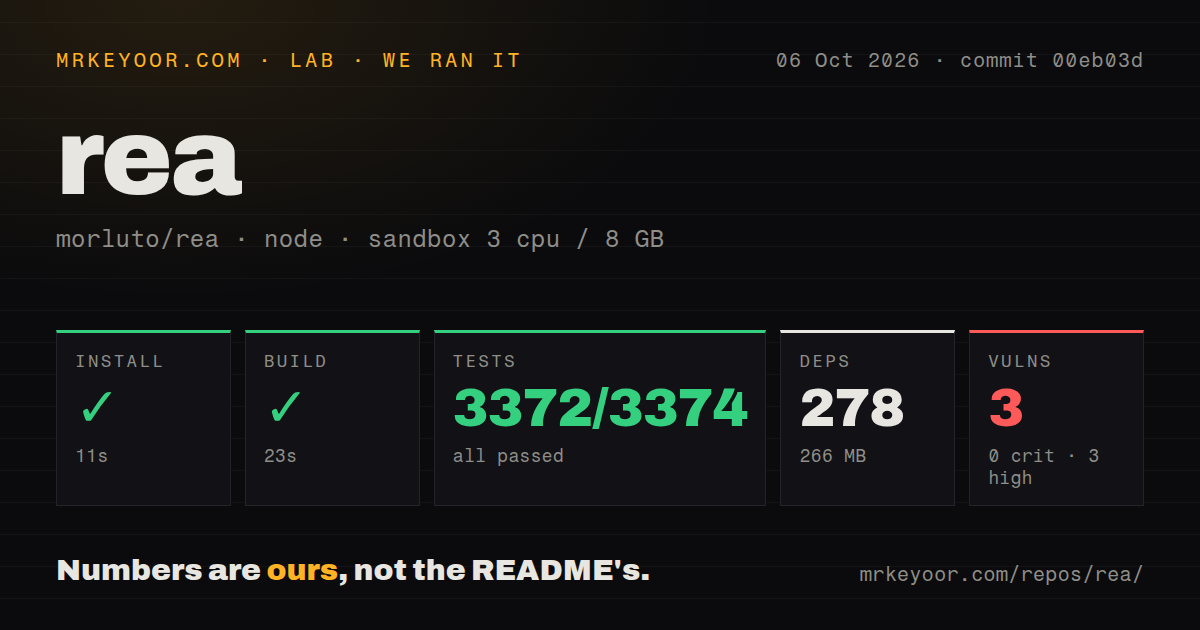
Our sandbox installed commit 00eb03d in 11 seconds. npm added 278 packages and the installed tree occupied 266 MB. The repository itself contained 1,502 files, about 235,008 lines of source, and a 16.9 MB checkout. The build completed successfully in 23 seconds. We found 6 CI workflow files and a tests directory, but no Dockerfile.
Vitest ran for 341 seconds and reported 3,372 passed, 0 failed, and 2 skipped out of 3,374 tests. That is a serious test corpus, and it passed under 3 CPUs, 8 GB of RAM, Node 22, no secrets, and no elevated privileges. npm audit still found 3 known high-severity vulnerabilities, with no critical, moderate, or low findings. Those advisories deserve review before REA is placed beside sensitive proprietary targets.
The sandbox result covers installation, compilation, tests, and the dependency audit. It does not test Hopper, Ghidra, JADX, a real MCP client, browser capture, decompilation quality, or reconstructed code. Treat the green suite as evidence that this commit builds cleanly, not as proof that every external provider is ready on your workstation.
Complete evidence can consume more context than the target
REA's insistence on complete evidence has a measurable cost. Open issue 723 reports 117 discovered MCP tools. Their complete definitions, including output schemas, occupied 1,949,695 bytes in that evaluation. Names, descriptions, and input schemas alone used 699,835 bytes. For a three-file JavaScript fixture containing 422 text bytes, MCP output reached 759,454 bytes because structured results and evidence repeat information for compatibility.
This is not a cosmetic complaint when an agent pays for every token it receives. The issue estimates 167,799 proxy tokens for the input-facing projection, while warning that this is not every host's actual tokenizer or context cost. The team is discussing concise summaries and reduced repetition without dropping provenance or unknowns. Until that changes, test discovery and one representative result in the exact MCP client you plan to use.
Large JavaScript targets still hit a hard string limit
Open issue 623 gives the clearest reason to keep another tool nearby. REA 3.2.1 failed while analyzing its own compiled directory, a target of 719 JavaScript files and about 5.7 MB of source. The public error only said reason: io; the underlying exception was RangeError: Invalid string length while canonicalizing a whole semantic graph for hashing. The reporter also found a second full-result failure in JSON formatting.
That bug is more relevant than a vague warning about scale. REA is meant to inspect applications, and compiled Electron or JavaScript packages can be much larger than 719 files. Filtering the output helped one formatter path in the report, but the analysis failure happened earlier. Before adopting REA for a large bundle, run the largest real target through the same version and preserve a CLI fallback for narrower queries.
Active development brings fixes and moving edges
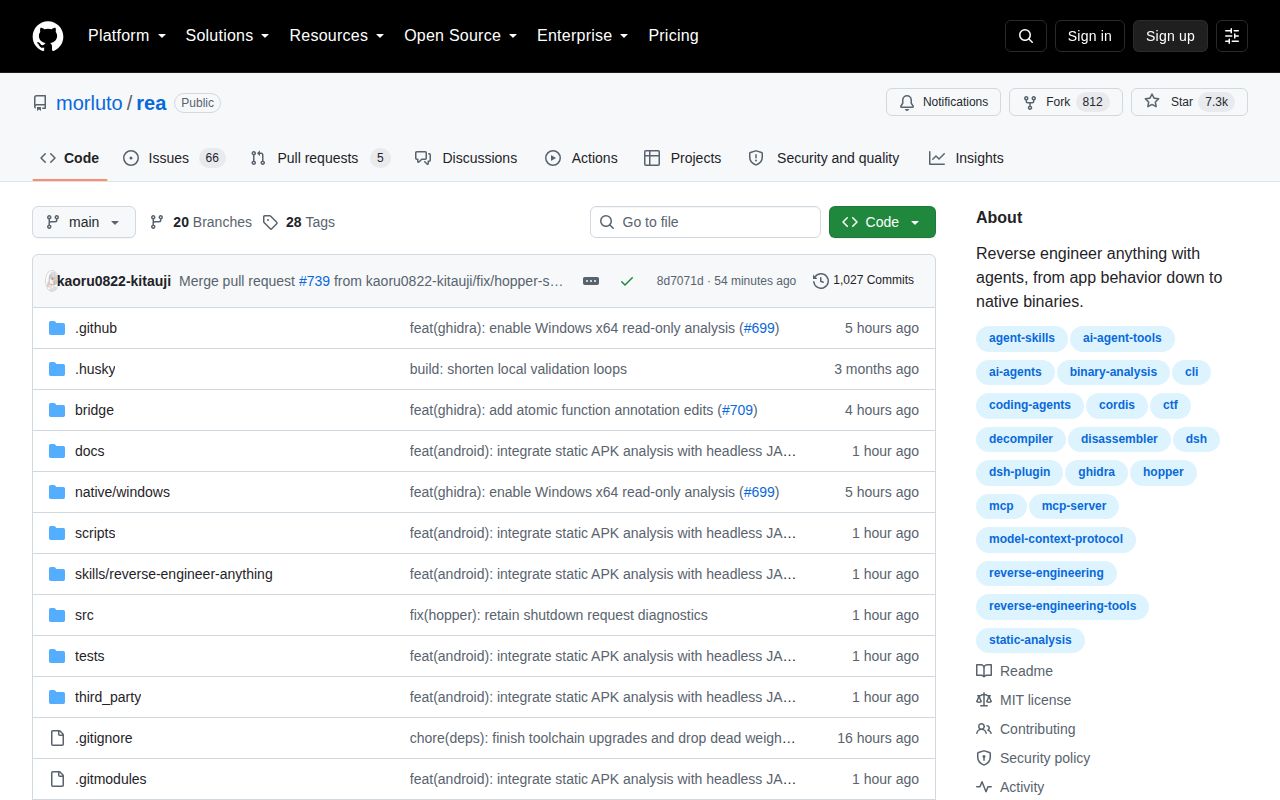
GitHub showed 7,293 stars, MIT licensing, and 71 combined open issues and pull requests on October 6, 2026. The repository was pushed that day, one day after release 4.0.1. Current activity includes Android integration, firmware work, browser metadata fixes, documentation gaps, and an open design question about how investigations should retain evidence after a target closes. This is active maintenance, with interfaces still being refined.
REA makes the most sense when breadth and auditable agent work are worth the provider setup and context load. Our passing 3,372-test run gives it more credibility than a polished MCP demo. The 3 high-severity audit findings, 1.95 MB tool catalog, and reproducible large-target failure set the conditions for adoption: pin the version, inspect dependencies, test your biggest artifact, and keep a human responsible for the conclusion.