This repository builds layer5.io, not Meshery
The README opens with Layer5's product family, which makes the repository easy to misread as an infrastructure-management application. The contribution guide is clearer: this is the Gatsby site hosted at layer5.io. It contains pages for Meshery, Kanvas, Nighthawk, the cloud-native catalog, Layer5 Academy, performance specifications, Sistent, community programs, blogs, events, and resources. Developers evaluating Meshery should stop here and open meshery/meshery instead.
As a website repository, it has a wide editorial job. Markdown and MDX collections feed articles and resources, React sections implement landing pages, and Sistent documentation mixes live components with usage guidance. Contributors receive preview deployments and are asked to work from assigned issues, follow the theme system, sign commits, and use the site's established components and content templates.
What happened when we ran it
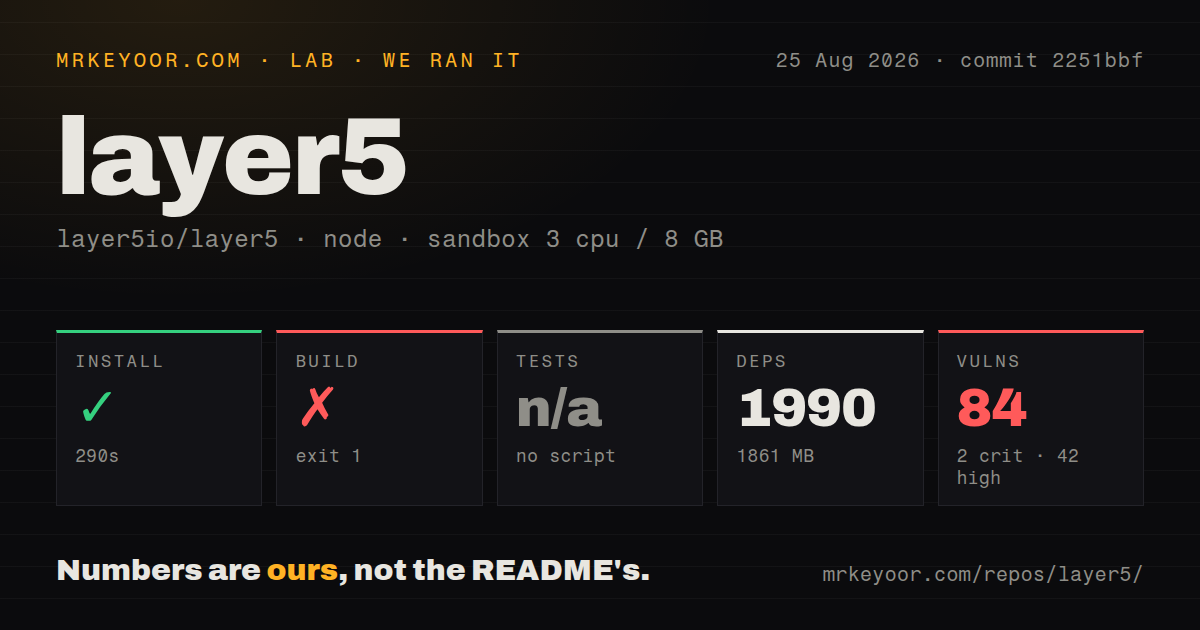
Our sandbox installed 1,990 npm packages in 290 seconds and used 1,861 MB on disk. The full Gatsby build then ran for 249 seconds before exiting with code 1. commit 2251bbf contained 13,581 files, about 316,523 lines of source, and occupied 587.9 MB before dependencies. This is a large local checkout even without its full Git history.
The tail of the failed build does not reveal the failure. It shows redirect data being written, bootstrap completing in 58.366 seconds, manifest work finishing, and a warning that Browserslist's caniuse-lite data was 11 months old. A stale browser database warning is not enough evidence to call it the cause. The honest finding is that the full command failed after 249 seconds and its provided tail lacks the decisive error.
No tests script or target existed, so our lab skipped tests. Npm audit found 84 known vulnerabilities: 2 critical, 42 high, 30 moderate, and 10 low. Our scan found 11 CI workflow files, no Dockerfile, and no tests directory. Those counts warrant dependency triage before treating a locally built preview as a production-ready artifact.
The full build asks Node for an 8,192 MB heap
The build script sets BUILD_FULL_SITE=true, gives Node an 8,192 MB old-space heap, and runs Gatsby. Development has a lighter core profile through npm run dev, while the full command also fixes Gatsby CPU and image-processing concurrency values. The split acknowledges that loading every content collection and page is expensive, though the supplied production build remains the final gate a contribution has to clear.
Repository history is larger still. The contribution guide warns that a normal clone downloads about 6 GB and tells contributors to use --depth=1. Our measured checkout was 587.9 MB, so that advice is concrete rather than ceremonial. Anyone opening a small typography or MDX issue should shallow-clone first and avoid paying for years of binary and content history.
Content contributions follow assignment and preview rules
The guide asks contributors to search existing issues, explain an intended approach, and wait for assignment before opening a pull request. Inactive assignments can be released after 2 weeks. Blog authors start from a template, while resources are organized by type and use frontmatter fields for technology and product. News reprints can carry a source URL for attribution.
This structure helps a large volunteer site avoid duplicate work, but it creates overhead for tiny fixes. Contributors must also sign commits under the project's DCO rule and follow a design document. A hosted preview is part of review, which is appropriate for theme and layout changes because a successful compiler cannot tell whether a card clips or a dark-mode link disappears.
MDX, navigation, and production logging have current gaps
Open issue 7991 says the ESLint MDX glob targets an empty directory while the actual content lives elsewhere, leaving 1,138 MDX files outside lint coverage. Issue 7992 reports that a Sistent page passes navigation content to a component that ignores the prop, producing an empty in-page list. Issue 7994 identifies font-weight: 5000, an invalid value that removes the visible active state on several navigation variants.
Issue 7993 also reports leftover console.log calls in production component paths, including one that runs on every Sistent documentation page. These are specific defects in the site code, not a judgment about Layer5's other products. Together with the absent test target, they show why preview review and page-level browser checks are carrying more quality responsibility than an automated suite.
Product pages should not be mistaken for product source
Meshery, Kanvas, Nighthawk, the catalog, and Academy receive prominent README sections, but several belong to other repositories or hosted services. This repo is useful for changing how those projects are explained and discovered. It is the wrong place to inspect Meshery's controllers, performance behavior, Kubernetes integrations, or release quality. The same distinction applies to Sistent: component documentation appears here, while implementation lives in layer5io/sistent.
That boundary matters when assessing the 119 combined open issues and pull requests returned by GitHub. Many concern documentation, alignment, theme behavior, or community content. The count is not a product bug total for Meshery, and it includes pull requests. Buyers should judge each Layer5 product from its own source, release history, tests, and issue activity.
Same-day activity keeps the site moving, not necessarily clean
GitHub recorded 1,112 stars, 119 combined open issues and pull requests, and a last push on August 26, 2026. The latest-release endpoint returned no release for this website repository. Same-day work included Sistent documentation and interface fixes, while other August issues tracked lint coverage, navigation, debug output, and card layout. The project is active despite its build and dependency debt.
For contributors, the right approach is narrow: shallow-clone, run the lighter profile while editing, inspect the affected pages in both themes, and require the full Gatsby build before merge. Our failed 249-second build and 84 advisories make broad adoption hard to defend. This repository earns attention as Layer5's public site, not as reusable infrastructure software.