Thirteen files coordinate services they do not provide
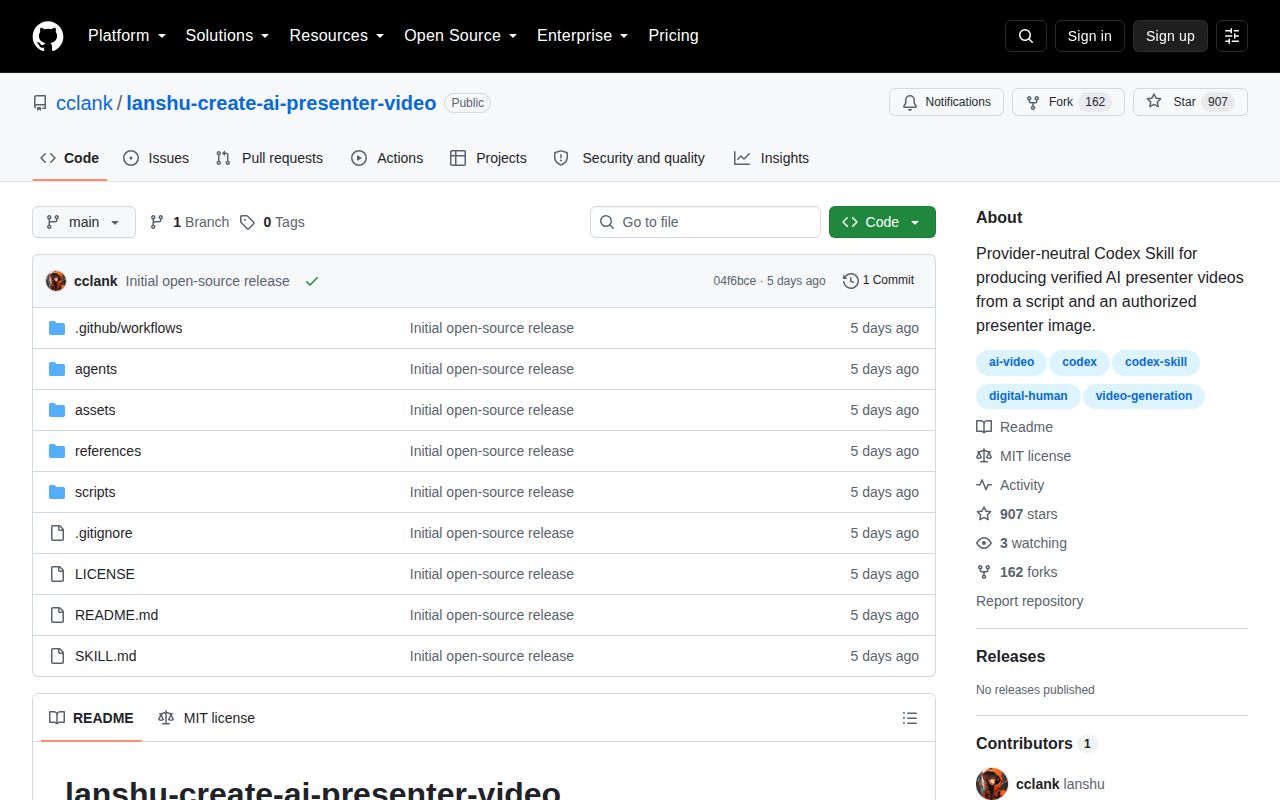
Lanshu is a workflow package for Codex, not a presenter model. Its 13-file checkout contains a skill definition, job template, three reference guides, and helper scripts for initialization, preflight, and delivery. The instructions tell an agent when to inspect inputs, lock narration, select available capabilities, run a paid pilot, compose the result, check failures, and hand off final files. Actual speech and video come from tools already available in the environment.
That distinction is the buying decision. Installing the repository does not create access to voice synthesis, avatar generation, lip sync, transcription, or a timeline renderer. The README requires at least one callable capability for the major generation stages plus FFmpeg and command-line utilities. Provider-neutral means the workflow can choose among current tools; it does not mean the project replaces those tools or their bills.
One narration track becomes the clock for every scene
The skill locks a complete voice track before presenter generation or final scene boundaries. It then uses measured audio durations to place presenter footage, captions, graphics, cuts, and transitions. Video sources are muted in the final composition so the approved narration remains the only dialogue track. This is a sensible answer to doubled audio, drifting lip sync, and chapter clips whose timing changes during editing.
Default output is vertical 9:16 at 1080 by 1920 pixels and 30 fps. Topic-led videos target 45 to 75 seconds, while a supplied script keeps its natural duration. The workflow usually uses one presenter image, one voice identity, one visual treatment, and one continuous presenter source. Those defaults are editable, but they force a producer to state a different platform or format instead of leaving basic delivery choices ambiguous.
The presenter guidance is specific about common defects. It asks for restrained motion, bilateral blinking, stable identity and lighting, hands kept low, and a settled closed-mouth tail. If body motion is accepted but mouth timing is late, the skill preserves the motion plate and applies a dedicated lip-sync repair using the locked audio. That saves a good performance instead of paying to regenerate every visual choice.
Paid generation pauses before money or private media leaves
Before the first remote or paid call, Lanshu requires a disclosure of uploaded files, selected capability, requested seconds or units, known cost, pilot size, retry ceiling, expected output, and main risks. It also requires image rights, confirmation that the presenter is an adult, remote-upload permission, and voice authorization where cloning is involved. These are decision gates, not footer disclaimers.
The workflow stops after 3 rejected paid candidates. Interrupted jobs should be polled by saved task ID before resubmission, which reduces duplicate charges. Each job records provider, model, version, region, parameters, price evidence date, sanitized request body, and task ID without credentials or expiring URLs. A provider change that affects cost, privacy, voice, appearance, or quality returns to the user for approval.
Those rules will frustrate anyone seeking unattended volume. That is appropriate for identity-based media, where a wrong upload or repeated generation can create privacy and cost problems quickly. Teams can loosen their own process, but the repository's value lies in refusing to treat every provider call as interchangeable. Its state machine preserves accepted work and resumes from the earliest unfinished stage.
What happened when we ran it
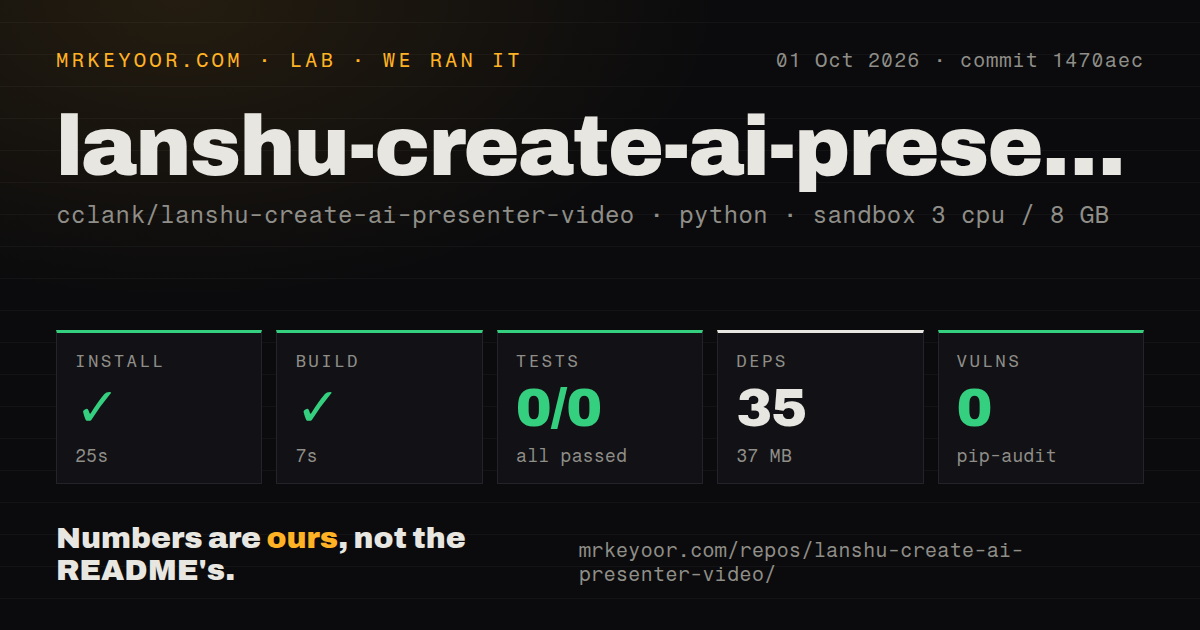
Our unprivileged Python 3.12 Bookworm sandbox cloned commit 04f6bce. The checkout contained 13 files and about 497 lines of source, occupying less than 1 MB. Installation succeeded in 11 seconds with 35 packages, and the environment used 37 MB on disk. The package build succeeded in 4 seconds.
There was no tests script or target, so our harness skipped tests. The repository also had no tests directory and no Dockerfile, though it did include one CI workflow. Pip-audit reported 0 known vulnerabilities in the installed environment. These results verify that the small Python support layer installs and builds; they do not verify video generation, lip sync, caption timing, provider APIs, or delivery quality.
A meaningful end-to-end test needs authorized media and real external capabilities. It may also incur cost, which the skill correctly places behind an approval gate. Our sandbox had no secrets and the supplied measurement did not run a production job. Buyers should judge the first real pilot by decoded output, ASR agreement, mouth timing, identity stability, full playback, and the generated contact sheet rather than by the 4-second build.
Good recovery rules need a tested provider stack
The finalizer creates master and share encodes, probes them, fully decodes both, writes reports, and produces a 9-frame contact sheet. QA also calls for normal-speed viewing, word checks around names and numbers, audio loudness near the chosen target, black-frame and freeze detection, safe-zone checks, and visual inspection of face, hands, lighting, captions, and continuity. That is far more serious than declaring success when an API returns a URL.
GitHub recorded the last push on August 20, 2026, with zero open issues and pull requests and no latest release. The MIT license is clear, but the small activity record and missing production tests make this an early workflow rather than established infrastructure. The Chinese README is accessible to its intended audience, and the English SKILL and reference files contain the detailed operating rules international contributors would need.
Lanshu is worth installing when a Codex setup already has media providers and the weak point is process discipline. It gives the agent a practical state machine, approval boundaries, and recovery paths. Teams starting without voice, avatar, ASR, and composition tools should choose and validate those components first. The 37 MB helper environment is the cheap part; reliable identity, timing, authorization, and human review are the actual production system.