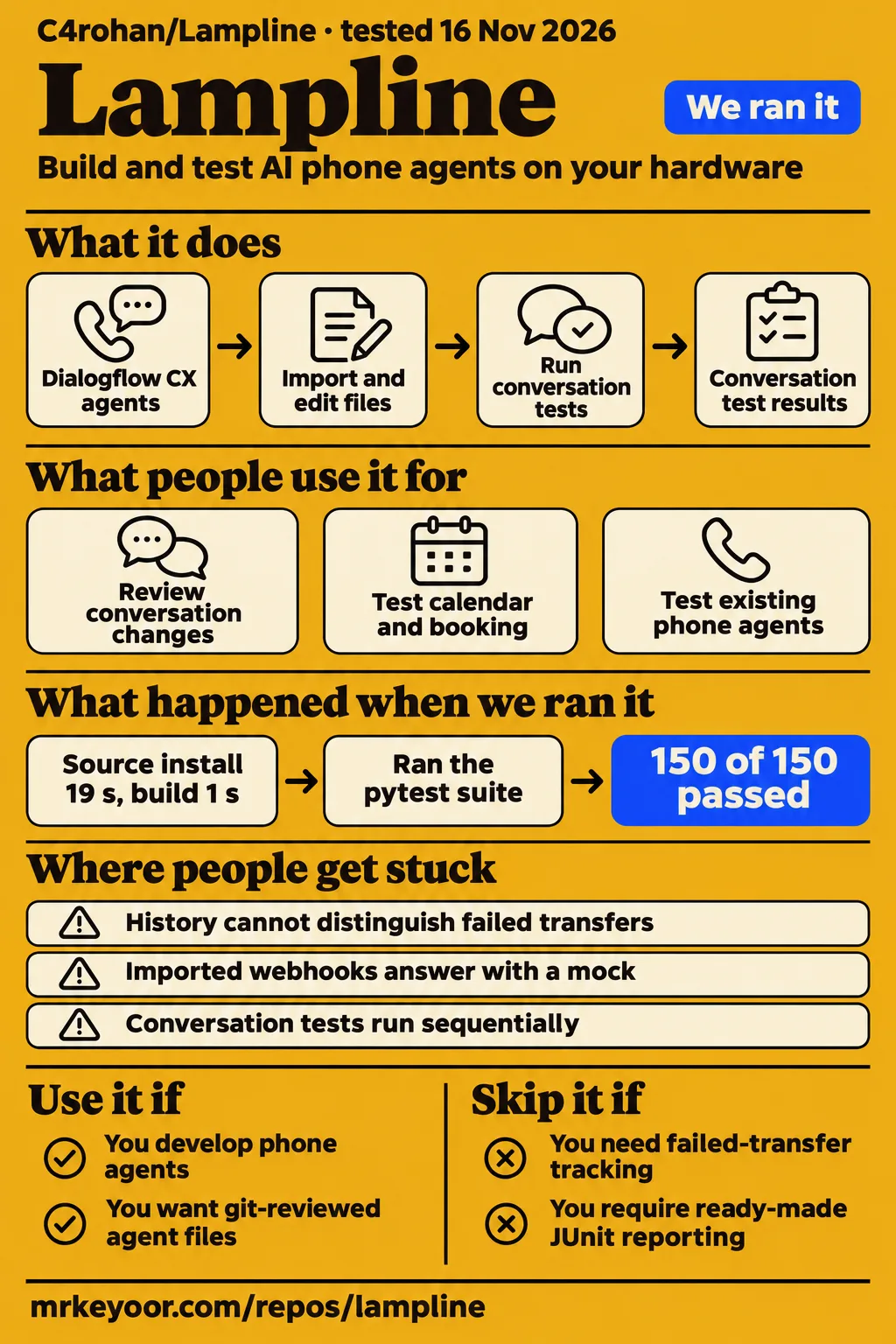
Our Lampline CLI run passed all 150 tests, but the separate phone-platform attempt stopped at a safety check: compose config unreadable. Use it if you develop phone agents and want reviewable conversation tests or a way out of Dialogflow's editor. Skip it if you need a ready-made operations console for tracking failed human handoffs. The sampled transfer-history issues explain why that distinction matters.
What people use Lampline for
C4rohan/Lampline is a self-hosted voice-agent platform that imports Dialogflow CX and CX Agent Studio agents and stores agents as editable files. Its appeal is being able to review a conversation change in git, express the expected behavior in a test, and run that test before callers encounter the change. The project README documents a CLI, visual builder, engine and AI caller rather than a single model you download.
Start with the smallest useful piece. The documented CLI path uses pipx install lampline, followed by vk templates install front-desk --dir agents/front-desk and vk lint agents/front-desk. Offline linting checks the folder. Conversation tests need a target engine or supported live Google agent. That separation matters if your immediate problem is reviewing prompt changes rather than replacing the system that answers your phone.
The import workflow has a consequential catch: imported webhooks answer with a mock until connected. EveryDev's import description says the conversion includes a report of items to check. A booking flow appearing in the builder therefore isn't a completed booking integration. Read that report, connect the external service and make the appointment actually appear in the destination calendar before routing callers to it. That is our recommended acceptance task, not a result from our sandbox.
The supplied records show a recorded clean-machine run, a calendar correction and a request to isolate failed transfers. These are more useful examples than a directory calling the platform production-ready, because each reveals the work someone was trying to finish.
- Bring up the engine on a clean machine. The creator of “Lampline tested” gave an automated agent the job of making the project run without assistance. The video reports an engine answering health and chat-session endpoints. Its transcript supplies no channel name, so the attribution here is to the titled recording. This is a separate reported run from our CLI check.
- Exercise calendar and booking behavior. In that same setup recording, the automated agent changed hardcoded UTC times to dynamic New York-to-UTC conversion using zoneinfo. The useful lesson is the task: check the appointment time at the receiving service, rather than accepting a reassuring conversational reply. The recording describes a local correction, not a merged upstream fix.
- Find the calls where a human handoff went wrong. GitHub commenter Reggiebro asked for combined transfer and error filtering in issue #35. The maintainer found that transfer results never reached history and opened #65. That exchange turned an apparently small filter request into a missing-data problem.
The second example is particularly instructive for appointment agents. A conversation can reach its booking step while the integration interprets the time differently. The recording's concrete repair concerns timezone conversion. It gives a developer a regression scenario worth keeping: ask for a local appointment time, inspect the stored UTC value, then read it back in the caller's timezone. We recommend that check because it follows the reported failure, without assigning the video the status of a production reference customer.
What happened when we ran it
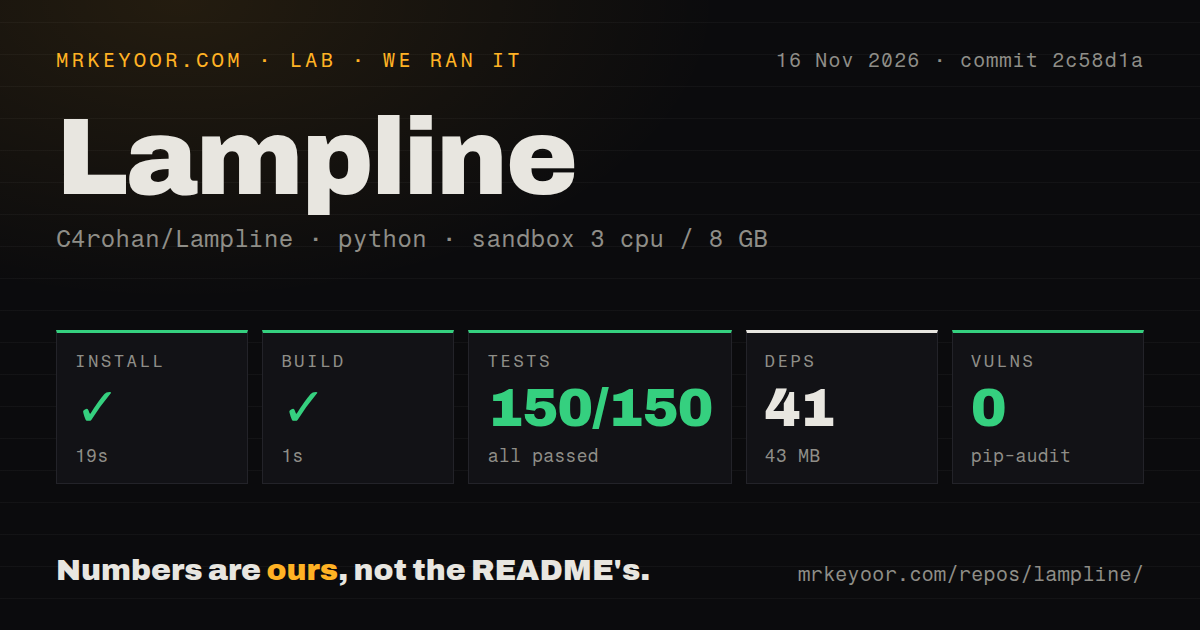
Our hands-on record for 2026-11-16 names the project's own Docker Compose and localhost-bound ports, but its safety step failed with “compose config unreadable.” The separate CLI sandbox at commit 2c58d1a installed in 19 seconds, built in 1 second and passed 150 of 150 pytest tests in 6 seconds. Those results describe different scopes, and the failed safety step prevents us from treating the Compose record as a completed phone-platform demonstration.
| Recorded check | Outcome | What it tells you |
|---|---|---|
| Hands-on Compose attempt | Safety: FAILED, compose config unreadable | The safety check stopped the attempt |
| Hands-on teardown | ok | Cleanup was recorded |
| CLI install | Succeeded in 19 seconds | 41 dependencies recorded, 43 MB on disk |
| CLI build | Succeeded in 1 second | The recorded build step passed |
| CLI tests | Succeeded in 6 seconds | Pytest: 150 passed, 0 failed of 150 |
| Dependency audit | pip-audit: 0 known vulnerabilities | No known vulnerabilities reported by that audit |
The hands-on run record, failed safety step and teardown record are the complete supplied trail for that attempt. The run summary uses the word “deployed”; the step record supplies only the failure above. There is no diagnostic log explaining why the Compose configuration was unreadable. Calling that an application defect would add a cause the evidence doesn't contain.
Our measurement setup for the CLI run used a recorded sandbox configuration of 3 CPUs, 8 GB RAM and image ghcr.io/astral-sh/uv:python3.12-bookworm. The image label is configuration information, not a runtime-version check. The measured Python project lives in ./cli/. The checkout contained 311 files, approximately 33,622 source lines and occupied 13.1 MB. The scan recorded five CI workflow files, a tests directory and no Dockerfile. That scan result describes the recorded checkout, rather than a claim that today's entire platform lacks Docker support.
For a contributor working on the CLI, the successful checks are encouraging: the measured install footprint was modest and the suite completed. For someone buying phone coverage for a business, those same results answer a narrower question. They show that the recorded CLI checks passed. They don't turn a YAML test into evidence that a person picked up a transferred call.
Where people get stuck: transfer history and portability
Issue #65 says a failed human transfer looks like a successful one because history is saved before the transfer is dialed. That is the operational issue I would put ahead of the builder's convenience. If your bot's purpose is to get urgent calls to staff, knowing that it attempted the handoff is insufficient for deciding whether the caller reached anyone.
Reggiebro's request in #35 was specific: transferred calls plus errors, with successful transfers treated as noise. The maintainer explained that adding both filters would still return an empty result for failed transfers. The follow-up, #65, proposes authenticated telephony-result callbacks, a history migration and a dedicated failed-transfer filter. Both are open in the supplied records. An assignment to a contributor shows someone has taken the work, not that callers now get the proposed behavior.
| Need | What the sampled issue says | Decision for an operator |
|---|---|---|
| Revisit a filtered call list | #35 proposes combined filters and URL persistence | Treat bookmarks as the proposed saved-view mechanism |
| Separate busy or unanswered transfers | #65 proposes recording the dial result | Require an actual result callback before relying on history |
| Keep a call beyond retention | #34 proposes authenticated JSON export | Include record portability in acceptance checks |
| Match a PBX's caller-detail headers | #32 proposes a configurable SIP prefix | Compare the current prefix with your phone-system mapping |
Issue #34 asks for a Download button containing transcript, collected details, steps, events and outcome. It remains open in the supplied record, even though a contributor was assigned. Issue #32 describes X-Lampline- as the current prefix and asks to make it configurable. These are distinct purchasing questions: can you retain the evidence you need, and can the receiving phone system read the caller details? Neither is settled by an import succeeding.
CLI testing exists; the requested CI integrations are separate
The sampled issues request JUnit reporting, parallel conversation tests, a reusable GitHub Action and a pre-commit hook. Existing vk test support should not be confused with those proposed conveniences. The distinction is especially relevant to a team whose release process expects a standard test report attached to every pull request.
Issue #99 proposes JUnit XML, including failure information and a transcript. #108 proposes an action that lints agent folders and optionally tests them using an engine. #109 requests a packaged pre-commit hook to catch broken folders and personal-data warnings. The supplied records mark all three open. The example commands inside those requests are desired interfaces, not installation instructions for completed features.
At volume, #107 identifies sequential conversation suites as the slow path and proposes --jobs parallelism with ordered output. It also calls for respecting the engine's concurrent-session limit. That is a reason to ask how long your own regression conversations take before making them a mandatory release check. Our six-second pytest result concerns the CLI's recorded test suite, not the duration of a production agent's model-backed conversations.
Local mode changes the bill, not the work you own
Lampline's documented local mode runs models and speech on your hardware without model API keys; telephony and optional cloud providers have separate costs. The README specifies the local components, and EveryDev explicitly separates model API, telephony and hosting costs. The README's --free route uses Ollama, Moonshine and Kokoro. The ordinary phone connections are Twilio, Telnyx or SIP through jambonz. “Free” is useful shorthand for avoiding model API charges in that local configuration, but it is a poor substitute for specifying the deployment you intend to operate.
Reveneau's account of the cost model correctly labels the comparison as the project's October 2026 list-price calculation and says staff time is excluded. Use that model to ask which costs move from a platform invoice to your own hardware, providers and operating work. A team already paying engineers to run voice infrastructure faces a different decision from a small business that expects a hosted provider to answer when something fails.
Security defaults put the engine on localhost
The README describes localhost binding, a key on every request, no telemetry and settings stored outside the repository. Its security and architecture description is the source for those defaults. Those are documented defaults, not findings from a penetration test. They are useful starting conditions for a developer evaluating an agent locally. They also make it important to distinguish a local builder session from a telephony deployment with endpoints reachable by a carrier.
Issue #65 requires validating proposed transfer-result callbacks with Twilio signatures and the jambonz webhook secret. The contributor guidance makes this a condition of the change. Keep that requirement attached to the feature: an externally supplied “completed” result is valuable only when the engine can trust its sender. Our audit reported zero known vulnerabilities, but dependency advisories and callback authentication answer different security questions.
Lampline vs Tel-Agent, Pipecat, Vapi and Retell
Choose Lampline for its agent-file, import and testing workflow; consider the alternatives according to which part of the phone system you want to own. The comparison below is a fit guide drawn from the supplied sources, not a measured race between voice stacks.
| Option | Reason to consider it | When I would choose it |
|---|---|---|
| Lampline | Imports Google agents and provides conversation tests plus an AI caller | An engineering team wants to review and test agent behavior in files |
| Tel-Agent | The comparison video emphasizes routing rules, records and additional chat channels | Managing an existing phone line is the main job, subject to checking that video's claims against the project |
| Pipecat with Twilio | AIx describes a direct Python implementation as an alternative to Lampline's platform overhead | A developer wants to write a simple custom agent and own the application code |
| Vapi or Retell | The supplied comparisons frame managed operation as the alternative to self-hosting | The team prefers a managed service to operating its own runtime |
The creator of “Lampline vs Tel-Agent” positions Lampline around agent creation and testing, while positioning Tel-Agent around the phone line and routing. The transcript supplies no channel name. Treat its distinction as the creator's fit assessment. Pipecat is a Python framework for real-time voice and multimodal conversational agents, according to its README. AIx suggests a Python script using Pipecat and Twilio directly as an alternative to Lampline's platform overhead. That is the AIx author's fit argument, not a benchmark.
Migration is optional for testing. GetToolRank describes Lampline's caller evaluating agents with a phone number, including Vapi, Retell and an IVR. That offers an incremental way to assess the testing workflow while leaving the current answering system in place. I would start there if moving the runtime is a larger commitment than the team can justify today.
What the other reviews get wrong
AISignal presents a speed advantage without a supplied benchmark method, while AIx turns modeled call costs and local-mode independence into broader product claims. Neither shortcut helps a team decide what it will actually have to run.
AISignal's performance table labels Lampline faster than cloud alternatives. The supplied extract provides no test setup for that comparison, and Reveneau says published benchmarks are still open. There is no sound basis here for selecting hardware or a provider using that claimed advantage.
AIx states a per-call cost as though it were a settled operating result. GetToolRank instead identifies those figures as the project's estimates. AIx also says Lampline eliminates cloud dependencies. That needs the mode attached: local models can avoid model APIs, while the documented carrier connections and optional hosted models introduce external services. Choose the architecture first, then price it.
The promotional X posts are equally easy to overread. In the supplied X search, codebubdotcom promotes low call costs and LeNoobCodeur describes simulated callers and testing existing agents. These are capability posts, not accounts of running a business's phone service. Lampline Lighting's customer reviews concern a different entity and have no place in a software adoption tally.
Questions people ask
Lampline is the C4rohan open-source voice-agent project; Lampline Lighting is a separate lamp supplier. Use the repository owner to disambiguate the name before treating a search result as software evidence.
What is Lampline, and is this the open-source voice-agent project or Lampline Lighting?
C4rohan/Lampline is the Apache-2.0 voice-agent project described in the repository. Lampline Lighting Inc sells replacement lamps and bulbs, according to its About page. The truncated search phrase “lampline li” alone is insufficient to identify a software project. Check the owner and destination URL rather than borrowing a lighting-store rating.
Does Lampline Business Solutions or Lampline Study Consult refer to the voice-agent project?
No: the supplied results concern business and study services, not evidence about C4rohan's software. The X record describes a Business Solutions event about study and business opportunities in China; the consultancy video discusses study, visas and business assistance. Those results answer different questions despite the similar names.
Should I choose Lampline or Tel-Agent for self-hosted AI phone agents?
The comparison video's recommendation favors Lampline for creating and testing agents, and Tel-Agent for managing a phone line with routing. Use that as a shortlist criterion. If regression tests for a Dialogflow agent are your immediate need, Lampline's documented CLI workflow is the relevant place to begin.
How can I filter for failed transfers and save that filter view?
The sampled records propose two separate changes: #35 combines filters and persists them in the URL, while #65 records transfer results and adds a failed-transfer filter. Both records are open. A bookmark can only become a useful failed-transfer view once the underlying result is captured.
How can I download a call's transcript, collected details and outcome as JSON?
Issue #34 proposes an authenticated export endpoint and Download button for those fields, plus steps and events. The supplied record shows an assigned contributor and an open request. It doesn't show a completed button you can follow today, so make call export an explicit requirement when evaluating the chosen revision.
Can I change the SIP header prefix used when transferring caller details?
Issue #32 says the current prefix is X-Lampline- and requests configurability. The sampled issue is open. If your PBX expects another naming convention, compare its mapping with the actual transfer headers before adopting this path for caller details.
How do I run Lampline on Windows through WSL 2?
Issue #36 requests a real-machine WSL 2 quick-start check covering startup, microphone permissions, WebRTC and Docker Desktop integration. It remains open in the supplied record. That checklist is more informative than EveryDev's Windows badge because it names the browser-audio boundary the setup must cross.
Is there a veterinary front-desk starter template for appointments and urgent transfers?
Issue #33 requests that template and says the existing templates are mostly human clinics. The request covers appointment changes and urgent transfers to staff and is open in the supplied record. The existing front-desk template is a starting shape to adapt, not evidence that a veterinary workflow is already delivered.
How can I publish Lampline conversation-test results as JUnit reports in CI?
Issue #99 requests native JUnit XML output for test reports. Its sample redirect command describes the requested feature. The record supplies no completed implementation, so keep native conversation testing distinct from the reporting format your CI expects.
Can vk test run multiple conversation tests in parallel?
Issue #107 proposes --jobs and preserving output order while respecting concurrent-session limits. The sampled record is open. A passing pytest suite in our sandbox doesn't establish that this proposed conversation-test scheduler has shipped.
How can I lint and test agent folders on every pull request?
Issue #108 proposes a reusable GitHub Action that runs lint and optionally conversation tests against an engine. That integration is an open request in the supplied record. The README already documents the underlying CLI commands, which are separate from having a reusable action ready to reference.
Can I run vk lint automatically before each commit?
Issue #109 requests a packaged pre-commit hook for linting agent folders and flagging personal-data warnings. The supplied issue is open, so its example configuration is a proposal. Offline vk lint itself is documented in the project's quick start.
What we have not tested yet
Our successful CLI checks do not establish production call quality, concurrent-call capacity, uptime or actual telephony spending. We have not tested those workloads, a successful full-platform deployment, Windows browser audio, import fidelity or the local-model experience. The failed Compose safety step has no supplied diagnostic beyond “compose config unreadable,” and the pack contains no screenshots or known-answer call results from that attempt.
The separate setup video reports working endpoints and a timezone correction, but its upstream merge status is unknown. Its installation and test totals are not our lab measurements and are deliberately excluded from our measured table. The sandbox image label also leaves actual runtime and operating-system versions unknown without the raw toolchain logs.
The cost model excludes staff time and leaves model adequacy and GPU concurrency unresolved. The supplied community sample contains no Reddit deployment accounts, and its Bilibili search results concern unrelated material. Neither search absence nor GitHub attention establishes customer adoption. The 2026-11-16 API snapshot reports 496 stars, 24 open issues and PRs, and a last push on 2026-11-16; the latest release is v0.5.1, published 2026-11-11. Those facts and the maintainer's issue replies show activity, without measuring support capacity or production maturity.
Google Cloud deployment and named contact-center connectors are still marked coming soon in the supplied overview. The sampled open issues describe requested behavior at collection, not a permanent inventory of missing features. Before committing to a revision, make the decisive acceptance case a real handoff: the caller reaches a person, the result arrives in history, and the record can be retained by the team that needs it.