mrkeyoor.com_
Tue 01 Sept 17:41 UTC
AI Toolsevaluationupdated 26 Aug 2026

pipecat review

Pipecat is a Python framework for real-time voice and multimodal agents. It connects speech recognition, language models, speech generation, phone or web transports, and conversation logic in one pipeline, so teams can swap providers without rebuilding the whole call flow.

+316stars / 7d
Verdict

Our Pipecat run installed 81 packages and built in 10 seconds, but its test collection stopped after 9 seconds because dotenv was missing. Pipecat is a strong choice for a Python team that needs to compose several voice services and is prepared to test full calls, disconnects, and interruptions. Choose a more transport-specific framework when your media stack is fixed, or a hosted product when you do not want to own provider compatibility.

We ran it

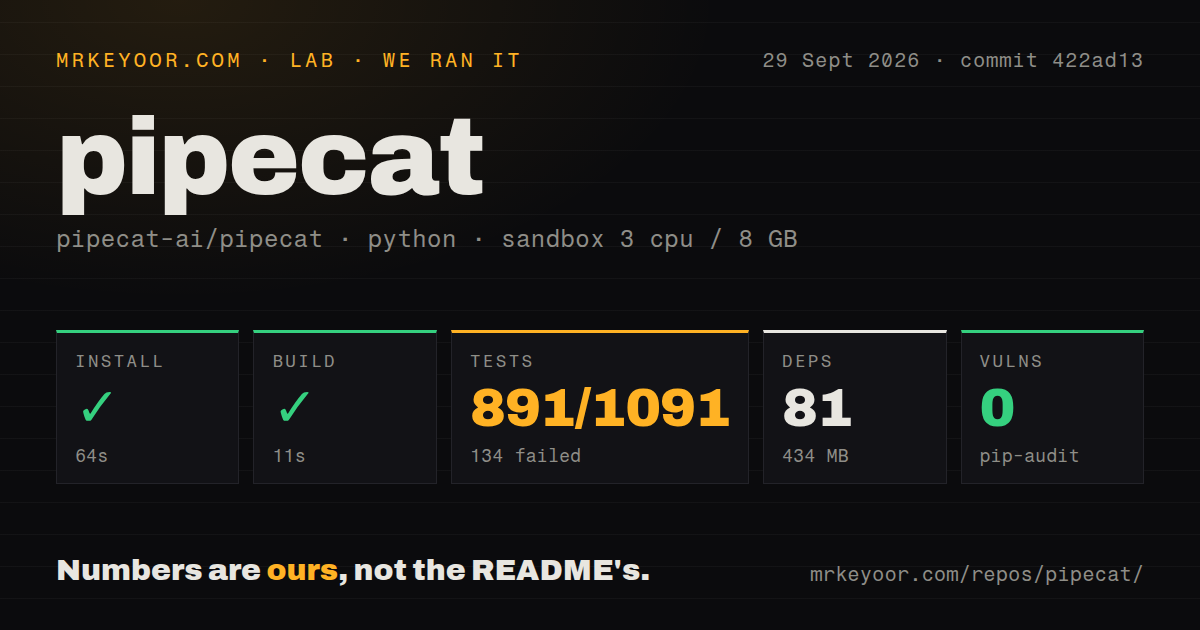
Lab card: what happened when we ran pipecatScreenshot of pipecat (pipecat.ai)
Install✓ · 66s81 packages · 435 MB
Build✓ · 10s
Tests✗ · 9sran, no count parsed
Known vulns0(pip-audit)
Repo1706 files~335,640 lines of source · 41.7 MB · 11 CI workflows · tests dir

Answers from our run

Does pipecat build from source?

Dependencies installed in 66 seconds (81 packages), and the build succeeded in 10 seconds. We cloned commit a3a5b4e into a clean Debian container with 3 CPUs and no project-specific setup.

Do pipecat's tests pass?

The test command failed in our container, and its output did not report a pass or fail count.

Does pipecat have known vulnerabilities in its dependencies?

pip-audit found none in the dependency tree at the time of our run.

Who should not use pipecat?

Teams wanting a voice product with no vendor accounts: most useful pipelines need credentials for speech, model, telephony, or transport services listed in the README.

What are the alternatives to pipecat?

LiveKit Agents, Vocode, TEN Framework. Our Pipecat run installed 81 packages and built in 10 seconds, but its test collection stopped after 9 seconds because dotenv was missing.

Setup3/566-second install; tests stopped on a missing dotenv module
Docs5/5Clear CLI, manual setup, extras, examples, and service catalog
Community5/514,757 stars and active issue and pull request work on August 26
Maturity4/5v1.7.0 has broad integrations; live-call edge cases remain

Discussed on

  1. hnShow HN: An open source framework for voice assistants346 points
  2. hnShow HN: Open-source, native audio turn detection model126 points
  3. hnShow HN: Whisker, a real-time Pipecat debugger for your voice AI agents11 points
  4. hnShow HN: Open-Source Quarter Sized AI Voice Assistant (ESP32-Pipecat)5 points
  5. hnShow HW: Tail, a terminal dashboard for your Pipecat voice agents4 points

Who it’s for

Python teams building voice assistants, phone agents, or multimodal conversations across several service providers.
Developers who need interruption handling, conversation state, metrics, and transport code around speech models.
Product teams willing to test the exact speech, model, and transport combination they will ship.
Claude Code users who want the project's development skills and scaffolding workflow.

Who it’s NOT for

Teams wanting a voice product with no vendor accounts: most useful pipelines need credentials for speech, model, telephony, or transport services listed in the README.
Developers expecting every optional integration to install from the core package: the README uses extras and excludes local and GStreamer extras from its standard development sync because they need system dependencies.
Production callers who cannot tolerate provider-specific silent failures without their own monitoring: issue 5305 reports unspoken TTS text entering conversation history after a WebSocket failure.
Deepgram Flux users who mute callers during the greeting without regression tests: issue 5425 reports that overlapping speech can leave a caller unheard for the rest of a call.
Cerebras users relying on max_tokens alone as a reply cap: issue 5448 reports that v1.7.0 accepted the setting but left it out of requests.

Setup reality

Our sandbox install succeeded in 66 seconds, adding 81 packages and using 435 MB on disk. The build passed in 10 seconds. Tests failed with exit code 4 after 9 seconds because tests/conftest.py imported dotenv, which was unavailable. Pip-audit found 0 known vulnerabilities.

A useful bot needs Python 3.11 or newer, plus chosen extras and credentials for its speech, model, transport, or telephony services. The CLI can scaffold a project, while the manual path asks you to copy the environment template and select only the provider extras you need.

Local and GStreamer extras require system dependencies and are excluded from the documented all-extras development command. Real-time behavior also depends on the exact provider mix, interruption rules, network, and client transport, none of which our dependency build exercised.

Pipecat joins voice services through Python pipelines

Pipecat gives a voice application one place to coordinate speech recognition, a language model, synthesized speech, media transport, and conversation state. Its pipeline model also covers video, images, multi-agent handoffs, parallel workers, and structured flows. The README lists client SDKs for JavaScript, React, React Native, Swift, Kotlin, C++, and ESP32. Python stays on the server side, where processors pass frames and services can be replaced without rewriting every neighboring component.

That breadth has a real repository cost. Our commit a3a5b4e checkout contained 1,706 files, about 335,640 source lines, and 41.7 MB before dependencies. The project has a tests directory and 11 CI workflow files, but no Dockerfile. Pipecat is less a single voice bot than a framework for assembling one. A team should identify its exact transport, transcription, model, and speech services before judging how much of the catalog it will use.

Core installs stay small by moving providers into extras

The manual setup starts with uv add pipecat-ai, then asks developers to add optional extras for third-party services. That is a sensible way to avoid installing every speech SDK and native library. The CLI can scaffold phone or web and mobile bots, while focused examples demonstrate individual services. Python 3.11 is the minimum and 3.12 or newer is recommended. An environment template holds provider configuration, so the first runnable conversation still depends on keys and endpoints outside the core package.

Our sandbox installed 81 packages in 66 seconds and used 435 MB on disk. The README's development command syncs dev dependencies and most extras while explicitly excluding GStreamer and local extras because some choices need system packages. That warning should shape CI images and onboarding docs. A developer who selects telephony, hosted speech, and a hosted model will also manage several credentials, usage limits, and failure modes even though the Python framework itself installed quickly.

What happened when we ran it

We ran commit a3a5b4e in an unprivileged Debian container with 3 CPUs, 8 GB of RAM, Python 3.12, and no secrets. Installation succeeded in 66 seconds. The build succeeded in 10 seconds. Pip-audit reported 0 known vulnerabilities in the installed environment. We did not place a call, connect a browser client, or contact any speech or model provider, so these results say nothing about audio latency or conversation quality.

The test command stopped with exit code 4 after 9 seconds. Pytest was loading tests/conftest.py, which imports dotenv, and raised ModuleNotFoundError: No module named 'dotenv'. No test cases ran far enough to give a pass or fail total. The log does not explain why the module was absent, so the defensible conclusion is limited: the installed dependency set in our stated sandbox could build, but it could not collect the repository's tests as configured.

Live calls need failure tests for each provider combination

Open issue 5305 describes a Cartesia WebSocket failure where text that produced no audio was still written into the language model's conversation history. The configured fallback did not activate because the successful reconnect emitted no error frame. That combination can make the stored conversation disagree with what the caller heard. It is a specific report against v1.7.0, yet it points to a useful acceptance test for any TTS service: kill the connection mid-response and verify playback, failover, history, and recovery.

Interruption handling deserves the same care. Issue 5425 reports that Deepgram Flux plus a mute-during-greeting strategy could discard a turn start and then ignore the caller for the rest of the call. Our 9-second collection failure did not reach that path, and the issue does not establish that other speech services behave the same way. If the opening greeting cannot be interrupted, test speech that begins during it, at its boundary, and immediately after it.

Active maintenance tracks a fast-moving provider catalog

GitHub recorded a push on August 26, 2026, with 14,757 stars and 235 combined issues and pull requests. Release v1.7.0 arrived on August 1 and includes changes across speech recognition, speech generation, models, transports, metrics, and turn handling. The combined open count is not a bug count. The same-day issue and pull request activity shows maintainers and users working through current provider behavior rather than leaving an old catalog untouched.

Fast maintenance also means settings must be checked per integration. Issue 5448 says Cerebras accepted max_tokens but omitted it from a request, while comparable services honored the setting. Pipecat gives teams a common structure across many providers; it cannot make their APIs identical. The 81-package install and 10-second build make a trial cheap. Production approval should come only after recorded calls cover disconnects, overlapping speech, cancellation, spending caps, and the particular services selected for the deployment.

Alternatives

ProjectWhat it isPick it when
LiveKit Agents gh↗A framework for real-time voice, video, and multimodal agents built around LiveKit.pick this instead when LiveKit is already your media transport and you want its agent runtime and deployment path.
VocodeA modular Python library for voice-based language-model agents.pick this instead when you want a narrower voice-agent toolkit and its supported provider set matches your stack.
TEN FrameworkAn open-source framework for conversational voice agents and extensions.pick this instead when its extension system and multi-language runtime fit your deployment better than a Python pipeline.

What people are saying

  1. [github-trending] pipecat-ai/pipecat

Sources

  1. Pipecat repository and README
  2. Pipecat v1.7.0 release
  3. Issue 5305: silent TTS reconnect and conversation history
  4. Issue 5425: muted greeting strands a caller turn
  5. Issue 5448: Cerebras token cap setting

More ai tools reviews

claudian · SkillSpector · robin · mjlab · MoGe · awesome-design-md · the whole board →