mrkeyoor.com_
Thu 12 Nov 07:22 UTC
Self-Hostedevaluationupdated 12 Nov 2026

ladder review

Ladder is an HTTP web proxy whose README describes testing paywall implementations and content-delivery behavior. It documents domain rules for changing requests and returned pages. Our recorded npm run did not demonstrate those proxy capabilities or establish their behavior in v0.0.23.

Verdict

Ladder warrants a local evaluation when domain-based request and page transformations are the experiment. Our npm installation and build passed, but tests were skipped and the Go proxy was not demonstrated. Verify one target, its transformations and the access controls before sharing an instance.

We ran it

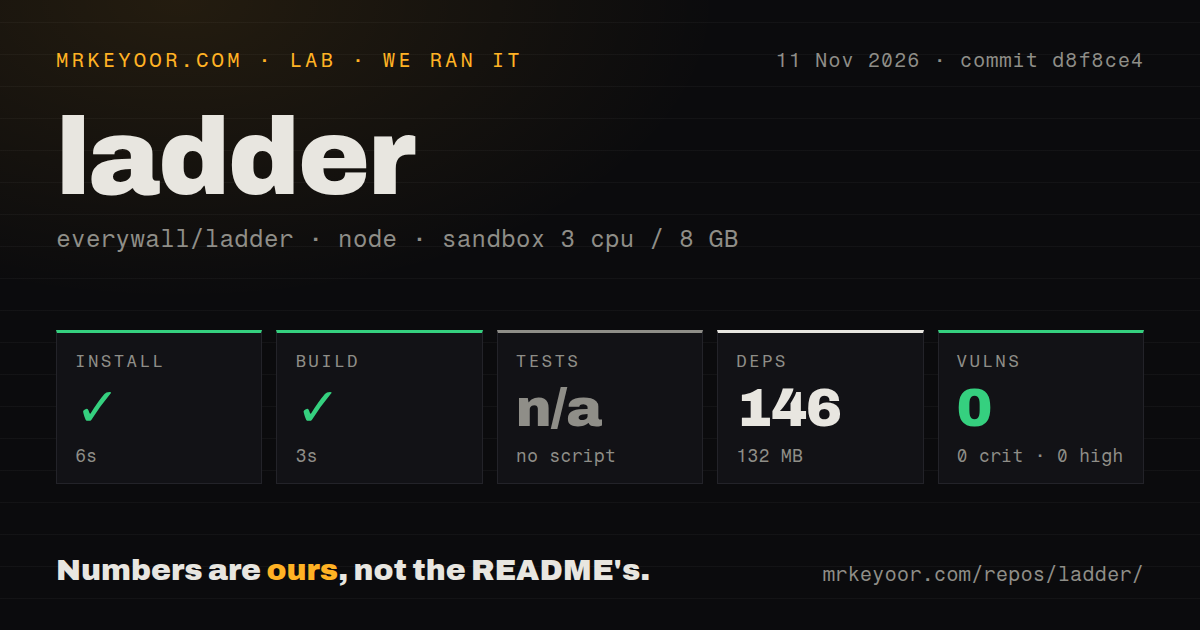
Lab card: what happened when we ran ladderScreenshot of ladder (github.com/everywall/ladder)
Install✓ · 6s146 packages · 132 MB
Build✓ · 3s
Testsn/ano test script
Known vulns00 critical · 0 high · 0 moderate · 0 low (npm audit)
Repo56 files~1,783 lines of source · 0.3 MB · 3 CI workflows · Dockerfile

Answers from our run

Does ladder build from source?

Dependencies installed in 6 seconds (146 packages), and the build succeeded in 3 seconds. We cloned commit d8f8ce4 into a clean Debian container with 3 CPUs and no project-specific setup.

Does ladder have tests you can run?

Not through a standard command: the project exposes no test script or target that our harness could run.

Does ladder have known vulnerabilities in its dependencies?

npm audit found none in the dependency tree at the time of our run.

Who should not use ladder?

Teams requiring a demonstrated Go proxy deployment or passing behavior tests from this review.

What are the alternatives to ladder?

mitmproxy, Playwright. Ladder warrants a local evaluation when domain-based request and page transformations are the experiment.

SetupN/AN/A: npm installation and build completed, but the documented Go deployment was not reproduced. The recorded timings do not establish the effort needed to configure, start or operate the proxy, so they cannot support a numerical setup rating.
DocsN/AN/A: the README supplies deployment directions, configuration settings and ruleset examples. Those directions were not validated in a running deployment, and its differing FlareSolverr passages leave compatibility questions that this review cannot resolve.
CommunityN/AN/A: the supplied evidence does not establish typical response times, support capacity or adoption in production. Repository attention and an individual issue would not justify a numerical assessment of the help a prospective operator could expect.
MaturityN/AN/A: the release record establishes a published tag and the sandbox establishes successful npm steps. Neither demonstrates proxy reliability, page fidelity or access-control enforcement under a workload, so a numerical maturity rating would exceed the evidence.

Who it’s for

Developers investigating content delivery on sites they are authorized to test.
Self-hosters willing to evaluate the documented URL-entry, API and raw-HTML workflows locally.
Operators prepared to test authentication, destination restrictions and transformations before sharing an instance.

Who it’s NOT for

Teams requiring a demonstrated Go proxy deployment or passing behavior tests from this review.
Investigators who need an unchanged response while page transformations are enabled.
Operators expecting public deployment to require no access-control configuration.
Readers seeking a guarantee that every protected website will work.

Setup reality

Our November 11, 2026 sandbox run at checkout d8f8ce4 recorded successful npm installation in 6 seconds and a successful build in 3 seconds. It recorded 146 dependencies occupying 132 MB. Tests were skipped because no test script or target was found. npm audit reported zero known vulnerabilities.

These results establish completion of the recorded npm steps. The supplied record lacks the underlying commands and output needed to identify the build target. The README separately documents a Go development server and pnpm tooling for a Tailwind stylesheet. We cannot identify the recorded npm build as either a verified stylesheet build or a successful Go service build.

The README describes binary and container installation, a browser entry point at localhost:8080, USERPASS for Basic Auth and settings for restricting destinations. We did not reproduce those deployment directions. A local evaluation should establish that the proxy starts, handles the intended target and rejects requests outside the chosen destination policy before anyone shares it.

The sandbox configuration specified 3 CPUs, 8 GB RAM and image label lab-node:22. That label does not establish actual runtime or operating-system versions. The npm audit does not assess Go dependencies. Release v0.0.23 was published May 4, 2026; the measured checkout d8f8ce4 is a separate identifier, and this run must not be presented as testing that release.

Ladder's npm installation and build passed in our sandbox; its Go proxy remains untested. That distinction matters if you are choosing a tool to investigate why a website delivers different content to different clients. The README describes request and page transformations, but our run does not establish that they work for your target.

Consider a local evaluation when those transformations are the experiment. If the question depends on browser interaction or detailed inspection of HTTP exchanges, the alternatives below offer different documented workflows.

What happened when we ran it

Our November 11, 2026 sandbox run at checkout d8f8ce4 completed npm installation in 6 seconds and the build in 3 seconds. It recorded 146 dependencies occupying 132 MB. The checkout contained 56 files, approximately 1,783 source lines and 0.3 MB of source. Tests were skipped because no test script or target was found; there is no passing-test count from this run.

The scan recorded three CI workflow files, a Dockerfile and no tests directory. Those observations do not establish a passing workflow or prove that tests are absent elsewhere. npm audit reported zero known vulnerabilities, which does not assess Go dependencies or the security of a deployed proxy. The sandbox configuration specified 3 CPUs, 8 GB RAM and image label lab-node:22; the label does not establish actual runtime or operating-system versions.

The Ladder README documents a Go development server and says pnpm builds a Tailwind stylesheet. Our measurement names npm steps without their underlying commands or output. We therefore cannot identify the successful build target. It does not demonstrate that the Go service compiled, started or handled a request.

The release and measured checkout are separate evidence

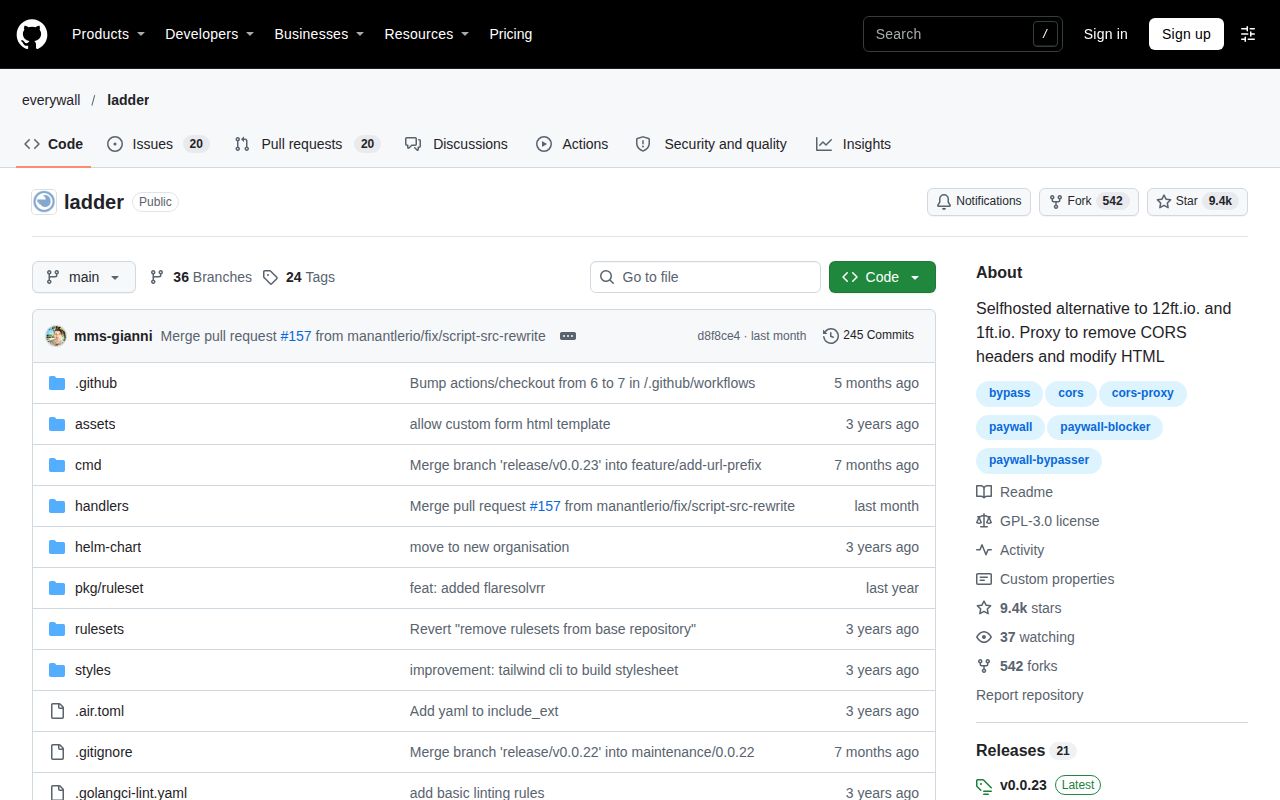
The supplied release record identifies v0.0.23, published May 4, 2026. The measurements identify checkout d8f8ce4. This review does not present the npm run as a test of v0.0.23, and the supplied README is not pinned to that release. Its capabilities are described below as documentation claims, rather than verified release behavior. The packet does not supply release-pinned implementation files that would close that gap.

Domain rules are the reason to evaluate Ladder

The README documents changes to request and response headers, HTML injection or removal, and domain rules that modify the response or requested URL. It also describes a browser URL-entry page, an API route and a raw-HTML route. These controls make Ladder relevant to an investigation that deliberately varies a request or transforms a returned page. They also mean the resulting page may differ from the target's original response.

A useful local evaluation would retain an original response, record the rules applied and compare Ladder's output for one authorized target. Change one request property and repeat the comparison. This procedure is proposed and unexecuted; it is not a reproducible result from our sandbox. Record which Ladder checkout and ruleset you use so the comparison has an identifiable configuration.

Access controls need a deployment test

The README tells operators of publicly accessible instances to enable Basic Auth and lists USERPASS for that purpose. It also documents ALLOWED_DOMAINS and ALLOWED_DOMAINS_RULESET, stating: "If both are empty, no limitations are applied." That is documentation wording, not evidence that we tested every combination of these settings. Choose the destinations needed for the investigation, then verify that other destinations are rejected before sharing an instance.

Rules are documented as loading on startup from a local file, directory or URL. Keep the rules used for each comparison. The README also lists URL logging and ruleset exposure as enabled by default, so review those settings before submitting private URLs to a shared instance. We did not test authentication enforcement, destination filtering, logging or ruleset exposure.

The FlareSolverr documentation does not establish compatibility

The README's limitations section says Ladder may not function correctly on services that restrict automated access through fingerprinting, rate limiting or behavioral analysis. A later section documents FlareSolverr integration for challenge handling. These passages do not establish which protected sites will work in a particular deployment. We did not run FlareSolverr, and this review makes no claim about its timeout behavior or Ladder's recent maintenance activity.

Alternatives depend on the investigation

mitmproxy is an interactive intercepting proxy with a console interface for HTTP traffic. Consider it when examining HTTP exchanges is the main task. This recommendation follows its documented workflow; we did not compare its speed, setup effort or reliability with Ladder.

Playwright is a framework for web automation and testing. Consider it when the investigation requires scripted browser interaction. The choice depends on the behavior you need to reproduce, rather than a performance ranking from this review. No comparative browser workload was run.

What remains untested

The supplied run does not demonstrate the Go binary, container startup, page fidelity, authentication enforcement, destination restrictions or FlareSolverr operation. It includes no browser workload, throughput measurement or Go dependency audit. The score cards remain N/A because the evidence does not support numerical product ratings. Start locally with one authorized target and recorded rules, then test the access controls before deciding whether anyone else should depend on the instance.

Alternatives

ProjectWhat it isPick it when
mitmproxy gh↗An interactive intercepting proxy with a console interface for HTTP traffic.Consider mitmproxy when inspecting HTTP exchanges is the main task. Its documented purpose supports this choice; no comparative workload was run.
Playwright gh↗A framework for web automation and testing.Consider Playwright when the investigation requires scripted browser interaction. This recommendation follows its documented purpose, without a comparative setup or reliability result.

What people are saying

  1. [github-trending] everywall/ladder

Sources

  1. Ladder README
  2. Ladder v0.0.23 release
  3. mitmproxy README
  4. Playwright README

More self-hosted reviews

iSponsorBlockTV · run-ai · sure · woodpecker · localthings · kubevirt · the whole board →