Karpenter chooses machines from pending-pod constraints
Karpenter watches for pods that Kubernetes marks unschedulable. It evaluates CPU, memory, selectors, affinities, tolerations, and topology rules, then works with a cloud provider to create a suitable node. Later it can remove unused or inefficient capacity. The practical difference from scaling a fixed node group is that Karpenter can choose among allowed machine types for the current scheduling batch rather than only changing one group's desired count.
This repository is the provider-neutral core. The README lists implementations for AWS, Azure, Alibaba Cloud, Bizfly, Clever Cloud, Cluster API, Exoscale, GCP, Hetzner, Huawei, IBM, Proxmox, OCI, and Linode. Each provider owns the machinery that turns a NodeClaim into an actual instance. You need to evaluate that repository and release separately; passing the core build does not validate your provider's IAM, images, networking, pricing data, or interruption handling.
The 119-second build passed, while 10 test suites failed
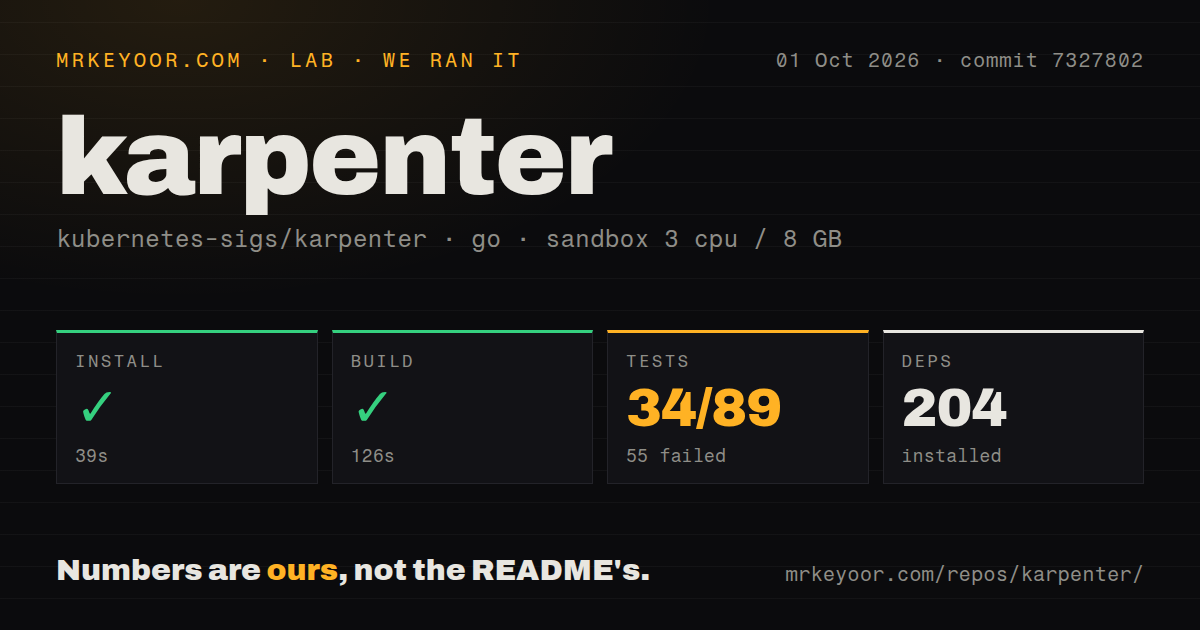
Our clean Go environment fetched 204 packages in 50 seconds. Building commit 2266468 took 119 seconds and succeeded. The test command then ran for 88 seconds before exiting 1. Its summary counted 15 passed and 10 failed out of 25. That is a mixed result: source compilation worked, but the complete test step supplied to our harness did not.
The repository contained 501 files, roughly 130,020 source lines, and 17.5 MB. We found 10 CI workflow files, a tests directory, and no Dockerfile. Those signals fit a serious controller project, though they do not cancel the failed local run. Before modifying or packaging Karpenter, reproduce the upstream test environment and understand which suite dependencies your development container must supply.
What happened when we ran it
Our run installed Karpenter in 50 seconds, built it in 119 seconds, and reached a failed test result after 88 seconds on 3 CPUs with 8 GB of RAM. Go reported 15 passed and 10 failed of 25. Install and build both succeeded; only the test step returned a nonzero exit.
The last log lines show the DRA suite failing in 0.030 seconds, the performance suite failing in 0.025 seconds after announcing 7 specs, and the regression suite failing in 0.031 seconds after announcing 99 specs. The log then ends with FAIL. It does not show an assertion, missing service, permission error, or stack trace, so assigning a cause would be guesswork. The actionable finding is limited: this commit did not pass the supplied suite in our stated sandbox.
Production setup starts with a provider, CRDs, and cloud authority
A real installation needs a Kubernetes cluster and one of the provider implementations named by the project. Its controller needs Kubernetes permissions plus cloud identity capable of creating and deleting compute. Operators define NodePools and provider-specific NodeClasses, set allowed zones and instance properties, then decide how consolidation, expiration, budgets, and interruption behavior should work. This is control-plane software with direct cost and availability consequences.
Start with a non-production cluster. Exercise unschedulable pods, zone spread, daemon overhead, storage attachment, pod disruption budgets, spot interruptions, controller restarts, API throttling, and failed node launches. Keep a stable fallback node group for the controller and other cluster services. Metrics and logs should answer whether cluster state is synchronized, why a NodeClaim failed, which NodePool incurred the error, and whether a draining node is still billing.
Draining and DRA permissions deserve explicit failure drills
Open issue 3144 reports NodeClaims remaining in a draining state during bulk cluster teardown even though the remaining pods were described as evictable. The reporter says restarting the controller allowed those nodes to finish. That report is version and workload specific, but it identifies a failure mode worth simulating: a finalizer can leave compute running after the owning NodePool is gone. Alert on age in draining states, not only pending pods.
Issue 3249 describes a v1.14.0 controller panic when DRA was enabled without permission to list resourceclaims, while the cited design text only called out resourceslices. The reporter says granting the missing permission fixed startup. If you enable DRA, audit every watched resource and test the chart with deliberately incomplete RBAC. A critical controller should fail legibly before production, rather than discovering one missing verb during a node shortage.
August activity is strong, and large-cluster changes still need canaries
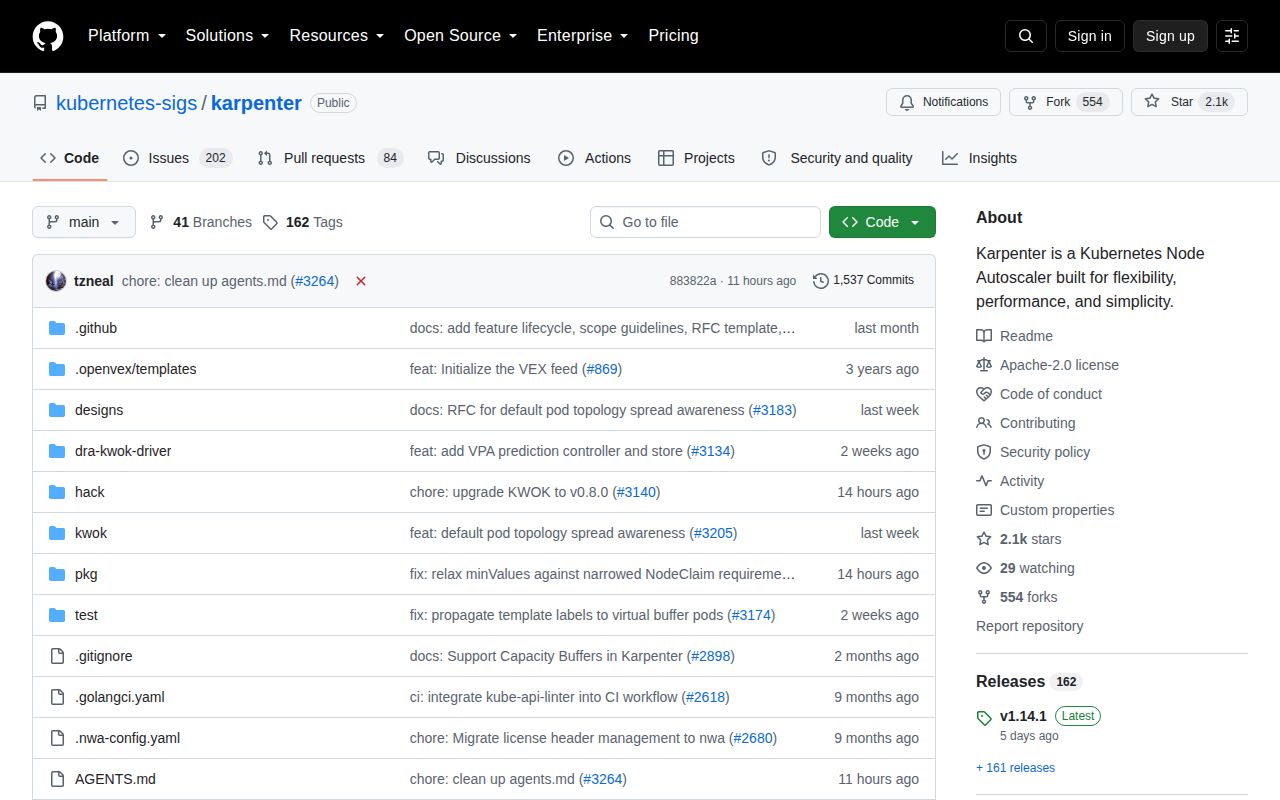
GitHub showed 2,126 stars, 286 combined issues and pull requests, and a last push on August 26, 2026. Release v1.14.1 arrived on August 21, while current issues were receiving updates on August 25 and 26. The project also documents alternating working-group meetings and weekly issue triage. Those are healthier signals than the brevity of the latest release note.
Open issue 3204 reports higher controller CPU and blocked provisioning after an upgrade on a very large cluster; its scale is far beyond an ordinary installation. The useful lesson is to canary upgrades against your own NodeClaim count and pending-pod bursts. Karpenter can remove wasted capacity and respond directly to workload constraints. It also sits in the path between an unschedulable pod and a billable machine, so adoption should look like a platform migration, not a Helm experiment.