macOS 13 through 27 gets device-level keyboard remapping
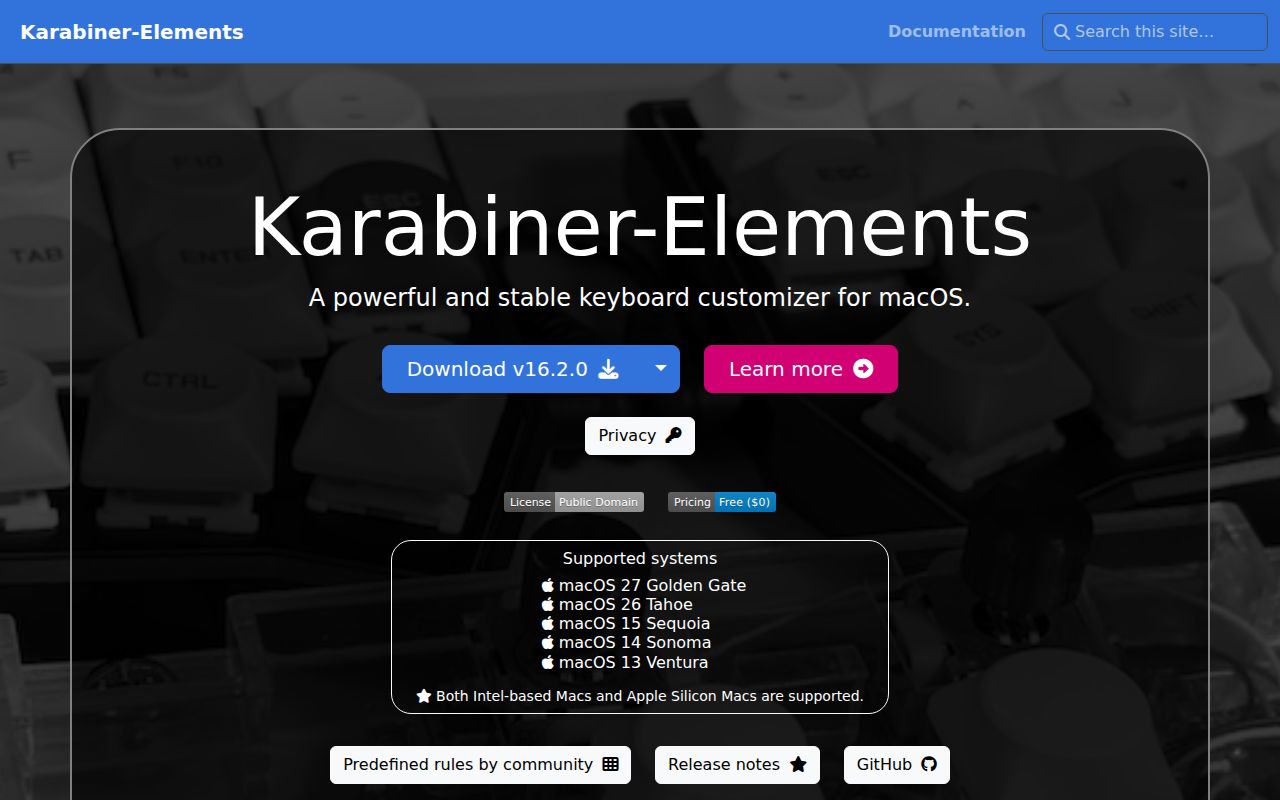
Karabiner-Elements supports macOS 13 Ventura through macOS 27 Golden Gate, with Intel support through macOS 26 and Apple Silicon across the range. Simple Modifications changes one key into another. Complex Modifications can respond to applications, devices, modifiers, and variables, while profiles hold different rule sets. EventViewer shows the key names the mapper receives, making an unfamiliar keyboard easier to configure.
Our checkout contained 1,277 files, roughly 67,464 lines of source, and occupied 42.8 MB. This is a native macOS tool with C++ and Swift components, background agents, and a virtual input driver. The npm project detected by the lab lives under vendor/duktape-2.7.0/debugger/. Its result describes a bundled debugger utility, not the application that rewrites keyboard events.
Four macOS permission classes are the price of low-level control
The installation guide asks macOS to allow privileged and non-privileged background services, Accessibility, Input Monitoring, and a driver extension for the virtual keyboard and mouse. Karabiner-Elements has to see input before ordinary applications and emit replacement events. Homebrew and the signed DMG make file installation easy, but first-run permission work cannot be skipped on a locked-down Mac.
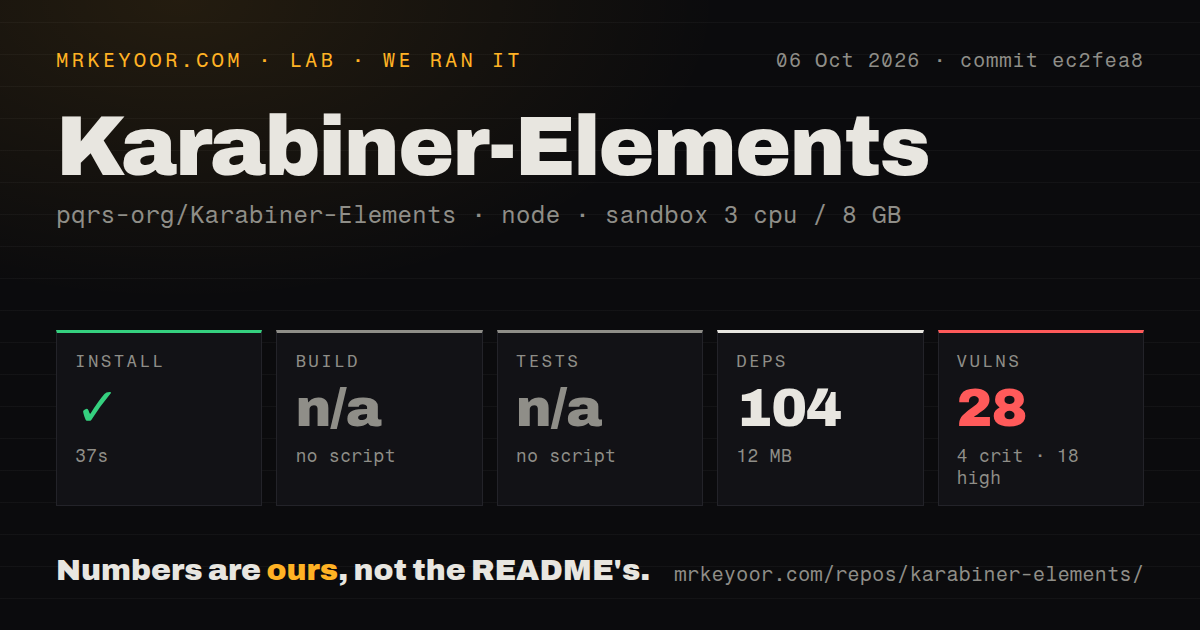
Our Debian sandbox installed 104 npm packages in 42 seconds and used 12 MB. That setup neither granted macOS permissions nor started Karabiner-Elements. Personal Macs can follow the Settings prompts. Managed fleets need an administrator to allow those services and extensions. If policy forbids input monitoring or third-party driver extensions, the product cannot do its main job, even for a simple Caps Lock swap.
What happened when we ran it
Our run at commit 2e35d79 reached only vendor/duktape-2.7.0/debugger/, the detected npm project. Installation succeeded in 42 seconds with 104 packages and 12 MB on disk. npm audit reported 25 known vulnerabilities: 4 critical, 18 high, 1 moderate, and 2 low. The audit does not show whether an advisory affects the distributed macOS application, so we make no such claim.
The vendored npm project exposed no build script or target, so the lab skipped the build. It had no test script or target either, so tests were skipped. We have no measured app build, application test count, or runtime result. The scan found 2 CI workflow files, no Dockerfile, and a tests directory, but those signals do not turn a Linux npm probe into a macOS package check.
A source build needs Xcode 26 and signing identities
The README requires macOS 15+, Xcode 26+, command-line tools, xz, XcodeGen, and CMake. Builders must clone submodules and provide application and installer signing identities before make package. The DMG relies on those identities for permissions. Switching to a self-signed build invalidates existing grants and can require disabling services, removing Accessibility access, restarting, and approving everything again.
The repository had 2 CI workflow files and a tests directory, yet our lab ran neither because the detected npm package offered no targets. make package also copies a prebuilt Karabiner DriverKit VirtualHIDDevice package from the source tree. Swift packages including Sparkle and AsyncAlgorithms resolve separately. Reproducing the full binary set takes more than compiling the visible C++ and Swift source.
Complex rules are useful, while some input events stay out of reach
Complex Modifications can give held and tapped modifiers different actions, restrict mappings to chosen applications, and run shell commands. Rules come from a community catalog or hand-written JSON. v16.2.0 added list filtering plus JavaScript and single-rule JSON imports. Start with EventViewer and one rule. A broken low-level mapping can affect login and recovery screens as well as the target app.
The 42-second npm install did not exercise a keyboard or EventViewer. Open issue 1362 has tracked horizontal scroll-wheel input since 2018 and had 76 comments when fetched. Issue 2398 reports that Bluetooth headset play and pause taps do not appear in EventViewer. These are specific boundaries. Test the exact hardware event before designing a large rule set around it.
v16.2.0 is current, but upgrades deserve a quick keyboard check
The v16.2.0 notes warn that upgrading from v15.9.0 or earlier disables service startup until the app opens. A report filed one day later describes Caps Lock mapped to Control causing all-caps input after returning to Microsoft Windows App on macOS 26.6.2; reinstalling v16.1.0 removed the behavior. One report cannot establish a general regression. It does justify testing remaps after an update.
The 25 advisories in our vendor npm audit deserve contributor attention even though their app reach is unknown. Four were critical and 18 were high. That count warrants tracing whether the debugger ships, runs during a build, or stays unused. Signed-DMG users should not translate it into 25 application flaws. Maintainers and packagers should document the dependency's role and update or isolate it.
August 2026 activity supports adoption on a current Mac
GitHub recorded a push on August 30, 2026, minutes after v16.2.0. The repository had 22,713 stars and 17 open issues and pull requests; an issue-only search returned 16 open issues. The release added device options, EventViewer capture, and a fix for modifications pausing after wake. The dated push, release, and issue discussion show active maintenance.
Karabiner-Elements has 2 visible CI workflows, though our sandbox produced no native build or test evidence. On a supported Mac, use the signed release. Begin with one mapping, verify it in normal apps and at the lock screen, then add conditions or community rules. Keep another input method available while testing changes to modifiers, Return, or password-entry keys.