Shared visual context turns many questions into one bounded job
Jev Visual takes one image and asks up to 64 typed questions about it. A question can be yes or no, a choice among candidates, or an ordered score. Instead of asking Qwen3.5-0.8B-4bit to generate a JSON object, it prepares the image and context once, copies the model state for each question, and scores candidate answers from logits. Code then normalizes those scores and assembles the typed response.
That design is narrow on purpose. It supports 2 to 26 options per question, uses verified single-token labels where possible, and can score complete answer sequences including the end token. The shared cache exists only within one request and is copied rather than shared without duplication. Only the Qwen3.5 adapter is verified. These constraints make the implementation readable, which matters more here than supporting every multimodal model.
The scores rank supplied options but do not predict correctness
The returned probability says how strongly the model prefers one supplied candidate relative to the others. It is not a calibrated estimate that the answer is true. The project uses existing model weights with no new training or calibration. A high score can still be confidently wrong, especially when the image is unclear, the options omit the right answer, or the question asks more than the 0.8B model can infer.
The README states that boundary several ways and separates this experiment from TypeSafe Jev. It does not claim to reproduce Jev's proprietary architecture, RLCD training, calibration, or serving system. That candor is a strength. You can study shared context and direct scoring without pretending the result carries the same behavior or guarantees as a commercial decision model.
What happened when we ran it
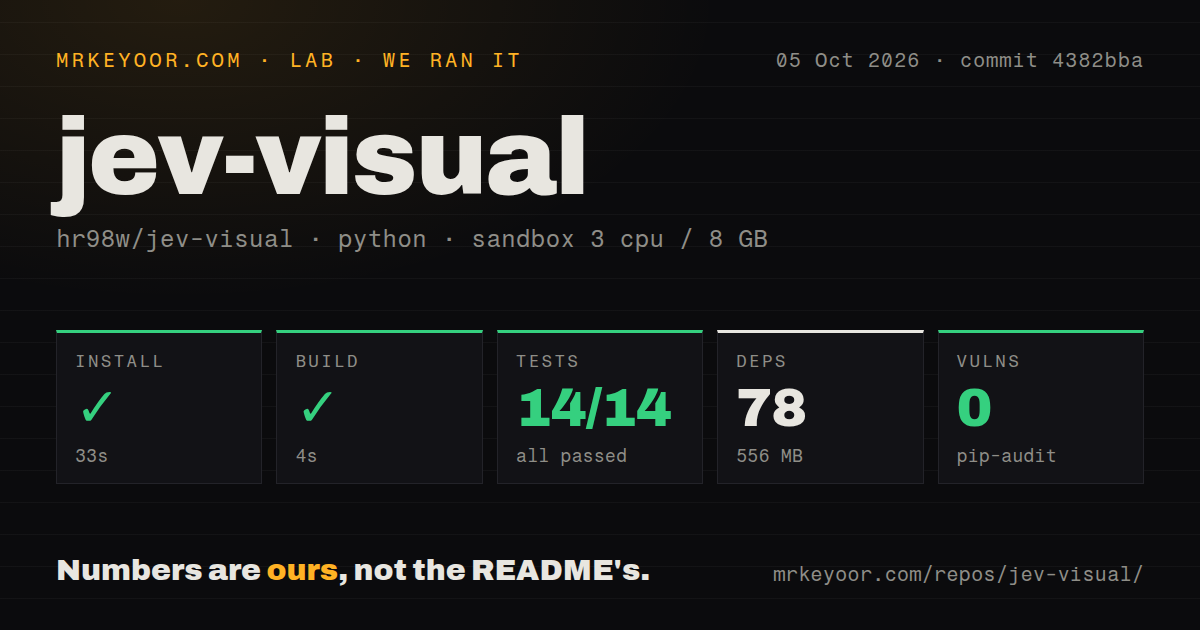
Our sandbox installed commit 4382bba in 33 seconds, pulling 78 Python packages and using 556 MB on disk. The build succeeded in 4 seconds. Pytest then passed all 14 tests in 8 seconds, and pip-audit reported 0 known vulnerabilities. The checkout contained 99 files, about 4,255 lines of source, and occupied 20.9 MB. No measured step failed.
Those tests do not prove that image inference works on the machine we used. The lab ran Python 3.12 in a fresh Debian container with 3 CPUs, 8 GB of RAM, no secrets, and no elevated privileges. The README says model inference requires an Apple Silicon Mac with Metal. The supplied test command covers unit and API behavior without model inference, so our clean result is packaging evidence rather than a visual-accuracy result.
A Mac, 596 MiB of weights, and one worker are the real setup
The documented route creates a Python 3.13 environment, installs the locked requirements and editable package, then downloads about 596 MiB of Qwen3.5-0.8B-4bit weights. The README says the project was tested on an M4 Mac with 16 GB of memory and macOS 15.1. Once the weights are present, inference stays local and does not need a hosted model credential.
The web server listens on 127.0.0.1:8788 and exposes API documentation at /docs. The author recommends one worker and warns that first inference can be slower. This is a local learning server, not a hardened public service. Our scan found no Dockerfile and no CI workflows, which is understandable for Metal-specific code but leaves Mac-side reproduction to the adopter.
The demos reveal the model's limits instead of hiding them
Included demos cover a sorting line, camera gestures, Breakout, and a 2 by 2 cube. Breakout originally asked the model to track the ball or choose left and right, but repeated choices could pin the paddle at an edge. The working version draws 5 numbered regions, enlarges the ball and paddle, slows the game, and asks which region contains the ball. Ordinary code moves the paddle toward that region.
That is a useful lesson in task design. The demo succeeds by turning control into a bounded classification problem, the sort of job direct candidate scoring can handle. It is not evidence that the model learned general game play. The README says the current model cannot reliably solve the cube, and it does not blame quantization without an experiment that isolates the cause.
A small, young repository can still be the right teaching tool
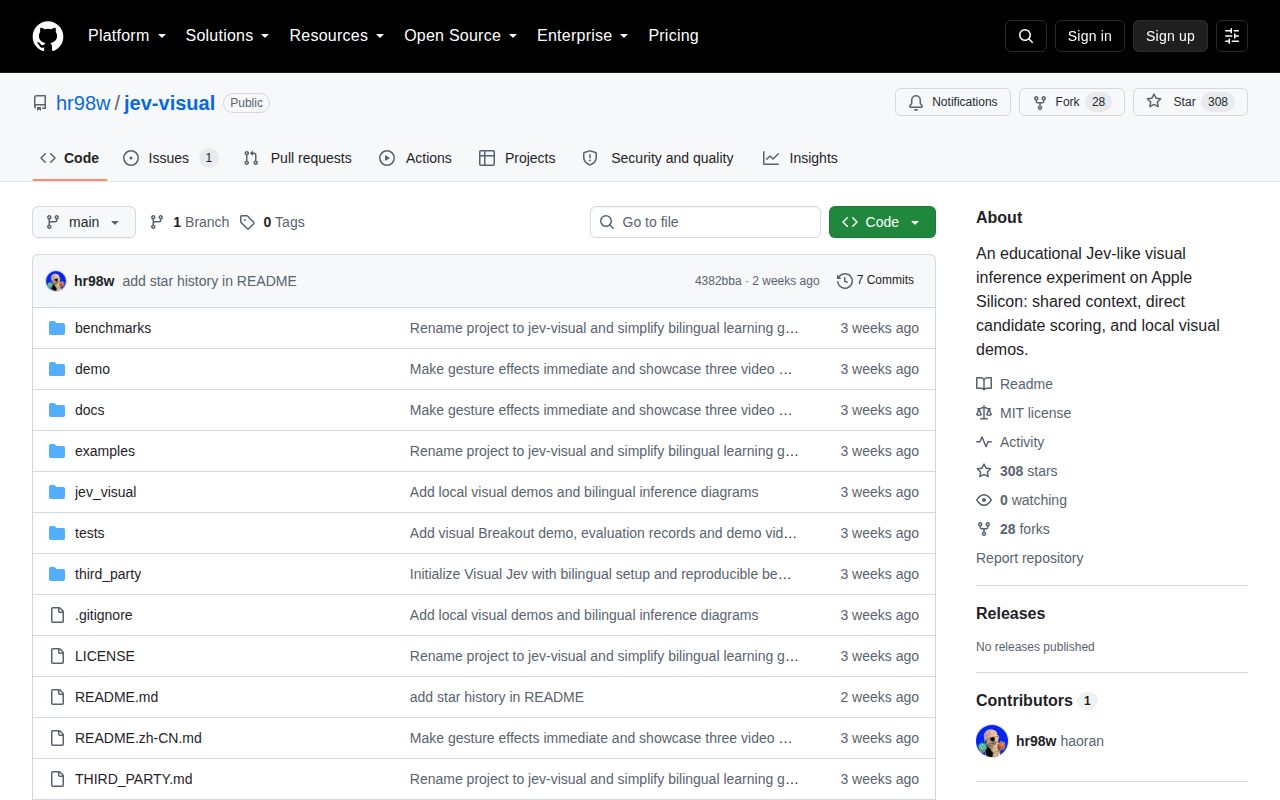
GitHub showed 308 stars, 1 open issue, an MIT license, and a last push on September 21, 2026. The repository was created only 4 days earlier and has no published release. The sole open issue asks for coordinates at a specified image position, a feature beyond the current answer-shape focus. This is active early work, not a versioned library with a long compatibility record.
Choose Jev Visual when you own an Apple Silicon Mac and want the candidate-scoring path exposed in roughly 4,255 lines rather than buried inside a large serving system. MLX-VLM is the better base for broad model support, while SGLang fits production GPU serving. Our 14 passing tests make Jev Visual easy to recommend for study. Its uncalibrated scores and one-adapter boundary should keep it out of unsupervised high-stakes decisions.