Short answer: use a spare console for experimentation
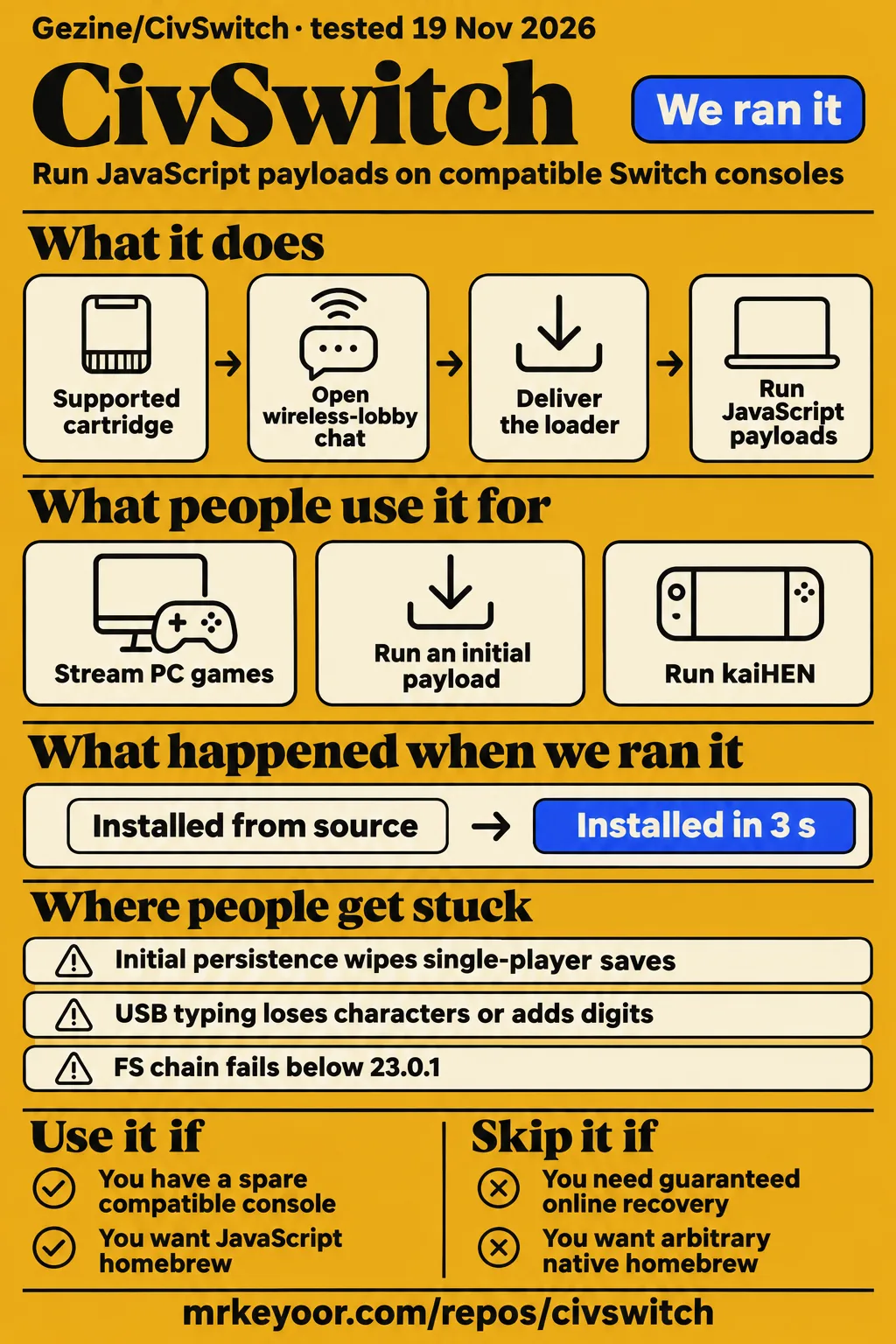
Our npm sandbox installed CivSwitch's PicoSwitch dependencies in 3 seconds; the console workflow requires hardware and a compatible Civilization VII cartridge. Use it if you want to experiment with JavaScript homebrew on a console you can keep out of everyday online use. Skip it if your purchase depends on a trouble-free route back to online play. The distinction that matters is which layer you intend to run: the original loader, an app launcher, or an additional filesystem exploit.
The required game is the physical Switch 1 edition of Civilization VII at version 1.0.0, according to Gezine's README. A Switch 2 console does not make the Switch 2 edition the right purchase. Buying the game is only the first decision. Persistent setup changes saves, delivery forks require different equipment, and applications can impose narrower firmware requirements than the entry point itself.
What people use CivSwitch for
XITRIX's Moonlight client has reported working picture, sound and app switching on Switch 2. That makes PC streaming the most tangible reason to investigate the project if you already have the required console and game. The useful evidence is a completed task, with its author and scope attached:
| Who used it | What they did | Reported outcome |
|---|---|---|
| XITRIX and a console tester | Ran Moonlight through CivSwitch | Four short Launcher-to-Moonlight-to-stream-to-Launcher roundtrips completed, with picture and sound confirmed. Moonlight record |
| ItsNerisma | Replaced the Pico with a rooted Android phone | The Android author reports testing the persistent installer. The named configuration is a Xiaomi Redmi 10 and Switch 2 firmware 23.0.1. Android record |
| flex36ty and the port's console tester | Delivered the payload with an ESP32-S3 USB keyboard/controller | The two-message test produced exact text after timing fixes; the user later reported the full payload working well. USB port record |
| yotumeru1392 | Executed CivSwitch on a Japanese domestic Switch 2 | Reported successful execution in a November 5 X post. Japanese-console report |
| s8n | Used CivSwitch to enter a separate FS/kaiHEN chain | The repository reports booting kaiHEN through Civilization VII, with HEN lasting until console restart. kaiHEN record |
The Moonlight report is especially useful because it follows the user back out of the stream and into the launcher. A payload landing once says little about switching between applications. Here the tester confirmed picture, sound and interface details across repeated short roundtrips. Sunshine runs on the PC, and the console joins the same local network. This is a client for your PC's games, not evidence that those games run natively on Switch 2. Moonlight setup and test notes
There is also evidence of ordinary owners reaching the entry point. X user iM4CH3T3 reported running a first payload after obtaining the console, game and Pico. Reddit user Jmes1991 described keeping a console on 23.0.1 offline and moving everyday activity to a Zelda Switch 2. Those are individual reports of setup and preservation choices, respectively. Neither should become a claim about the typical owner's experience. First-payload report, offline-console discussion
What happened when we ran it
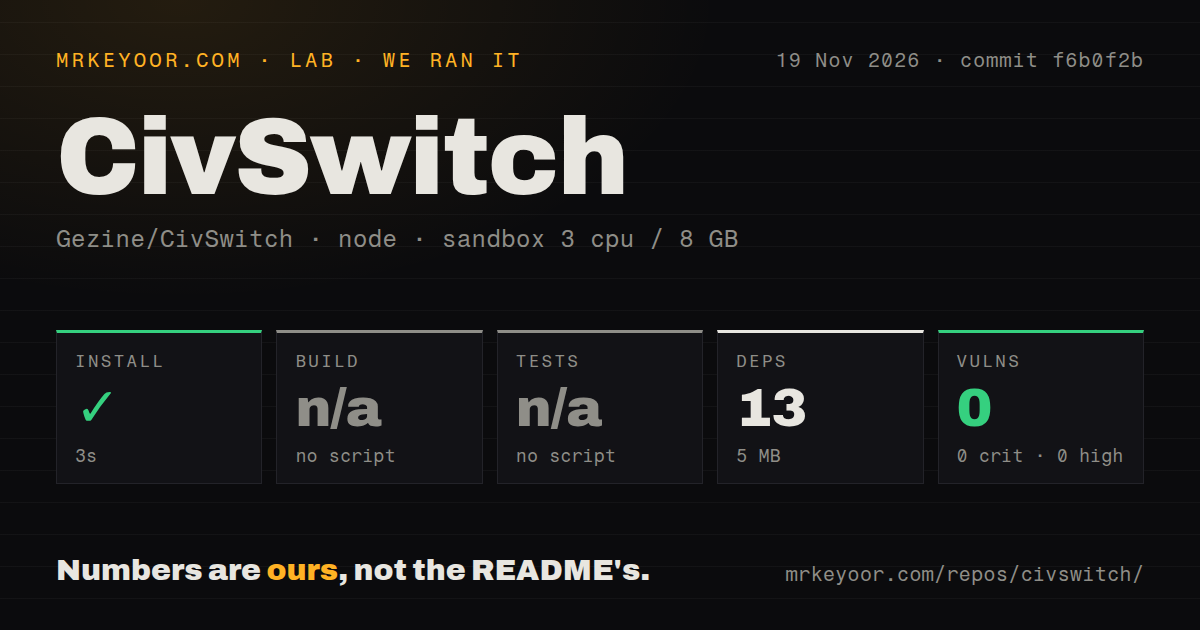
Our November 19, 2026 sandbox run at commit f6b0f2b installed the npm dependencies in 3 seconds, recording 13 dependencies and 5 MB on disk. It operated in ./PicoSwitch/ with a recorded allocation of 3 CPUs and 8 GB RAM. The image label was lab-node:22; actual runtime and operating-system versions require the raw toolchain logs.
| Check in our repository sandbox | Recorded result | What it tells you |
|---|---|---|
| npm installation | Succeeded in 3 seconds | The measured Node dependency step completed. |
| Dependencies | 13 recorded, 5 MB on disk | This is the dependency footprint of that step. |
| Build | Skipped, no build script or target detected | There is no firmware-build result from this harness. |
| Tests | Skipped, no tests script or target detected | There is no passing test-suite result. |
| npm audit | 0 known vulnerabilities, including 0 critical, high, moderate and low | The audit reported no known advisories in its scope. |
| Repository scan | 52 files, about 5,432 source lines, 1.4 MB checked out | The checkout is small. |
| Automation signals | 0 CI workflow files, no Dockerfile, no tests directory | Those files and directories were absent from the scan. |
The practical consequence is easy to miss: npm is one part of the Pico toolchain. Gezine documents a separate Pico SDK and cross-compilation workflow. The harness skipping a build target must not be rewritten as the project having no way to build firmware. Equally, a completed npm step must not be described as installing the exploit on a console. The supported cartridge, USB delivery and savedata operations sit outside this Node dependency check. Upstream workflow
A separate hands-on attempt in the research pack stopped at an identity check. Its quickstart-cli recipe cloned the repository and ran an apt prerequisite command, but then identified the apt package git as the product under test. The failed identity step explicitly says that git is a different project from Gezine/CivSwitch. The associated wrong-package finding is a failure of that attempted evaluation, not evidence of a broken console exploit. Its teardown record says cleanup completed. We exclude that attempt's package-install timing from CivSwitch setup results.
Where people get stuck: delivery and persistence fail differently
The persistent installer can delete Civilization VII single-player saves, while a session-only loader can leave savedata alone. That choice deserves more attention than whether the delivery device is a Pico or an ESP32. CivSwitch-LDN-NX labels its ZR action as destructive and keeps R as the loader-only action. Back up wanted saves before choosing persistence. LDN-NX save warning
| Symptom or decision | What the cited project says to do | Resolution in the record |
|---|---|---|
| ESP32 USB typing loses characters or adds digits | The port repeats USB reports and waits after opening chat | Console testing corrected the text symptoms. USB port |
| LDN-NX detects an LDN interception module | Remove ldn_mitm or another interfering module and reboot | Startup now blocks while the interference is present. LDN-NX |
| LDN-NX sees rooms but cannot join after title override | Launch from Album, or override Civilization VII itself | A launch-mode guard blocks unrelated title overrides. LDN-NX |
| Persistent installation times out after leaving local wireless | Reconnect both consoles to the same saved network, enable automatic joining and check access-point client isolation | The README supplies a retry procedure. LDN-NX |
| Android USB or SELinux cleanup is interrupted | Run the documented teardown command; retain recovery files if restoration fails | The next run also attempts recovery. Android port |
| Control Center input stops | Keep the owning terminal connection open; relaunch if it terminated | Use Payload Mode for additional payloads. Control Center |
| FS chain stops at Positive canary verification failed, find-metadata or install-retained | Restart the console, make one attempt per boot, and consider rebuilding the save after repeated failures | The author describes race failures and a retry procedure. FS/kaiHEN |
Save management has three distinct operations. Initial persistence replaces single-player saves. CivHomebrew's installer instead documents backing up and replacing an existing trigger while preserving apps, settings and other saves. Control Center exports the particular XSTRIG.Civ7Save trigger through a read-only extractor. Exporting that file is not the same operation as backing up all your original Civilization campaigns. Match the backup to the thing you want to recover. CivHomebrew replacement procedure, Control Center export scope
Firmware compatibility belongs to each layer
Gezine lists tested base-entry-point configurations on Switch 1 firmware 22.5.0 and Switch 2 firmware 20.4.0 and 23.0.1. The wider 20.x.x-through-23.0.1 range in the README is worded as what should work. The separate s8n filesystem chain explicitly says its supplied implementation does not currently work below 23.0.1. Gezine's compatibility statement, FS chain requirements
| Layer | Prerequisite and capability | Compatibility evidence |
|---|---|---|
| Base CivSwitch | Supported cartridge, JavaScript entry point and Remote JS Loader | Upstream names the tested console/firmware pairs above. |
| CivHomebrew | Existing CivSwitch setup, app library and .civapp installation | Its README supports CivSwitch JavaScript apps and excludes .nro homebrew. Launcher record |
| Moonlight-CivSwitch | Existing CivSwitch setup and Sunshine PC host | The README identifies Switch 2 console testing. Streaming record |
| civ7-fs-kaihen | CivSwitch plus a separate FS exploit, SD card and host workflow | The author tested firmware 23.0.1 and excludes lower firmware for this implementation. FS record |
This matrix is the reason I would choose an application before buying hardware. A successful base loader on one firmware answers the entry-point question. It does not answer whether your chosen FS-dependent tool supports that firmware. Likewise, installing CivHomebrew adds an interface for JavaScript apps; the launcher explicitly says .nro homebrew is unsupported. Buying a cartridge in anticipation of unrestricted native homebrew skips the most consequential compatibility check.
Security: save deletion and network access need separate decisions
The upstream persistence workflow wipes the single-player save directory and writes a trigger, and downstream FS documentation warns that Nintendo-server access can bring a blacklist update that blocks Civilization VII. These are different hazards: one is a documented savedata operation, the other concerns continued access to the game entry point. Upstream workflow, network warning
CivHomebrew documents plain FTP, with anonymous login unless credentials are configured, and asks for a trusted local network and trusted packages. Control Center says Payload Mode executes arbitrary JavaScript without restricting it. A friendly launcher or a checksum on a downloaded file does not change what a payload can do after you start it. My recommendation is to treat the console, local host and selected payloads as one experiment, rather than assessing only the small Pico dependency folder. FTP instructions, Payload Mode boundary
The Reddit network discussion illustrates a practical distinction. Commenter djricekcn recommends Ethernet at both ends for the additional FS exploit and explicitly allows Wi-Fi for typing and save conversion. Applying that advice to every CivSwitch stage would misread the comment. The s8n repository also says a wired network helps its FS chain. Choose networking for the stage being attempted, and follow the chosen project's filtering instructions before giving the console a route to the internet. Network discussion, FS instructions
Japanese consoles have method-specific instructions
Gezine's November 14 release update added JIS UF2 files for Japanese Switch 2 consoles. The current English README describes JIS builds with English input enabled, plus delivery through another Switch over local wireless. This is more useful than repeating the original English-US requirement as a universal exclusion. Upstream release
The yotumeru1392 X post reports successful execution on a Japanese domestic Switch 2. Treat that as a dated owner report, alongside the method documented by upstream. It is not a reason to discard keyboard-layout instructions from an unrelated fork: flex36ty's ESP32 USB port still specifies English-US system language and keyboard layout. Language requirements belong in your chosen delivery route's checklist. Japanese-console report, ESP32 USB requirements
CivSwitch vs rooted Android, ESP32 delivery and CivHomebrew
A compatible rooted Android phone can replace a Pico for USB delivery; an LDN sender changes the transport, while CivHomebrew changes what you do after delivery. They solve different parts of setup, so there is no single replacement that makes every prerequisite disappear.
| Choice | Pick it when | Equipment, network and save implications | Evidence quality |
|---|---|---|---|
| Original Pico route | You want Gezine's documented USB workflow | Pico firmware, supported cartridge, keyboard settings and a host for persistence; initial persistence wipes single-player saves | Upstream instructions and release updates. |
| ItsNerisma's Android fork | You already own a compatible rooted phone | Termux, root, ConfigFS/FunctionFS USB support; persistence can run from the phone on the console's LAN and replaces saves | Author-tested on a Xiaomi Redmi 10 and Switch 2 23.0.1. Android record |
| SeanHeuc's ESP32 LDN fork | You can build firmware using your own console keys | Local-wireless delivery without USB typing, language changes or LAN access; includes the persistent installer | Author documentation describes the route. ESP32 LDN record |
| CivSwitch-LDN-NX | You have a homebrew-capable Switch 1 | Built NRO avoids Linux, Python, Node.js and prod.keys; persistence reconnects both consoles to the LAN; R is session-only, ZR deletes single-player saves | Documented launch guards and troubleshooting. LDN-NX record |
| CivHomebrew | Your loader works and you want an app library | Existing CivSwitch required; FTP packages and app switching; replacing an existing trigger has a backup procedure | Launcher documentation and downstream Moonlight reports. CivHomebrew record |
For a spare rooted phone already in a drawer, Android is an attractive reuse option. Rooting a daily phone solely to avoid buying a Pico is a different proposition: that fork temporarily changes SELinux state and has recovery procedures for interrupted cleanup. The hardware saving comes with phone administration. For an owner who already runs homebrew on Switch 1, LDN-NX moves the sender onto familiar hardware, but its persistence stage still requires the saved-network arrangement in the table.
The s8n README now recommends CivSwitchFS-kaiHEN as a faster, fully on-device alternative to its own host-assisted chain. That recommendation is the author's comparison, not our timing result. SmileBASIC also appears in the lineage as a different entry route for kaiHEN. Neither comparison justifies treating the base CivSwitch loader as interchangeable with the entire downstream homebrew stack. Author's recommendation and lineage
What the other reviews get wrong
ONE Jailbreak's November 1 description of Pico 1 as untested predates Gezine's updated firmware record for Pico 1 and 2. The release notes also report a November 5 fix for Switch 1 Pico instability. Readers choosing hardware should use the dated release record rather than preserve the launch article's limitation. ONE Jailbreak coverage, release updates
Shattered's claim of perfectly reliable scripted typing overreaches. flex36ty's port documents missing initial characters and extra leading digits that required USB-report and delay changes. That is a specific counterexample to absolute keyboard reliability, not proof that every Pico run fails. Shattered also treats the alleged cartridge recall as unconfirmed; retailer reports should not become an official publisher recall in buying advice. Shattered coverage, console typing report
Navsplace's early account of JavaScript-only capability needs a dated qualification: later records describe separate FS escalation and kaiHEN projects using CivSwitch as the entry point. Its argument about the durability of physical cartridges also overlooks the later downstream warning about blocked game launch. You can keep a cartridge and still lose access to the entry point. Finally, the original Pico, English-language and PC-installer workflow is no longer the only documented delivery route, as the Android and LDN forks show. Navsplace coverage, FS chain, Android, LDN
Questions people ask
CivSwitch's persistent installer can delete single-player saves; the available safety discussion supplies no measured brick or ban rate. MinerBruh's question on r/switch2hacks asks precisely about bricking and returning online. The replies are warnings and recommendations, not a controlled safety study. Safety discussion
Is CivSwitch safe, and can it brick my Switch 2?
A zero-advisory npm audit cannot answer whether a console exploit is safe. The documented save deletion is concrete; brick probability is unknown. I would keep experimentation off a console whose online use you need. The Reddit replies advise caution but provide no measured rate. Safety question and replies
Can I return to online play or factory-reset my console after using CivSwitch?
The supplied discussion offers no demonstrated procedure that guarantees restored online access. A factory reset should not be sold as a proven reversal. MinerBruh asks about both outcomes, and commenters recommend a separate console for online use. Online-play discussion
Is buying Civilization VII worthwhile for CivSwitch on an original Switch or a possible V2 softmod?
Buy for a capability supported on your actual hardware today, rather than an assumed future V2 softmod. Gezine lists a Switch 1 test configuration, while the separate FS/kaiHEN implementation discussed here targets Switch 2. A cartridge purchase does not collapse that distinction. Original-Switch buying question, upstream, FS requirements
Do I need a Pico 2, or can another device deliver CivSwitch?
Pico 2 is not mandatory: upstream provides Pico 1 and Pico 2 firmware, and the records describe rooted-Android and ESP32 delivery forks. LDN-NX uses a homebrew-capable Switch 1. Choose by the equipment you have and the prerequisites in the comparison table. Upstream release, Android, LDN-NX
How do I set up CivSwitch on Switch 2 step by step?
The original route is to obtain the supported cartridge, flash the matching Pico firmware, apply upstream's keyboard and network instructions, open the wireless-lobby chat and deliver the loader. Back up wanted saves before running the optional persistent installer; subsequent Load Game entry starts the saved trigger. Michael's early-exploration video walks through footage reaching a payload-waiting state on port 9026, then explains the README. It is walkthrough evidence, not our console run. Upstream workflow, Michael's video
Which Civilization VII cartridge edition should I buy for CivSwitch?
Choose the physical Switch 1 edition of Civilization VII running game version 1.0.0. The digital edition and a vaguely labeled Switch 2 purchase do not satisfy that stated requirement. Confirm the edition and game version before paying for a cartridge specifically for this purpose. Upstream requirement, GBAtemp's upstream quotation
What is the safest offline workflow for avoiding the supernag while installing CivSwitch?
No supplied record establishes a safest workflow. The original upstream route tells readers to follow 90DNS instructions carefully; SeanHeuc's LDN firmware instead documents delivery and persistence without LAN access. The Reddit thread contains a proposed ESP32-bridge workflow and questions about it, not a certified safety procedure. Upstream network warning, LDN design, workflow discussion
Can I install the persistent trigger through an ESP32 bridge, and what happens if installation fails?
The ESP32 LDN fork explicitly includes the persistent installer; flex36ty's USB typing firmware explicitly does not run it. A generic ESP32 bridge is therefore insufficient information to promise persistence. The Reddit bridge question has no demonstrated universal recovery procedure; use the documentation for the actual firmware and preserve saves first. LDN installer, USB port boundary, bridge question
Where should I block Nintendo-server access, and is 90DNS sufficient?
Filtering must match your network path; the records provide no universal guarantee for 90DNS. djricekcn describes a console-to-PC Ethernet arrangement, while upstream and the FS chain direct users to follow 90DNS's own instructions. Those are documented approaches and personal reports, not equivalent validated protections. Network discussion, FS warning
Can CivSwitch dump games, and does that require the additional FS exploit?
The Ouncecake announcement describes game dumping through CivSwitch with FS access. MaruluVR's reply ties the reported capability to the FS exploit on 23.0.1. Do not attribute that capability to the base JavaScript entry point alone. Ouncecake discussion
Does the CivSwitch FS exploit work on lower firmware, or can it be ported to 20.1.5?
The supplied s8n implementation says it currently does not work below 23.0.1. An X user asks for a 20.1.5 port, but a request is not a released port. Upstream's broader base-loader statement cannot answer the downstream filesystem question. FS requirements, port request
Can I update an older Switch 2 specifically to firmware 23.0.1?
The supplied discussion gives no demonstrated route for selectively updating an older console to 23.0.1. DoneWithIt0101 says the then-current cartridges lacked that firmware update. Treat that as a dated forum answer, not a permanent inventory of cartridge contents or an instruction to update online. Firmware-update discussion
What we have not tested yet
We have not run CivSwitch on a physical console, built or flashed its Pico firmware, exercised persistence, or reproduced the downstream applications. Our supported result is the supplied npm sandbox measurement; the separate wrong-package attempt adds no console validation. Neither record establishes actual runtime versions from the image label, hardware compatibility, or exploit reliability.
Moonlight's short roundtrips do not establish sustained frame rate, latency, battery life or long-session stability. flex36ty's physical BOOT start/stop behavior still needs an on-console check. Android compatibility beyond the documented Redmi configuration, broad Japanese-console compatibility and repeated success rates for FS/kaiHEN remain untested by us. The sources identify working examples, not a representative device sample. Moonlight qualification, BOOT validation boundary, Android test configuration
Brick rates, ban rates, a guaranteed return to online play and a universally reliable supernag-recovery procedure are unknown. The corpus supplies questions and warnings, not measured outcomes. It also lacks independent sustained comparisons between delivery routes and official confirmation of the alleged cartridge recall. Channel identities for the supplied setup-video records are absent, so the video attribution above uses the presenter who identifies himself as Michael and the supplied title. Safety discussion, recall reporting, video record
The next useful lab result is a supported console completing loader delivery, a backed-up save transition and an actual app session, with each step recorded separately. Until then, buy the required cartridge for a specific supported experiment you want to perform, with the save and network consequences understood before the first payload.