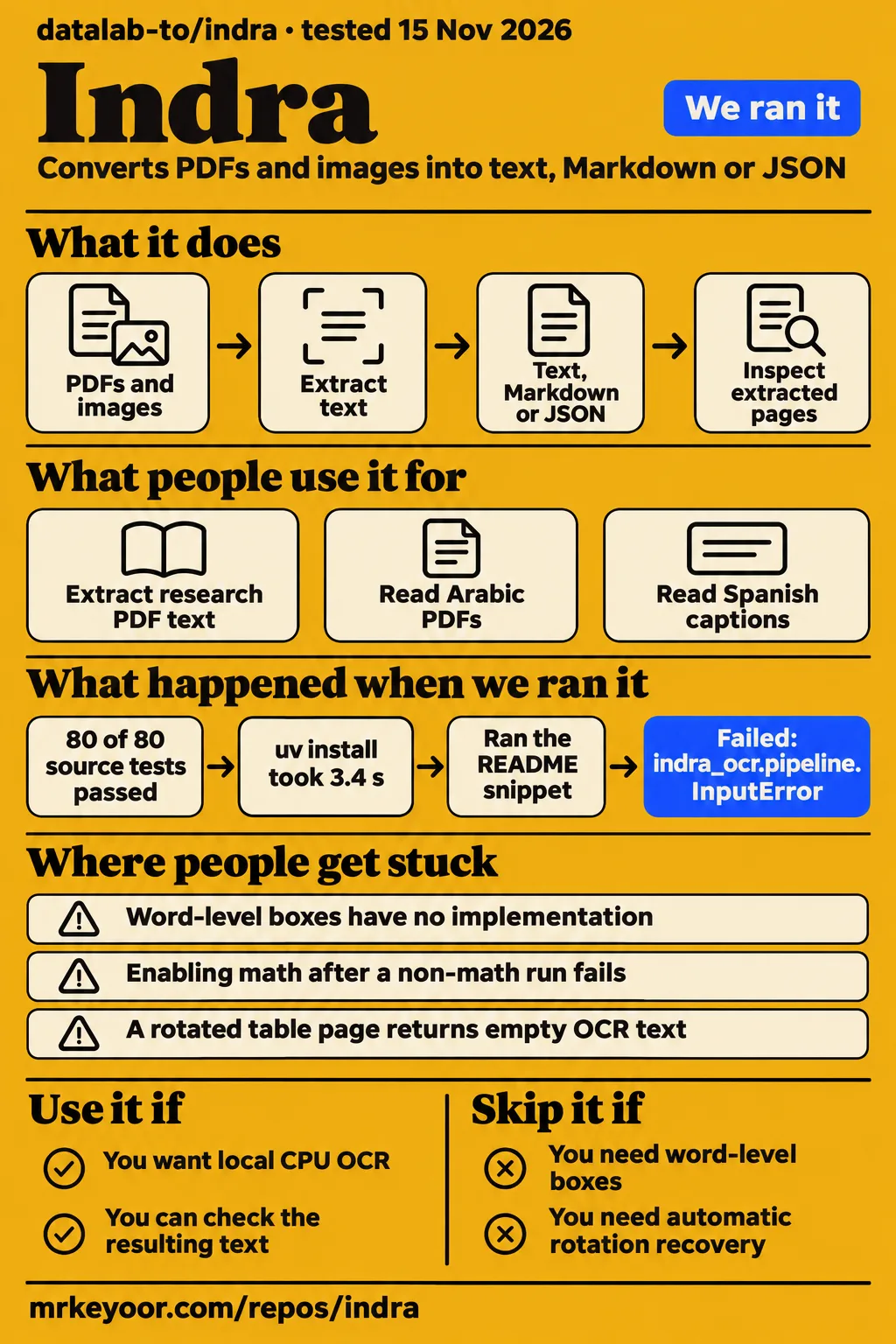
Short answer: passing tests earn a document trial
Indra passed all 80 tests in our sandbox, but our separate unedited Python quickstart stopped at a missing paper.pdf. Use it if you want local CPU OCR and can check the resulting text against your documents. Skip it if your application depends on word-level boxes, unattended correction of awkwardly rotated pages, or model licensing without Datalab's commercial conditions.
This review concerns datalab-to/indra, distributed as indra-ocr. It converts PDFs and images into text, Markdown or JSON containing positions and layout information. The useful distinction is between getting the software running and getting a particular document right. Our repository checks answer the first question. The public reproductions below give you a much better starting point for the second than a language list alone.
What people use indra for
Issue reporters have used Indra on research papers, Arabic PDFs and Spanish captions, with markedly different outcomes. These are their reproductions, attributed here so you can distinguish them from our lab results.
| Who tried it | Document or task | What happened |
|---|---|---|
| Reporter of issue #3 | A 472-page research PDF with mathematical italic characters | Version 0.3.1 crashed while writing text. Maintainer VikParuchuri reports a character-handling fix in 1.1.0. |
| Reporter of issue #11 | An Arabic paragraph printed to PDF by Chrome | Older Indra output reversed letters in 16 of 25 words. The maintainer reports that 1.1.1 reads the reproduction correctly through OCR fallback. |
| Reporter of issue #16 | Spanish words in Impact, Arial Bold and outlined captions | The plain Impact sample returned 4/8 correct words, Arial Bold 8/8, and the outlined caption sample 5/8. |
| Reporter of issue #17 | Sideways plan sheets | Turning the sheets upright by hand raised reported keyword recall from near zero to 63–88%. |
The Arabic case is especially useful for anyone feeding a search index. The output looked trustworthy: every line had confidence 1.0 and its source was the PDF text layer. Yet the letters inside many words were backward. A pipeline accepting text solely because the confidence field is high would have accepted those words. The maintainer's reported repair changes which extraction path is trusted, sending affected pages through OCR instead.
For research papers, distinguish extracting existing mathematical characters from recognizing formulas in a scan. Issue #3 concerns Unicode handling in a PDF text layer. Optional Math as LaTeX recognition has a separate model-loading path and a separate cache report. Fixing one does not tell you whether the other works for your paper.
What happened when we ran it
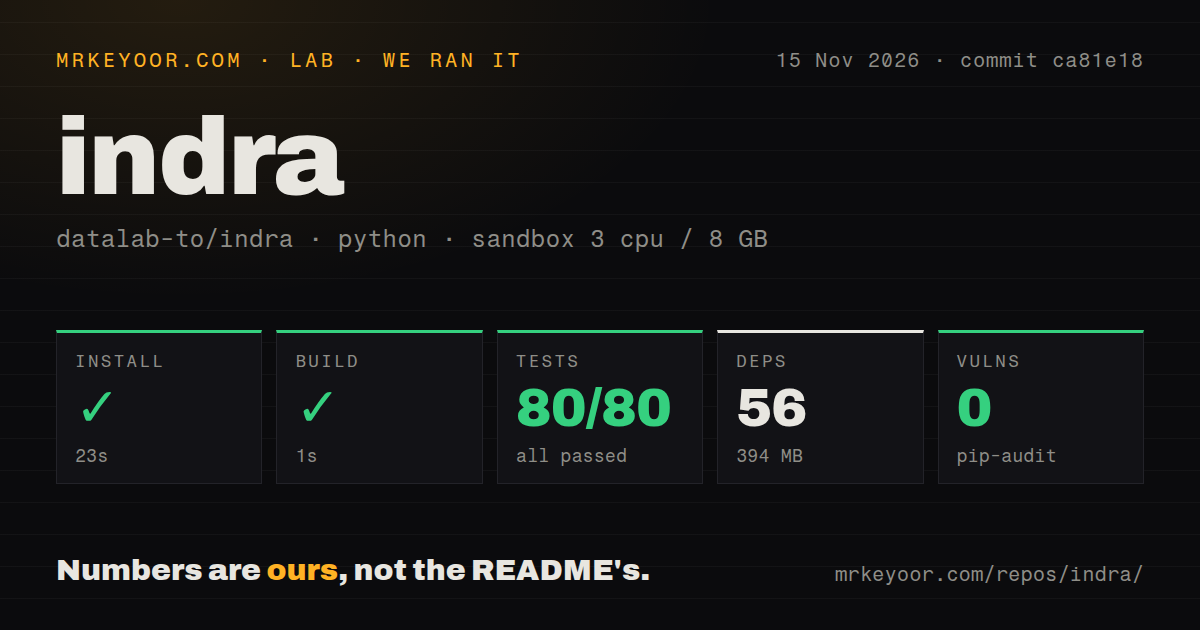
Our sandbox installed Indra in 23 seconds, built it in 1 second and passed 80 of 80 pytest tests in 9 seconds. Those are the repository harness results from November 15, 2026, at commit ca81e18.
| Repository check | Our recorded result |
|---|---|
| Install | Succeeded in 23 seconds |
| Dependencies | 56 recorded |
| Installed footprint | 394 MB on disk |
| Build | Succeeded in 1 second |
| Tests | Succeeded in 9 seconds: 80 passed, 0 failed of 80 |
| Dependency audit | pip-audit reported 0 known vulnerabilities |
| Repository scan | 58 files, approximately 6,701 source lines, 4.5 MB checked out |
| Automation signals | One CI workflow file, a tests directory, no Dockerfile detected |
The recorded sandbox configuration was 3 CPUs, 8 GB RAM and image ghcr.io/astral-sh/uv:python3.12-bookworm. The actual runtime and operating-system versions require raw toolchain logs. The modest checkout and passing suite make a source evaluation practical, while the installed footprint gives a more useful disk budget than the checkout size.
A separate quickstart run on November 15 used commit ca81e18f7403 and the published indra-ocr package in a fresh unprivileged container configured with 2 CPUs and 4 GB RAM, without published ports or secrets. The task was the README's Python block under “From python”, executed unedited. It reached conv.convert("paper.pdf") and exited with indra_ocr.pipeline.InputError: paper.pdf: no such file. The snippet log records that failure, and the finding record identifies the missing example input.
That is a concrete quickstart snag. The sample names a local file; the run supplied no file at that path. Replace it with a real input you control before judging recognition. Calling this an OCR accuracy failure would give the log a meaning it cannot carry. The teardown record reports successful cleanup.
Where people get stuck: fix map by symptom
Maintainer replies report fixes for Unicode output crashes, negative page limits and Arabic text-layer reversal. The supplied threads give different answers for feature requests and proposed patches, so an issue's closed label is insufficient on its own.
| Symptom | Evidence and action | Status in the supplied record |
|---|---|---|
| UnicodeEncodeError while writing mathematical characters | VikParuchuri in #3 says 1.1.0 combines supplementary characters correctly and replaces lone surrogates with U+FFFD. Update from the affected release. | Maintainer reports fixed in 1.1.0 |
| Negative page limit silently loses output | VikParuchuri in #10 says 1.1.0 makes negative values a CLI usage error and raises ValueError through the Python APIs. | Maintainer reports fixed in 1.1.0 |
| Arabic letters reversed despite confidence 1.0 | VikParuchuri in #11 says 1.1.1 rejects affected visual-order text layers and uses OCR. | Maintainer reports fixed in 1.1.1 |
| Math enabled after a non-math first run fails | DylanMing in #18 describes PR #19 checking required cache files and completing downloads. | Proposed repair with contributor testing; release status absent from the extract |
| Need word-level positions | Reporter and respondent in #7 request word-level boxes instead of line-level boxes. | Open request, no implementation in the thread |
Keep the package version and model revision with each saved result. An output file from 0.3.2 and one produced after the Arabic repair are different evidence. If you are investigating missing text, record the input page count and extracted page count too: the negative-limit report is a reminder that a successful exit can accompany incomplete output in an affected version.
Language accuracy changes with the document
A Spanish caption-font change moved the reporter's result from 4/8 correct words to 8/8, while a Chinese issue remained disputed after a maintainer-reported improvement. These reports make script, font and layout part of the acceptance test.
In issue #6, VikParuchuri says 1.1.0 improves Chinese layout and recognition. The reporter, anhducxz, replies that results still contain noise, especially in layout detection and text recognition. The thread is closed, but that follow-up prevents a clean “Chinese fixed” conclusion. Keep a representative Chinese page with its correct reading order as a reference, rather than accepting a language-support checkbox.
The Spanish reporter in #16 used indra-ocr 1.1.2 on Windows 11 with CPU inference. NIÑO became MINO and SEÑOR became SENOR in the plain Impact sample, while the Arial Bold control read the eight test words correctly. The outlined caption variant produced different mistakes. Font substitution is a useful workaround when you control image creation. It does nothing for captions or scans somebody else has already rendered.
The latest release returned by GitHub, v1.1.2, is also the version named in the math-cache report. Its public release notes separately describe a repair for Hindi PDFs using legacy-font text layers and recommend --mode ocr when a text layer still reads incorrectly. English README instructions are available. For a multilingual application, save both the source path and the actual text: whether a page used text extraction or OCR can explain a surprising change in results.
Rotation problems deserve a separate input check
The reporter of issue #29 recovered 189 lines by manually turning a table image that had returned four empty lines. That reproduction is more useful than assuming automatic orientation will handle every angle.
In issue #29, the source was the repository's table example rotated 60° counterclockwise. Indra reported rotation 0 and skew 30.0, with four empty lines. An additional clockwise quarter-turn recovered 189 lines and 2,187 alphanumeric characters. The reporter expanded the canvas before rotation, so cropped-away content was excluded as the explanation in that reproduction.
The plan-sheet reporter in issue #17 requested known quarter-turns through convert() and a configurable orientation threshold. Their own examples show why simply lowering the threshold is a poor blanket recommendation: it would turn one sheet the wrong way. Both threads describe manual input rotation as a practical recovery step, with automatic recovery still unresolved in their records. For unattended ingestion, keep an empty-output check and route suspicious pages for inspection before declaring the file processed.
CPU profiling identifies work, not a universal speed verdict
The author of issue #15 reports that models accounted for about 80% of a Latin scanned page after native-kernel work on one single-thread Intel i7-13620H setup. This is profiling evidence for that workload.
The profiling thread discusses recognizer window size, activation changes, quantization and the CJK recognition head. Some proposals require retraining, and changes to tokens require accuracy checks. A participant also says the original training code and data are not public. Those details matter if your adoption plan depends on changing the model yourself rather than using the published inference assets.
For operating a batch job, the README documents one single-threaded worker per core through convert_many and a --cores limit. Choose that limit alongside other work on the machine, then record throughput on your own mix of scans and digital PDFs. Our successful source checks supply no pages-per-second result. The profiler's machine and document mix should stay attached to any performance claim you take from the thread.
Security and licensing: inspect the weights separately
Indra's code is Apache-2.0, while its model weights use a modified OpenRAIL-M license with commercial conditions. The README describes free use for research, personal use and startups under $20 million funding/revenue, and says the weights cannot be used competitively with Datalab's API. Read those conditions before building a commercial service around the models.
The local quickstart documents no hosted API credential. Models download from Hugging Face on first use, and the README offers INDRA_OCR_MODEL_DIR or --model-dir for a local copy. Its viewer description says files stay on your machine and gives an SSH port-forwarding example. That is a useful local workflow for inspecting text and boxes before integrating the Python API.
Our pip-audit result was 0 known vulnerabilities. Keep the meaning of that result narrow: it is a dependency-advisory observation from the recorded run. For a document ingestion service, decide separately how uploaded files reach the process, where output is stored and who can reach the viewer. The supplied quickstart run used an unprivileged container without published ports; it offers no reason to expose the viewer publicly.
Indra vs Poppler, Tesseract and PaddleOCR
Poppler's pdftotext preserved all 25 words in the Arabic reproduction where older Indra output reversed letters in 16. Indra's maintainer subsequently reported a repair in 1.1.1, so that historical comparison needs its version attached.
| Option | What the evidence supports | When I would choose it |
|---|---|---|
| Poppler pdftotext | The reporter of #11 used it as a reference and obtained the Arabic words in source order. | Check an existing PDF text layer before adding recognition to the workflow. |
| Tesseract | Its README documents image OCR and plain text, PDF, TSV, ALTO and PAGE outputs. | You need one of those output formats or want to evaluate its documented training route. |
| PaddleOCR | Its README documents PP-StructureV3 conversion to Markdown or JSON with table-cell and text coordinates. | Fine-grained document coordinates are central to the integration you want to evaluate. |
| OpenVINO backend | The author of #15 found mixed results against ONNX Runtime and listed the substitution as not worth pursuing on that setup. | Treat it as a backend experiment, rather than an alternative OCR product. |
| modly | Mid or Real places it beside Indra in a Local AI score comparison. | That page supplies no task-level OCR result on which to choose it for this job. |
The first choice is often the extraction path. A digital PDF with usable text has a different problem from a scanned page. For actual OCR, evaluate the same inputs and required output fields with each candidate. In particular, line positions, word positions and table-cell positions are different integration requirements. A high-level comparison score cannot answer which one your application receives.
What the other reviews get wrong
The math-download promise needs a cache-state qualification: issue #18 reports that enabling math after a non-math run failed repeatedly on 1.1.2. This corrects the README's quoted download behavior, rather than proving that every first math run fails.
The reporter of #18 says an incomplete cache was trusted even when the network worked. DylanMing describes a proposed repair in PR #19 that checks requested files, finishes downloads online and names missing files offline. The extract records contributor testing on Windows, but gives no merged or released outcome. Do not turn “closed” into “fixed in the version I downloaded.”
The Mid or Real comparison gives both Indra and modly the label MID and lists popularity figures. That is an opinion and an attention snapshot, not an OCR comparison on a shared document set. Likewise, the supplied Reddit film discussion, X search record and YouTube mythology transcript concern other uses of the name Indra. None is evidence of OCR adoption.
The search phrases “indrajith film”, “indrajaal”, “indrajit”, “indra dev”, “indramma indlu”, “indra kumar”, “indrajaal movie”, “indra”, “indra movie”, “indrans”, “indra vs ravana” and “indra vs ashura” do not identify this OCR package. They appear in the supplied autocomplete record; this page answers the software question for datalab-to/indra. Reading those suggestions as developer demand would mix unrelated entities into the assessment.
Questions people ask
Indra's supplied Chinese issue contains a maintainer-reported improvement followed by a user reporting continued layout and recognition errors. Choose evidence from pages resembling yours over a blanket language-accuracy claim.
How accurate is Indra OCR on Chinese pages, especially during layout detection?
The reporter of issue #6 still found noise after the maintainer described improvements in 1.1.0. That is a disputed result on the reported material, not a measured accuracy figure for your collection. Include region detection and reading order in a Chinese evaluation, because a correctly recognized line is less useful when attached to the wrong layout block.
Does Indra support word-level bounding boxes?
The supplied issue #7 asks for word-level boxes instead of the existing line-level boxes and remains open. The README describes lines and layout blocks. If you need per-word highlighting, treat that request as a feature gap in the evidence rather than promising that line positions will satisfy it.
Why can Arabic words be letter-reversed even when text-layer confidence is 1.0?
The maintainer in issue #11 confirmed that Chrome-printed PDFs could pass through visual-order Arabic-script text as a clean layer. They report a 1.1.1 fix that rejects affected layers and uses OCR. The confidence field in the older reproduction therefore failed to distinguish readable logical order from backward letters inside words.
How do I fix UnicodeEncodeError when extracting mathematical characters from PDFs?
VikParuchuri reports the issue #3 repair in 1.1.0: characters outside the BMP arrive as single characters, while a lone surrogate becomes U+FFFD. Updating from the affected release follows the maintainer's advice. Replacing output characters with question marks can hide the crash at the cost of losing the mathematical characters you wanted to extract.
Does --max-pages -1 mean unlimited pages, or can it drop output?
The reporter of #10 found silent page loss with negative values in 0.3.2; zero meant all pages. The maintainer says 1.1.0 rejects negatives through both CLI and Python entry points. Avoid importing a minus-one-means-unlimited convention from another tool into an ingestion script.
Why does Math as LaTeX fail after I first run Indra without math?
The reporter of #18 traced the 1.1.2 failure to an incomplete cached model folder being accepted before the missing math files could download. DylanMing describes a proposed cache-validation repair in PR #19. Repeatedly pressing “Read again” was ineffective in that reproduction even with a working connection.
Why does Indra misread Spanish Ñ in Impact captions?
The reporter of #16 demonstrated font-sensitive errors: Impact lost or changed Ñ, while Arial Bold read the eight control words correctly. The thread contains no maintainer diagnosis proving the model-level cause. Its suggestion to add training samples is a user proposal, not a shipped repair.
Can I pass a known page rotation to convert() or configure the orientation threshold?
The author of #17 requests both features for Indra 1.1.2. The supplied thread provides no implementation, and its examples show that lowering the threshold alone would also introduce wrong turns. Manually orienting the source is the documented recovery in that report.
Why does a rotated table page return empty OCR text?
In issue #29, a 60° input produced four empty lines after orientation and deskew, while an additional manual clockwise quarter-turn recovered text. The reproduction reports an orientation/deskew decision problem. It does not supply a released automatic fix or justify applying that extra turn to every rotated table.
Can Indra's models be retrained to improve speed?
A participant in issue #15 says the training code and data are not public. The thread proposes model changes and describes accuracy checks they would need. It provides profiling directions for contributors, not a completed retraining recipe you can follow from the inference repository alone.
What we have not tested yet
Our passing source suite and missing-file quickstart leave recognition quality unmeasured by us. We have not tested a supplied real PDF to completion in this quickstart, word-level integration, multilingual accuracy, handwriting, complex tables, degraded scans, rotation recovery, math output, or a repaired partial cache. No screenshots or known-answer OCR questions accompany these runs.
The two lab records use different sandbox configurations and different scopes. Their dependency-install measurements must not be combined into a single footprint or setup benchmark; this review uses the repository harness numbers for install, build, tests, dependency count and audit. The image label alone cannot confirm runtime or operating-system versions. Raw toolchain logs would be needed for those claims.
We have not tested GPU paths, long-running service memory, concurrent uploads, hostile files, network behavior or alternative engines on a shared corpus. The dependency audit does not establish application security, privacy or license suitability. Search volume, production adoption and the support capacity behind the sampled issue replies remain unknown. The current public API reports a November 4, 2026 push and the issue records show both maintainer fixes and unresolved requests; a release date alone cannot settle project health.
For the next evaluation, bring one correctly transcribed page from your own workload and compare the characters, boxes and reading order. If you expect to enable math later, include that exact cache transition. A clean run of someone else's tests is useful preparation for that decision, but the document your application needs to read is the one that should decide it.