mrkeyoor.com_
Thu 01 Oct 03:25 UTC
Dev Toolsevaluationupdated 01 Oct 2026

Ikemen-GO review

Ikemen GO is an English-documented fighting game engine that runs characters, stages, screenpacks, and other resources made for M.U.G.E.N. It gives creators a maintained, open-source base for building a complete fighting game while adding netplay, modern renderers, Lua hooks, and features beyond M.U.G.E.N 1.1.

Verdict

Our Ikemen GO run installed 77 packages and built in 6 seconds, but go test failed all 3 reported package results during setup because arena was excluded. Use the release build if your priority is running or extending M.U.G.E.N content on current hardware. Engine contributors should wire the documented arena experiment into their test command and prove a green suite before treating the fast build as release evidence.

We ran it

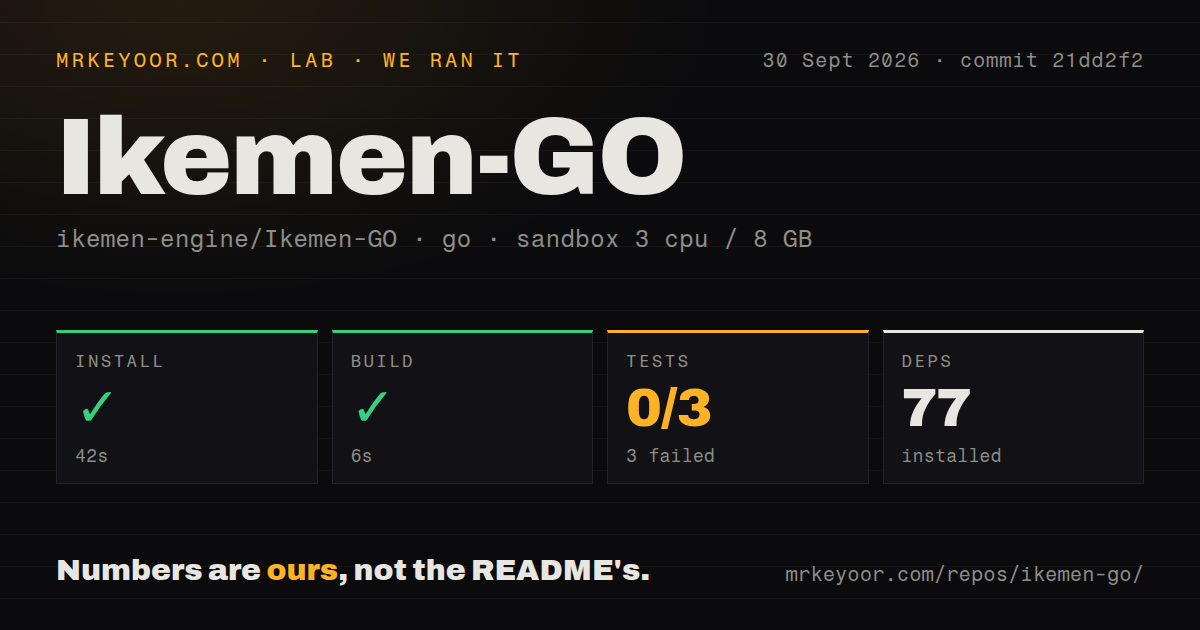
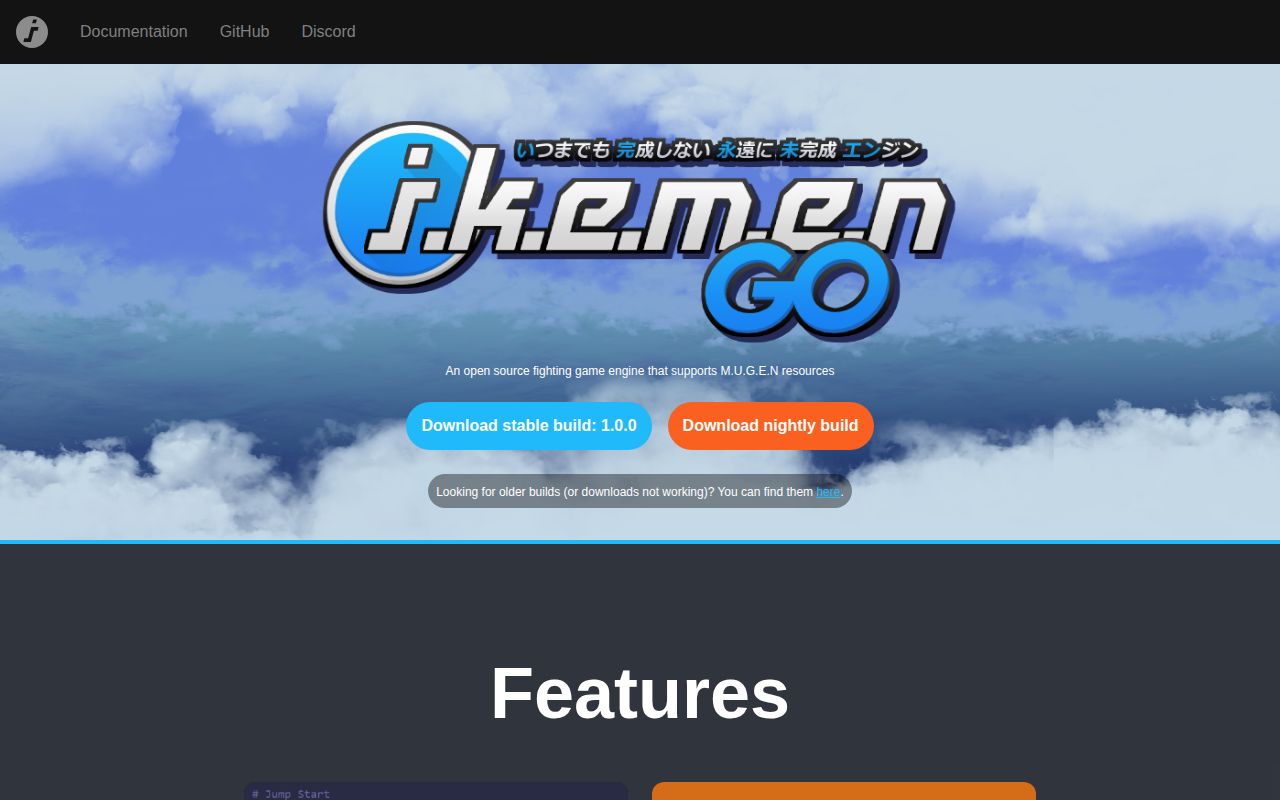
Lab card: what happened when we ran Ikemen-GOScreenshot of Ikemen-GO (ikemen-engine.github.io)
Install✓ · 42s77 packages
Build✓ · 6s
Tests✗ · 3s0 passed · 3 failed of 3 (go test)
Repo175 files~133,388 lines of source · 6.7 MB · 8 CI workflows

Answers from our run

Does Ikemen-GO build from source?

Dependencies installed in 42 seconds (77 packages), and the build succeeded in 6 seconds. We cloned commit 21dd2f2 into a clean Debian container with 3 CPUs and no project-specific setup.

Do Ikemen-GO's tests pass?

Not all of them: 0 of 3 passed and 3 failed when we ran the project's own test command (go test). Some failures need services or credentials a bare container does not have.

Who should not use Ikemen-GO?

Teams that need every M.U.G.E.N quirk reproduced exactly: the README says compatibility does not include bug-for-bug emulation, and open issue #4060 documents one character failing on an undocumented HitDef velocity value.

What are the alternatives to Ikemen-GO?

Castagne, Godot, LÖVE. Our Ikemen GO run installed 77 packages and built in 6 seconds, but go test failed all 3 reported package results during setup because arena was excluded.

Setup3/542-second install and 6-second build, but the test command failed
Docs4/5Clear platform, source-build, runtime, and licensing guidance
Community4/51,582 stars with issues and code active through October 1
Maturity4/5v1.0.0 is released, while compatibility reports remain active

Who it’s for

M.U.G.E.N creators who want to move an existing roster or screenpack to an actively maintained engine.
Fighting game developers who need rollback netcode, configurable game modes, and Lua extension points.
Players assembling custom games from community characters and stages on current desktop systems.
Contributors comfortable with Go, C-linked media libraries, and platform-specific release builds.

Who it’s NOT for

Teams that need every M.U.G.E.N quirk reproduced exactly: the README says compatibility does not include bug-for-bug emulation, and open issue #4060 documents one character failing on an undocumented HitDef velocity value.
Projects that require a clean default go test gate in a fresh container: our run reported 0 passed and 3 failed of 3 because the arena package was excluded during setup.
Older or low-spec targets: current releases require Windows 10, macOS 13 on Apple Silicon, Android 13, iOS 17, or Linux with glibc 2.35, plus a suitable GPU API.
Studios wanting one-license asset distribution: the engine is MIT, bundled screenpack assets use Creative Commons terms, and FFmpeg brings LGPL obligations.
Mobile teams expecting store-ready packages: Android is a downloaded APK, while iOS requires sideloading and free Apple IDs refresh every 7 days.

Setup reality

Our sandbox installed commit 21dd2f2 in 42 seconds, adding 77 packages. The build succeeded in 6 seconds. Tests failed in 3 seconds: go test reported 0 passed and 3 failed of 3 because the src package imported arena, whose Go files were excluded by build constraints.

Building from source needs Go 1.27 or newer, GOEXPERIMENT=arenas for direct Go commands, pkg-config, SDL2, libxmp, and a C toolchain. The build script can compile a minimal FFmpeg and sets the arena experiment itself. Running a source build also needs the separate Ikemen-GO-Screenpack files. No account, API key, or hosted service is required.

Published builds have firm platform floors and need OpenGL 3.3, OpenGL ES 3.2, or Vulkan. Android packaging uses Docker. iOS is a sideloaded IPA, and Linux releases target glibc 2.35 or newer. Asset and FFmpeg licenses need separate distribution checks.

M.U.G.E.N 1.1 compatibility is the reason to choose it

Ikemen GO aims to load resources made for M.U.G.E.N 1.1 while giving creators a maintained engine they can inspect and change. Characters, stages, screenpacks, fonts, and fight logic carry over far enough to turn years of community material into a playable custom game. The project also adds rollback netcode, Lua control, modern graphics paths, extra game modes, and 3D stage features. That combination is much more specific than choosing a general 2D engine.

The Ikemen GO README draws an important line: compatibility does not mean preserving every M.U.G.E.N bug or undocumented behavior. Open issue #4060 gives the tradeoff a concrete face. A character that uses the undocumented n value for HitDef velocity closes with an invalid-data error in v1.0.0. If your game depends on a large inherited roster, testing each character and stage is part of migration, not final polish.

A 6.7 MB checkout needs Go 1.27 and native media libraries

commit 21dd2f2 had 175 files, about 133,388 source lines, and occupied 6.7 MB. The repository is compact, but its build crosses Go and C library boundaries. The source build guide requires Go 1.27 or newer, pkg-config, SDL2, libxmp, and a C toolchain. Its helper script can build a decoder-only libvpx and minimal FFmpeg, reducing the need to align a full system FFmpeg.

The engine uses Go's arenas experiment for rollback-state cloning. build/build.sh exports GOEXPERIMENT=arenas, while direct go build and go test commands need the variable supplied separately. Running the resulting executable also requires files from the separate Ikemen-GO-Screenpack repository. There are no cloud accounts or API credentials to configure. The cost is local toolchain precision: a normal distribution package may be older than Go 1.27, and a successful binary build does not prove a direct test command has the same environment.

What happened when we ran it

Our run installed commit 21dd2f2 in 42 seconds, adding 77 packages, and the build completed in 6 seconds. The fresh Debian container had 3 CPUs, 8 GB of RAM, no secrets, and no elevated privileges. We counted eight CI workflow files, no Dockerfile, and no tests directory. The build result proves that the supplied build path can compile in that sandbox. It says nothing about gameplay feel, netcode quality, or asset compatibility.

The test step failed in 3 seconds. go test reported 0 passed and 3 failed of 3, all under a setup failure for github.com/ikemen-engine/Ikemen-GO/src. The log says build constraints excluded every Go file in the toolchain's arena package. The build guide separately says direct Go commands require the arenas experiment. We did not rerun the suite with a changed environment, so we cannot claim the tests would pass after that adjustment.

Current releases leave old systems and easy mobile installs behind

v1.0.0 requires Windows 10, macOS 13 on Apple Silicon, Linux with glibc 2.35 or newer, Android 13, or iOS 17. Graphics require OpenGL 3.3, OpenGL ES 3.2, or Vulkan. Those floors are clear and defensible for a modern engine, yet they exclude Intel Mac release users, older Windows cabinets, and many repurposed Android devices. The README directs those users to older releases rather than implying current support.

Mobile packaging also asks more of the owner than a store download. Android users install an APK from the release archive, and open issue #3991 reports a Play Protect warning on a recent Samsung device. iOS users sideload an IPA with AltStore, SideStore, or Sideloadly. A free Apple ID requires refreshing it every 7 days. These paths suit hobby projects and testing better than mass-market distribution.

v1.0.0 broadens the engine while compatibility bugs stay visible

Release v1.0.0 shipped on September 12, 2026, and the repository was pushed again on October 1. GitHub showed 1,582 stars and 79 combined issues and pull requests. The release includes work across input, cameras, renderers, 3D stages, localization, controllers, and M.U.G.E.N behavior. Recent issue activity includes both new-format work and old content that no longer loads as expected.

Licensing also needs a deliberate pass before redistribution. The engine source is MIT, the default screenpack uses Creative Commons licensing, and FFmpeg is LGPL 2.1. The project publishes corresponding FFmpeg source with releases, including for the statically linked iOS build. That is better documentation than many hobby engines provide, but it does not turn the whole game bundle into one MIT-licensed artifact. Track the terms for every asset pack you add.

Ikemen GO is the practical choice when an existing M.U.G.E.N library is the center of the project. A new commercial fighter with no legacy assets gets more editor tooling and fewer compatibility assumptions from Godot or Castagne. For Ikemen GO contributors, the 6-second build is promising, while our 3-second test failure is the release-gate fact that matters. Put the arena setting into CI explicitly, then test the actual roster and stages you intend to ship.

Alternatives

ProjectWhat it isPick it when
CastagneA fighting game engine and toolkit built around Godot.pick this instead when you are starting a fighter from scratch and prefer Godot tooling over M.U.G.E.N resource compatibility.
Godot gh↗A general-purpose open-source engine with dedicated 2D and 3D editors.pick this instead when full control over game systems matters more than loading an existing M.U.G.E.N collection.
LÖVEA Lua framework for building custom 2D games with a small core.pick this instead when you want to program the combat engine yourself in Lua rather than adopt M.U.G.E.N conventions.

What people are saying

  1. [github-trending] ikemen-engine/Ikemen-GO

Sources

  1. Ikemen GO README
  2. Ikemen GO source build guide
  3. Ikemen GO v1.0.0 release
  4. Issue #4060: undocumented HitDef velocity value
  5. Issue #3991: Android Play Protect warning
  6. Ikemen GO repository facts

More dev tools reviews

libuv · fframes · gander · lipgloss · roundhouse · GhostTrack · the whole board →