HVE Core turns Copilot chats into a prescribed workflow
HVE Core packages custom agents, reusable prompts, coding instructions, and skills for GitHub Copilot. Its main Research, Plan, Implement method asks the agent to understand a problem, write an explicit plan, then change the project under review. Separate artifacts cover code review, security planning, responsible AI, documentation, and other engineering work. The attraction is consistency: teammates can invoke the same named workflow instead of passing around personal prompts.
The prescription is also the risk. Microsoft describes HVE Core as highly opinionated and rapidly evolving, and says workflows or interfaces may change incompatibly. Our commit 8692fe3 checkout contained 2,625 files, about 150,314 lines of source, and occupied 32.1 MB. This is much closer to adopting an engineering playbook than installing a small editor add-on. Read the relevant agent and skill files before allowing them to shape a repository.
The VS Code extension is simpler than copying the repository
The documented easiest route is the HVE Core extension from the VS Code Marketplace. Open a project, start GitHub Copilot Chat, select the RPI agent or run its command, and describe the task. Copilot CLI users can register this GitHub repository as a marketplace and install the hve-core plugin. Those managed routes carry the complete component set.
Teams wanting fewer pieces can adopt from a clone. The included installer copies agents, prompts, instructions, and complete skill directories, preserves their relative paths, and records tracking metadata using schema version 2. Hooks are excluded from that copy path. The team must still choose components, check name collisions, and decide whether updates arrive automatically or through a pinned revision. That ownership work is the price of a smaller footprint.
What happened when we ran it
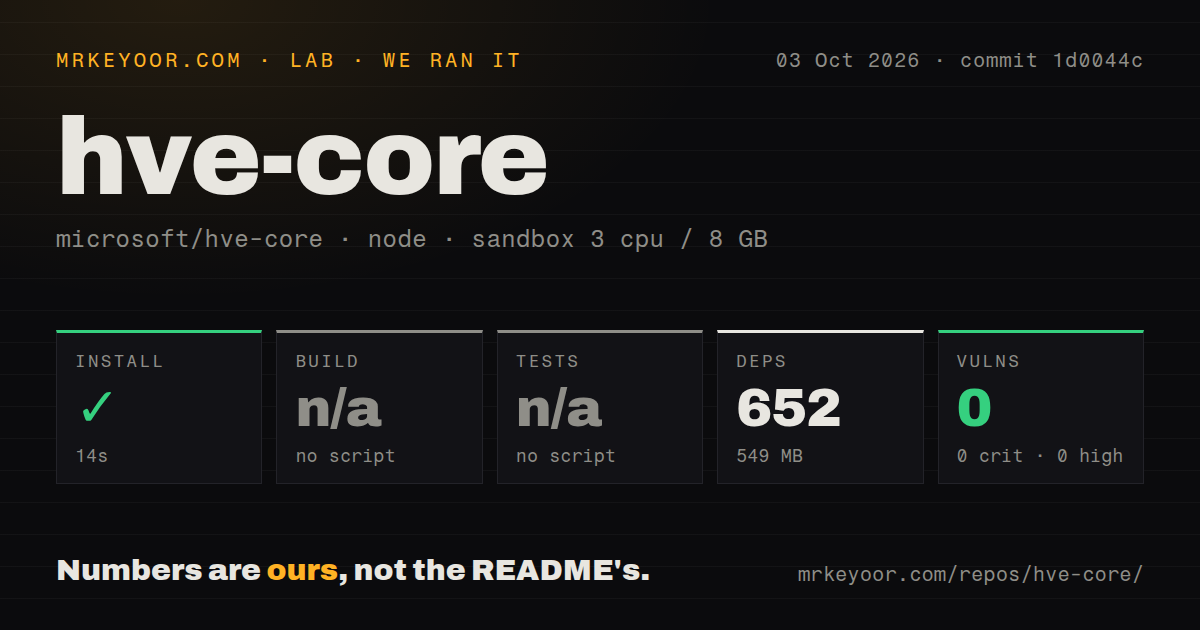
Our sandbox installation succeeded in 34 seconds on commit 8692fe3. Npm added 891 packages and used 682 MB on disk, a large dependency footprint for a repository whose delivered product is mostly workflow artifacts. Npm audit reported 0 known vulnerabilities: 0 critical, 0 high, 0 moderate, and 0 low in that resolved tree. Those figures describe our fresh Node 22 container, not future installs.
The harness found no default build script or target, so it skipped building. It also found no default test script or target and skipped tests. The package file does contain narrower commands such as test:node, test:py, PowerShell Pester tests, documentation checks, and many lint and validation jobs. A contributor needs to choose the relevant command and install its non-Node tooling rather than assuming npm test represents the project's checks.
Our scan counted 67 CI workflow files, no Dockerfile, and no top-level tests directory. That workflow count matches the repository's emphasis on validating artifacts, permissions, dependencies, documentation, and release channels. It also makes local parity harder: many scripts call PowerShell, Python, uv, documentation tools, or specialized evaluation commands. The 34-second npm install proves only that the root JavaScript dependencies resolved cleanly.
File validation cannot promise correct agent behavior
HVE Core checks markdown, frontmatter, links, model references, manifests, workflow permissions, dependency pins, Python, PowerShell, and skill structure. Its transparency note draws the boundary well: these gates can show that an artifact is formed and packaged as intended, but the project has no model of its own and cannot guarantee what a host model will produce from the instructions. Different model choices and Copilot versions may behave differently with the same file.
That limitation changes how teams should use the planning agents. Security, responsible AI, supply-chain, and code-review outputs are drafts for qualified people to check. The repository says agent suggestions are advisory and should not become the sole basis for decisions affecting finance, medicine, employment, housing, or other high-stakes areas. A detailed template may improve coverage, but its confident formatting is not evidence that the underlying judgment is correct.
Release channels trade freshness for a clearer review boundary
The ref-less main registration tracks the current development tip. Moving prerelease and stable branches provide reviewed channels, while exact version tags freeze the marketplace catalog and source payload. Microsoft says the published release workflow produces a VSIX along with SBOM and provenance sidecars. Teams using HVE Core for production-relevant work should pin a tag and review changes before upgrading.
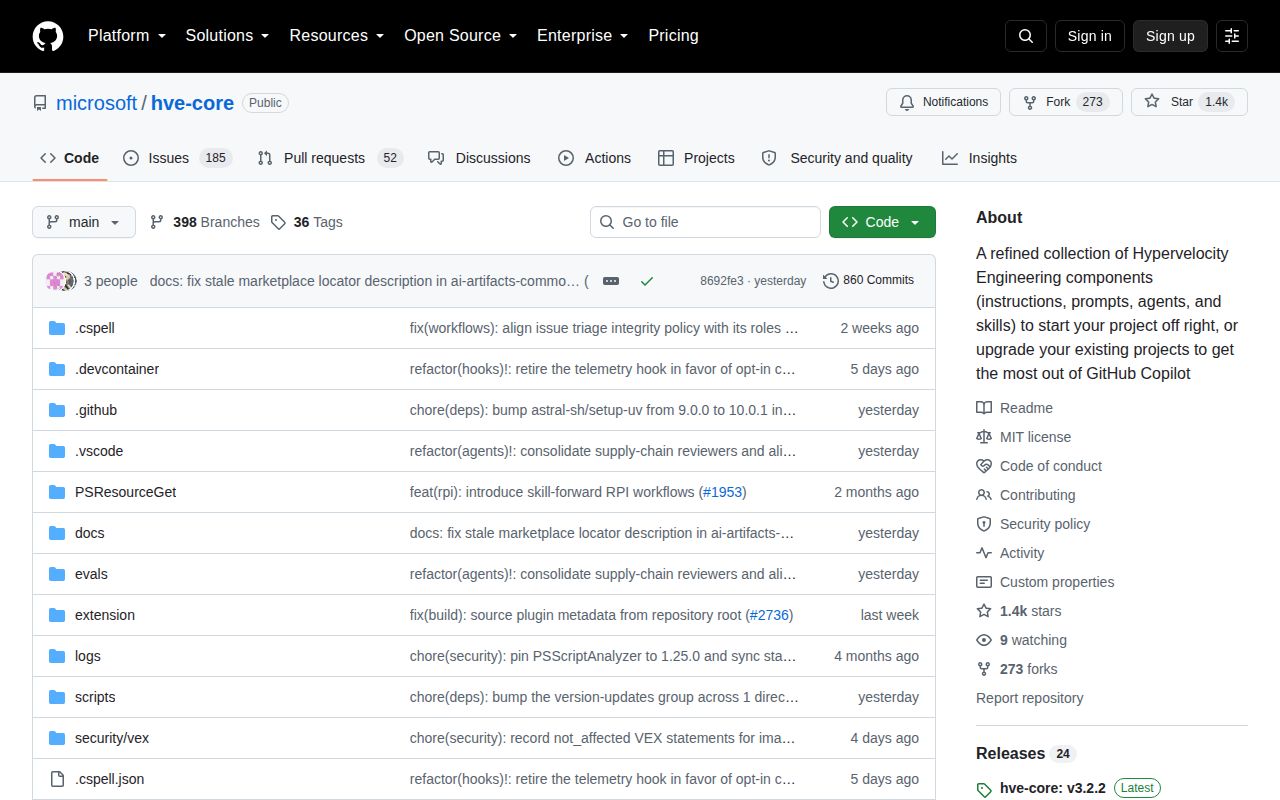
GitHub recorded the last push on August 28, 2026, with current issue and pull-request updates the same day. The latest GitHub release was 3.2.2 from March 23, and GitHub listed 1,375 stars plus 237 combined open issues and pull requests. The older release tag alone does not indicate inactivity because development and issue activity are current. It does reinforce the need to understand whether a chosen marketplace channel follows main, stable, or one immutable tag.
Copy the useful patterns and keep responsibility local
HVE Core is most persuasive as a reference implementation. Its docs explain installation choices, artifact structure, review gates, release identity, model limits, and human responsibility with more candor than most prompt collections. A team can study the RPI flow, take a security-planning skill, or adapt its validation ideas without promising to follow every upstream change.
The whole package demands real maintenance. Our 891-package, 682 MB install was clean, but the harness had no single build or test command that summarized readiness. Host behavior remains outside the repository's control, and copied files lose upstream history and verification unless the adopter records them. Use a reviewed tag, select only the components that solve an observed problem, and keep human approval on code, infrastructure, and decision-shaping outputs.