Static publishing with more machinery inside
Hugo reads content and configuration, applies templates, processes assets, and writes a directory of files ready for a web server or CDN. Nothing in the deployed site needs Go, a database, or a resident Hugo process. That model keeps production cheap and reduces the number of moving parts exposed to visitors. A local server watches files and rebuilds during editing.
The generator covers far more than Markdown to HTML. Its content model handles sections, taxonomies, page bundles, multilingual sites, menus, related content, and several output formats. The resource pipeline can resize and transform images, bundle and minify CSS, process Sass, run PostCSS, compile Tailwind, and bundle TypeScript or JSX through its included tooling. Hugo Modules share themes, assets, data, translations, and content through Git repositories.
This breadth is why Hugo works well for a publication or documentation estate that would otherwise assemble several build tools. It is also why the first serious theme takes time. Go template syntax, lookup rules, page context, partials, shortcodes, resource paths, and content organization form their own framework. A prebuilt theme can hide that learning curve until the first unusual requirement arrives.
Where the fit breaks
Hugo produces static output. Search, comments, forms, authentication, payments, private dashboards, and per-user responses require browser code or an outside service. That is a clean boundary for articles and docs. It is awkward for a product whose main value happens after a visitor signs in. Astro is often a better bridge when a site needs component-framework islands, while a server framework fits request-time logic.
Existing Markdown is not always drop-in content. An open proposal from documentation users explains that bare files may lack front matter and may link to .md paths rather than generated routes. Hugo expects content to participate in its model. A migration can need metadata insertion, link conversion, layout selection, and asset-path cleanup. Test a representative directory before promising a cheap move.
Specialized template features deserve regression coverage. One current bug report shows identical templates.Defer block bodies in different output formats sharing an escaping mode nondeterministically. The builds reportedly exit successfully even when one output is wrong. Another report concerns concurrent scratch-map access aborting a build. Neither makes ordinary sites unsafe, but both argue for checking generated HTML rather than treating exit code zero as sufficient.
What happened when we ran it
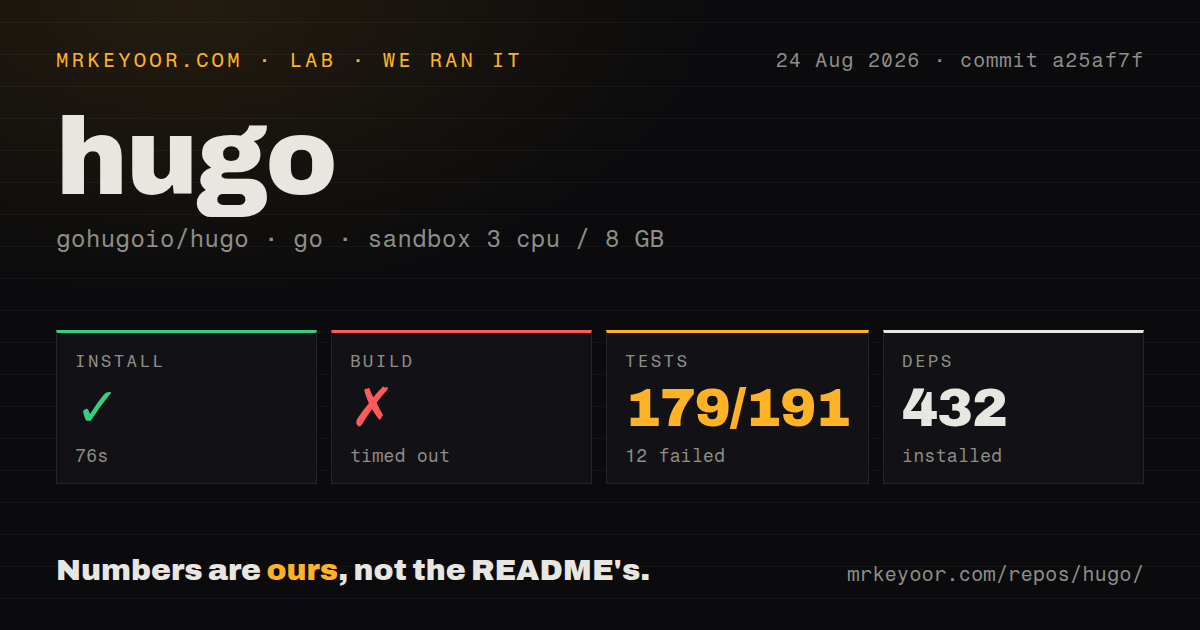
We cloned commit a25af7f into a fresh Debian Bookworm container based on Go 1.24. The sandbox had 3 CPUs, 8 GB of RAM, no secrets, and no elevated privileges. The repository occupied 26.9 MB and contained 2,548 files with about 238,539 source lines. It had three CI workflow files and a Dockerfile, but no top-level tests directory.
Installation succeeded in 76 seconds and installed 432 packages. The build did not complete before the 900-second limit. That is a timeout, not a compiler error, and the available record does not identify why it kept running. We will not turn the container image, source size, or dependency graph into a guessed explanation.
The separate test command ran for 375 seconds and exited with status 1. Its summary reported 179 passed and 12 failed out of 191. The supplied tail listed successful packages in template, transform, and watcher areas, then ended with FAIL. It did not include the names or assertions of the 12 failures, so the defensible finding is limited: this commit did not complete the measured test run cleanly in that sandbox.
These results matter most to contributors, distribution maintainers, and anyone compiling Hugo during deployment. Site authors normally install a published binary. That path avoids rebuilding the generator, though it still deserves a pinned version and a real site build in CI.
Pick the right edition
Hugo publishes standard, deploy, extended, and extended/deploy editions. Standard has the core generator and asset pipeline. Deploy adds direct uploads to Google Cloud Storage, Amazon S3, or Azure Storage. Extended includes embedded LibSass and needs a C toolchain when built from source. The README says LibSass was deprecated in version 0.153.0 and will be removed, with Dart Sass as the replacement. A new site should avoid making LibSass its foundation.
Current source builds require Git and Go 1.26 or later. The standard build can disable CGO. Extended builds need GCC or Clang. Prebuilt packages remove most of that friction, but external Dart Sass, PostCSS, and Tailwind workflows still bring their own versions and executable permissions. Release 0.165.0 removed Tailwind from the default security allow list, a reminder that an upgrade can affect build policy even when content is unchanged.
Cloud deployment is optional. A normal local build needs no secret. The deploy editions need provider credentials, and private modules need Git access. Keep those credentials in the CI secret store, not in the repository or Hugo configuration committed with the site.
Health and the decision
The repository was pushed on August 24, 2026. Version 0.165.0 arrived on August 12 with new CSS resource functions, import-context support, dependency updates, and fixes for static-file deletion plus macOS atomic saves. GitHub listed 248 open issues and pull requests combined. Recent bug reports received detailed reproductions and maintainer attention, while enhancement work continued through the forum and proposal process.
Hugo's documentation is one of its strongest assets. Installation, configuration, templates, content management, deployment, modules, functions, and troubleshooting all have dedicated material. Support questions go to a large public forum rather than the issue tracker, which keeps bug reports focused but asks newcomers to search two places.
For a content-heavy static site, Hugo is still an easy recommendation. Download the edition you need, pin its version, and build the actual site in CI with link and HTML checks. Walk away if the product needs request-time application logic or the team dislikes Go templates enough that every layout change will become specialist work.