Short answer: use it for editable product graphics
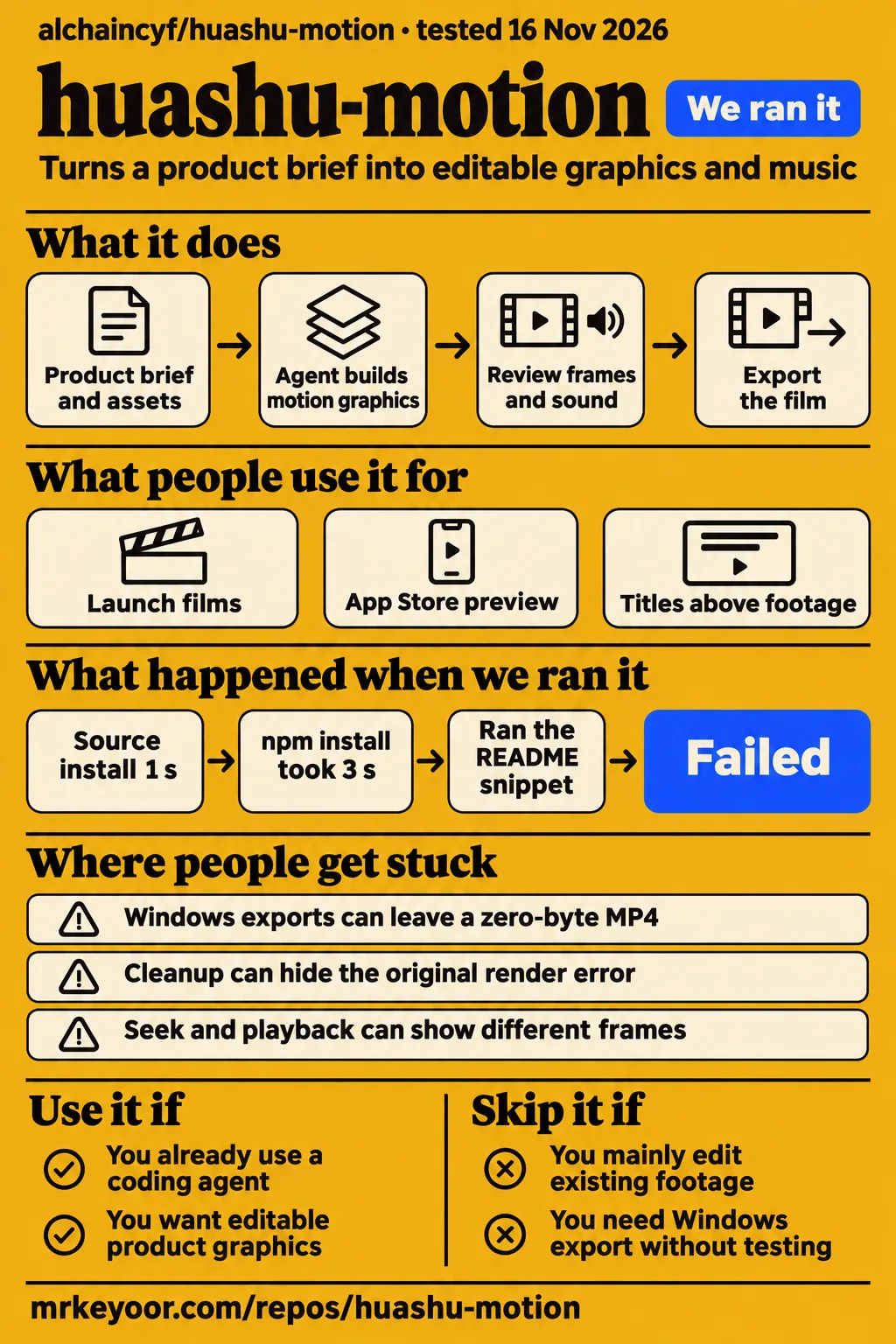
Our huashu-motion test command exited 1 after 14 seconds, while the author documents finished product films and repeated creative revisions. Use it if you already work with a coding agent and want a short product film whose text, timing and graphics remain editable. Skip it if your immediate job is trimming recorded footage or you need dependable Windows delivery without checking a complete export on your machine.
Huashu-motion builds motion graphics as code, with a browser drawing the frames and FFmpeg assembling the output. The attraction is a specific editing loop: click the offending part of a frame, leave a note, and let the agent change the source. That is useful when a product name, number or visual beat changes after a first cut. It also means the agent's creative decisions remain part of the job. Official workflow.
What people use huashu-motion for
Huashu reports a finished DeepSeek film, an App Store preview submission and a repeatedly revised launch film for the tool itself. Those examples show what the workflow can produce, with the author doing much of the directing. They deserve more weight than a feature checklist, but they should retain their attribution.
| Who used it | What they made | Reported outcome |
|---|---|---|
| Huashu, the project author | A DeepSeek motion film using Claude Code backed by DeepSeek V4.1 Flash | A 22-second film with music and effects, under half an hour, three rounds of notes and delivery at version 8. Author's account. |
| Huashu, the project author | A vertical Kitten Fill Light Pro promotion | The author says the 16-second version became an App Store preview and was submitted for review. Launch account. |
| Huashu, posting as AlchainHust | An unofficial Claude Duet launch film | The X post identifies Opus 5.5 and huashu-motion, and labels the film fan-made. Creator's post. |
| Huashu, the project author | Huashu-motion's own launch film | An hour and a half and ten versions, with changes to the opening, transitions, rhythm and sound. Revision account. |
| kelencc on Bilibili | A zippic promotional film | The creator's title praises the result. The record is a search listing rather than a production diary. Bilibili listing. |
The DeepSeek example is especially revealing. Huashu asked for a fast motion demonstration, then asked for the whale logo, removed effects he disliked and shortened the ending. The skill supplied structure, but a person still rejected shots. A cheaper model can participate in this workflow without making taste automatic.
Bilibili creator 朴厂长AI落地 also titles a video around getting two very different promotional films from the same skill. That is a useful counterweight to the happy zippic title: neither listing gives us a repeatable quality test. The English YouTube record titled “huashu-motion: free Claude Motion alternative” describes titles, number cards and captions as transparent layers for an editor. Its supplied transcript gives no channel name, so we attribute it by title rather than inventing one. Bilibili results, YouTube transcript.
What happened when we ran it
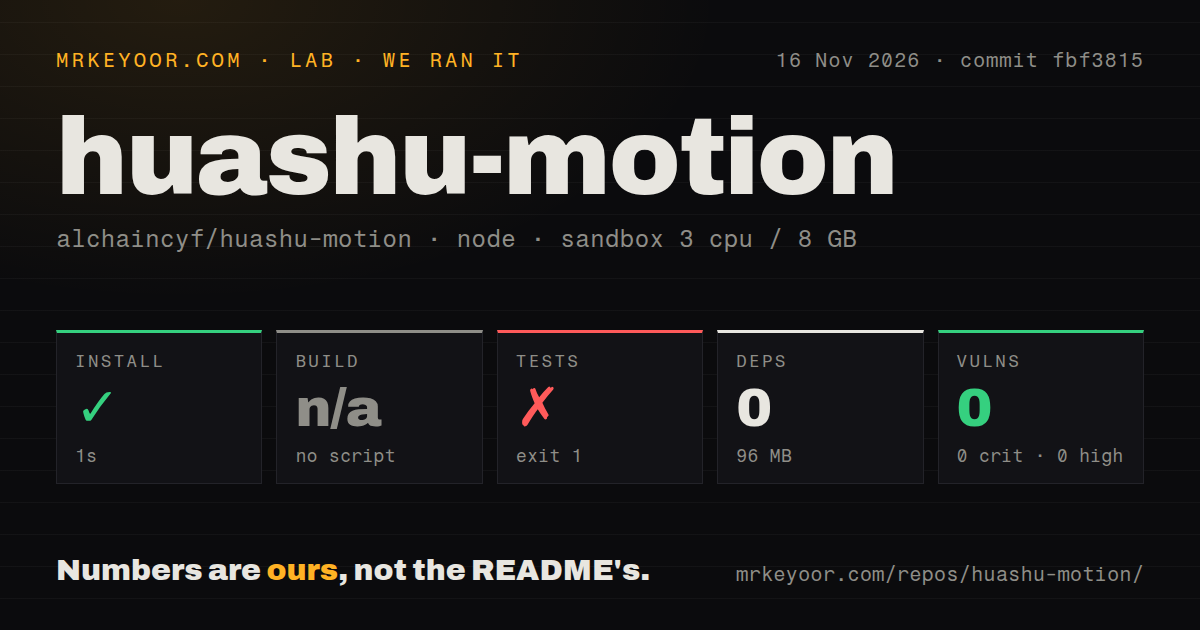
In our sandbox, installation succeeded in 1 second, but the test command failed with exit 1 after 14 seconds. The run used commit fbf3815 on 16 November 2026, with a recorded allocation of 3 CPUs and 8 GB RAM and image label lab-node:22. That label alone tells us neither the actual Node version nor the operating-system version.
| Recorded check | Our result | What it means |
|---|---|---|
| npm install step | Succeeded in 1 second | The recorded installation step completed. |
| Dependencies and disk | 0 dependencies recorded, 96 MB on disk | This describes the measured environment, not every external program the renderer needs. |
| Build | No build script or target, skipped | There is no successful build result to claim. |
| Tests | Failed, exit 1, 14 seconds | The command failed even though the supplied tail contains passing cases. |
| npm audit | 0 known vulnerabilities across critical, high, moderate and low categories | This is an advisory result, not an assessment of agent permissions. |
| Repository scan | 280 files, about 20,121 source lines, 53.1 MB checked out | A source-size observation, not a rendering benchmark. |
| Automation signals | One CI workflow file, a tests directory, no Dockerfile detected | These are repository signals, not evidence of a passing CI run. |
The last supplied test lines are all marked ok. They cover speech alignment surviving substitutions, reading Whisper JSON, caption boundaries and applying voice tracks without duplicating them. The final visible case concerns ignoring tags inside HTML comments. None of those lines explains the command's failure. Calling this a passing suite would be wrong, and blaming a missing browser or a Node mismatch would add a cause absent from the log.
A separate hands-on recipe in the research pack tried to treat this project as a JavaScript library. Its snippet step failed because the README contains no JavaScript or TypeScript code block to run. That is a mismatch between the recipe and an agent/CLI workflow, rather than a failed film-generation attempt. The record labels teardown successful. The recipe stopped before a film task.
Where people get stuck: a good still can precede a bad export
The reporter of Windows issue #3 produced correct stills and passed environment checks, yet also received an empty MP4. That makes a complete exported film the useful acceptance check for Windows users. A green dependency check answers a smaller question.
| Report | What happened | Fix or next action supported by the record |
|---|---|---|
| Issue #3, Windows 11 reporter | Intermittent zero-byte MP4s with Edge, including one worker and software rendering | Open in the supplied record, with no confirmed repair. Keep the completed output file and playback as the acceptance criteria. |
| Issue #4, Windows reporter and maintainer | Temporary-folder EPERM replaced the original render error or spoiled an otherwise successful run | Maintainer says v0.4.1 retries cleanup and turns cleanup failure into a warning. The maintainer's forced-error check ran on macOS. |
| Issue #4 reporter | Default concurrency produced a CDP timeout after cleanup was made nonfatal | Two workers succeeded reliably on that reporter's machine. Try that setting for this symptom rather than treating it as a universal setting. |
| Brian at RepoSquare | Environment checks failed with missing ffprobe and a browser outside the usual paths | Brian reports success capturing stills after supplying ffmpeg and ffprobe and setting OM_CHROME. Account. |
| Brian at RepoSquare | Kinetic-type stills looked almost black | The writer attributes them to sampling before the words appeared. Inspect other timestamps before discarding the composition. Account. |
Issue #4 is a good troubleshooting story because the first visible error was misleading. A temporary folder failed to delete. Once the reporter prevented cleanup from throwing, the earlier browser timeout became visible. Reducing the worker count then produced a film. There are two separate improvements here: exposing the error and finding a concurrency setting that worked on that machine. The maintainer's cleanup fix addresses the first.
Issue #3 reports failure even with one worker, so “use fewer workers” cannot cover every Windows export failure. Its stderr includes a MaxListenersExceededWarning, followed by no actionable render error. The warning is an observation, not a demonstrated root cause. Read the two reports together before promising delivery.
The third sampled ticket, issue #1, is a closed advertisement for an unrelated school-management app. It supplies no huashu-motion troubleshooting or resolution evidence. Excluding it from technical conclusions matters more than counting every closed ticket as a fix.
Seek and playback can disagree
The project's skill documents a history-dependent warning when jumping to a timestamp produces a different frame from playing through to it. It names tween start values inherited from another tween and stateful callbacks as causes. Scrubbing and still captures show the jumped-to version, while the render follows playback. Skill documentation.
That distinction matters most when you approve a complicated transition from a still. A correct paused image answers “does this layout look right here?” Watching through the transition answers whether the animation reaches that layout correctly. I would require both before signing off on a product reveal. The code remains editable, but editability alone gives no reason to dismiss a warning about timeline state.
Revision effort is part of the price
Huashu reports ¥1.95 for one heavily cached DeepSeek project, with 99.4% cache hits. That is an agent bill for a particular film, not a price per finished video. The film's three rounds of feedback and version-8 delivery make the example more useful: they show the work surrounding the small bill. Author's cost and revision account.
For repeated campaign work, separate agent spending from human review. A new aspect ratio, different opening or revised product claim can require another creative pass even when frame generation is repeatable. The author's own launch film reached ten versions and included complaints about slide-like transitions and flat rhythm. Budgeting only for rendering would miss the work the author actually describes.
Sound needs its own approval. The author reports that feedback about stuttering and cutouts around 37–38 seconds led to a music-engine fix. The launch account also says the agent judges music through notation, energy curves and spectrograms, leaving the final listening check to you. Put headphones on before accepting a soundtrack, especially when scene timing changed during revisions. Revision history, Audio boundary.
Security and licensing extend beyond the package audit
The official workflow asks a coding agent to research products, write files and run local browser and export commands. Treat that as software operating with your agent's permissions. A clean npm advisory report answers a dependency question, while the workflow also consumes websites, downloaded material and review comments. I would keep client secrets out of the working project and inspect what the agent proposes to download or execute. Workflow.
The source code's MIT license also leaves separate asset obligations. The official requirements describe instrument samples under CC0 and CC-BY, so attribution can depend on the sample. Brian's review identifies the demo bean character as the author's cartoon, outside the code's MIT grant for reuse in your own product. Use your own artwork and keep an asset-license list alongside the film. Neither “local” nor “open source” clears every image or sound. Sample requirements, Character exception.
Chinese-first documentation now has English studio controls
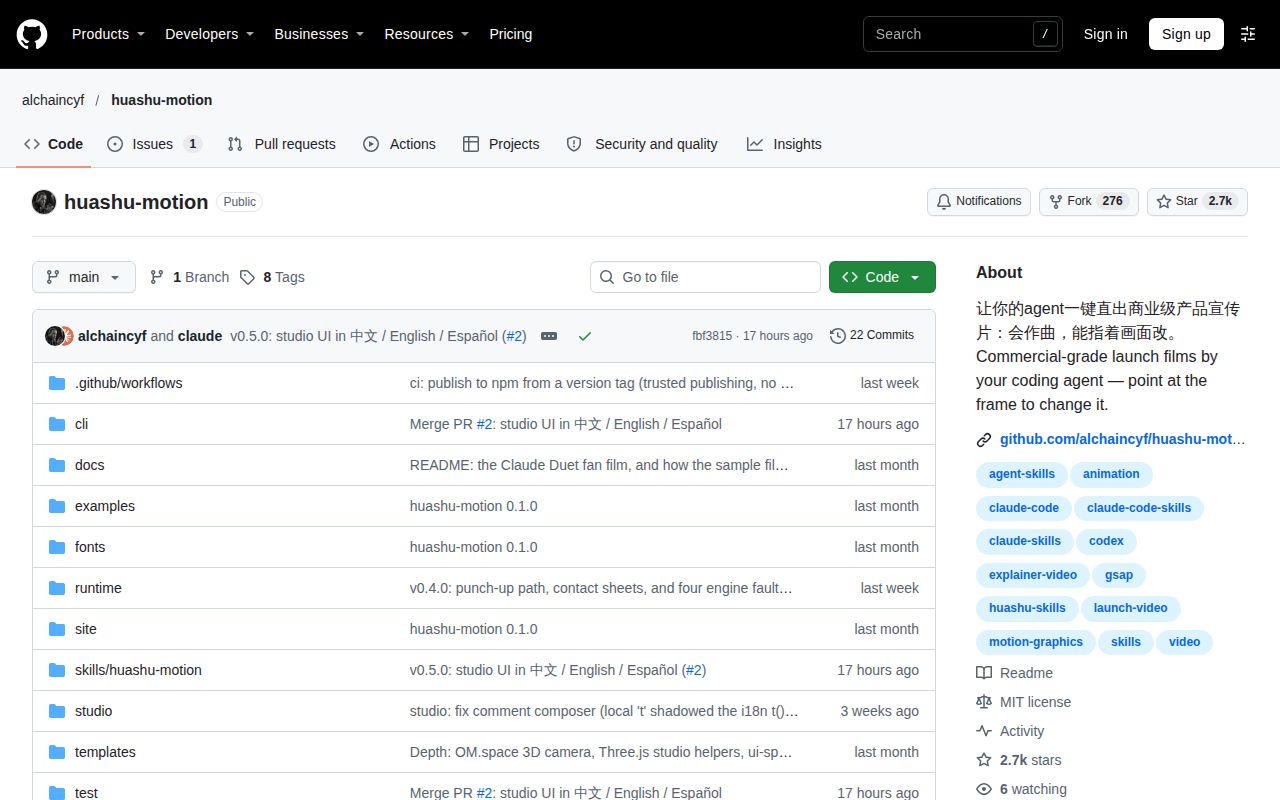
Huashu-motion's main README is in Chinese and an English README exists. Release v0.5.0, published on 15 November 2026, adds Chinese, English and Spanish studio controls. The release says browser language selects the interface automatically, with overrides through the header selector, URL, OM_LANG or the studio language option. Labels belonging to the film itself remain unchanged. Release notes.
For an English-speaking team, this is a meaningful difference from early coverage: interface labels and film content have separate language behavior. Select English controls if you need them, then specify the language of titles and narration in the brief. The Chinese creator accounts and Bilibili listings remain useful sources of examples, but the translated launch account and English README provide a practical entry point.
huashu-motion vs CapCut, Hyperframes and Remotion
Pick huashu-motion for an agent-directed product graphic, CapCut for editing footage, and compare Hyperframes or Remotion when you want a different code-video workflow. This is a choice about how you author and revise the film. The comparison records support workflow distinctions rather than a measured speed winner.
| Alternative | What the supplied comparison says | When I would choose it |
|---|---|---|
| CapCut | Brian distinguishes cutting existing footage from drawing motion graphics, and describes using transparent huashu-motion titles above footage. Comparison. | The clips already exist and trimming or captioning is the main job. Keep huashu-motion available for graphics layers. |
| Hyperframes | Gennaro Automates prefers huashu-motion's screenshot transitions and iteration, while crediting Hyperframes for more complex multi-clip work. Comparison. | Compare it for multi-clip work using your own brief and assets, rather than adopting one writer's preference as a benchmark. |
| Remotion | AIListScout contrasts a developer-owned component pipeline with huashu-motion's agent-directed film and score. Comparison. | You want the video system to be application code your team maintains. |
Remotion's current README documents agentic, interactive and programmatic video creation, so calling it a tool only for manual coding would be misleading. It also warns that some uses require a company license. HyperFrames' current README advertises an agent-oriented HTML-to-video workflow. Huashu-motion therefore competes on its directing, scoring and frame-comment process, rather than exclusive access to agents or editable code. Remotion README, HyperFrames README.
What the other reviews get wrong
Gennaro Automates' claim of zero ongoing cost conflicts with the author's reported agent bill. The guide's claim of no quality variation or failed generation also goes beyond the Windows report and the author's documented revisions. Code drawing the frames does not make every creative choice good or every export successful. Its upload-and-export description misses the agent's product research, direction and composition work. Guide, Author, Windows report.
ByteSprint's specific rendering description should not replace the primary account. Huashu reports a 22-second film completed in under half an hour, not an exact 22-minute benchmark with proven resolution, frame rate and motion blur. ByteSprint also describes the sample collection as CC0, while the official requirements list CC0 and CC-BY. Reveneau's broad reassurance about licensing misses that distinction and the character exception. Its statement that session cost was unmeasured also predates the README's reported ¥1.95 example. ByteSprint, Official requirements, Reveneau.
The skill-sets directory's “no external dependencies” description is too broad for someone preparing a rendering machine. Node, a Chromium-family browser and FFmpeg are explicit runtime requirements. A scan of a skill directory and a ready-to-render workstation answer different questions. Directory, Requirements.
Questions people ask
Huashu-motion turns a coding agent's product brief into editable motion graphics and a score, with frame comments for revisions. Its official workflow uses local browser rendering rather than a service generating live-action footage. README.
What does huashu-motion do?
It creates motion graphics as an HTML composition, with an agent directing the film and writing the score. You can point at a frame in the browser studio to request a targeted change. Official workflow.
Is huashu-motion right for my workflow?
Use it for editable product graphics when you already have a coding agent. Choose a footage editor when the task is primarily cutting recorded clips, and require a successful full export before assigning it a Windows deadline. CapCut comparison, Windows issue.
How do I create a launch video with huashu-motion?
Add the skill with npx skills add alchaincyf/huashu-motion, supply the product brief and assets, choose a proposed direction, review frames and sound, then export. The official requirements are Node 22+, Chrome, Chromium or Edge, and FFmpeg. Use om doctor to identify missing programs. Instructions.
Can huashu-motion work with budget models such as DeepSeek?
Yes: Huashu reports making the DeepSeek film with Claude Code backed by DeepSeek V4.1 Flash. That example took three rounds of feedback and reached version 8, so model compatibility is only part of the decision. Creator's account.
How much does huashu-motion actually cost?
The code is free under MIT, while coding-agent usage has its own cost. Huashu reports ¥1.95 for one DeepSeek film with 99.4% cache hits. Treat that as one bill, not a quoted rate for your first project. Cost account, Cost distinction.
Does huashu-motion need an API key or paid video-generation service?
Brian reports capturing local stills without an API key. Creating a new film through a coding agent is a separate service choice, with that agent's access and billing requirements. The renderer does not require buying generated-video credits. Independent still run, Workflow.
Why does om render sometimes leave a zero-byte MP4 on Windows 11?
Issue #3 reports intermittent empty exports, but its supplied log does not identify the cause. The same setup also completed a valid film in another run. An EventEmitter warning alone is insufficient to diagnose the failure. Report.
Why does Windows rendering report EPERM instead of the underlying error?
Issue #4 describes temporary-folder deletion throwing during cleanup and replacing an earlier render error. The maintainer says v0.4.1 changes cleanup to retry and warn, preserving the original error. Report and maintainer reply.
Can lowering the worker count prevent Windows render timeouts?
Two workers worked reliably for the issue #4 reporter. Issue #3 still reports intermittent failure with one worker, so worker reduction is a symptom-specific workaround. Issue #4, Issue #3.
Can huashu-motion replace CapCut?
Keep CapCut for cutting and captioning existing footage. Brian's comparison assigns huashu-motion the graphics work, including layers an editor can place above recorded clips. Comparison.
Can I put huashu-motion titles over footage I already shot?
Yes: Brian describes om render --transparent for titles and number cards that sit above footage in CapCut or Premiere. That lets you keep your existing editing workflow. Overlay account.
How do I render a still frame?
Brian used om still examples/showcase/index.html --at 1.5 after making the browser available. If a frame is nearly black, inspect other timestamps before concluding the composition is empty. Still-frame account.
What we have not tested yet
Our repository run and the snippet recipe do not establish finished-video quality, export speed or successful studio operation on our machine. We did not make a new launch film, reproduce either Windows report, compare costs across models, or reconcile the complete failing test log. The separate snippet recipe records commit fbf381542318 and a fresh unprivileged container, but stopped before a film task.
The creator films remain creator reports. The App Store submission is not proof of approval, an agent's quality score is not an independent audience test, and the Bilibili search titles provide neither transcripts nor a reproducible quality comparison. The pack supplies no screenshots from our run. We have not tested long films, repeated campaign production, narration quality, seek/playback parity, the v0.5.0 interface or asset-license compliance for a finished commercial project.
We also have no runtime security assessment covering product research, external downloads and untrusted comments, and no matched benchmark against the alternatives. The source activity and sampled fixes show ongoing work, not production reliability. For a purchase decision involving your team's time, the next useful check is one complete film from your actual brief, revised once and played back from the exported file on the delivery machine.