
Open the HTML file before setting up Python
Download index.html and open it in a browser. That's the useful first action with cdyforever/how-to-live-better, a Chinese reading interface for an upstream book of everyday advice. The README and interface are Chinese, and this repository offers no English documentation. It packages the book into searchable cards so you can keep a copy on your phone or another computer without operating a server.
Our checkout occupied 2.6 MB across 5 files, with roughly 644 lines of source. That small footprint suits the project's narrow job: preserve a readable snapshot. The README says the page uses no external fonts, CDN resources, or data fetches. Reading therefore doesn't depend on a Python environment, an account, or a hosted API, although opening the linked evidence still requires internet access.
What happened when we ran it
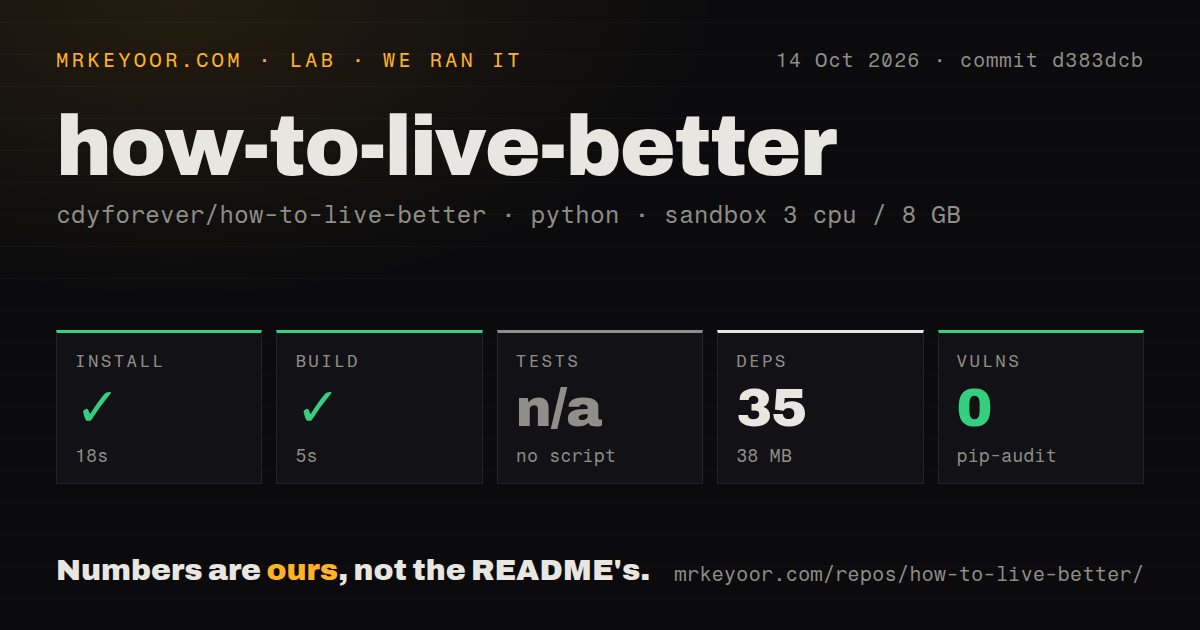
Our sandbox installed commit d383dcb in 18 seconds, adding 35 packages and using 38 MB on disk, then completed the build in 5 seconds. We cloned it on October 14, 2026, into an unprivileged Debian container with 3 CPUs and 8 GB of RAM, using ghcr.io/astral-sh/uv:python3.12-bookworm. The container had no secrets. Both measured steps succeeded, so there was no failed-step log to explain.
Our harness skipped tests because it found no test script or target. Pip-audit reported 0 known vulnerabilities, and the scan found 1 CI workflow, no Dockerfile, and no tests directory. Those findings establish that the measured repository steps completed. They don't establish that browser search, printing, or mobile scrolling behaves correctly, and they say nothing about whether the book's advice is accurate.
Rebuilding requires the upstream book on disk
The rebuild instructions require a separate clone of eternity4719/HowToLiveBetter. Pass its location through --repo or HLTB_REPO, then ask build.py for the full book or selected sections. The script's fallback is a developer's Windows directory, D:\Agent\HowToLiveBetter. On another machine, forgetting the explicit path makes the script look somewhere unsuitable before it can find the book's Markdown files.
The 38 MB installed footprint we measured belongs to the sandbox environment, rather than the browser's reading requirements. This distinction matters if you're sharing the book with a nontechnical relative: send the generated file. Someone maintaining a customized edition needs Python and the upstream source, plus Git if they want the script to record the source revision. No service credential appears in that local regeneration path.
Evidence filters help you browse, not verify advice
Cards expose evidence grades, cost labels, and expandable source links. A filter keeps only the book's A-grade entries, while another view emphasizes everyday-language explanations. The renderer imports these labels from the upstream text. It doesn't independently evaluate the papers or official documents behind them. Use the interface to locate an entry and inspect its reference, rather than treating the badge as the reader application's endorsement.
The roughly 644 source lines include a parser tied to named Chinese fields and the upstream book's cost-ranking rules. A comment in build.py says those rules must stay synchronized with the upstream implementation. That makes this a poor starting point for a general Markdown library. A team adapting it to unrelated books would first need to replace assumptions about entry headings, cost tags, and evidence fields.
Automatic updates leave documentation behind
The scheduled workflow clones upstream, regenerates index.html, and commits only when that output changes. A saved local copy won't participate in those updates. Its usefulness depends on knowing which source revision it contains, especially when an entry points to a policy or official website that can change. The generator records an upstream revision and date when Git can supply them.
Our scan found 1 CI workflow, but its presence isn't evidence of browser regression coverage. Documentation drift is already visible: pull request 3 reports outdated section and entry counts in the README. More consequentially, the reader README calls the upstream book public domain, while the current upstream README specifies CC BY 4.0 for text and MIT for code. Check the license attached to your source revision before republishing an edition.
Readers report slow scrolling and lost position
Issue 1 describes lag from loading the long document on one screen. Issue 2 asks for a way to return to the previous reading position after reopening. These are reader reports, not failures from our sandbox. They're good reasons to choose a different presentation if you want comfortable chapter browsing or expect a book app to remember where you stopped.
The 5-file checkout remains attractive for offline sharing, but that simplicity has a visible tradeoff. Another report, issue 9, identifies a broken official travel-safety reference. That issue concerns a source link inside the book, not the reader's search implementation. Carrying the text offline preserves what it says, while leaving external citations and upstream corrections outside the saved file.
October activity supports use as a reading snapshot
The last push was October 14, 2026, and GitHub listed 11,688 stars with 9 open issues and PRs. The API's issue list includes recent reader reports and proposed navigation changes, so the lack of a latest release isn't a reason to call the project abandoned. It does mean a tagged reader release isn't available through that endpoint. Save the revision alongside any copy you redistribute.
Our 18-second install and 5-second build make regenerating this reader approachable, but most readers should begin with the existing HTML. Choose the upstream project when you need original sources, export formats, or its linked translations. Choose dumplingszw/how-to-live-better when chapter pages and a VitePress site better match your reading habits. For this edition, keep the source revision and licensing information beside the file you pass on.