mrkeyoor.com_
Thu 01 Oct 08:15 UTC
Dataevaluationupdated 01 Oct 2026

HowToLiveBetter review

HowToLiveBetter is a Simplified Chinese guide written mainly for people living under mainland China's medical, legal, employment, and social-benefit systems. The main repository has no English README; it links to a third-party English and multilingual translation that the author warns may lag behind the Chinese source.

Verdict

Our EPUB run installed 1 package in 6 seconds and built in 5 seconds, but no automated test target checked the 649 advice entries or their evidence. Use HowToLiveBetter as a well-indexed Chinese starting point whose citations you can open, not as the final word on a diagnosis, legal deadline, or benefit amount. English readers should use the linked translation only after checking its snapshot against the Chinese source.

We ran it

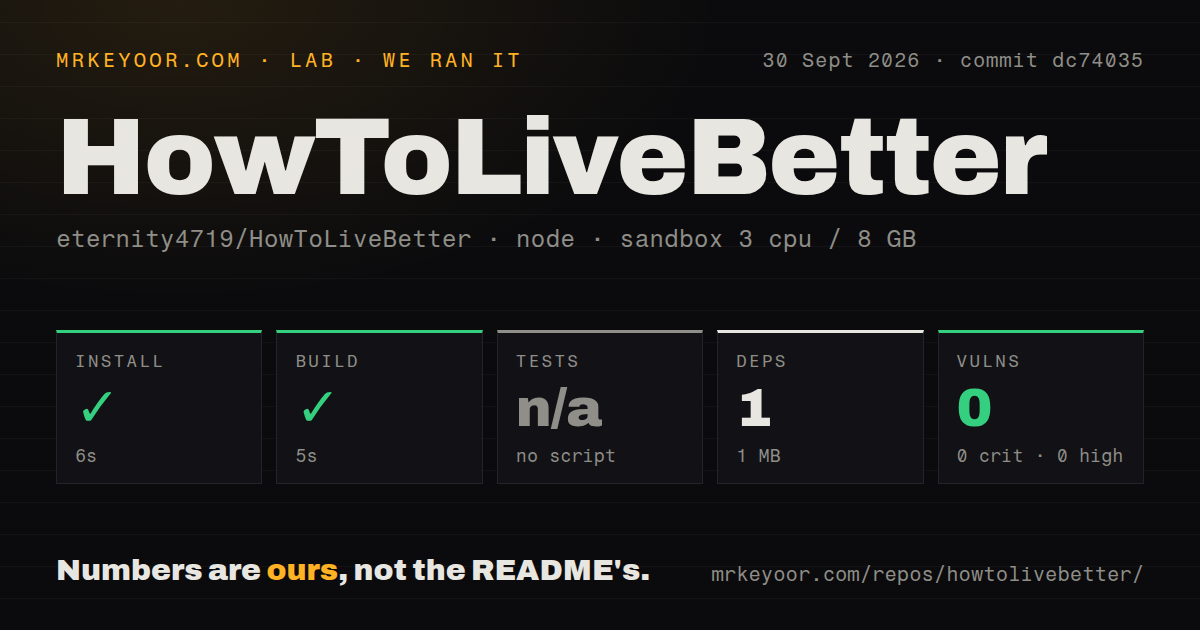
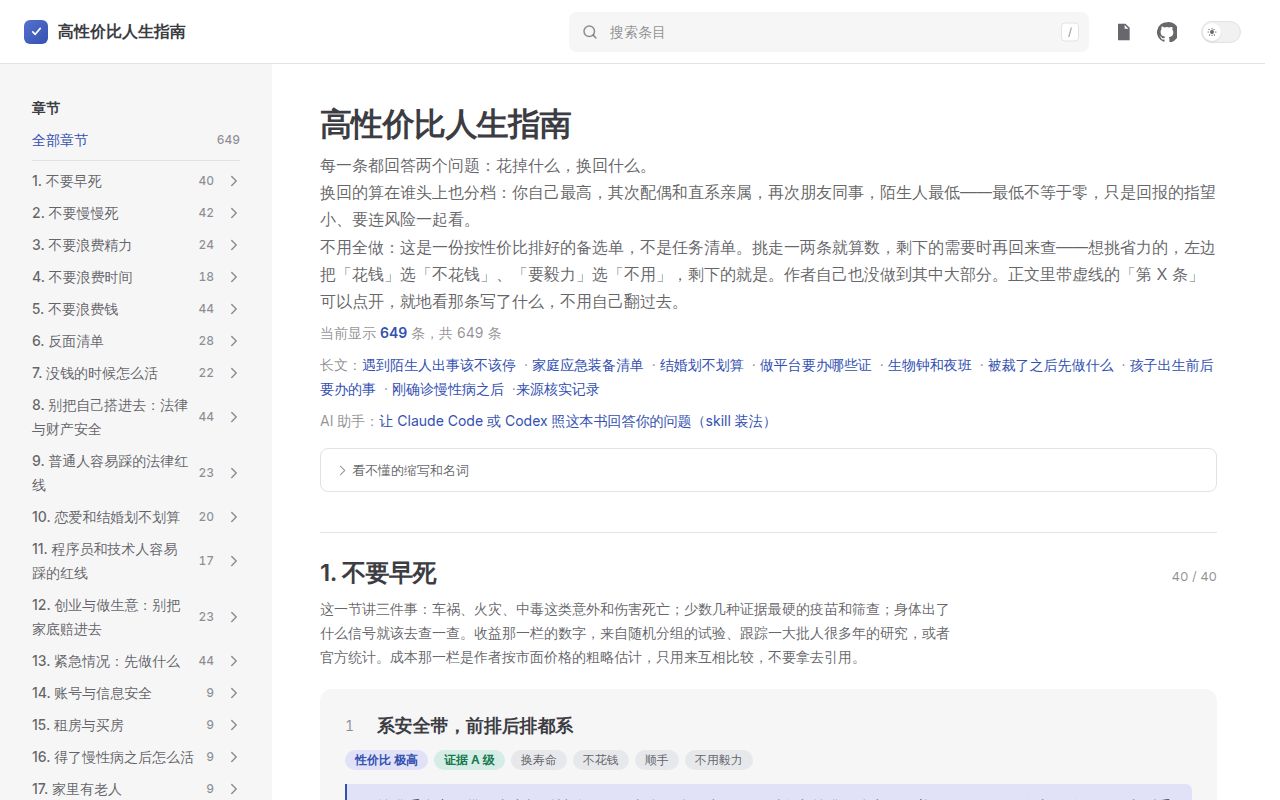
Lab card: what happened when we ran HowToLiveBetterScreenshot of HowToLiveBetter (eternity4719.github.io/HowToLiveBetter)
Install✓ · 6s1 packages · 1 MB
Build✓ · 5s
Testsn/ano test script
Known vulns00 critical · 0 high · 0 moderate · 0 low (npm audit)
Repo177 files~1,102 lines of source · 3.8 MB · 1 CI workflows

Answers from our run

Does HowToLiveBetter build from source?

Dependencies installed in 6 seconds (1 packages), and the build succeeded in 5 seconds. We cloned commit dc74035 into a clean Debian container with 3 CPUs and no project-specific setup.

Does HowToLiveBetter have tests you can run?

Not through a standard command: the project exposes no test script or target that our harness could run.

Does HowToLiveBetter have known vulnerabilities in its dependencies?

npm audit found none in the dependency tree at the time of our run.

Who should not use HowToLiveBetter?

Readers who need an authoritative English edition: the linked translation is maintained in another repository and may be behind the Chinese text.

What are the alternatives to HowToLiveBetter?

HowToLiveBetter translations, BetterLifeApp, Zotero. Our EPUB run installed 1 package in 6 seconds and built in 5 seconds, but no automated test target checked the 649 advice entries or their evidence.

Setup5/5Static site and downloads; EPUB installed and built in 11 seconds
Docs4/5Detailed Chinese guide, but no canonical English documentation
Community4/532,365 stars with issue and pull-request activity on October 1
Maturity2/5Active evidence edits, but the project is under one month old

Who it’s for

Chinese readers who want practical advice linked to papers and official documents.
Editors who prefer a searchable, versioned source over an opaque advice app.
Claude Code or Codex users who want a skill that retrieves relevant book entries before answering.
Publishers who can follow the separate CC BY 4.0 content and MIT code licenses.

Who it’s NOT for

Readers who need an authoritative English edition: the linked translation is maintained in another repository and may be behind the Chinese text.
People outside mainland China seeking legal, benefits, insurance, employment, or licensing guidance: those sections use mainland rules.
Anyone treating an evidence grade as individual medical or legal advice: issue 61 found denominator, classification, and conclusion-strength problems in several entries.
Teams needing a frozen reference: the book, laws, benefit amounts, and generated downloads change frequently.
Release gates that require automated tests: our sandbox found no test script or target and skipped the test step.

Setup reality

Our sandbox installed commit dc74035 from tools/epub in 6 seconds, adding 1 package and 1 MB. The EPUB build passed in 5 seconds. There was no test script or target, so tests were skipped; npm audit reported 0 known vulnerabilities across all severities.

Most readers need no setup. The searchable site is static, and releases provide EPUB, PDF, and single-file HTML. Rebuilding the EPUB needs Node and npm; the separate PDF path also needs Pandoc 3.1 or newer and Typst 0.13 or newer.

The repository contained 177 files, about 1,102 lines of source code, and 3.8 MB checked out. It has 1 CI workflow, no Dockerfile, and no tests directory. The small build does not validate the book's medical, legal, or financial claims.

The 649-entry guide is Chinese and mainland-specific

HowToLiveBetter is an open book organized as a ranked set of practical choices. Its 649 entries cover health, emergencies, money, work, family, travel, online services, and legal risk. Each entry states a cost, a plain-language outcome, an evidence grade, a source, and any caveat. The content is Simplified Chinese, and sections on law, insurance, benefits, employment, and permits follow mainland China's rules.

English readers get a clear warning rather than a false promise. The main repository has no English README, and its language links point to a separate fork maintained by another contributor. That fork includes English, Russian, Spanish, and Portuguese, but the Chinese README says outside translations may lag and treats the Chinese original as authoritative. For changing laws or benefit amounts, a delayed translation can change the decision rather than merely the wording.

Search filters expose cost, evidence, and source

The online page can filter by chapter, evidence grade, money, time, and effort. EPUB, PDF, and a single-file offline HTML version are attached to a rolling release. The static site reads the book files directly, so there is no account, database, or backend to operate. The content license is CC BY 4.0, while tools, skills, workflows, and the search page use MIT.

This is more useful than a loose advice list because readers can move from a recommendation to its cited paper or official document. The format still contains editorial judgment. Choosing a cost category, assigning evidence grade A, or ranking one action above another requires decisions about population, baseline risk, and whether a legal requirement counts as a measurable benefit. A visible citation lets you audit that judgment. It does not make the judgment disappear.

What happened when we ran it

Our sandbox cloned commit dc74035 and worked inside tools/epub. Installation took 6 seconds, added 1 package, and occupied 1 MB. The EPUB build completed in 5 seconds. We used an unprivileged Debian container with Node 22, 3 CPUs, 8 GB of RAM, and no secrets. Npm audit reported 0 known vulnerabilities: 0 critical, high, moderate, or low.

No test script or target existed, so the test step was skipped. The repository had 177 files, about 1,102 lines of source code, and a 3.8 MB checkout. Our scan found 1 CI workflow, no Dockerfile, and no tests directory. Those figures describe the publishing tools, not the much larger prose corpus, and a successful EPUB does not verify a health claim or legal interpretation.

Most readers should not build anything. The hosted search page and release downloads already cover online, offline, print, and e-reader use. A local static server is enough for the repository page. Rebuilding the PDF is the heavier branch because the README calls for Pandoc 3.1 or newer and Typst 0.13 or newer. The measured 5-second step covered the EPUB command only.

Issue 61 found nine repeatable reasoning problems

A review opened on October 1 reported nine high-confidence problems found by at least two independent readers. Examples included relative risk without baseline risk, legal obligations presented as benefits, and evidence grades that did not match the strength of the conclusion. The issue was closed the same day, and the repository received another push. That response is a good maintenance signal, while the report itself is a warning against reading grades as settled truth.

The distinction matters most in high-stakes chapters. A population study may not describe your medical risk. A national average may not equal the payment in your city. A legal deadline can have exceptions that a short entry omits. Open the cited source, check its date and jurisdiction, and get professional advice when the cost of being wrong is high. The guide's traceability makes that check possible.

The AI skill retrieves entries before it answers

The repository includes one skill shared by Claude Code and Codex. Its rule is narrow: search the local book first, rank the relevant entries using the book's method, name the section and item, and say when the source does not answer. That is a better contract than asking a general model to remember 649 entries, especially when the content changed after the model's training data.

The skill does not cure source errors or translation drift. It can retrieve an outdated number faithfully, and a local clone can fall behind the October 1 source. Keep the repository fresh, require section references in every answer, and open the underlying citation before acting on medical or legal advice. HowToLiveBetter is worth using because it leaves an evidence trail. Its value ends where the reader stops following that trail.

Alternatives

ProjectWhat it isPick it when
HowToLiveBetter translationsA community-maintained fork with English, Russian, Spanish, Portuguese, and Chinese editions.pick this instead when you need an English or multilingual reading copy and accept that it may trail the Chinese source.
BetterLifeAppAn Android app built around the guide's entries, tasks, recommendations, and check-ins.pick this instead when you want reminders and a phone workflow, while checking its bundled content snapshot against the source.
ZoteroA research manager for collecting, annotating, and citing the primary sources yourself.pick this instead when your job is building an evidence library rather than accepting one editor's cost-benefit ranking.

What people are saying

  1. [velocity-scout] eternity4719/HowToLiveBetter

Sources

  1. HowToLiveBetter repository and Chinese README
  2. Rolling EPUB, PDF, and offline HTML release
  3. Reasoning audit issue 61
  4. Life Decision Guide skill documentation
  5. Community multilingual translation fork

More data reviews

INSLIB · TradeGenuis-box · awesome-submitlist · ccf-deadlines · instagram-private-graph · OpenBB · the whole board →