One sidebar tracks agents across every herdr device
herdrm is the graphical half of a 2-part system. The separate herdr background server owns spaces, agent processes, and their pseudo-terminals. HerdrM connects to the local Unix socket or forwards remote sockets over SSH, then displays every space and agent in a native SwiftUI sidebar. Rows are ordered by urgency, so blocked and completed sessions rise above agents that are working or idle.
That model solves a specific annoyance for developers running several coding agents at once. A normal terminal multiplexer preserves sessions but does not inherently know whether Claude Code needs approval or Codex has finished. herdrm receives that state from herdr, sends a macOS notification, and opens the relevant live terminal when clicked. Command-K searches across devices, and Command-N creates a new agent using CLIs advertised by the selected machine.
Remote sessions need herdr on 2 sides
The README requires macOS 14 or newer plus herdr on the Mac and on each remote machine. SSH authentication can use OpenSSH keys or an agent, Tailscale SSH 1.98.0 or newer, or a password stored in the macOS login Keychain. Tunnels reconnect with backoff, and the UI attempts to explain whether the remote daemon is absent or socket forwarding is misconfigured.
The terminal is an actual PTY attachment rather than a chat rendering. Native selection, URL opening, paste, font controls, and light or dark color handling sit around the agent's existing interface. A dropped connection presents a reconnect path. The release is a universal binary for Apple Silicon and Intel Macs, signed and notarized, with updates delivered through Sparkle. This preserves command-line behavior and makes the app compatible with several agents, but it also means herdrm cannot normalize every agent's prompts, approval screens, or failure messages into one consistent workflow.
What happened when we ran it
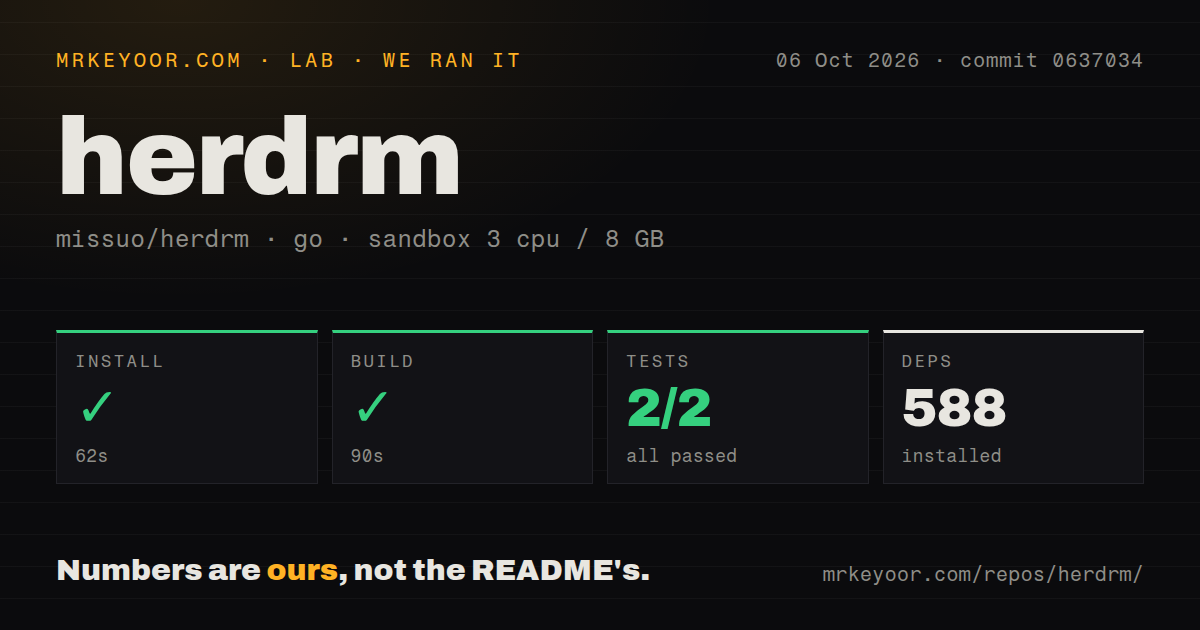
The lab entry for commit d8ec416 is NOT RUN. Swift is outside the sandbox's supported ecosystems, and the repository has no Dockerfile that could supply an alternative execution path. As a result, MrKeyoor has no measured install time, build outcome, test count, dependency size, or vulnerability audit for herdrm. Any such number would be invented.
The source instructions call for XcodeGen and Xcode's build tools: make build generates and compiles the macOS application, while make kit-test exercises HerdrKit against a running local herdr. Those commands are project documentation, not lab results. The requirement for a live daemon also means the integration check covers more than Swift compilation. We cannot say whether commit d8ec416 passed it.
The missing run matters because this is native, permission-sensitive software. SSH behavior, Keychain storage, PTY fidelity, notifications, auto-update signing, and dual-architecture packaging need macOS verification. A Linux container would be a poor substitute even if Swift compilation were available. The right follow-up is a controlled Mac test, not a guessed score based on the README.
A 7-day remote paste cache deserves attention
Pasting a local file or image forwards it to the agent. For remote sessions, herdrm copies the item over SSH into a self-pruning cache with 7-day retention and a 50 MB cap. That is convenient for screenshots and documents, but it creates another copy on the remote host. Teams handling source bundles, customer files, or credentials should define which machines may receive attachments and confirm the cache cleanup behavior themselves.
New-agent creation has a sharper default: the README says each agent's bypass-permissions flag is on by default. That may reduce approval interruptions, but it gives the launched coding agent more freedom on its host. Combined with remote machines and paste support, this is not a harmless UI preference. Change the default or isolate the machines if agent commands can touch production credentials, repositories, or deployment tooling.
Version 0.4.5 is active, with early-stage limits
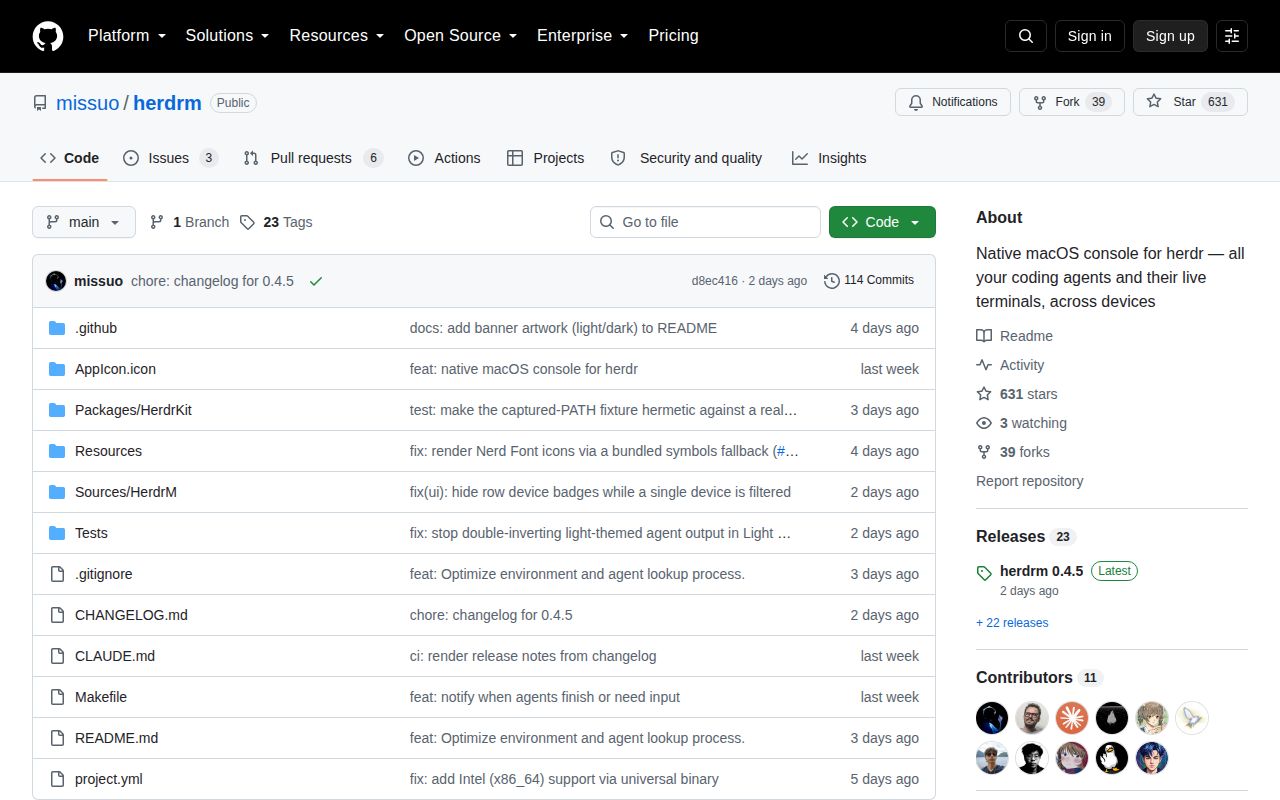
Release v0.4.5 arrived on August 24, 2026, the same date as the repository's last push. GitHub reported 631 stars and 9 open issues and pull requests combined. Activity continued on August 25 around CJK input, Simplified Chinese localization, sidebar clicks, and socket handling. The project is moving quickly, though a one-day burst does not replace sustained maintenance history.
The README explicitly says test coverage is incomplete and there is no CI gate. Contributors are asked to run the build and HerdrKit integration tests locally. That honesty should shape adoption: use herdrm when herdr already matches how you operate several agents and the native overview removes real terminal juggling. If you primarily need durable remote shells, tmux or Zellij has a narrower job, fewer moving pieces, and much longer operational history.