Zellij combines persistent panes with a guided interface
Zellij belongs in the same conversation as tmux and GNU Screen, but its defaults teach the interface as you use it. Tabs and panes are visible, floating and stacked panes are built in, and layouts can recreate a workspace. Sessions persist when the client disconnects. Multiple people can attach for collaboration, while plugins written in languages that compile to WebAssembly can extend behavior without becoming native dynamic libraries.
Version 0.45.0 adds first-class nested sessions, Kitty image protocol support, shell-aware scrollback, a redesigned pane interface, and a mobile web client. Nested Zellij after an SSH hop can hand control between outer and inner sessions instead of forcing users to untangle identical keybindings. OSC 133 shell markers let scrollback jump between prompts or select one command with its output.
Prebuilt v0.45.0 is the sensible installation path
The README recommends an operating-system package first, then a prebuilt release binary. Cargo installation is also documented with a locked dependency graph. It specifically warns against installing from main: pre-release code may be broken and can corrupt cache data used by later versions. That warning matters in a tool whose server holds long-running terminal state.
The latest release was published August 20, 2026 and raises the minimum supported Rust version to 1.95.0 for packagers. It removes automatic YAML-to-KDL conversion, so users with old YAML configuration need a 0.44.x release to convert it. These migration notes are good release engineering. They give package maintainers and long-time users concrete work before an upgrade.
What happened when we ran it
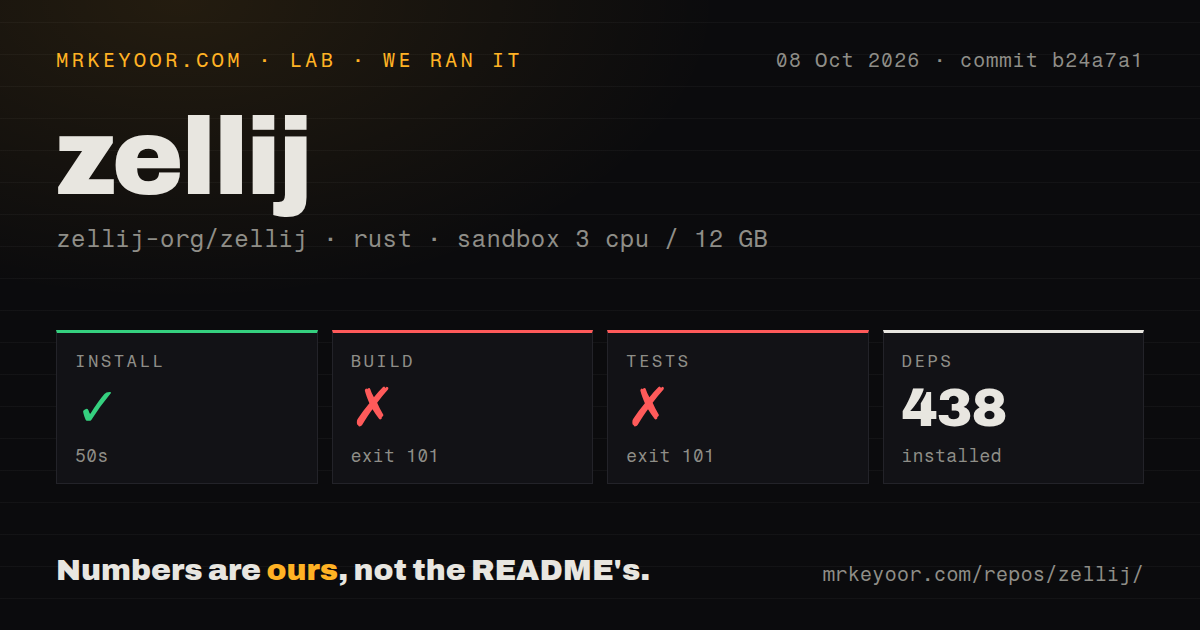
Our 3-CPU, 12 GB sandbox installed 436 Rust packages in 42 seconds. The build ran for 307 seconds and failed with exit code 101. zellij-utils produced 12 compilation errors while include_bytes! expanded for bundled plugin files under target/wasm32-wasip1/debug; the shown invocation included link.wasm. Those artifacts were not present for the crate to embed.
Tests failed with exit 101 after 39 seconds at the same zellij-utils stage. The log again showed 12 missing embedded-plugin errors, then other crates compiling before Cargo stopped. Our checkout had 1,831 files, about 331,324 source lines, and 42.8 MB. It included 3 CI workflow files, a compose file, no Dockerfile, and no tests directory.
Development uses xtask to prepare embedded plugins
The README does not tell contributors to run a plain Cargo command. It says cargo xtask run for a debug development build and cargo xtask test for the full test path. That distinction matches the failure shape in our sandbox: the main Rust crate expects compiled WebAssembly plugin files to exist before embedding them. The log does not show whether the xtask path would have succeeded in the same container.
This is an important buyer distinction rather than a mark against binary installation. End users receive built artifacts. Contributors enter a 331,324-line systems project spanning terminal parsing, session state, rendering protocols, a web client, networking, and plugins. Follow the project's task runner and supported Rust version, and use CI definitions when packaging instead of treating the root as a conventional single-crate application.
The web client makes terminal access an authentication problem
Zellij's built-in web client can make the host terminal optional. Version 0.45.0 adds a mobile layout, touch controls, an on-screen keyboard, single-pane fullscreen, and PWA installation. That is useful for checking a session away from a laptop. It also turns shell access into a browser-exposed service that requires deliberate binding, authentication, TLS, and reverse-proxy policy.
Open issue 5540 reports the mobile root page stacking authentication dialogs every 3 seconds while logged out, with pull request 5541 addressing overlapping polling. Even a visual bug can matter on an auth boundary because it obscures the expected login state. Test logout, expired sessions, reconnects, base paths, and multiple devices before relying on the web interface for operational access.
Clipboard and graphics features have cautious defaults
The release adds Kitty graphics alongside existing Sixel handling, with host-terminal capability detection. Images can survive pane resizing, relayout, scrollback, and floating or fullscreen transitions. Issue 5530 reports that one Kitty Unicode-placeholder form is rejected, and an accompanying pull request adds support. Terminal protocols vary enough that users should test their actual emulator rather than infer compatibility from the protocol name.
Clipboard reading through OSC52 is disabled by default. Enabling dangerously_enable_paste_buffer_read allows any program running inside the terminal, including software reached over SSH, to read clipboard content without a separate prompt. That default is correct. Clipboard writes are convenient; silent reads can expose passwords, tokens, or copied customer data to a remote process.
Active issue traffic reflects a wide compatibility surface
GitHub recorded 35,131 stars, 1,870 combined issues and pull requests, and a push on August 26, 2026. The README warns that this count includes experiences and requests, not only confirmed bugs. Current reports cover Codex reattachment, macOS memory corruption, WezTerm startup, clipboard behavior, Kitty images, themes, and mobile authentication. That range follows from sitting between shells, terminal emulators, operating systems, and web clients.
Zellij is mature enough to recommend as a daily terminal workspace, especially to someone who never bonded with tmux's initial interface. Install the release, keep configuration under version control, and test reattachment plus clipboard behavior before using it on critical hosts. Source contributors should budget for the xtask and WebAssembly pipeline that our 307-second generic build never completed.