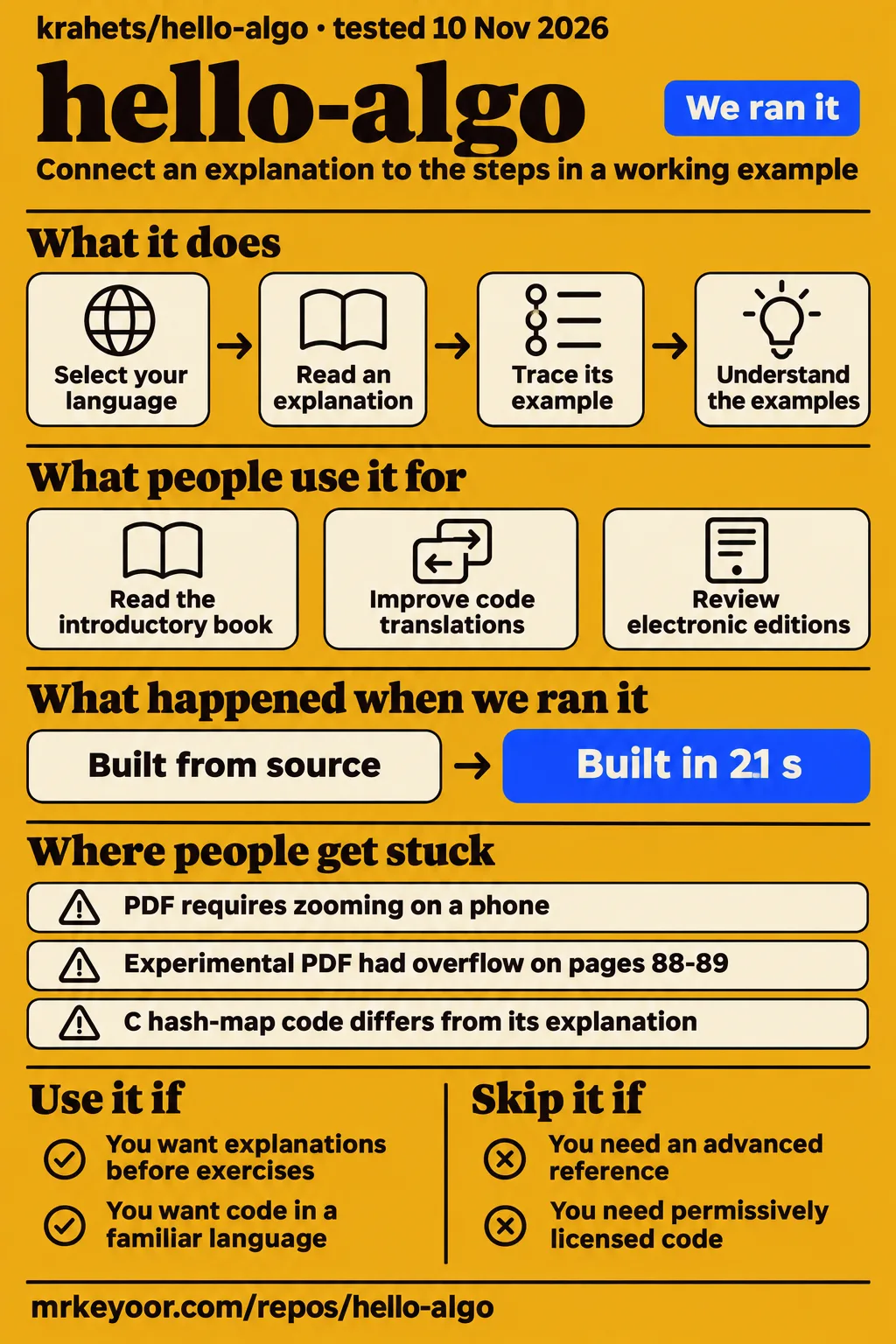

Hello Algo is a visual introduction to data structures and algorithms, with educational code in multiple languages. Our Rust build succeeded in 21 seconds. The cargo test command ran zero tests. Use it if you want explanations before tackling exercises; skip it if you need an advanced algorithms reference or code you can incorporate under a permissive software licence. The README applies CC BY-NC-SA 4.0 to the code as well as the text and images.
What people use hello-algo for
Readers use Hello Algo for introductory study, while contributors use the same material to improve code translations and electronic editions. These named accounts give you a more useful picture than a collection of endorsements.
| Person | What they did | What came out |
|---|---|---|
| Douban reader Ty_Hsu | Read the introductory book | Called it relatively simple, clearly explained and sufficient for beginners, with code in different languages. This is a Chinese-language reader review. |
| GitHub user ofou | Reviewed an experimental English PDF | Reported overflow on pages 88-89, questioned the boolean-storage explanation and requested an English EPUB. |
| khoaxuantu and the Ruby contributors | Translated the educational code into Ruby | khoaxuantu reported checking all topics and completing Ruby transpilation; the tracking issue is closed. |
| GitHub user Dr-XYZ | Reviewed the Traditional Chinese edition | Reported chapter links opening English and untranslated illustrations; the maintainer reported link and image corrections. |
The speakers in the YouTube video "What is an algorithm? - Hello Algo" use the book as the basis for a conceptual explanation of algorithms and data structures. Their walkthrough discusses instructions and how information is organized. It is an example of the material being used to explain a subject, rather than a recorded learner completing a course. The captured transcript does not identify the channel, so attribution here is to the named video.
For you, Ty_Hsu's qualification is the most useful one: simple can be a reason to choose the book. If your problem is understanding the first explanation of a hash table, an approachable introduction has a different job from the reference you will consult after implementing one.
What you can do with Hello Algo
You can read illustrated explanations and follow the corresponding code in a language you already know: the official English homepage advertises code in 14 programming languages. Hello Algo began in Chinese, and an English edition is available. That combination makes it a sensible starting point if a conventional algorithms textbook has left you trying to understand both the idea and unfamiliar notation at once.
My recommendation is to use one language throughout your first pass. Read an explanation, trace its example, then change an input and predict the result before running it. This is a suggested study method, not a learning outcome measured by our lab. The project's code-contribution instructions ask translators to compare output with Python or Java reference implementations, which also gives you a useful way to inspect an example when something surprises you.
The English chapter navigation includes complexity analysis, arrays and linked lists, stacks and queues, hashing, trees, heaps, graphs, searching and sorting. Complexity analysis means reasoning about how time and memory requirements grow as the input grows. Learn that vocabulary alongside the structures: being able to recite how a list works is less useful than understanding when a different structure changes the work required.
What happened when we ran it
Our November 19 hands-on attempt stopped at its safety check because the runner required a Compose file, returning "unsafe repo: none of compose.yaml, compose.yml, docker-compose.yaml, docker-compose.yml exists (rule: a compose file is required)". There is no application task result to describe from that attempt.
The November 19 run summary says "deployed with its own docker compose", but the step-level result says the prerequisite failed. We give the failure priority: a summary cannot turn a stopped check into a working deployment. The final teardown result was "ok". The word "unsafe" is the runner's classification for its missing prerequisite, not a finding of malicious code.
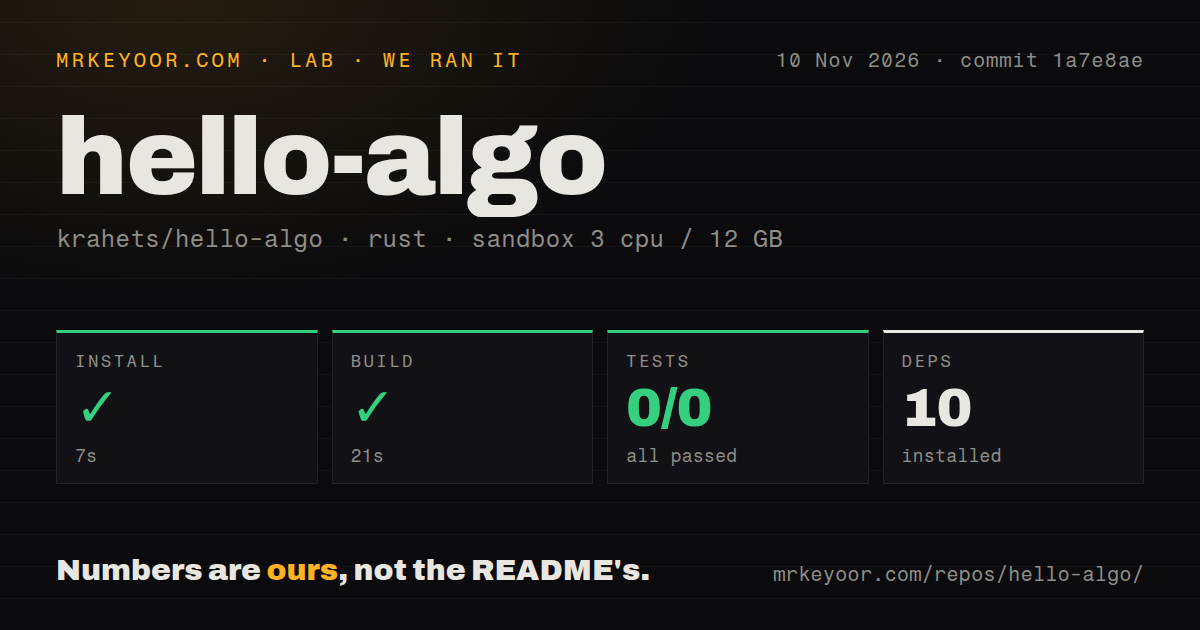
The earlier sandbox run did reach the Rust project. On November 10, at commit 1a7e8ae, our lab worked in ./codes/rust/: installation succeeded in 7 seconds with 10 dependencies recorded, followed by a successful build in 21 seconds. Then the test command completed successfully in 12 seconds and reported no tests.
| Step or observation | Our November 10 result |
|---|---|
| Install | Succeeded in 7 seconds; 10 dependencies recorded |
| Build | Succeeded in 21 seconds |
| Tests | Succeeded in 12 seconds; cargo test: 0 passed, 0 failed of 0 |
| Sandbox configuration | 3 CPUs, 12g RAM, image label lab-rust:1 |
| Checkout | 12,248 files, approximately 495,368 source lines, 274.4 MB |
| Repository scan | 14 CI workflow files; no Dockerfile; no tests directory |
The successful build gives a Rust reader a concrete reason to try the examples. The zero-test result puts a boundary on that confidence: no algorithm assertions passed in this invocation. Fourteen continuous-integration workflow files, meaning files describing automated repository jobs, are an organizational signal; counting those files says nothing about the result of each job.
The Rust subdirectory is also an important detail. The checkout contains many languages and book assets, so the repository-wide source-line total is a poor proxy for the size of the Rust examples you want to study. Start with the language directory rather than treating the whole repository as one Rust application.
Where people get stuck: reading formats and mismatched explanations
The clearest reader friction concerns electronic-book layout and edition details: ofou reported English PDF overflow on pages 88-89 in issue #1366. They had asked for an experimental English PDF, looked through it and returned with a specific defect. Contributor seven1240 suggested changing the formula to a multiline formula. That is a proposed correction, not confirmation that the generated pages were repaired.
| Problem | What the discussion actually offers | What you should do with it |
|---|---|---|
| PDF requires zooming on a phone | Evilrabbit520 requested EPUB reflow in #817; the issue is closed. Release 1.3.0 now offers both formats. | Choose EPUB as the first format to try on a small screen. |
| Experimental English PDF overflow | seven1240 suggested a multiline formula in #1366. | Record the edition and affected page if you encounter it; the historical report is specific. |
| Traditional Chinese chapter links open English | Dr-XYZ reported the links in #1171; krahets replied "Fixed". | Use the Traditional Chinese edition rather than treating that historical report as proof its links still fail. |
| C hash-map code differs from its explanation | Gonglja in #425 directed the contributor to the array_hashing_map examples in other languages. | Compare the explanation and reference implementation before translating the example. |
The boolean discussion in #1366 is useful for a different reason. ofou thought the table should say bit rather than byte. krahets replied that one byte is more common for a bool in modern languages, and ofou thanked them for the clarification. Don't turn the initial complaint into a confirmed textbook error: the thread contains an explanation as well as the report.
English exists, and keeping editions aligned takes human review
The English edition uses machine translation followed by human editing and pull-request review, according to krahets's workflow in issue #914. A pull request is a proposed change that another contributor can inspect before it enters the project. The workflow explicitly repeats editing and review for further improvements. That makes English availability and English editorial quality separate things to assess.
In issue #736, krahets identifies synchronization between languages as the main problem beyond API costs. A corrected explanation in Chinese needs a corresponding English change. The maintainer also declined the suggested GitBook route because of animation-display limitations and the desire for a consistent reading experience between editions. That is a publishing choice tied to the book's visual teaching approach.
Traditional Chinese needs more than character conversion. In issue #1054, Dr-XYZ describes terminology differences, and krahets discusses row and column terminology changing the actual meaning. A global word replacement can also damage unrelated words. For a teaching text, an illustration and its explanation have to agree about which direction a row runs; readable characters alone don't settle that.
The consequence is practical if you want to contribute. Work on a bounded passage or chapter and explain the conceptual correction, rather than assuming a language converter can finish the job. Issue #1171 asks native Traditional Chinese speakers to review the converted edition.
Repository attention is easier to count than learning
GitHub reported 132,459 stars and a last push of November 18, 2026 when we fetched the repository metadata on November 19. That is substantial attention, and the Ruby completion and translation discussions show people doing identifiable work. It doesn't tell you how many readers finished the book or became better at solving problems.
The distinction matters because the official homepage promotes animated illustrations and community questions alongside its language coverage. Those describe the resource you can access. Ty_Hsu's review describes one reader's assessment. Our Rust run describes a particular checkout. None should quietly stand in for a controlled study of learning speed.
For maintenance, look at the dated push together with the actual issue replies. The English improvement issue remains open, while the Ruby tracking issue records completed work. An open translation effort is consistent with an evolving textbook; it doesn't make every language implementation incomplete.
Reuse comes with CC BY-NC-SA conditions
The README says the repository's texts, code, images, photos and videos are licensed under CC BY-NC-SA 4.0. The licence label includes attribution, noncommercial and share-alike conditions. If you're choosing source material for a paid course or searching for code under MIT or Apache terms, that is a decision to resolve before copying material into your project.
Reading the online book and incorporating its assets into something you distribute are different uses. The repo's educational examples can help you understand an implementation without becoming a dependency in your application. For commercial reuse, consult the licence terms and the rights holder about your intended use. This review doesn't grant permission or settle a particular licensing case.
Hello Algo vs VisuAlgo, CLRS, LeetCode and The Algorithms
Choose according to the work you need next: the Repo-AI-Analysis comparison positions Hello Algo as guided introductory teaching, VisuAlgo as interactive visualization and LeetCode as problem practice. Those are editorial distinctions, not results from a side-by-side learner trial.
| Resource | Choose it for | How it differs from Hello Algo |
|---|---|---|
| VisuAlgo | Manipulating inputs and stepping through visualizations | Hysen Labs emphasizes its interactive exploration compared with Hello Algo's guided book. |
| Introduction to Algorithms, commonly called CLRS | Deeper theory and a more rigorous textbook | Repo-AI-Analysis positions CLRS as deeper, Hello Algo as the introductory illustrated choice. |
| LeetCode learning cards and problem bank | Practicing problem solving | Repo-AI-Analysis distinguishes its exercises from Hello Algo's explanations of concepts and basic structures. |
| The Algorithms repositories | Browsing implementations | Repo-AI-Analysis describes implementation collections rather than Hello Algo's teaching narrative. |
The Algorithms/Python README describes its implementations as for learning purposes only, and warns that they can be less efficient than the Python standard library. You can combine these resources rather than choose a permanent winner. My suggested progression is to read an explanation in Hello Algo, explore a visualization when the state changes are confusing, then attempt a related problem without looking at the sample code. If you already understand the concepts and your obstacle is solving unfamiliar exercises, spend the session on the problem bank.
What the other reviews get wrong
Hysen Labs's 12-language description is out of step with the official homepage's advertised 14 programming languages. Its overview says 12 and suggests Ruby could have incomplete chapters because translation is ongoing. Yet khoaxuantu explicitly reported Ruby transpilation complete after checking all topics in #1253. General contribution requests are a poor substitute for the language-specific completion thread.
Agentifizierung's article lists red-black trees in its topic table. The maintainer's #1086 discussion names red-black trees and KMP among possible additions marked undecided; the captured navigation lists binary trees, traversals, array representation, binary search trees and AVL trees. A request for a chapter, or a merged request mentioned in a discussion, isn't the chapter itself.
These corrections change a buying-style decision even for a free book. A Ruby learner gets a concrete completion report to investigate. Someone specifically seeking red-black-tree instruction should locate the actual chapter before committing their study time.
Questions people ask
Start with Hello Algo's introductory algorithms chapter, then complexity analysis and the basic structures: those entries appear in the English chapter navigation.
Where should I begin learning algorithms with Hello Algo?
Begin with "Getting to know algorithms" and follow the introductory sequence in the English edition. Pick the code language you can already read. Treat the first pass as understanding the examples, then return to the same topic to write your own version without copying it.
Who is Hello Algo for, and is it worth my time?
Beginners wanting clear explanations are the best fit: Ty_Hsu called the book simple but clear and sufficient for an introduction. If you already know the structures, use the contents to find a specific gap rather than assuming another complete introductory read is the best use of your time.
What is an algorithm, and how does it relate to data structures?
An algorithm is a sequence of steps for solving a problem; a data structure organizes the information those steps work on. The speakers in "What is an algorithm? - Hello Algo" explain that relationship through instructions and information organization. The choice of structure affects how you carry out operations such as finding, adding and deleting information.
How does finding a word in a dictionary illustrate an algorithm?
Looking up a word follows a search procedure: use alphabetical order to narrow where to look instead of reading every entry. The "Algorithms are everywhere" video discusses dictionary lookup as its first example. The useful distinction is between the organized dictionary and the steps you take to find a word in it.
Are English and Traditional Chinese PDF editions available?
Yes: release 1.3.0 lists English and Traditional Chinese PDF downloads. Older requests in #1366 predate those downloads. Choose the human-language edition and the code-language variant you intend to study rather than following an old experimental-file link by default.
Is there an EPUB edition suitable for phones and e-readers?
EPUB editions are available in release 1.3.0. Readers in #817 requested that format because PDF required manual zooming on small screens. EPUB is the format I would try first for reflow, meaning text that rearranges to fit the screen, while the web edition is the natural place for the animations.
How can I build and test the latest English PDF myself?
krahets directs readers to build the PDF using the main branch in #1366. That reply is branch guidance, not a complete command recipe. Use the project's current generation instructions, and inspect the affected formulas in the resulting file; our successful Rust build is a different operation.
Will Hello Algo add chapters on red-black trees, tries, KMP or other advanced topics?
Those are requests and possibilities in #1086, where krahets describes potential additions as undecided. Readers request tries too. Choose your study resource on the content you can open now, rather than treating the discussion as a delivery commitment.
Can I contribute code translations, and which chapters still need help?
Yes: #15 requests code translations, prefers Python or Java references and asks that a pull request cover at most one chapter. The language tracking threads are the place to find work. Ruby's #1253 contains a completion report, so an older general request is insufficient reason to start translating an already completed chapter.
Can I help improve the English edition without knowing Chinese?
Yes: krahets welcomed an English-proficient contributor to review fluency and authenticity in #914. The workflow distinguishes that work from checking consistency with Chinese. If you can explain an algorithm clearly in English, a focused review of an awkward passage has a defined role.
Where can translation contributors get a working Discord invitation?
Ask in #914, where krahets replaced an expired invitation and a later contributor again reported trouble with earlier links. Commenting on the issue provides a route that doesn't depend on an old invitation remaining active. The thread also points contributors to the English contribution guidelines before reviewing changes.
Does Traditional Chinese localization require terminology changes beyond character conversion?
Yes: #1054 discusses different technical terms and row/column wording that can change meaning. That is why native-language review matters for an algorithms explanation. Converting the characters can leave a sentence readable while conveying the wrong relationship between the diagram and the text.
What we have not tested yet
Our Rust run covers commit 1a7e8ae on November 10, 2026, not every language or the current default branch. We have not measured learner retention, completion rates, interview results or learning-speed gains. The captured X search and Bilibili entries add no substantive learner outcome to those questions, and we found no Reddit learner thread in this research.
We did not inspect raw toolchain logs to identify the exact Rust or operating-system version. lab-rust:1 is an image label. No installed-memory measurement, security audit, live website assessment or cross-language correctness comparison accompanies the build. The Compose prerequisite failure supplies no deployment or application benchmark.
We have not compared current PDFs and EPUBs on phones or e-readers, reproduced the page 88-89 overflow, or checked every translated illustration. In #1171, krahets reported image corrections through #1327 while leaving the untranslated "共 n 层" text unresolved. Yui-Huang's macOS VS Code report about escaped Chinese bytes has no confirmed remedy in that thread. The exact C hash-map correction is also absent from #425's closing account.
We cannot confirm the current Discord invitation, the delivery of the requested advanced chapters, or comparative learning outcomes against VisuAlgo, CLRS, LeetCode and The Algorithms. Before choosing this as your main book, open the chapter you need, select your language and try the matching example. That gives you a useful next result without mistaking a build for a course evaluation.