mrkeyoor.com_
Wed 09 Sept 05:35 UTC
Dev Toolsevaluationupdated 09 Sept 2026

Python review

TheAlgorithms/Python is a large, browsable collection of algorithms implemented in Python for education. It gives learners and contributors readable examples to study, compare, and improve, rather than a production library to install behind an application.

trackingstars / 7d
Verdict

Our build completed in 5 seconds, but the test run still ended with 3 failures and 186 collection or setup errors. Use TheAlgorithms/Python as a generous study shelf and contribution playground, not as a dependency whose implementations you trust by default. Its size, recent activity, and approachable organization make it valuable, while its own educational warning and our failed suite set the right boundary.

We ran it

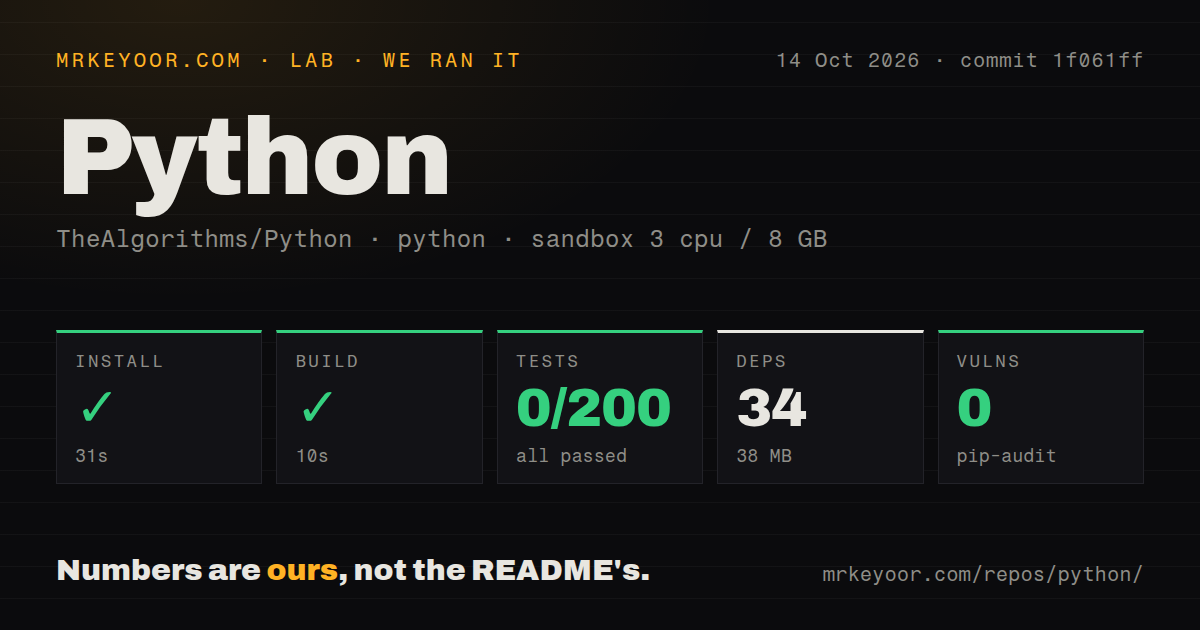
Install✓ · 24s34 packages · 38 MB
Build✓ · 5s
Tests✗ · 48s2425 passed · 3 failed · 186 errors of 2614 (pytest)
Known vulns0(pip-audit)
Repo1536 files~125,580 lines of source · 15 MB · 8 CI workflows · tests dir

Answers from our run

Does Python build from source?

Dependencies installed in 24 seconds (34 packages), and the build succeeded in 5 seconds. We cloned commit 96c429d into a clean Debian container with 3 CPUs and no project-specific setup.

Do Python's tests pass?

Not all of them: 2425 of 2614 passed and 3 failed when we ran the project's own test command (pytest), with 186 collection errors. Some failures need services or credentials a bare container does not have.

Does Python have known vulnerabilities in its dependencies?

pip-audit found none in the dependency tree at the time of our run.

Who should not use Python?

Production teams seeking a supported algorithms dependency, because the README explicitly says the code is educational and may be less efficient than Python's standard library

What are the alternatives to Python?

Exercism Python Track, Interactive Coding Challenges, JavaScript Algorithms and Data Structures. Our build completed in 5 seconds, but the test run still ended with 3 failures and 186 collection or setup errors.

Setup3/5Install and build were quick, but the full test run failed
Docs3/5Clear purpose and navigation, sparse setup troubleshooting
Community4/5Huge adoption and a recent push, tempered by 729 open issues
Maturity3/5Long-lived project, but educational scope and no listed release

Who it’s for

Python learners who understand syntax and want concrete algorithm implementations to inspect
Students preparing for data structures or algorithms coursework
Contributors who want a large, welcoming open-source project with clear contribution guidance
Instructors looking for examples that can prompt discussion, testing, and code review

Who it’s NOT for

Production teams seeking a supported algorithms dependency, because the README explicitly says the code is educational and may be less efficient than Python's standard library
Beginners expecting a guided course with a fixed lesson sequence
Teams requiring a clean full-suite test result in a fresh environment, because our run ended with failures and collection or setup errors
Users who want versioned releases and a conventional package lifecycle, because no latest release is listed

Setup reality

Our install succeeded in 24 seconds with 34 packages using 38 MB, and the build succeeded in 5 seconds, but the 48-second test run failed: 2,425 tests passed, 3 failed, and 186 collection or setup errors were reported out of 2,614. That is more friction than the README's brief getting-started section suggests. You can browse the code immediately, but reproducing a clean contributor environment requires investigating the named failing modules and errors rather than assuming the repository is ready after installation.

A 2016-era catalog built for reading, not importing

TheAlgorithms/Python is best understood as a public study shelf. The repository contains 1,536 files and roughly 125,580 lines of source in the snapshot we examined, so its appeal is breadth: learners can move among implementations instead of hunting across unrelated blogs. The README states the purpose plainly, all algorithms implemented in Python for education, and points readers to a generated directory for navigation. That framing matters because this is not presented as a polished runtime dependency or a replacement for Python's own batteries. It is a place to read code, compare approaches, and contribute exercises.

The project also makes an unusually direct limitation clear in its opening material: these implementations are for learning and may be less efficient than equivalents in the Python standard library. With 224,396 GitHub stars, that warning protects against confusing popularity with production suitability. A useful algorithm implementation can prioritize clarity, familiar control flow, and teachable tests, while application code may need mature edge-case handling, profiling, stable interfaces, and maintenance guarantees. Treat each file as instructional material that deserves review, not as a drop-in primitive whose star count substitutes for validation.

What happened when we ran it

We cloned commit 96c429d and tested it on September 8, 2026, in an unprivileged fresh Debian container with Python 3.12, 3 CPUs, 8 GB of RAM, and no secrets. The checkout occupied 15 MB. Installation succeeded in 24 seconds, adding 34 packages and using 38 MB on disk, while the build completed successfully in 5 seconds. Those results make initial inspection inexpensive: the repository did not require a long compile or a complicated service topology merely to reach the build stage on our box.

The full test result was not clean. After 48 seconds, pytest reported 2,425 passing tests, 3 failures, 186 collection or setup errors out of 2,614, 1 warning, and 10 passing subtests. The named failures were in the IIR filter coefficient method, the binomial heap, and Minkowski distance. The tail of the log also named errors in modules involving ISBN search, Slack messaging, GitHub information fetching, and world COVID-19 statistics, among others. We are not assigning causes that the displayed log did not establish.

That distinction is practical. A successful 5-second build says the codebase can be prepared in the measured container, while 186 errors say a contributor cannot assume the default suite is healthy in that same fresh environment. Some affected files sit under web programming, but the evidence does not prove that networking, missing credentials, package gaps, or code defects caused them. The responsible next step is to reproduce individual errors and read their traces. Security scanning was cleaner: pip-audit found 0 known vulnerabilities among the installed dependencies at the time of our run.

Its strongest feature is a wide, navigable learning surface

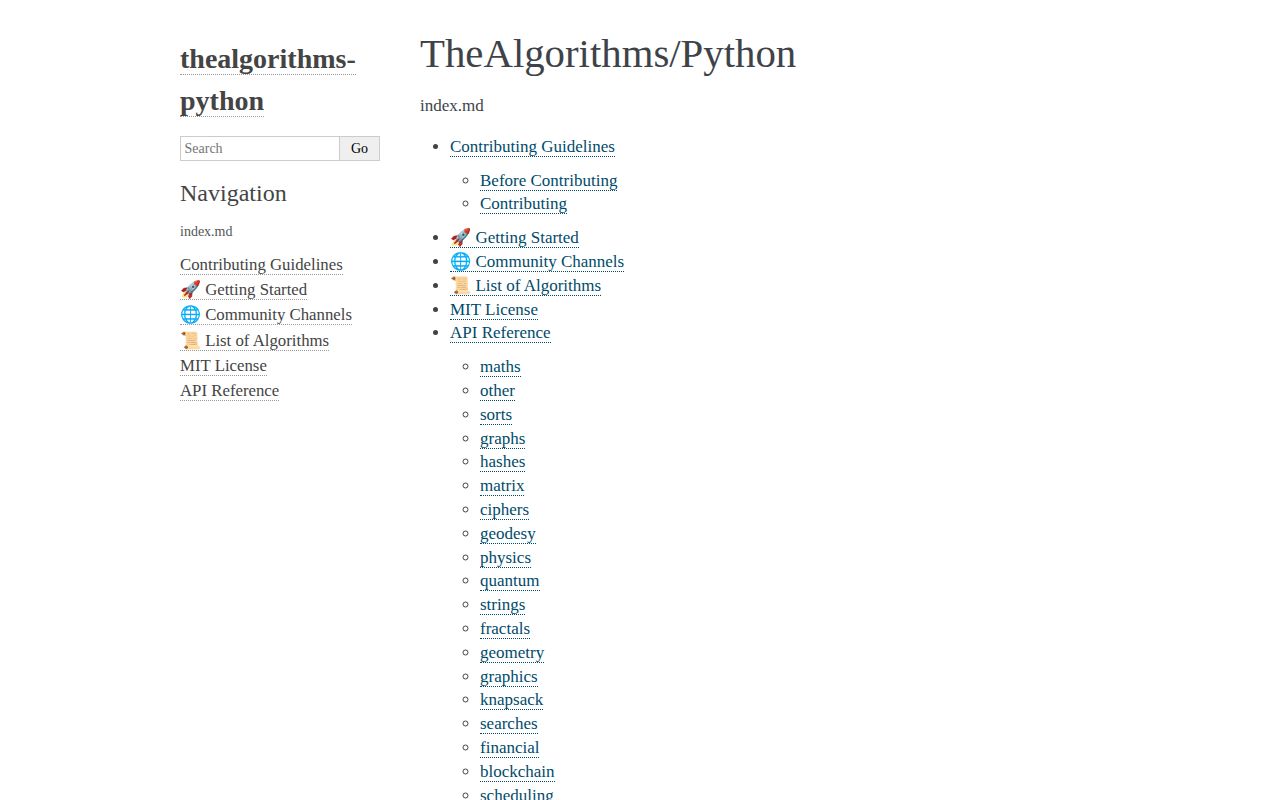
The README keeps the entry point simple. It links contribution guidelines before inviting changes, provides a DIRECTORY.md index for the algorithm catalog, advertises a ready-to-code Gitpod route, and points learners toward a Discord community. The repository also includes 8 CI workflow files, a tests directory, pre-commit support, and Ruff formatting signals. Together, those specifics give an aspiring contributor more structure than a loose collection of snippets. The MIT license further lowers the barrier to studying, adapting, and discussing examples, subject to the license terms.

Breadth is also the project's defining pedagogical advantage, but 125,580 source lines create a tradeoff. A student can inspect different domains in one checkout and learn how tests express expected behavior. An instructor can select a file, ask learners to critique complexity or edge cases, and then compare revisions through normal Git workflows. Yet the catalog does not provide the steady narrative of a textbook or the deliberate progression of an exercise platform. The directory helps you find topics; it does not turn thousands of implementations into a sequenced curriculum.

The rough edges matter before you contribute or reuse code

The README excerpt is much stronger on purpose and community entry points than on reproducing the full development environment. Our 24-second install was easy, but a newcomer meeting 3 failures and 186 errors receives little troubleshooting context from that front page. There is also no Dockerfile in the measured snapshot, so the repository itself does not offer a checked-in container recipe matching our setup. None of that prevents reading individual implementations, but it raises the cost of deciding whether a failure belongs to one algorithm, an optional integration, or the wider environment.

There is no latest release listed, which makes this feel like a continuously edited knowledge repository rather than a versioned library. That alone is not abandonment: the last push was September 8, 2026, just 1 day before this review, and the repository shows substantial active surface area. Still, 729 open issues are a meaningful maintenance burden. The combination suggests an active and heavily used project with a large review queue, not a quiet archive and not a tightly supported package with predictable release notes.

It fits beside a course or editor, not inside a critical service

In a real stack, keep TheAlgorithms/Python outside the production dependency path. Use its 1,536-file checkout as reference material beside an editor, a course, a notebook, or an interview-practice routine. If an implementation inspires production code, verify its license obligations, tests, complexity, numerical behavior, and edge cases in your own context, then prefer a standard-library or established domain package where one exists. For contributors, start with a narrow module and its tests rather than treating the entire failing suite as one problem. The repository earns a recommendation for study and contribution, but our run does not support recommending it as a trusted algorithms library.

Alternatives

ProjectWhat it isPick it when
Exercism Python TrackA structured set of Python exercises with tests, progression, and feedback-oriented practice.Pick this instead when you want a guided learning path and exercises to solve, not a catalog to browse.
Interactive Coding ChallengesNotebook-based interview problems with explanations, tests, and worked solutions.Pick this instead when interview preparation and problem walkthroughs matter more than breadth.
JavaScript Algorithms and Data StructuresAlgorithms and data structures paired with explanations and examples in JavaScript.Pick this instead when you prefer explanation-led browsing or work primarily in JavaScript.

What people are saying

  1. [github-trending] vinta/awesome-python
  2. [lobsters] Python Iceberg
  3. [hackernews] Making a Python interpreter in 1024 bytes
  4. [velocity-scout] TheAlgorithms/Python
  5. [velocity-scout] openai/openai-agents-python
  6. [velocity-scout] openai/openai-python

Sources

  1. TheAlgorithms/Python GitHub repository
  2. The Algorithms Python homepage

More dev tools reviews

drawio-desktop · glow · serenity · mocha · ohmyzsh · system-design-academy · the whole board →