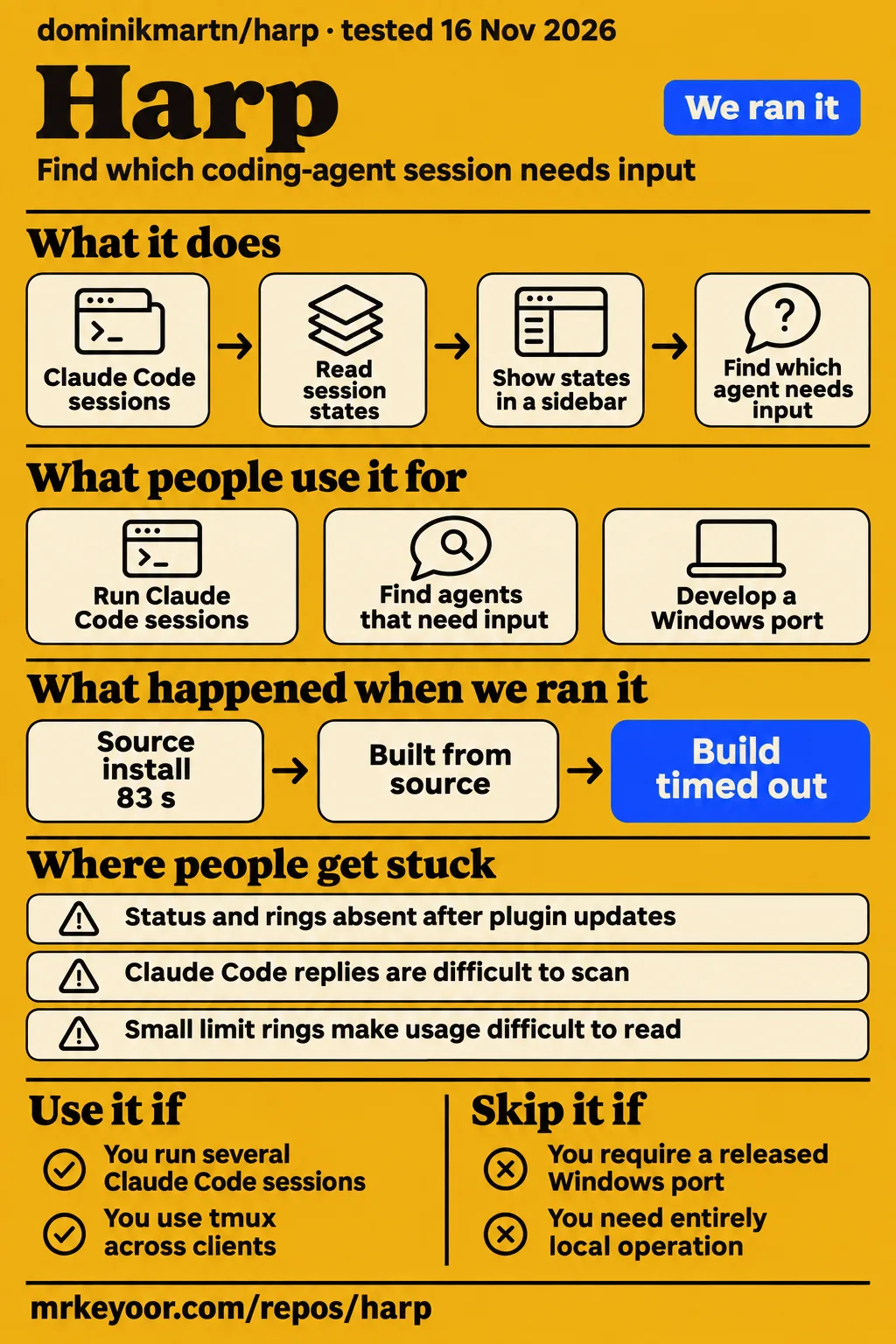
Our Harp source build timed out after 900 seconds, while one user reports that its sidebar solved a problem when running several Claude Code sessions. Harp is worth considering for macOS developers who want to see which agent needs input. Choose another option if released Windows support, formatted replies or entirely local operation are requirements.
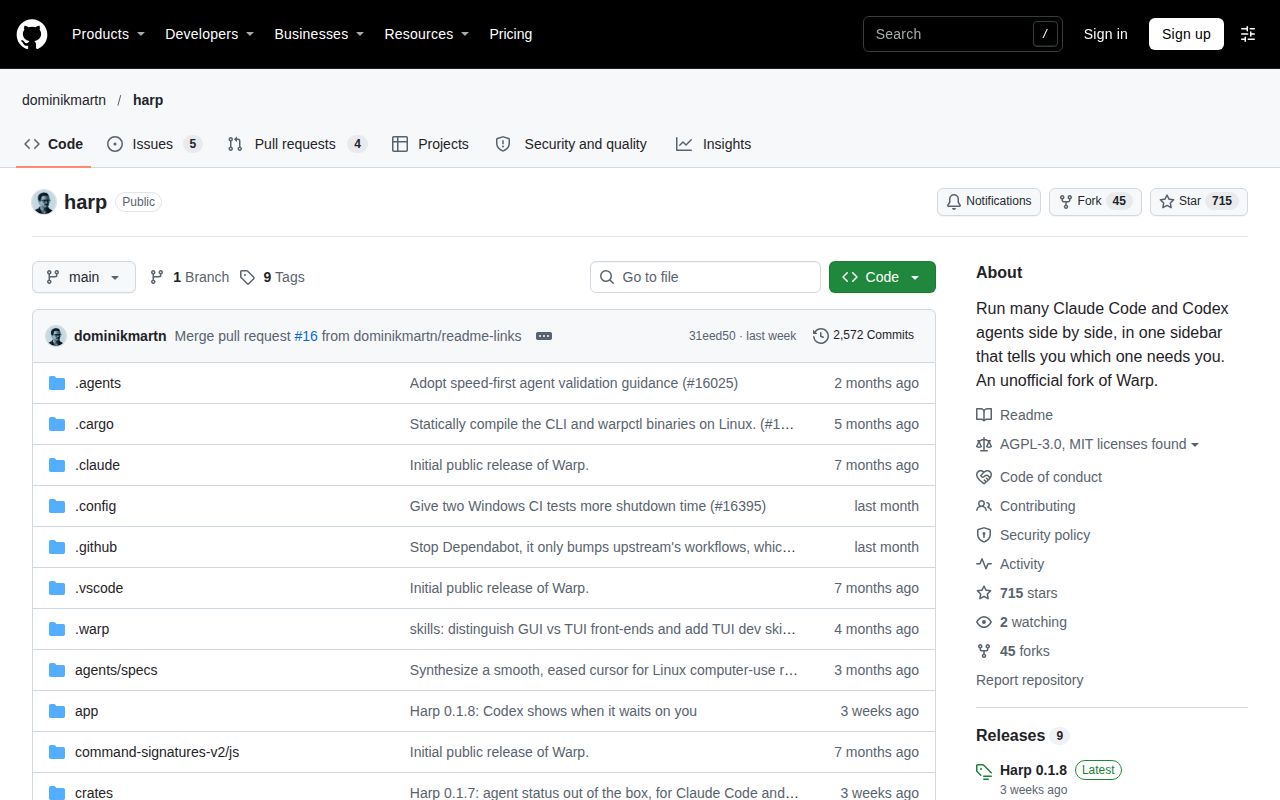
This review covers dominikmartn/harp, an unofficial fork of the Warp terminal. The Harp README describes a replacement for the tab bar, with session states and named groups. The decision is whether that layout addresses your daily work. The evidence combines the project's documentation, attributed GitHub reports and our source-harness results at commit 31eed50 on 2026-11-16.
What you can do with Harp
Harp replaces Warp's tab bar with a sidebar showing Claude Code and Codex session states. The README describes working, waiting and done states, unread marks, a background-work dot and a moon for a tab set aside. These indicators give you a place to look when several agents are running and you need to decide which session deserves attention next.
Named groups add another way to organize the same sessions. With tmux integration enabled, the README says group membership and order are stored on tmux sessions and survive a restart. Tabs attached to tmux also follow session names and read or inactive flags. That makes the feature relevant to developers who use tmux across clients, including sessions started over SSH from another device.
The footer answers a different question: account usage. The README describes two rings per provider, covering the 5 hour window and weekly limit, with numbers and reset times on hover. Codex readings come from session logs; Claude readings come from Claude Code's status line. Session attention and provider usage therefore have separate inputs, even though both appear in the same sidebar.
What people use harp for
The author of issue #9 reports that Harp's sidebar helped while running several Claude Code sessions at once. The other concrete use account in the supplied synthesis comes from a contributor developing a Windows port. These accounts serve different readers: one concerns everyday agent management, while the other concerns implementation work on window behavior, sidebar controls and platform integration.
| Who | What they did | Reported outcome |
|---|---|---|
| The user who opened issue #9 | Ran several Claude Code sessions together | Said the sidebar and "needs you" states were exactly what they had been missing; requested clearer answer formatting. |
| The contributor who opened issue #6 | Developed a local Windows port with sidebar behavior and psmux integration | Reported a working local implementation and planned small pull requests. |
The issue #9 account separates two tasks that can otherwise blur together. Finding an agent that needs attention made the terminal more useful to that author, while reading the resulting answer remained frustrating. For a prospective user, that is a useful way to assess the sidebar: consider how often you lose track of sessions and how often the actual problem is scanning their output.
What happened when we ran it
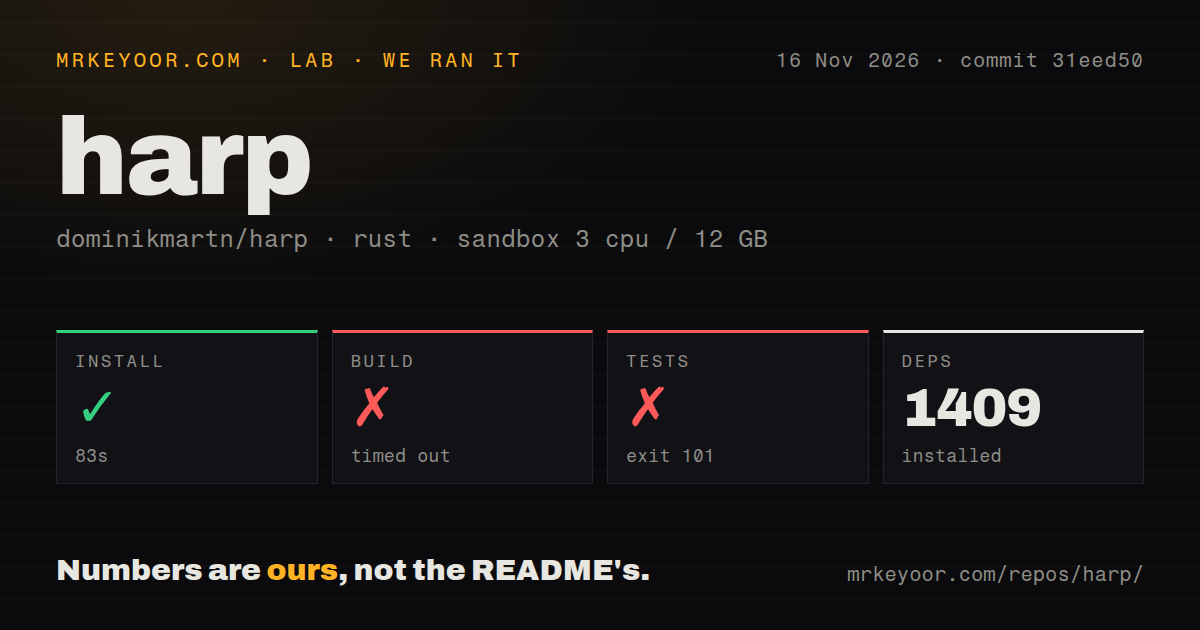
Our sandbox installed Harp's dependencies in 83 seconds, the build timed out at 900 seconds, and the test command failed with exit 101 after 818 seconds. Our run used commit 31eed50 on 2026-11-16, with a recorded configuration of 3 CPUs, 12 GB RAM and image label lab-rust:1. These are source-harness results rather than a completed desktop session.
| Source-harness step | Recorded result | What that tells you |
|---|---|---|
| Install | Succeeded in 83 seconds; 1,409 dependencies recorded | Dependency setup completed in this sandbox. |
| Build | Timed out in 900 seconds | The build reached the run's time limit. |
| Tests | Failed, exit 101, after 818 seconds | The command failed; the supplied tail contains compiler arguments without an explanatory diagnostic. |
The checkout scan recorded 6,496 files, approximately 1,835,159 source lines and 317.1 MB checked out. It found 21 CI workflow files, no Dockerfile and no tests directory. These are repository-layout observations. A Rust project can contain tests outside a directory named tests, and counting workflow files says how many files the scan found rather than how their checks performed.
The supplied test-log tail names warp_core, warp_editor and warp_errors in compiler arguments, then ends with a summary marker. It contains no named failing assertion or explanation for exit 101. The recorded result is a failed command. Assigning it to a compiler defect, missing package or application bug would require diagnostic evidence beyond that excerpt.
A separate application attempt produced conflicting records. Its application-run summary claims deployment through Docker Compose on 2026-11-16, with every port bound to 127.0.0.1. The safety step failed because no Compose file existed. The teardown record says "teardown: ok". The failed step determines the application-attempt outcome; the runner's "unsafe repo" wording refers to its Compose requirement.
Where people get stuck: status, themes and readable replies
Issue #8 reports missing limit rings and per-agent status after plugin updates and repeated settings changes. The author also reports opacity and sidebar-theme behavior that differs from their expectations of Warp. These are that user's observations. The README's separate session-status and usage-feed instructions provide a more focused starting point than changing appearance settings while troubleshooting both displays together.
| Report | Evidence-backed next step | Resolution in the supplied record |
|---|---|---|
| Status and rings absent, #8 | Follow the README's separate status and usage-feed paths; record which display fails | Open report. |
| Custom theme mismatch, #10 | Compare sidebar and hover-card colors with the selected theme | Theme-derived colors and overrides requested. |
| Rings difficult to read, #10 | The reporter uses whole-window zoom and a smaller font | Whole-interface workaround; ring-size control requested. |
| Replies hard to scan, #9 | Compare the value of session visibility with answer readability | Formatted replies requested. |
| CLI installation wanted, #14 | Use the documented macOS DMG route | Homebrew/curl installation requested. |
Issue #10 identifies Harp 0.1.3, macOS 27.0 and arm64 as the reporter's environment. With Rosé Pine Dawn, the author reports a fixed grey sidebar, limit rings and hover card. They describe 20 px rings with 1.6/1.8 px strokes and say a low 5-hour share, such as 5%, becomes a dot-sized arc. Their workaround sets whole-window zoom to 110 and reduces font size, enlarging the whole interface.
Start with the two separate Claude Code integrations
The README supplies Claude Code session status through a bundled plugin and Claude plan usage through status-line input. Each Claude Code session started in a Harp shell loads the bundled plugin through CLAUDE_CODE_PLUGIN_DIRS. The documentation says Harp installs nothing into ~/.claude for this plugin, ignores duplicate reports from Warp's plugin and uses jq, which macOS 15 and later include.
For Claude usage rings, Harp checks ~/.claude/settings.json on first start. If no statusLine exists, it adds one that saves input to ~/.harp/claude-statusline.json and prints nothing. An existing status line stays in place. The README's example preserves its command by saving the input first, and says rings appear after Claude Code's next answer for Claude.ai plans rather than API keys.
A useful problem report should identify the app version, where the agent started and whether the missing information belongs to a session row or the footer. For tmux sessions, the README also describes a card message asking for an agent restart when the agent reports nothing. Those details connect a report to the documented input path and give maintainers something more specific than a general statement that the sidebar fails.
Harp keeps Warp's cloud connections
Harp's README says upstream AI and cloud features still talk to Warp's servers. It lists agents, Warp Drive, session sharing and login among those inherited features, while saying Harp adds no servers of its own. Its local limit-ring inputs describe the usage display's data path; they do not change the documented destination of requests made by inherited cloud features.
The documented macOS installation uses a DMG dragged into Applications. Harp has its own bundle ID, URL scheme and ~/.harp settings folder, allowing it to run alongside Warp. The README also describes an updater that checks GitHub releases every 10 minutes, downloads a newer DMG, checks its Developer ID team signature and offers to restart into it.
The README identifies GNU AGPL v3 licensing, with the warpui and warpui_core crates under MIT. It also explains the source-offer obligation when running a modified version for others over a network. For someone considering distribution or modification, those named terms are the relevant starting point. The terminal's licence and the account used by an agent concern separate parts of the workflow.
Recent pushes show activity, not adoption
GitHub metadata records 715 stars and a last push on 2026-11-10 in the snapshot fetched on 2026-11-16. The API's open count is 9 and combines issues and pull requests. These figures describe repository attention and activity at that observation date. The issue accounts supply more specific evidence about how individual people use Harp and what they want changed.
The latest-release record identifies v0.1.8, published on 2026-10-29. Its Harp v0.1.8 release notes say Codex approval or answer waits show "needs you" by reading the terminal title. The notes also say updates are automatic from 0.1.2 or later, while 0.1.0 and 0.1.1 require one manual download. The source harness used commit 31eed50, rather than the release's 54c5286 commit.
Harp vs Warp, Claude desktop and Codex desktop
The author of issue #9 finds Claude and Codex desktop replies easier to read while praising Harp's session sidebar. Their comparison gives a concrete selection criterion: do you need help locating the next session, or help reading its answer? The table preserves that author's preferences and the README's description of Harp's relationship to Warp.
| Choice | What the supplied reports say | Pick it when |
|---|---|---|
| Harp | Issue #9 praises sidebar visibility and "needs you" states | Finding the next agent that needs input is your repeated frustration. |
| Warp | Issue #9 says Warp's own agent displays formatted replies | You prefer the upstream terminal and its own agent presentation. |
| Claude desktop | Issue #9's author finds its formatted replies easier to read | Answer readability is your priority. |
| Codex desktop | The same author also prefers its formatted reply display | Desktop answer presentation matters more than Harp's sidebar. |
The comparison comes from the reply-formatting request in issue #9. That author likes Harp enough to say they are happy with it either way, which gives the request useful context. A person can benefit from the terminal's session organization and still prefer another application's presentation. Decide which of those tasks is causing the greater interruption in your own work.
Avoid confusing Harp with namesakes
The HARP use-case page describes an API proxy, while dominikmartn/harp is a Warp terminal fork. The supplied HARP proxy use-case page places that product between applications and remote APIs. Its proxy capabilities belong to a different project and cannot support this terminal review. Keep the repository name attached to searches and comparisons; the supplied namesake autocomplete results do not establish demand for this terminal.
FAQ
Harp documents separate inputs for Claude Code session status and plan-limit rings. That distinction answers the setup question raised by issue #8 and helps organize the other questions in the supplied issues. The answers below distinguish documented behavior, a reporter's workaround and requested changes, so readers can connect each answer to the kind of evidence behind it.
How do I get Harp's limit rings and per-agent status working with Claude Code?
The Harp integration instructions say to start Claude Code in a Harp shell for the bundled status plugin. Claude plan rings use status-line input and appear after the next answer. Check an existing status-line command separately, because Harp leaves it alone. This separates the two paths implicated in issue #8's setup report.
Can Harp display formatted Claude Code and Codex replies with clearer separation between prompts, tool calls, and final answers?
Issue #9 requests formatted replies or clearer separation of prompts, tool calls and final answers. The author says headings, lists, code and answers look alike in terminal output, while Claude and Codex desktop replies are easier to read. Their positive account concerns the sidebar and attention states, which solve a different part of managing agent work.
Can Harp's sidebar, limit rings, and hover card use my custom theme's colors?
Issue #10 reports fixed grey colors with Rosé Pine Dawn on Harp 0.1.3 and requests theme-derived colors or overrides. The author identifies sidebar palette tokens and literal ring colors in the implementation. Their suggested settings describe a requested interface, so the issue is useful for understanding the complaint rather than as a configuration recipe.
Can I enlarge Harp's limit rings without enlarging the whole interface?
The issue #10 workaround sets whole-window zoom to 110 and reduces font size. The author explicitly says this makes the whole UI bigger, including elements beyond the rings. They request a dedicated ring-size setting with a default of 20, which explains both the desired behavior and why their current workaround changes more of the window.
Does Harp support Windows, and what still needs to be implemented?
The issue #6 contributor reports a working local Windows implementation and plans small pull requests. Their report describes a main-branch compile problem involving tab_grouping.rs and libc::kill, plus window glass, turning rings, header dragging, shortcuts and installer identity work. They propose sending window-layer changes first, followed by sidebar and installer changes, while keeping self-update macOS-only for now.
Can Harp's Windows tmux integration use psmux or tmux inside WSL?
The Windows-port contributor says the local implementation uses psmux and excludes tmux inside WSL. That statement belongs to the port described in their issue. It matters for contributors comparing Windows session options, especially because the same report separates the working local implementation from the small pull requests the author intends to submit.
Can I install and update Harp through Homebrew or curl instead of a DMG?
The README's installation route is a macOS DMG, and it describes an in-app updater that checks GitHub releases. Issue #14 requests installation through a CLI tool instead of a DMG. That request concerns a different installation route from the documented updater, so it should not be read as saying Harp has no update mechanism.
Why doesn't window opacity work in Harp?
Issue #8 reports that window opacity does not work and that sidebar theming differs from the author's Warp expectations. The supplied report gives neither a diagnosis nor a corrective setting. Its useful contribution is identifying the observed appearance problem alongside the same author's missing rings and agent states, rather than supporting a particular explanation for the opacity behavior.
What we have not tested yet
Our evidence contains no successful supported macOS desktop run: dependency installation completed, the source build timed out, the test command failed and the separate application attempt stopped at its Compose safety check. We have not tested the DMG, login, updater, restored tmux groups, state accuracy or usage-ring path. The README also labels login through Harp untested. Complete toolchain logs are needed for runtime versions and diagnosis of exit 101.
Desktop memory use, simultaneous-agent capacity, response latency, long-session stability, accessibility, security and network traffic remain outside this run. The 0.1.3 theme report has no supplied retest on v0.1.8. The Windows port and its psmux behavior are contributor reports rather than our execution, and the supplied record establishes no released Windows port. The requested formatting, theme controls, ring-size setting and CLI installer have no recorded delivered resolution; issue #8 has no confirmed repair.
The supplied comparisons express one issue author's preferences rather than a feature-by-feature trial of the alternatives. Rendered layout, assets, automatic related links, recommendation modules and template content also remain outside this text review. For a macOS developer considering Harp, a useful next step is to start the usual agents, make one wait for input, check whether the sidebar identifies it, and then assess how easily its answer can be read.